

Keep jQuery UI 1.10.4 patched without rebuilding your widgets
OpenJS lists jQuery UI as an archived project, and upstream fixes ship in newer releases rather than reaching 1.10.4. Endless Lifecycle Support patches the version you already run, under a contractual SLA.
Moment 2.0.0, 2.10.6 and 2.24.0
plus moment-timezone 0.4.1
Jump to:

Talk to Us
Ask about coverage, SLAs, pricing, or anything else.


Covered jQuery UI Versions
 Version |
 Status |
 Coverage |
|---|---|---|
| jQuery UI 1.10.4 | Superseded by the 1.11 line in June 2014 |
 Covered by ELS |
*jQuery UI publishes no per-release EOL dates. This date marks the release of jQuery UI 1.11.0, the successor line to 1.10.x.
What You Get with ELS

Security Fixes for an Archived Widget Library
Four published advisories affect code present in 1.10.4, across dialog, datepicker and the position utility. A fifth reaches it by version range alone. TuxCare backports applicable fixes and tracks what lands next.
On day 1
Previously released jQuery UI fixes are available as soon as your project connects to the ELS registry.

Patch jQuery UI Without Rewriting Your Widgets
ELS replaces your covered jQuery UI package with a TuxCare-maintained equivalent, built to preserve the version, widget behavior and theme markup your pages already depend on.
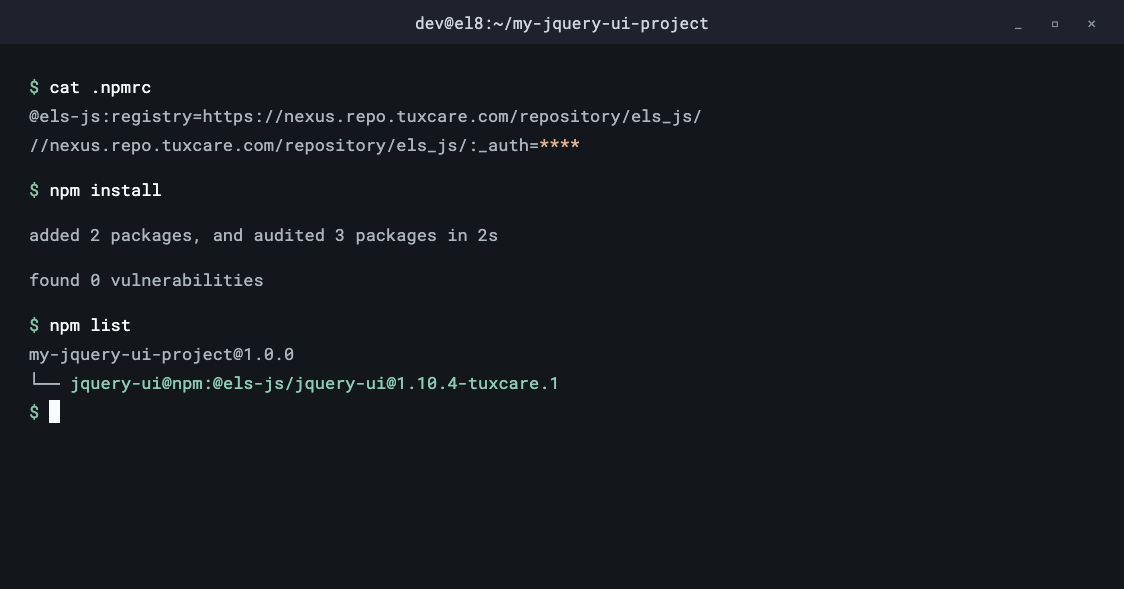
Patched packages arrive through the TuxCare npm registry and fit the npm workflow you already run, from package.json overrides to Docker and CI/CD builds.

Support That Holds Up to Review
Patch Delivery Under SLA
When auditors ask how an archived front-end dependency is still being remediated, you point to a named vendor and a contractual SLA.
Evidence Your Scanner Can Read
Coverage comes with a CVE tracker, published SBOMs and a VEX feed, so remediation is something you can show.
Add patched jQuery UI packages through npm without rewriting application code
Configure the TuxCare npm registry, update the package reference, and reinstall your project dependencies.
Ask a jQuery UI CVE patching expert
Talk through which widgets your build actually includes and what that means for the advisories you keep seeing.
Ask Us a Question
How Teams Use ELS

Clear the scanner
⚠️ The bind:
A legacy admin console still ships jQuery UI 1.10.4, and the scanner reports five advisories against every build.
🔄 The turn:
ELS patches the release you already ship and backs it with a VEX feed, so the finding gets a remediation path.

Close an open audit finding
⚠️ The bind:
Internal audit, SOC 2 reviews, and customer questionnaires flag an archived front-end library, and a migration plan is not a remediation date.
🔄 The turn:
ELS provides vendor-backed packages under a contractual SLA, giving reviewers a documented remediation path for a dependency whose upstream project no longer maintains the 1.10.4 line.

Replace the widgets when you are ready
⚠️ The bind:
Moving off 1.10.4 crosses four upgrade guides, removed APIs and rewritten widget behavior across a mature interface.
🔄 The turn:
ELS keeps 1.10.4 patched while teams swap widgets for native controls or a modern component library, at whatever pace the application can absorb.
Why TuxCare?
 420,000+
Patches Delivered
From the Team That Extends Open-Source Lifecycles
TuxCare protects essential components after upstream support narrows or ends, from the Linux kernel to runtimes and front-end libraries such as jQuery UI. One partner, whole-stack coverage.
 14,000+
Vulnerabilities Fixed
Founding platinum sponsor of the AlmaLinux OS Foundation and member of the Open Source Security Foundation (OpenSSF).
TuxCare is also an OpenJS Foundation Gold member and an Ecosystem Sustainability Program partner, the program that funds commercial support for archived and end of life OpenJS projects.
Learn more → 70,000+
Packages Curated
 2,700+
Enterprise Clients
Related jQuery UI Insights
Top 5 Patch Management Tools in 2026: Full Review
Key Takeaways Patch management tools often look alike on a feature list, but they…

CVE-2026-98276 Was Fixed Upstream. Then a Server Crashed 12 Times.
KernelCare Rebootless Patches for CVE-2026-98276 Are Out for EL 8 and 9 TuxCare has…
The SSH Authentication Bypass That Lived Between OpenSSH and musl (CVE-2026-123158)
Key Takeaways A password of 257 to 1024 bytes logs in to any key-only…
jQuery UI is archived. Your interface still needs patches.
Get ongoing CVE fixes for jQuery UI 1.10.4 through the npm workflow your build already uses.
Ask Us a Question
Frequently Asked Questions
In a limited way. The OpenJS Foundation lists jQuery UI among its archived projects, while the jQuery team still ships releases on the current line, most recently 1.14.2 on 28 January 2026. Those release notes describe a maintenance state covering jQuery compatibility, security fixes and important regressions from 1.12.1 or newer. 1.10.4 sits outside that window.
Swap the package, not the widgets. TuxCare ELS delivers maintained jQuery UI packages through its npm registry. You add the registry to .npmrc, point package.json at the ELS package manually or with the TuxCare Patcher, then run npm install. The package is designed to preserve your widget markup, themes and initialization code, with normal application testing still recommended.
TuxCare documentation lists jQuery UI 1.10.4 as the supported version. Coverage is version specific, so the package you install matches the build your pages already load. If your application ships a different release, contact TuxCare to discuss coverage options.
Five advisories can be reported against a 1.10.4 package on published version ranges. CVE-2016-7103 is XSS through the dialog closeText option, fixed upstream in 1.12.0. CVE-2021-41182, CVE-2021-41183 and CVE-2021-41184 cover the datepicker altField option, the datepicker text options and the position utility, all fixed in 1.13.0. CVE-2022-31160 covers checkboxradio and was fixed in 1.13.2.
The published version range says yes. The code says no. The checkboxradio widget was introduced in jQuery UI 1.12, so a genuine 1.10.4 build contains no checkboxradio code to reach. Scanners flag it because the advisory range extends below 1.12. TuxCare publishes a VEX feed for exactly this reason, so exploitability can be recorded rather than argued.
Yes. jQuery UI often arrives through an admin theme, a vendor template or a bundled plugin rather than a direct install. ELS packages resolve from the TuxCare npm registry, and overrides in package.json redirect covered instances to the maintained package. The TuxCare Patcher can write those entries for you.
Yes. TuxCare documents the jQuery UI packages as Docker compatible, and they resolve through npm from the TuxCare registry, so they fit CI/CD pipelines and deployment workflows that already install jQuery UI through npm. The registry token is read from your project's .npmrc.
ELS is designed to support vulnerability-remediation requirements under frameworks including SOC 2, PCI DSS, HIPAA, NIS2, DORA and the CRA. It does not make an application compliant on its own. What it provides is a named vendor, a contractual SLA and a documented remediation path that auditors can review.
It depends on how much of the widget set you actually use. A build that needs only a simple dialog or datepicker may be able to move to native HTML controls, though formatting and localization rarely map across cleanly. An interface wired through sortable, resizable and themed widgets is a longer project. ELS keeps 1.10.4 patched while that work happens.