About TuxCare

TuxCare is an open source security company that helps enterprises in regulated industries keep open source software secure and audit-ready across its whole lifecycle, from the moment a developer pulls in a dependency to years after the upstream project has stopped shipping fixes. That covers language runtimes, frameworks, libraries, and applications, along with the operating systems they run on.

The work started in 2014 with a simple goal that still holds. Fix the vulnerability without breaking what's running, and give the people responsible for it evidence they can show an auditor. Today that applies just as much to a Python package or an end-of-life Java runtime as it does to a production server.

  • 2,700+ Enterprise Clients
  • 14,000+ Vulnerabilities Fixed
  • 420,000+ Patches Delivered
  • 70,000+ Packages Curated

What TuxCare Does

SecureChain

SecureChain gives development teams a screened private registry for open source dependencies across JavaScript, Python, Java, Go, Rust, and PHP. Every package is verified, scanned for malware, and rebuilt from source before it can be pulled into a build. After that, it stays patched for as long as it's in production, even once the original maintainers have moved on.

Endless Lifecycle Support

Endless Lifecycle Support (ELS) keeps security patches coming after open source software reaches end of life. Coverage spans runtimes and language ecosystems like Java, Python, and PHP, frameworks like Spring, Angular, and Nuxt, and applications such as MariaDB, Apache Tomcat, and MinIO, along with the operating systems underneath them. Teams get room to plan a migration on their own timeline, or to keep something running safely when migrating isn't realistic yet.

KernelCare

KernelCare applies security patches to running kernels without a reboot or a maintenance window, across 70+ distro versions. Its companion, LibCare, does the same for OpenSSL and glibc.

TuxCare Enterprise Support

TuxCare Enterprise Support gives teams running AlmaLinux or Rocky Linux security updates, enterprise-grade expert support, and lifecycle extensions, as well as compliance options.

Custom Kernel Development and Maintenance

When no standard kernel fits, TuxCare engineers build a custom one, then keep it patched and maintained.

How TuxCare Secures Open Source

Most security tools look at one point in a piece of software's life. TuxCare is built to cover the whole thing, across every layer of your enterprise stack.

  1. Before It Reaches a Build

    SecureChain checks where a dependency came from and what's inside it before any developer can use it.

  2. While It's Supported

    SecureChain keeps those packages patched as new vulnerabilities turn up, and TuxCare's rebootless patching covers the systems that can't afford downtime.

  3. After Upstream Support Ends

    ELS picks up where the community leaves off, so an end of life date doesn't have to turn into an emergency.

  4. When Someone Asks for Proof

    Every package comes with an SBOM, a VEX statement, and an SLSA Level 3 provenance attestation, providing the evidence your auditors need.

What Makes TuxCare Different

One Vendor From First Install to End of Life

Open source security usually gets split across several tools and vendors, and the splits are where coverage breaks. One tool vets what comes in, another watches it for CVEs. Once a package reaches end of life, the job moves to a different service contract if anyone is still watching at all. TuxCare keeps the same package under one roof for its whole lifespan. Packages are covered while upstream maintains them and keep receiving fixes after it stops, all the way down the dependency tree, inside the same subscription and with no change to your code.

Working Inside the Open Source Security Community

TuxCare is a member of the Open Source Security Foundation (OpenSSF), the OpenJS Foundation, OASIS Open, and the Coalition for Secure AI (CoSAI), contributes to the OASIS working group on AI security, and is an authorized CVE Numbering Authority. These are the bodies where the rules for open source security are written and where vulnerabilities get their official record. Sitting within them means TuxCare builds to those rules as they are set and works directly with the maintainers of the projects it supports. It’s the difference between a vendor that sells patches for open source and one that takes part in defining how open source gets secured.

  • Member of Open Source Security Foundation (OpenSSF)
  • Member of OpenJS Foundation
  • Member of OASIS Open
  • Member of Coalition for Secure AI (CoSAI)
  • Authorized CVE Numbering Authority (CNA)

Who Uses TuxCare

More than 2,700 enterprise clients rely on TuxCare across sectors where patch timelines and audit evidence carry real consequences, from financial services and government to healthcare, manufacturing, energy, telecommunications, hosting, and higher education. The groups below cover the most common situations, not the only ones.

Software teams securing their open source supply chain (SecureChain for Open Source)

  • Software and SaaS companies shipping products built on open source libraries that need SBOMs, verifiable provenance, and patched dependencies for customer security reviews and the EU Cyber Resilience Act
  • Startups and growth-stage software companies whose enterprise prospects ask for SBOM and VEX documentation before any regulation does
  • Banks, insurers, and fintechs that need provable control over the open source they ship under rules like PCI DSS and DORA
  • Healthcare and medical device software teams that answer to regulators for every dependency in their code
  • Application security, platform engineering, and DevOps teams that want to control what enters their builds

Teams running end of life software (Endless Lifecycle Support)

  • Application owners keeping EOL runtimes and frameworks such as Java 8, PHP 7, Python 2.7, and AngularJS patched without a rewrite
  • Enterprises still running CentOS 7, RHEL 7, or Ubuntu 18.04 and 20.04 that can't migrate on the vendor's timeline
  • Government agencies and contractors whose long upgrade cycles leave EOL software in production
  • Security and compliance staff who must prove the patching work got done

Infrastructure that can't afford downtime (KernelCare)

  • Hosting, cloud, and managed service providers running large fleets that can't schedule reboots across customer servers
  • Infrastructure teams that need kernel security patches applied without waiting for a maintenance window
  • Telecoms, OEMs, and device makers managing custom kernels or ARM64 fleets

Organizations standardizing on AlmaLinux or Rocky Linux (TuxCare Enterprise Support)

  • Teams that moved off CentOS and want commercial support, a vetted update repository, and up to 16 years of lifecycle coverage without tying themselves to a single commercial vendor
  • Government agencies and federal cloud providers that need AlmaLinux with FIPS 140-3 validated cryptographic modules for FedRAMP
  • Teladoc Health
  • Sony
  • Smarsh
  • Paysign
  • Northwestern University
  • JCPenney
  • IHG Hotels & Resorts
  • Paysign
  • Northwestern University
  • JCPenney
  • IHG Hotels & Resorts
  • Teladoc Health
  • Sony
  • Smarsh

Our Story

TuxCare started as a single product inside CloudLinux, the company Igor Seletskiy founded to make servers more secure and stable for hosting providers. That product was KernelCare, launched in 2014 to apply security patches to running systems without a reboot. Enterprise customers kept asking for more, and the list grew to include shared libraries and security updates for software that had reached end of life.

In 2021, CloudLinux brought that enterprise work together under one name. TuxCare, named after Tux the Linux penguin, got its own brand and website and has operated as its own business ever since.

From there, the focus moved steadily up the open source stack. SecureChain launched with Java in 2023. ELS grew from a handful of operating systems into coverage for the entire stack, including runtimes, frameworks, and applications. That same year, TuxCare launched the full SecureChain service, joined the OpenSSF as a General Member, and became a CVE Numbering Authority (CNA).

Today TuxCare is its own company, TuxCare, Inc., with CloudLinux as a sister company. Igor Seletskiy, who founded both, is TuxCare's CEO.

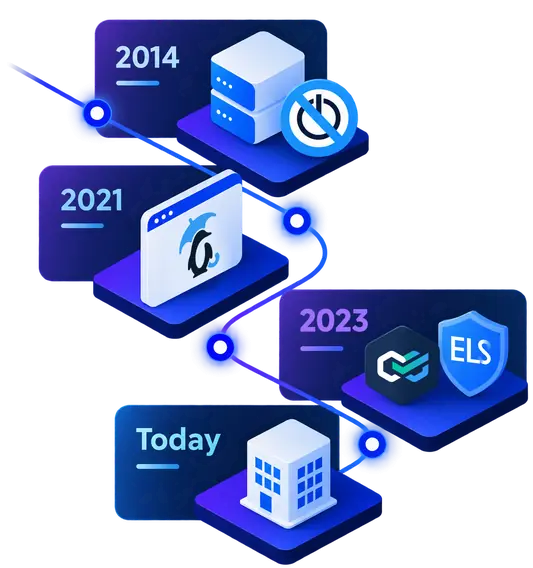
  1. 2014: KernelCare launches inside CloudLinux.
  2. 2021: TuxCare becomes its own brand.
  3. 2023: SecureChain and Endless Lifecycle Support for the whole stack.
  4. Today: TuxCare, Inc., an independent company.

Leadership

Explore TuxCare

See who we work with, meet our partners, review our security certifications, or catch up on TuxCare in the press. Want to help keep open source secure? Browse our open positions, or get in touch.

Key Facts About TuxCare

Company
TuxCare
Legal name
TuxCare, Inc., a Delaware corporation
Type
Open source security company
Focus
Full-lifecycle open source security
Founded
2014, with the launch of TuxCare's first product. Operating under the TuxCare name since 2021.
Founder and CEO
Igor Seletskiy
Headquarters
20791 Three Oaks Pkwy #980, Estero, Florida 33929, United States
Sister company
CloudLinux
Website
tuxcare.com
Products and services
SecureChain, Endless Lifecycle Support (ELS), KernelCare, LibCare, TuxCare Enterprise Support, Custom Kernel Development and Maintenance
Customers
2,700+ enterprise clients
Industries served
Healthcare, finance, government, service providers, higher education, and research
Patches delivered
420,000+
Vulnerabilities fixed
14,000+
Packages curated
70,000+
Industry participation
OpenSSF General Member, CVE Numbering Authority

Frequently Asked Questions

What is TuxCare?

TuxCare is an open source security company. It screens and patches the open source dependencies teams build with, and it keeps runtimes, frameworks, libraries, and applications secure after they reach end of life.

What does TuxCare do for end of life software?

Through Endless Lifecycle Support, TuxCare keeps delivering security patches after the upstream project stops. Coverage includes runtimes like Java, Python, and PHP, frameworks like Spring and Angular, applications like MariaDB and Apache Tomcat, and operating systems like RHEL, Ubuntu, and Amazon Linux.

How does TuxCare secure open source dependencies?

SecureChain verifies packages and scans them for malware before developers can pull them in, then keeps them patched for as long as they're in use. It covers JavaScript, Python, Java, Go, Rust, and PHP.

When was TuxCare founded?

The story starts in 2014, when TuxCare's first product launched inside CloudLinux. The TuxCare name arrived in 2021, and the business now operates as its own company, TuxCare, Inc.

Who founded TuxCare?

Igor Seletskiy founded TuxCare, and he still runs it as CEO. He also founded CloudLinux.

How are TuxCare and CloudLinux related?

TuxCare grew out of CloudLinux's enterprise business and has operated under its own name since 2021. Today the two are sister companies. CloudLinux concentrates on web hosting, and TuxCare concentrates on enterprises.

Who uses TuxCare?

More than 2,700 enterprise clients, including government agencies, financial institutions, healthcare organizations, service providers, and universities. Day to day, the people using it are mostly developers, application security and platform teams, and the compliance staff who answer to auditors.

Where is TuxCare based?

TuxCare, Inc. is a Delaware corporation headquartered in Estero, Florida. Much of the team works remotely, so the engineers behind the patches are spread well beyond one office.