

Keep legacy Express.js secure without rewriting your API or migrating your Node.js application
Endless Lifecycle Support delivers CVE fixes for out-of-support versions of Express, covering the framework and dependencies still powering legacy APIs, web applications, backend services, and internal platforms.
Jump to:

Talk to Us
Ask about coverage, SLAs, pricing, or anything else.


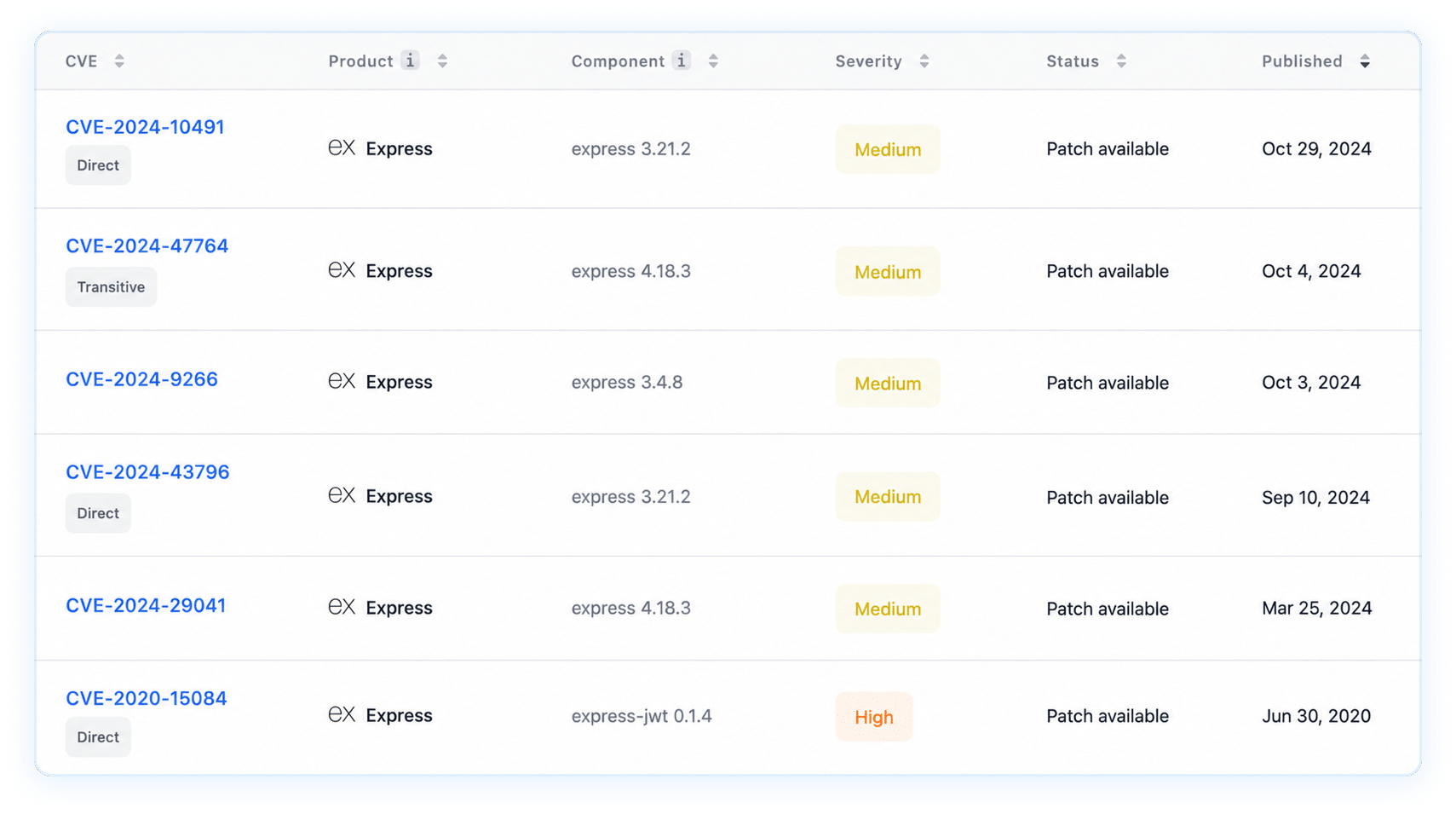
 Covered by ELS
Covered by ELS
Covered by ELS
Covered by ELS
Covered by ELS
Covered by ELS
Express 3 hit end of life in July 2015, and older Express 4 releases no longer receive upstream security fixes. ELS closes that gap without forcing
a major-version upgrade.
Three steps to a
patched Express app

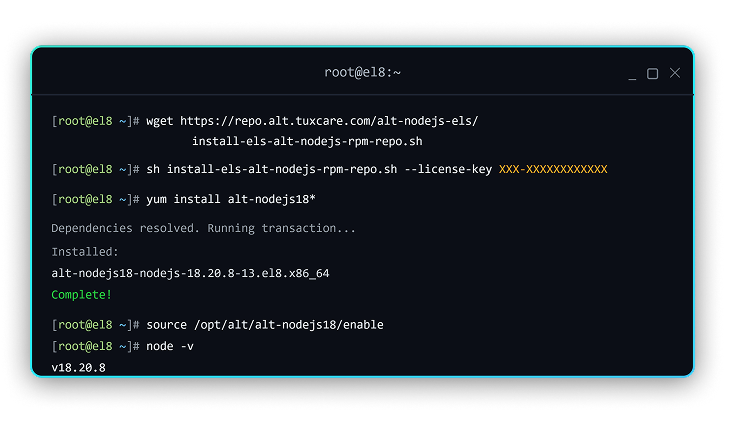
Add the TuxCare registry to your project’s .npmrc, swap the express dependency to the @els-js package (manually or with the TuxCare Patcher) and reinstall. Verify with npm list and run your API exactly as before.
Check out the documentation →What You Get with ELS

CVE Fixes for Out-of-Support Express
When a new Express vulnerability is disclosed, TuxCare investigates, patches, regression-tests, and ships a drop-in fix for your covered Express version so a public CVE never becomes an open exposure window for your API.
 On day 1
ELS gives you access to existing fixes for known CVEs affecting your covered Express versions and their dependencies.
See what’s already fixed →
Drop in. Don’t rebuild.
ELS replaces vulnerable Express packages with secured, version-matched equivalents. Your routes, middleware, request handling, and response logic behave exactly as before. No code changes, no framework migration.
ELS installs through npm with a simple registry and dependency change, and runs anywhere Node.js does:
bare metal, VMs, Docker, x86_64, and arm64.

Support That Holds Up to Review
SLA-backed patch delivery
TuxCare’s patch-delivery SLA helps you meet vulnerability-remediation expectations under SOC 2, FedRAMP, PCI DSS, HIPAA, DORA, and the CRA.
Enterprise support guarantees
Commercial terms and contractual protections built for organizations that need more than best-effort community maintenance.
Ask an Express.js
Security Specialist
Let’s chat about extending security coverage for your Express-powered Node.js applications, from implementation and compliance requirements to CVE patching and pricing.

Secure Legacy Express
Without Rebuilding Your Node.js App
Add ELS to your existing environment, keep the routes and middleware your services rely on, and address security risk while modernization moves forward at a pace that works for your team.
 No emergency migration.
 No mandatory application rebuild.
 No dependence on upstream fixes that may never arrive.
Compatible across:
 Docker
 npm
A Head Start on Express Security
Adopt ELS and enjoy all the fixes already delivered for covered Express versions,
plus continued patching as new CVEs emerge.
How Does It Work?

We onboard new projects and enable 24/7 automated CVE tracking – monitoring the NVD, vendor, and GitHub security advisories, and other sources.
Once CVEs are detected, we backport upstream fixes using algorithmic and AI-assisted automation, with expert validation to ensure accuracy.

Patches are compiled in a binary format, extensively tested (for integrity, functionality, and regression), signed, and deployed to ELS repositories.

Your package managers, build tools, or orchestrators check for updates, then automatically pull and install them.
How Teams Use ELS

Reduce the API CVE Exposure Window
⚠️ The bind:
A vulnerability scanner identifies an affected Express release inside a public API, customer portal, or internal Node.js service. Upstream support has ended, but replacing the framework could disrupt routes, middleware, and production dependencies.
🔄 The turn:
ELS gives covered Express releases a commercial security-patching path again. Fixes are carefully backported and tested, helping teams remediate vulnerabilities without accelerating a risky application migration.

Resolve an Outstanding Audit Finding
⚠️ The bind:
An internal audit, SOC 2 assessment, PCI DSS review, or customer security questionnaire identifies an unsupported Express release. There is no dependable upstream remediation path, and migration cannot be completed before the required deadline.
🔄 The turn:
ELS provides continued security coverage for eligible Express releases under commercial terms. Compliance teams gain documented remediation, while developers gain the time needed to modernize without introducing unnecessary production risk.

Modernize on Your Schedule
⚠️ The bind:
Express 3 and 4 may sit beneath years of legacy routes, bundled middleware, authentication workflows, and application logic your team did not build. An Express 5 migration can introduce removed APIs, compatibility issues, and regression risk across business-critical services.
🔄 The turn:
ELS protects the Express version already in production without changing how the application behaves. Your team gets additional runway to plan, test, and complete modernization while legacy services remain patched, supportable, and stable.
Why TuxCare?
 420,000+
Patches Delivered
From the Team That Extends Open-Source Lifecycles
TuxCare keeps essential components protected long after upstream support ends, from the Linux kernel to Node.js frameworks like Express. One partner, whole-stack coverage.
 14,000+
Vulnerabilities Fixed
Founding platinum sponsor of the AlmaLinux OS Foundation and member of the Open Source Security Foundation (OpenSSF).
TuxCare invests in the open-source ecosystem it secures, from Node.js applications to Linux, and beyond.
Learn more → 70,000+
Packages Curated
 2,700+
Enterprise Clients
Related Insights
Still Rocking the Classics? A Pragmatist’s Guide to AngularJS Support in the Enterprise
See why AngularJS still powers mission-critical enterprise apps and how to keep it secure long after official support ends.

When Bootstrap Reaches End of Life: Keeping Your UI Secure Without Breaking Everything
Find out how to protect Bootstrap 3 and 4 applications from growing security risk without breaking the UI your users rely on.
Secure EOL Angular Apps without Rewriting: Getting Started with Endless Lifecycle Support
Learn how teams can keep legacy Angular apps patched, compliant, and production-ready without rushing into a risky rewrite.
Secure Your Unsupported Express.js Versions
Talk to our team about protecting legacy Express 3 and 4 releases without a forced migration, risky rewrite, or waiting on upstream fixes that may never arrive.
Ask Us a Question
Frequently Asked Questions
Not yet. Express 4 entered maintenance on April 1, 2025, meaning it receives only security patches and high-priority bug fixes. Its proposed EOL date is no sooner than October 1, 2026, but the Express team may extend it. Only the latest Express 4 release is officially supported, leaving older 4.x versions without guaranteed upstream fixes.
No. Express 3 has been end of life since its final update on August 1, 2015, and is no longer maintained upstream. Applications using versions such as 3.4.8 or 3.21.2 may retain vulnerabilities in Express or its bundled middleware. TuxCare ELS provides backported, tested security fixes without requiring an immediate migration.
ELS currently covers Express 3.4.8, 3.21.2, 4.17.1, 4.18.1, 4.18.2, 4.18.3, and 4.19.2, along with eligible covered dependencies. Additional versions may be added as support needs change. Contact TuxCare to discuss coverage for a release not listed.
You can upgrade, maintain your own fork, or use commercial extended support. With TuxCare ELS, configure the TuxCare npm registry, replace your Express dependency with the matching @els-js package, and reinstall. This provides vendor-backed CVE fixes without a full framework migration.
No. ELS packages are version-matched replacements designed to preserve the behavior of your existing Express release. Your routes, middleware, request handling, and response logic remain unchanged. Deployment requires registry and dependency configuration rather than an application rewrite.
Yes. ELS provides a documented remediation path, commercially supported patches, and an SLA for covered vulnerabilities. This can help demonstrate vulnerability management under SOC 2, PCI DSS, HIPAA, NIS2, DORA, and the CRA. Compliance still depends on your broader controls and the auditor's requirements.
Express 5 is the recommended long-term destination, but migration may require code changes and regression testing. It removes or changes several APIs and routing behaviors used by older applications. ELS keeps your current version patched while you plan and test the migration on a manageable schedule.