

Secure EOL Node.js without changing your application or needing to upgrade
Stay protected on Node.js 12, 14, 16, 18, and 20 long after they reach end-of-life. Endless Lifecycle Support delivers ongoing CVE fixes that reduce risk with zero disruption to your stack.

Jump to:

Talk To Us
Get your Node.js security plan in place


Covered Node.js Versions
EOL since
April 2022
 Covered by ELS
EOL since
April 2023
Covered by ELS
EOL since
September 2023
Covered by ELS
EOL since
April 2025
Covered by ELS
EOL since
April 2026
Covered by ELS
EOL
April 2027

Security Fixes
We’ve Delivered to EOL Node.js Versions
High and Critical Severity CVEs
Total CVEs
What You Get with ELS

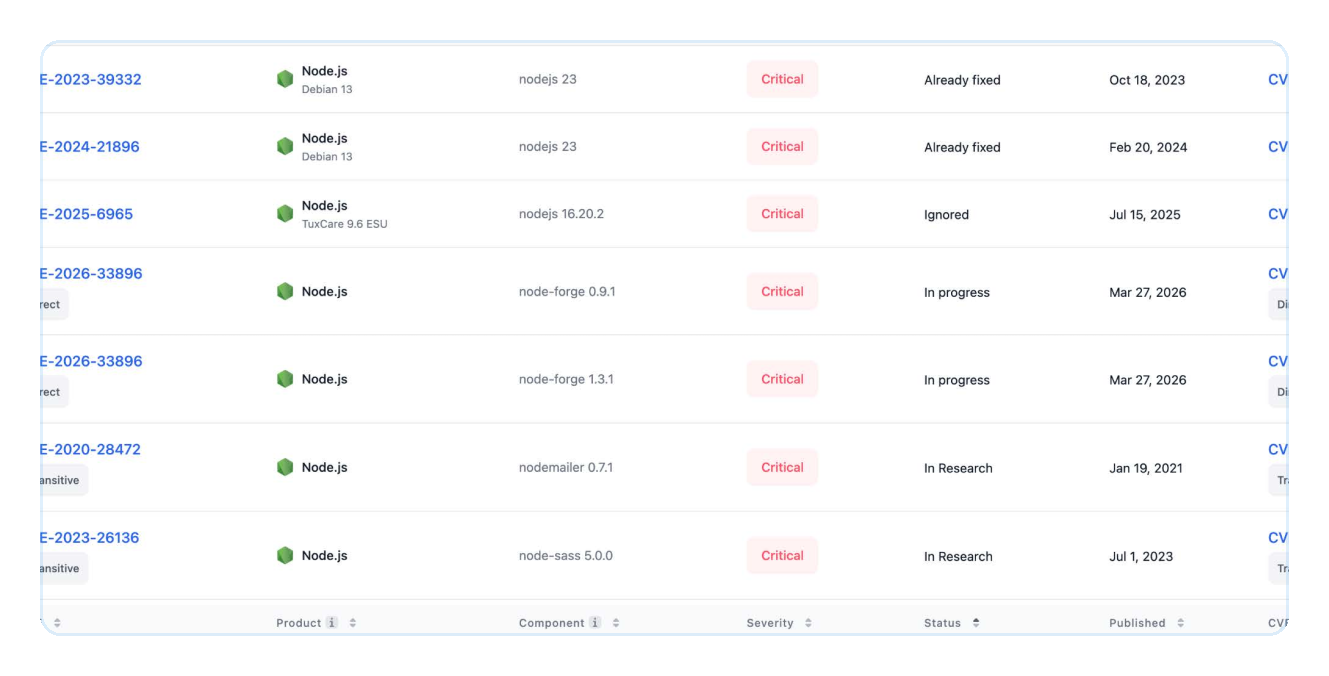
CVE Patching for Unsupported Node.js
As new Node.js vulnerabilities are disclosed, TuxCare investigates, patches, tests, and ships updates for covered EOL versions, helping you stay protected over time.
 On day 1
ELS gives you access to existing fixes for known CVEs affecting your version.
See what’s already fixed →
Keep Your Setup. Extend Your Security.
ELS fits into existing workflows, so teams can keep using the Node.js versions, tools, and deployment patterns they already rely on.
ELS works across
CentOS, CloudLinux, Oracle Linux, AlmaLinux, Debian, Ubuntu, Alpine Linux, x86_64, and arm64
with a simple package-manager change.

Support That Holds Up to Review
SLA-Backed Patch Delivery
TuxCare’s patch delivery SLA helps your organization meet vulnerability remediation expectations under frameworks and regulations such as SOC 2, NIS2, PCI DSS, HIPAA, DORA, and the CRA.
Enterprise Support Guarantees
ELS is built for enterprise use, with commercial support terms and contractual protections designed for organizations that need more than community best-effort maintenance.
Plug ELS into the stack you already have in minutes with no code changes required
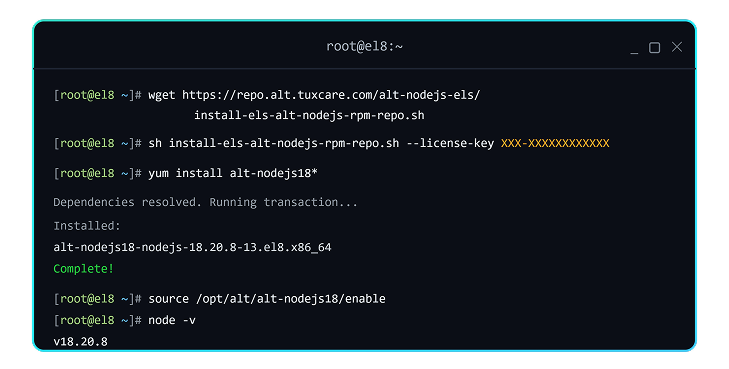
Compatible across:
 Debian
 Ubuntu
 CloudLinux
 AlmaLinux
 Alpine Linux
 Oracle Linux
A head start on Node.js security
Adopt ELS and benefit from the fixes already delivered for your version,
plus continued patching as new CVEs appear.
Ask a Node.js
CVE patching expert
Talk to us about ELS coverage, implementation, compliance, or pricing for your Node.js environment.
How Does It Work?

We onboard new projects and enable 24/7 automated CVE tracking – monitoring the NVD, vendor, and GitHub security advisories, and other sources.
Once CVEs are detected, we backport upstream fixes using algorithmic and AI-assisted automation, with expert validation to ensure accuracy.
Patches are compiled in a binary format, extensively tested (for integrity, functionality, and regression), signed, and deployed to ELS repositories.
Your package managers, build tools, or orchestrators check for updates, then automatically pull and install them.
How Teams Use ELS

Close the CVE exposure window
⚠️ The bind:
Hundreds of services are pinned to EOL Node.js 18 and 20. Scanners flag every deploy, no upstream patch is coming, and each new CVE leaves the gap between disclosure and exploit wide open.
🔄 The turn:
ELS resumes SLA-backed patching for Node.js 12–20 — signed, regression-tested, delivered through npm with no code changes. Backed by 24/7 CVE tracking, the fleet goes from exposed to defended in one deployment cycle.

Close an open audit finding
⚠️ The bind:
Internal audit, SOC 2, and a customer questionnaire all flag EOL Node.js, and the upstream project will never patch it — so there’s no remediation date to give auditors or the board.
🔄 The turn:
ELS delivers a named, vendor-backed runtime under a contractual SLA, with SBOM and VEX in every release. Findings close, scanners go quiet, and questionnaires point to coverage aligned with PCI DSS, HIPAA, SOC 2, DORA, NIS2, and CRA.

Migrate on your terms, not the EOL clock
⚠️ The bind:
Backlog full, headcount frozen, cloud providers retiring EOL Node.js runtimes. A rushed migration across hundreds of services risks production incidents and pulls engineers off the roadmap.
🔄 The turn:
ELS drops in fleet-wide — on-prem or across AWS, Azure, and GCP — with no code changes. You get years of runway to migrate deliberately while the runtime stays secure, compliant, and stable.
Why TuxCare?
 420,000+
Patches Delivered
From the Team That Extends Open-Source Lifecycles
TuxCare keeps essential components protected long after upstream support ends, from the Linux kernel to language runtimes like Node.js. One partner, whole-stack coverage.
 14,000+
Vulnerabilities Fixed
Founding platinum sponsor of the AlmaLinux OS Foundation and member of the Open Source Security Foundation (OpenSSF).
TuxCare invests in the open-source ecosystem it secures, from Node.js to Linux, and beyond.
Learn more → 70,000+
Packages Curated
 2,700+
Enterprise Clients
Related Insights
Node.js Vulnerabilities: Top Risks & How to Secure Apps In 2026
Most Node.js breaches don’t start with a zero-day. They start with a package.json nobody has touched in 14 months, running on an LTS line that quietly went end-of-life.

PostgreSQL 14 End of Life: Dates, Risks, and What to Do Next
PostgreSQL 14 end of life (EOL) is no longer a distant concern – it’s officially less than a year away. In November 2026, the PostgreSQL Global Development Group will ship the final planned minor release for this version.
When Next.js Support Ends: How to Keep Your App Secure Without Rewriting Everything
If you’ve built something meaningful with Next.js – a product dashboard, a SaaS front-end, or an internal portal – you already know the mix of pride and anxiety that comes with relying on a fast-moving JavaScript framework.
Secure Your EOL Node.js Versions
Talk to our team about protecting unsupported releases (including transitive dependencies) without code changes or forced migrations.
Ask Us a Question
Frequently Asked Questions
What happens when a Node.js version reaches end of life?
Upstream stops shipping security updates for that release. The version keeps running, but newly disclosed CVEs go unpatched, triggering scanner flags and audit findings, and remediation becomes your team's responsibility. TuxCare Endless Lifecycle Support (ELS) closes the gap by continuing to deliver CVE fixes for covered EOL versions.
Is it safe to keep using an end-of-life Node.js version?
Only if you have a reliable source of ongoing security patches. Without them, your app stays exposed to new CVEs, scanner findings, and compliance issues even if the code still works. With continued patching, an EOL version can stay secure for years – Endless Lifecycle Support patches Node.js 12–20 so you avoid rushing an upgrade.
How do I secure EOL Node.js without upgrading or changing my app?
Apply backported patches that fix vulnerabilities in your current version instead of migrating. This way, you can keep your code, dependencies, and deployment model unchanged. Endless Lifecycle Support delivers signed, regression-tested fixes through a simple configuration change, with no code changes required.
Can I stay compliant with CRA, SOC 2, PCI DSS, FedRAMP or HIPAA on EOL Node.js?
Frameworks require remediating known vulnerabilities on a timeline, which is impossible when no upstream patch exists. A vendor-backed SLA gives auditors a named, accountable remediation path. Endless Lifecycle Support provides SLA-backed patches plus SBOM and VEX documentation aligned with SOC 2, PCI DSS, HIPAA, DORA, NIS2, FedRAMP and the CRA – closing findings without a forced migration.
Which Node.js versions does Endless Lifecycle Support support?
ELS covers Node.js 12, 14, 16, 18, and 20, with Node.js 22 added when it reaches EOL. These versions are still common in production because applications, dependencies, or cloud runtimes are pinned to them. Coverage is built for teams that need security continuity without rewriting or replacing applications.
Is extended support a replacement for upgrading Node.js?
No. It buys safe time to upgrade rather than stopping you from upgrading. ELS keeps your current version patched so a move can happen on a planned schedule instead of being forced by the EOL clock. Teams use it when a rushed upgrade would risk production incidents or pull engineers off the roadmap.