Tech Support
 Documentation
 Login
 Contact Us




Go straight to an AI summary of this blog post instead 


Key Takeaways
- Each major PostgreSQL version receives approximately five years of community support after its initial release.
- PostgreSQL 14 will reach the end of its supported lifecycle on 12 November 2026.
- Continuing to run PostgreSQL 14 after EOL exposes your systems to increased security, compliance, and operational risks.
PostgreSQL 14 end of life (EOL) is no longer a distant concern – it’s officially less than a year away. In November 2026, the PostgreSQL Global Development Group will ship the final planned minor release for this version. After that date, community support ends.
For teams running version 14 in production, this means no more security patches or bug fixes. If a critical vulnerability surfaces after the end-of-life date, the lack of standard support means that the PostgreSQL project will not issue a fix.
While the standard advice is to “just upgrade,” major version jumps – like moving to PostgreSQL 17 or 18 – are rarely simple. They require extensive testing and often, high-stakes maintenance windows that may not align with operational constraints.
PostgreSQL Release and Support Lifecycle
The PostgreSQL project follows a predictable release cadence. Knowing how its lifecycle works helps teams plan upgrades, assess risk, and avoid surprises when a version reaches the it’s final support date – the end of community support. If you used PostgreSQL 13, then you are likely already familiar with how it all unfolds:
Major vs. Minor Versions
A new PostgreSQL major version is released approximately once per year, usually in September/October. Version numbers such as PostgreSQL 14, 15, and 16 introduce new features, internal improvements, and behavior changes that can affect applications. Because of this, moving between major versions is rarely something teams do casually.
Minor releases follow a very different pattern. Minor updates (14.x, 15.x, 16.x) are published several times a year or at least quarterly. They focus on fixing bugs and addressing security issues.
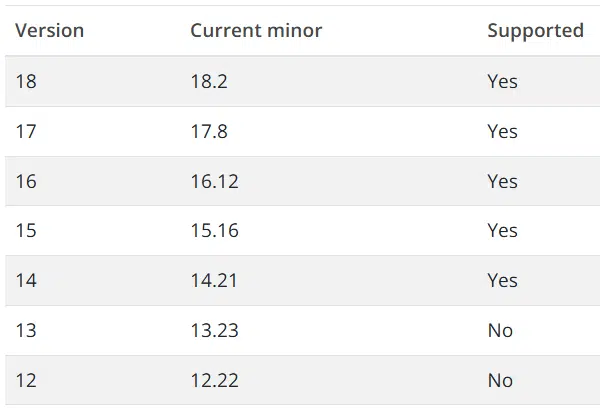
(Current Minor Versions As of February 2026)
The Five-Year Standard Support Window
Each major PostgreSQL version receives community support for five years from its initial release date. During that time, security issues and significant bugs are handled through regular minor versions. Once that five-year mark is hit, maintenance ends. No further patches are released for that version, even if new issues come to light.
For a closer look at PostgreSQL vulnerabilities and why timely patching matters, explore our detailed guide.
PostgreSQL 14 End of Life: Key Dates
PostgreSQL 14 was initially released on 30 September, 2021. Following PostgreSQL’s standard five-year versioning policy, community support for PostgreSQL 14 is scheduled to end on November 12, 2026. After this date, the PostgreSQL community will no longer provide security patches, bug fixes, or maintenance updates for version 14. Any newly discovered vulnerabilities will remain unpatched unless you upgrade to a supported version or use an extended support solution.
The table below shows how PostgreSQL versions progress through their standard support lifecycle.

Risks of Running PostgreSQL 14 After End of Life
Running PostgreSQL 14 after end of life exposes systems to avoidable risks across security, compliance, and daily operations. The database won’t suddenly stop working on November 13, 2026, but the security and maintenance safety net disappears. From that point forward, vulnerabilities remain unpatched, compliance becomes harder to demonstrate, and operational risks steadily grow.
Vulnerabilities Remain Unpatched
After end of life, newly discovered vulnerabilities are not fixed by the PostgreSQL community. Attackers often target unsupported software because exploits remain effective for longer periods. This increases the risk of data breaches and unauthorized access.
For more information about PostgreSQL security best practices, review our detailed guide on protecting database environments.
Compliance and Audit Failures
Many compliance standards like PCI DSS and HIPAA require supported software with active security updates. Running an unsupported PostgreSQL version can lead to audit findings, failed assessments, or increased scrutiny from regulators and customers.
Operational and Stability Risks
Without bug fixes, known issues remain unresolved. Compatibility problems may appear as operating systems, drivers, or dependent tools continue to evolve. Troubleshooting also becomes harder as fewer vendors and community members support the version.
What Are Your Options After PostgreSQL 14 Reaches End of Life?
When the PostgreSQL 14 end-of-life date arrives, “business as usual” is no longer an option. Teams are essentially choosing between three distinct strategies, each with different implications for risk, workload, and long-term maintainability.

Upgrade to a Supported PostgreSQL Version
Upgrading to a currently supported version – such as PostgreSQL 16, 17, or newer – is the ideal long-term path. It restores community support and provides access to performance improvements, planner enhancements, and ongoing fixes.
However, a major upgrade is not just a “patch.” Because PostgreSQL changes its internal data storage format between major versions, upgrades typically involve tools like pg_upgrade or logical replication.
For complex production environments, this requires significant downtime, potential breaking changes in third-party extensions, and the risk of “query plan regressions” where a fast query on version suddenly runs slow on version 17.
Use TuxCare’s Endless Lifecycle Support
For many organizations, an immediate major upgrade is not practical. Legacy applications, certification requirements, or operational constraints often mean teams need more time before migrating.
This is where solutions like TuxCare’s Endless Lifecycle Support (ELS) come in. TuxCare backports relevant security fixes from newer PostgreSQL releases to older versions that are no longer maintained by the community.
With TuxCare’s ELS, organizations can continue receiving security updates for PostgreSQL 14 while keeping their existing environment stable. This helps maintain compliance, reduce short-term operational risk, and create space for a properly planned migration rather than a rushed upgrade.
Operating Without Support
Some organizations choose to remain on PostgreSQL 14 without upgrading or purchasing extended support. While this avoids immediate effort, it leaves systems exposed.
Over time, vulnerabilities remain unpatched, compatibility issues increase as surrounding infrastructure evolves, and the likelihood of audit findings grows. The database may keep running, but the operational risk steadily rises.
You can also learn more about PostgreSQL 12 eol risks to understand how running legacy database versions without patches affects security over time.
Note: Most enterprise teams begin planning their post-EOL strategy 6-12 months before the deadline. This window is critical for dry-run testing, application validation, and preparing your upgrade path. If you’re already within this timeframe, evaluating extended support options now can prevent a rushed migration that might compromise production uptime.
Staying Secure After PostgreSQL 14 End of Life
PostgreSQL 14 EOL does not require an immediate upgrade, but it does require a clear plan to avoid risks for production systems. Once community maintenance ends, teams need to decide how they will continue managing security risks and maintaining operational stability.
For teams that cannot upgrade before the EOL date, TuxCare’s Endless Lifecycle Support for PostgreSQL helps keep existing deployments secure and stable while allowing time to plan upgrades on your own terms.
TuxCare already provides extended support via ongoing vulnerability patches for end-of-life PostgreSQL 13 and will extend the same approach to PostgreSQL 14 a few months before the EOL date.
The key is to act early. Review your PostgreSQL versions, assess upgrade readiness, and decide how you will maintain security after the end-of-life date.
FAQs
Is PostgreSQL 14 still supported?
Yes. PostgreSQL 14 is still supported by the PostgreSQL community and will continue receiving security updates and bug fixes until November 2026.
What version of PostgreSQL should I use in 2026?
You should run a PostgreSQL version that is still within its community support dates. In 2026, this will typically mean PostgreSQL 15, PostgreSQL 16, or any newer supported release.
Can I stay on PostgreSQL 14 without upgrading?
Yes, but only if you have a plan for security updates. For example, you can choose an extended support service such as TuxCare’s Endless Lifecycle Support after community maintenance has ended. Running PostgreSQL 14 without any security support increases both security exposure and compliance risks.