

Keep legacy LoopBack APIs patched without forcing a framework rewrite
LoopBack 1.x and 2.x have been out of upstream support for years. Endless Lifecycle Support keeps covered releases patched so you can protect production APIs without taking on a framework migration.
Jump to:

Talk to Us
Ask about coverage, SLAs, pricing, or anything else.


Covered LoopBack Versions
 Version |
 Status |
 Coverage |
|---|---|---|
 LoopBack 1.10.0 |
Predates the published LTS schedule |
 Covered by ELS |
|
LoopBack 2.42.0
|
End of life April 2019 |
Covered by ELS
|
*End-of-life dates come from the LoopBack long term support policy. Running a different release? Contact TuxCare about coverage.
What You Get with ELS

Security Fixes for Legacy LoopBack Apps
Old LoopBack stacks carry risk in the framework and across the dependency tree underneath it. TuxCare tracks new vulnerabilities and ships tested fixes for covered releases, even when a rewrite isn’t practical.
On day 1
Every LoopBack patch already shipped for your covered release is waiting as soon as your project connects to the ELS registry.

Patch LoopBack Without Rebuilding Your API
ELS replaces covered packages with TuxCare maintained equivalents while preserving the application structure and behavior your API already depends on.
Patched packages arrive through the TuxCare npm-compatible repository, using package aliases for direct dependencies and overrides for covered transitive ones. It fits the npm workflow you already have, including Docker and CI/CD builds.

Proof Your Auditors Will Accept
Patch Delivery Backed by SLA
When auditors ask how legacy LoopBack gets patched, point to a contractual SLA aligned with SOC 2, PCI DSS, HIPAA, NIS2, DORA, and the CRA.
Enterprise Support Guarantees
ELS is built for enterprise use, with commercial terms and contractual protections beyond community best effort maintenance.
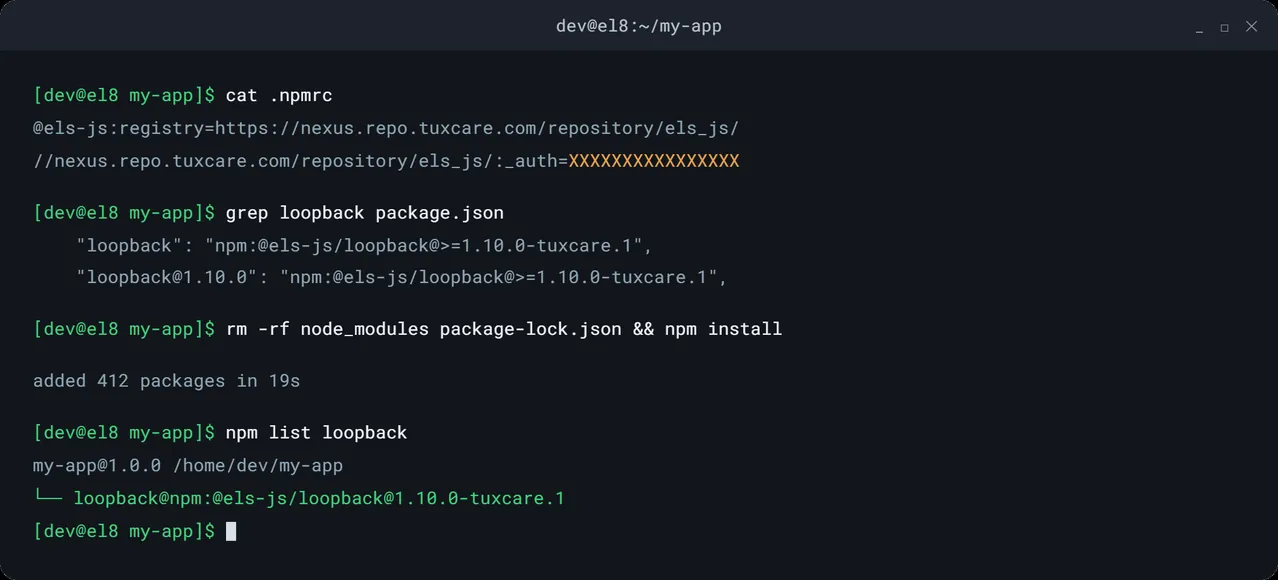
Add patched LoopBack packages through npm without rewriting your application
Point npm at the TuxCare repository, update your package references, refresh dependencies, and run your normal tests.
A head start on LoopBack security
Start with the fixes already shipped for your covered release and stay protected as new issues surface.
| CVE | Product | Component | Severity | Status | Published |
|---|---|---|---|---|---|
| CVE-2026-73643 Transitive | loopback | loopback 2.42.0 | High | Not vulnerable | |
| CVE-2026-59868 Transitive | loopback | loopback 2.42.0 | Medium | Not vulnerable | |
| CVE-2026-49356 Transitive | loopback | loopback 2.42.0 | Low | Not vulnerable | |
| CVE-2026-27601 Direct | loopback | loopback 1.10.0 | High | Patch available | |
| CVE-2024-33883 | loopback | loopback | Medium | Patch available | |
| GHSA-9h6g-pr28-7cqp Transitive | loopback | loopback 1.10.0 | Medium | Not vulnerable | |
| CVE-2023-46298 Transitive | loopback | loopback 2.42.0 | High | Not vulnerable | |
| CVE-2022-29078 Transitive | loopback | loopback 1.10.0 | Critical | Patch available |
Ask a LoopBack CVE patching expert
Talk through which covered packages sit in your application and how to move them onto maintained builds.

How Teams Use ELS

Quiet the scanner
⚠️ The bind:
A production API still runs on LoopBack 1.x or 2.x, and the dependency graph underneath it cannot be upgraded in one pass.
🔄 The turn:
ELS patches covered packages in place, so a security ticket stops turning into a framework migration.

Close an open audit finding
⚠️ The bind:
Security reviews keep flagging unsupported LoopBack, but the application has years of useful life left and no safe migration window.
🔄 The turn:
ELS delivers maintained packages under a contractual SLA and a documented remediation path. Auditors get something more concrete than a future rewrite plan.

Modernize when the roadmap is ready
⚠️ The bind:
Moving an old LoopBack app touches models, middleware, connectors, authentication, and client behavior. That is too much to rush for one CVE.
🔄 The turn:
ELS keeps covered releases patched while teams test the migration properly, phase it in, or leave a stable application where it is.
Why TuxCare?
 420,000+
Patches Delivered
From the Team That Extends Open-Source Lifecycles
TuxCare keeps important components protected long after upstream support ends, from the Linux kernel to runtimes, libraries, and frameworks such as LoopBack. One partner, broad open source coverage.
 14,000+
Vulnerabilities Fixed
Founding platinum sponsor of the AlmaLinux OS Foundation and member of the Open Source Security Foundation (OpenSSF).
TuxCare invests in the open source ecosystem it secures, from application dependencies to Linux and beyond.
Learn more → 70,000+
Packages Curated
 2,700+
Enterprise Clients
Related Insights
Top 5 Patch Management Tools in 2026: Full Review
Key Takeaways Patch management tools often look alike on a feature list, but they…

CVE-2026-98276 Was Fixed Upstream. Then a Server Crashed 12 Times.
KernelCare Rebootless Patches for CVE-2026-98276 Are Out for EL 8 and 9 TuxCare has…
The SSH Authentication Bypass That Lived Between OpenSSH and musl (CVE-2026-123158)
Key Takeaways A password of 257 to 1024 bytes logs in to any key-only…
Old LoopBack can keep running without staying unpatched.
Get ongoing CVE fixes for covered LoopBack releases through the npm workflow you already use.
Ask Us a Question
Frequently Asked Questions
LoopBack 4 is the actively developed line, but it sits well beyond the legacy releases covered here. LoopBack 2 reached end of life in April 2019 and LoopBack 3 followed in December 2020, which is where a lot of production LoopBack code still lives. TuxCare's ELS keeps covered LoopBack releases receiving security fixes.
Replace the covered LoopBack package and affected dependencies with TuxCare maintained equivalents instead of rebuilding on a newer framework. Setup is three lines in .npmrc, a package.json change that points your dependency at the ELS build, and npm install. Models, remote methods, boot scripts, and ACLs stay as they are.
ELS currently covers LoopBack 1.10.0 and 2.42.0. Both are legacy releases with no normal upstream maintenance behind them. If your application runs a different release, including anything on the 3.x line, contact TuxCare to discuss coverage.
Yes. A legacy LoopBack app inherits risk from the framework and from everything underneath it. ELS can redirect covered dependencies to TuxCare maintained packages through npm overrides, so remediation is not limited to the top level LoopBack package.
Yes. ELS is built for applications that cannot cleanly jump to a newer framework. Covered packages arrive through npm, which lets teams patch the existing dependency graph while keeping the architecture they already run.
No application code changes are required. You configure the TuxCare npm-compatible repository, replace the covered package references, refresh dependencies, and test as usual. The point is to preserve the LoopBack behavior your API already expects.
Yes. ELS packages resolve through npm from the TuxCare npm-compatible repository, so the same registry configuration works in container builds and in any CI/CD workflow that already installs dependencies with npm. The token is read from your project's .npmrc.
ELS is designed to support vulnerability remediation requirements under frameworks including SOC 2, PCI DSS, HIPAA, NIS2, DORA, and the CRA. A contractual patching path gives security and audit teams documented remediation for software that is otherwise unsupported.
Migration is still a sensible long term goal, since moving between LoopBack generations involves real application changes. ELS gives teams room to patch now and migrate when the API, data model, integrations, and test coverage are ready.