

Keep archived RequireJS releases patched while you plan your migration
RequireJS is an archived OpenJS Foundation project. Endless Lifecycle Support keeps covered 2.1.22 and 2.3.6 deployments patched under an SLA, so an AMD migration stays a plan rather than an emergency.
Jump to:

Talk to Us
Ask about coverage, SLAs, pricing, or anything else.


Covered RequireJS Versions
 Version |
 Status |
 Coverage |
|---|---|---|
 RequireJS 2.1.22 |
Superseded March 2016 |
 Covered by ELS |
|
RequireJS 2.3.6
|
Superseded July 2024 |
Covered by ELS
|
*RequireJS is an archived OpenJS Foundation project with no published EOL dates, so these mark when each release was superseded upstream
What You Get with ELS

Security Fixes for an Archived Project
CVE-2024-38999 is prototype pollution reaching every release through 2.3.6. TuxCare backports applicable fixes to covered releases and monitors what lands next on a project that went six years between releases before its last security fix.
On day 1
Previously delivered RequireJS fixes are available the moment your project connects to the ELS registry.

Patch RequireJS Without Reworking Your Code
ELS replaces your covered RequireJS package with a TuxCare-maintained equivalent, preserving the version and loading behavior your application already expects.
Patched packages arrive through the TuxCare npm registry and fit the npm workflow you already run, from package.json overrides to Docker and CI/CD builds.

Support That Holds Up to Review
Patch Delivery Under SLA
When auditors ask how an archived dependency is still being remediated, you point to a contractual SLA and a patch history you can put in front of SOC 2 and PCI DSS reviewers.
Enterprise Support Guarantees
ELS is built for enterprise use, with commercial terms beyond community best-effort maintenance.
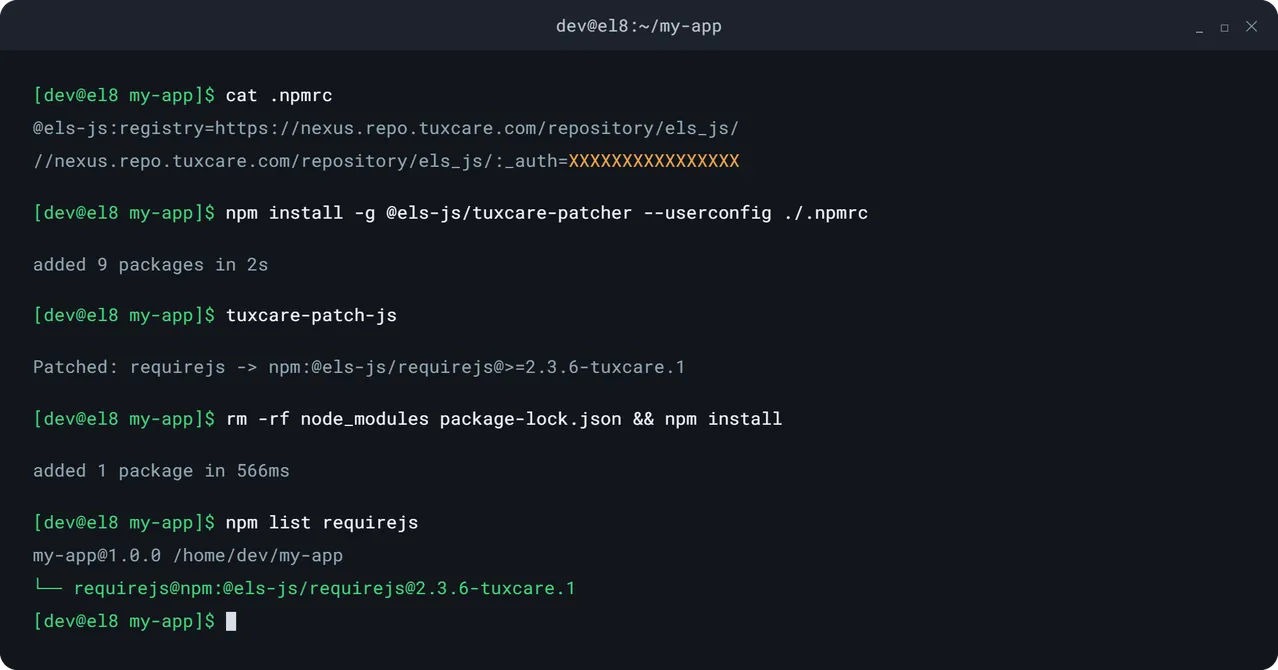
Add patched RequireJS packages through npm without rewriting application code
Configure the TuxCare npm registry, update the package reference, and reinstall your project dependencies.
Ask a RequireJS CVE patching expert
Discuss which covered release you run and how to keep it patched without pulling migration work forward.

How Does It Work?

We onboard new projects and enable 24/7 automated CVE tracking – monitoring the NVD, vendor, and GitHub security advisories, and other sources.
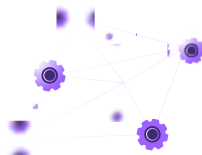
Once CVEs are detected, we backport upstream fixes using algorithmic and AI-assisted automation, with expert validation to ensure accuracy.

Patches are compiled in a binary format, extensively tested (for integrity, functionality, and regression), signed, and deployed to ELS repositories.

Your package managers, build tools, or orchestrators check for updates, then automatically pull and install them.
How Teams Use ELS

Clear the scanner
⚠️ The bind:
A production application still runs RequireJS 2.1.22, where the fix for CVE-2024-38999 sits two minor versions upstream.
🔄 The turn:
ELS patches the release you already run, so closing the finding does not become a loader upgrade and a full regression pass.

Close an open audit finding
⚠️ The bind:
Internal audit, SOC 2, and customer questionnaires flag an archived RequireJS release, and a migration plan is not a remediation date.
🔄 The turn:
ELS provides vendor-backed packages under a contractual SLA with a documented patch history, which gives reviewers a real remediation path for a dependency nobody upstream is maintaining any more.

Move to ES modules when you are ready
⚠️ The bind:
Replacing RequireJS touches loader configuration, AMD wrappers, optimizer steps, and legacy browser assumptions across a mature front end.
🔄 The turn:
ELS keeps covered releases patched while teams map dependencies, test native modules, and modernize on a schedule that protects stability, instead of letting the CVE clock choose it.
Why TuxCare?
 420,000+
Patches Delivered
From the Team That Extends Open-Source Lifecycles
TuxCare keeps essential components protected long after upstream support ends, from the Linux kernel to language runtimes, and libraries like RequireJS. One partner, broad open source coverage.
 14,000+
Vulnerabilities Fixed
Founding platinum sponsor of the AlmaLinux OS Foundation and member of the Open Source Security Foundation (OpenSSF).
TuxCare invests in the open-source ecosystem it secures, from RequireJS to Linux, and beyond.
Learn more → 70,000+
Packages Curated
 2,700+
Enterprise Clients
Related Insights
Top 5 Patch Management Tools in 2026: Full Review
Key Takeaways Patch management tools often look alike on a feature list, but they…

CVE-2026-98276 Was Fixed Upstream. Then a Server Crashed 12 Times.
KernelCare Rebootless Patches for CVE-2026-98276 Are Out for EL 8 and 9 TuxCare has…
The SSH Authentication Bypass That Lived Between OpenSSH and musl (CVE-2026-123158)
Key Takeaways A password of 257 to 1024 bytes logs in to any key-only…
RequireJS is archived. Your apps can stay patched.
Get ongoing CVE fixes for covered RequireJS 2.1.22 and 2.3.6 deployments through the npm workflow you already use.
Ask Us a Question
Frequently Asked Questions
No. The OpenJS Foundation lists RequireJS among its archived projects, and requirejs.org still shows 2.3.7 as the latest download. npm carries 2.3.8, but there is no roadmap and no security team, and the 2024 security fix was the project's first release in six years. TuxCare ELS covers older releases still running in production.
Use a security-patched replacement for the covered release you already run. TuxCare ELS delivers maintained RequireJS packages through its npm registry. You add the registry to .npmrc, point package.json at the ELS package manually or with the TuxCare Patcher, then run npm install. No AMD modules or loader config change.
ELS covers RequireJS 2.1.22 and 2.3.6, both long-lived releases in mature AMD applications. Coverage is version-specific, so the package you install matches the release your build already expects. If your application pins a different version, contact TuxCare to discuss coverage options.
If you can, yes. The fix for CVE-2024-38999 is a single guard inside the loader, and 2.3.6 to 2.3.8 is a patch-level move that needs no AMD changes. ELS is for builds frozen by validation, vendor certification, or a pinned toolchain, and for teams who want SLA-backed coverage for whatever comes next.
CVE-2024-38999 is prototype pollution through s.contexts._.configure, and it affects every RequireJS release up to and including 2.3.6. Upstream fixed it in 2.3.7. ELS delivers that remediation on covered releases for teams where moving to 2.3.7 or later is not an option.
Yes. ELS packages come from the TuxCare npm registry and resolve wherever a covered RequireJS version appears in your tree, including copies pulled in by packages you do not control. npm overrides in package.json redirect every instance to the maintained equivalent.
No. ELS preserves the covered version and its expected loading behavior. Existing define and require calls, loader configuration, paths and shim config, and r.js build steps all stay as they are while the package receives applicable security fixes.
Yes. ELS packages resolve through npm from the TuxCare registry, so they fit Docker builds, CI/CD pipelines, and deployment workflows that already install RequireJS through npm. The registry token is read from your project's .npmrc.
ELS is designed to support vulnerability-remediation requirements under frameworks including SOC 2, PCI DSS, HIPAA, NIS2, DORA, and the CRA. It does not make an application compliant on its own. What it provides is a named vendor, a contractual SLA, and a documented patch history that auditors can review.
It depends on the application and the migration cost. Moving from AMD to ES modules can touch module definitions, loader configuration, bundling, and browser support. ELS keeps covered releases patched while you modernize deliberately, or while you keep running an application where migration buys very little.