Tech Support
 Documentation
 Login
 Contact Us




Go straight to an AI summary of this blog post instead 


Key Takeaways
- Chainguard Libraries covers JavaScript, Python, and Java, with Go and .NET in beta, and its paid plans add CVE remediation for selected libraries.
- Google Assured OSS builds Java, Go, and Python packages from source on a free tier, and it has no published remediation SLA.
- RapidFort screens packages for malware, Endor Labs pairs a package firewall with backported patches, and Aikido pairs a free install blocker with paid, patched versions of the libraries you already run.
- TuxCare’s SecureChain serves verified, malware-screened, continuously patched open source packages across six ecosystems, and Endless Lifecycle Support (ELS) keeps patching them after upstream end of life, along with NuGet, C++, and Perl packages.
Chainguard sells hardened container images and Chainguard Libraries, which rebuilds open source packages from source and serves them from Chainguard’s own registry. Teams tend to look at Chainguard alternatives when a pinned dependency has a CVE, no upgrade path, and no fix from Chainguard.
The five tools below compete with Chainguard Libraries on three jobs: verifying where a package comes from, screening it for malware, and keeping it patched. Most cover one or two, so start from the job you’re missing.
Chainguard Alternatives Compared
| Tool | Ecosystems | Approach | Pricing model | Main drawback |
| Chainguard Libraries (reference) | Python, Java, JavaScript; Go and .NET in beta | Built from source, malware scanning, selected CVE backports | Free Starter plan; paid Team and Enterprise plans | Selective remediation with no published SLA |
| TuxCare SecureChain | JavaScript, Python, Java, Go, Rust, PHP; ELS adds NuGet, C++, Perl | Rebuilt from source and screened for malware; ELS patches after upstream ends | Custom quote, single enterprise license | No container images |
| Google Assured OSS | Java, Go, Python free; npm in Premium | Google-built packages with provenance | Free tier; Premium via Security Command Center | No published SLA or end-of-life commitment |
| RapidFort Curated Libraries | npm, PyPI, Maven, RubyGems, NuGet | Malware-scanned, pin-for-pin compatible packages | Not published | No CVE patching advertised |
| Endor Labs | npm, PyPI, Maven Central and other registries (firewall) | Package firewall plus backported patches | Quote-based, seat-based per product | Part of a broader platform |
| Aikido | JavaScript, Python, Java, .NET, Go, PHP, Ruby, Rust | Patched versions of pinned libraries, plus a free install blocker for npm and PyPI | Paid plan plus credits per repository; Safe Chain free | SLA covers new CVEs once an upstream fix exists |
1. TuxCare SecureChain
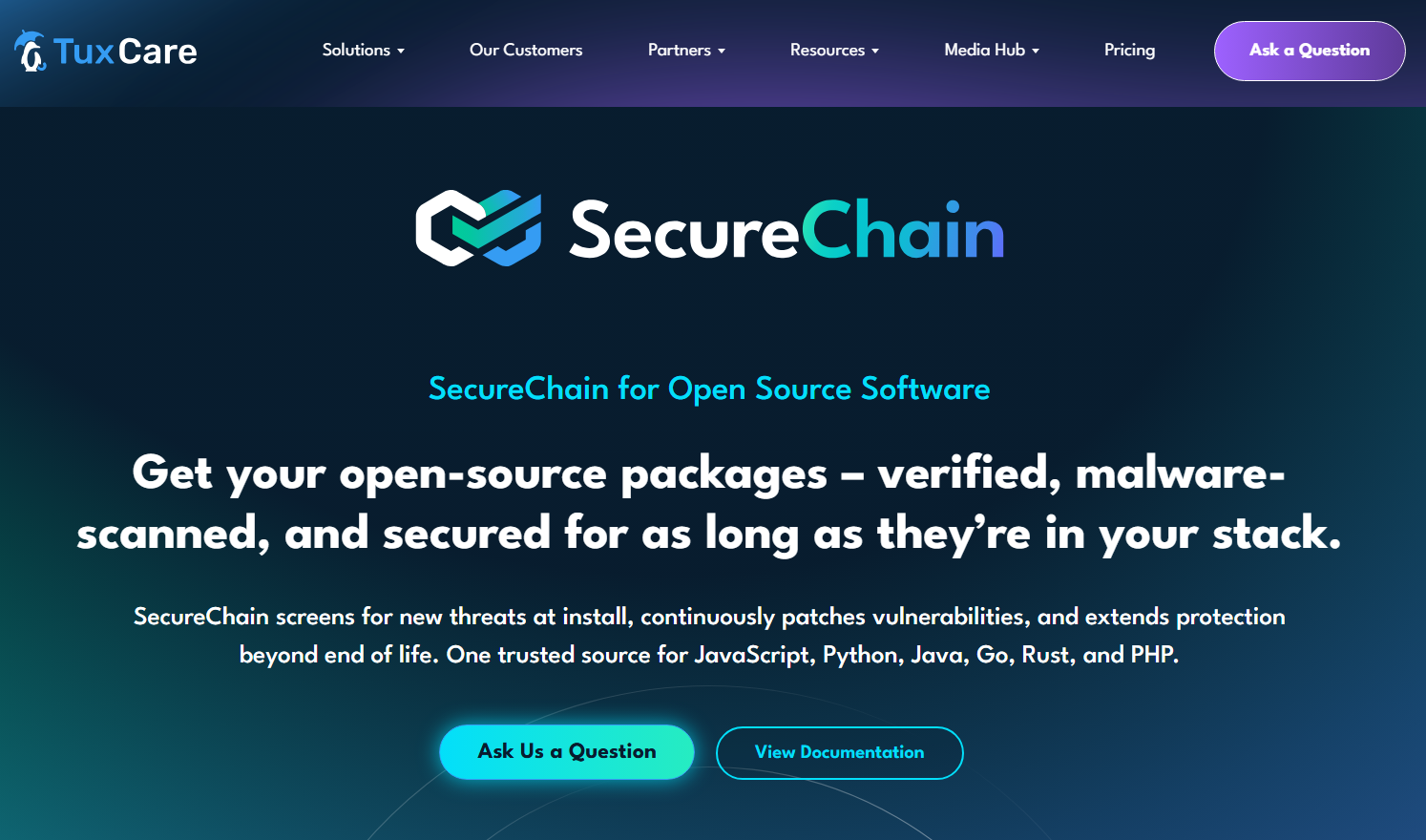
SecureChain from TuxCare screens the source code of each open source package for known malware and suspicious code patterns, rebuilds it from verified source in a hardened, isolated build environment, and serves it from a TuxCare-managed registry. TuxCare built it as the full-lifecycle alternative to Chainguard Libraries.
Key features
All six ecosystems (JavaScript, Python, Java, Go, Rust, and PHP) come from one registry. Developers use the TuxCare CLI on their machines and in CI: it scans lockfiles, installs TuxCare builds of the versions you already use, and can fail a pull request on new CVE findings. Results land in TuxCare’s web portal. If a package you depend on isn’t in the catalog yet, TuxCare adds it at no extra cost.
Before a package enters the catalog, TuxCare screens its source code for known malware and suspicious code patterns, then rebuilds it from verified source in a hardened, isolated build environment.
For audit evidence, every package is built and signed to support SLSA Level 3 and ships with a CycloneDX SBOM and VEX document.
Patching follows each package version through three lifecycle stages. In Mainstream, while upstream is still shipping fixes, TuxCare tracks them. When upstream stops fixing a version, meaning it misses a CVE SLA or goes nine months without a release, the version moves to Sustained, and TuxCare patches it directly for three months. After that, Endless Lifecycle Support takes over and backports fixes to the exact versions you run. ELS also covers end-of-life NuGet, C++, and Perl packages.
Response targets depend on severity and stage. Under ELS, TuxCare targets 14 days for critical and high CVEs, 60 days for medium, and 90 days for low, measured from CVE publication. In Maintenance, the clock starts at the upstream fix instead.
Pricing
You can request a custom quote, and a combined quote across TuxCare products is available. SecureChain is sold as a single enterprise license with no per-developer fee, and updates are included at a fixed price for the duration of the contract.
Where SecureChain Shines
SecureChain covers the versions you run for as long as you run them. TuxCare re-scans every project with the TuxCare CLI whenever a new advisory appears and turns the findings into a fix plan for each repository, prioritizing known-exploited CVEs. The fixes land on the versions you already use, so you close CVEs without upgrades or code changes. Coverage follows each version throughout its life: TuxCare rebuilds upstream fixes while the project is active, patches the version itself once upstream support ends, and automatically hands it off to Endless Lifecycle Support, with a patch deadline for each severity at each stage.
Where SecureChain Falls Short
It doesn’t offer hardened container or base images, so you’ll pair it with an image vendor listed near the end of this guide. It doesn’t scan your own code either, which means SAST, secrets detection, IaC scanning, and reachability analysis need a separate tool.
Coverage stops at six ecosystems for screened, rebuilt packages, and ELS adds NuGet, C++, and Perl. Ruby gems need another source, although TuxCare does cover the .NET and Ruby runtimes through a separate ELS offering.
Best for: Platform teams sitting on pinned or end-of-life dependencies across several languages, or answering to auditors who want provenance, SBOM, and VEX evidence.
2. Google Assured OSS
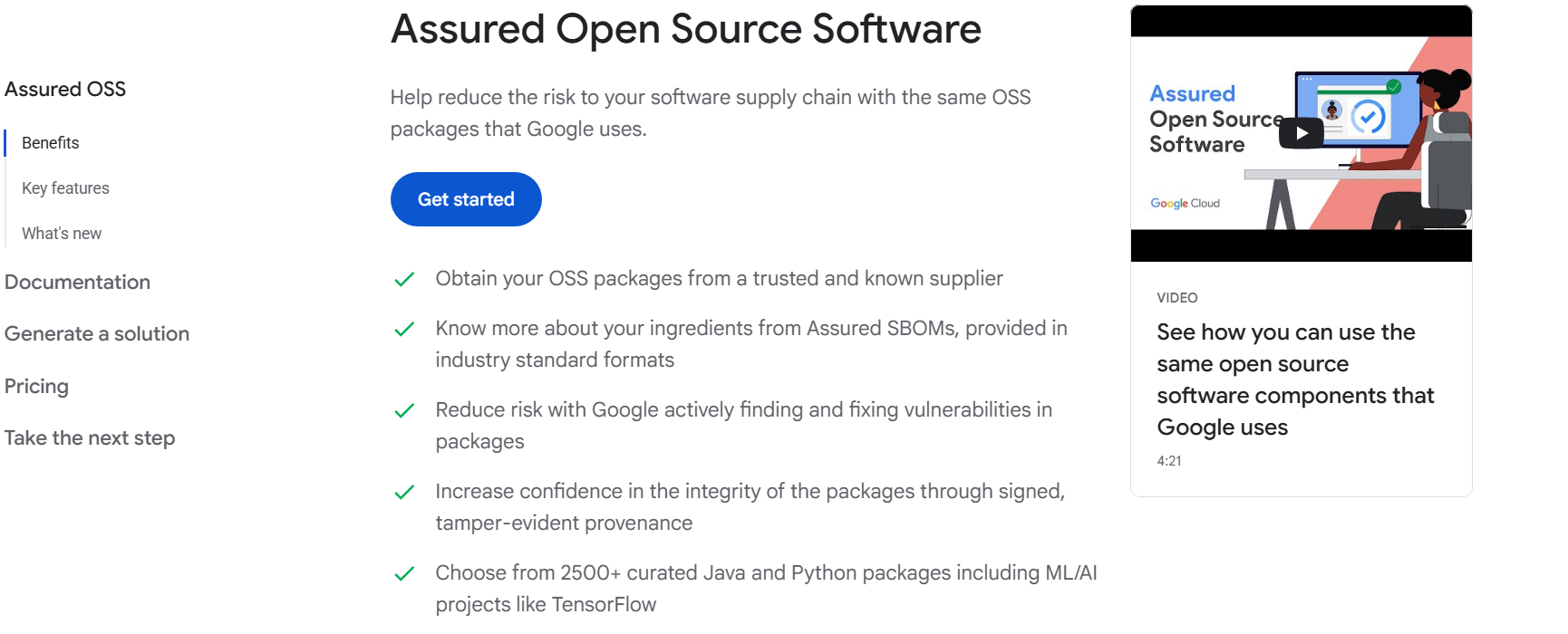
Google Cloud’s Assured Open Source Software is a free, build-from-source package service, and the closest thing on this list to a vetted registry that costs nothing to try.
Key features
Google builds the packages with verifiable provenance and an SBOM, and assigns each one of three assurance levels. Level 1 is built and signed by Google. Level 2 is securely built from vetted sources and attested to all transitive dependencies. Level 3 adds the full transitive closure and continuous scanning and fuzzing.
The catalog covers more than a thousand of the most popular Java, Go, Python, and JavaScript (npm) packages, including TensorFlow, Pandas, and Scikit-learn.
Packages are regularly scanned, analyzed, and fuzz-tested for vulnerabilities, and Google says it actively finds and fixes vulnerabilities in them. Metadata includes SPDX, VEX, package health, and license information.
You access packages through curated repositories, with a virtual upstream repository as a single access point for developers.
Pricing
The free tier covers Python, Go, and Java packages at no cost. The Premium tier adds JavaScript (npm) packages and Google-signed package metadata. It’s available only with a Security Command Center Premium or Enterprise subscription, so its cost is subject to Google’s Security Command Center pricing.
Where Google Assured OSS Shines
Python, Go, and Java packages come at no cost, so you can try the service before any budget conversation. Google builds the packages, and each package comes with provenance, a per-package SBOM, and a stated assurance level. Packages live in Artifact Registry, and Premium plugs into Security Command Center.
Where It Falls Short
Google publishes no remediation SLA or end-of-life patching commitment. The catalog is a curated list. Google’s universal proxy also serves packages outside the catalog, but Google doesn’t build those, and its package health data is only available for packages built by Google. npm coverage needs the Premium tier, which ties the cost to Security Command Center.
The catalog covers only Java, Go, Python, and npm, so Rust and PHP projects need another source. Google scans packages for vulnerabilities and fuzz-tests them, but it doesn’t advertise malware screening.
Best for: Teams working in Java, Go, or Python, teams already on Google Cloud, and teams that want a free build-from-source package to test before committing budget.
3. RapidFort Curated Libraries
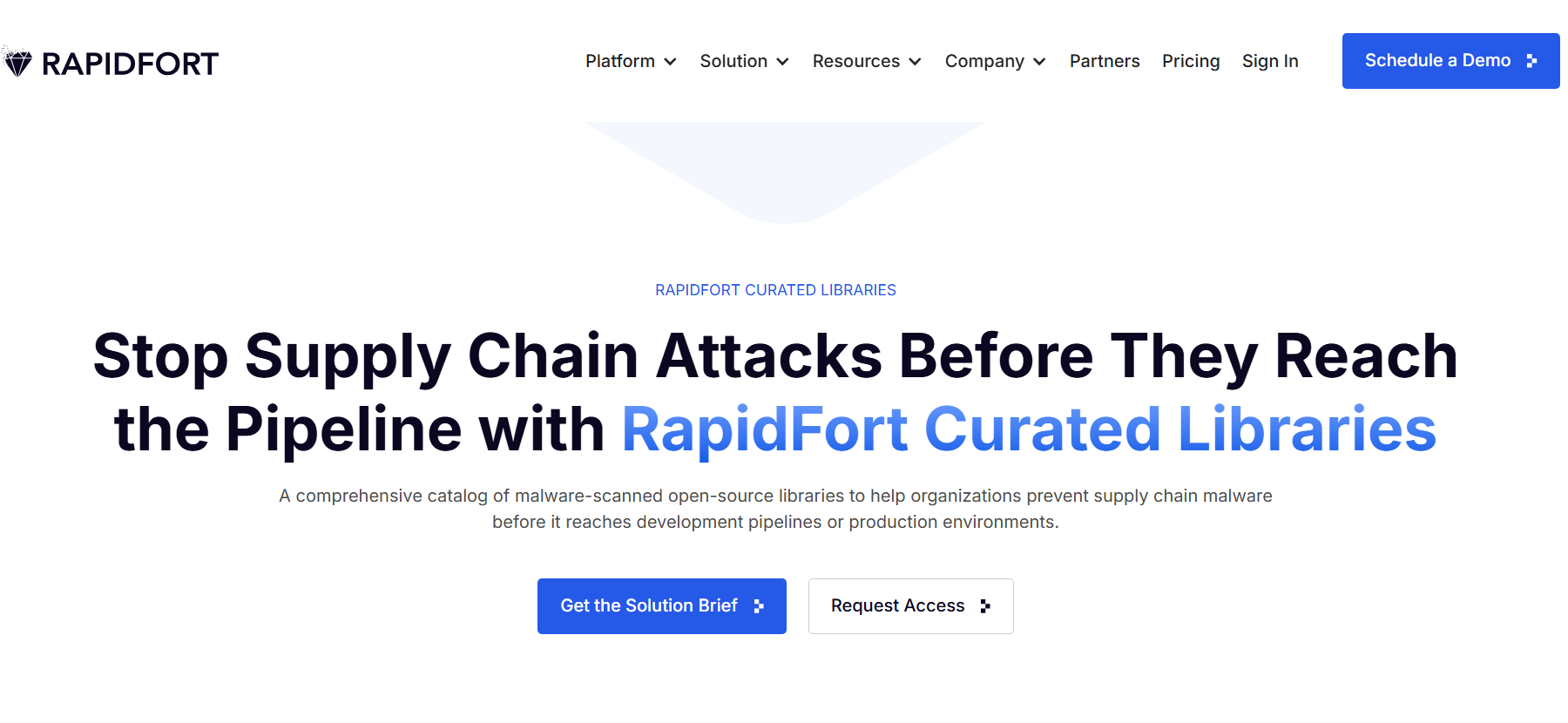
RapidFort is best known for curated container images. On June 11, 2026, it launched Curated Libraries, a catalog of malware-scanned open source packages that extends the same curation model to the packages your application installs.
Key features
The catalog covers npm, PyPI, Maven, RubyGems, and NuGet, with packages scanned for malware before developers pull them.
Packages are pin-for-pin compatible, so developers keep the same libraries, versions, CLI syntax, and workflows. They work with existing operating systems, tools, and artifact repositories, without migrating to a proprietary operating system.
The scanning targets backdoored dependencies, install-time payloads, typosquatted packages, credential stealers, and similar threats.
Pricing
RapidFort doesn’t publish pricing for Curated Libraries. Its container images follow a tiered model, with five free curated images and custom quotes for the paid tiers, so a quote is the likely route here too.
Where RapidFort Curated Libraries Shines
Pin-for-pin compatibility means developers keep their package names, versions, and CLI syntax. RapidFort says the libraries fit early in the delivery process, before untrusted packages become part of a product build, container image, internal artifact, or deployed service. RubyGems is on its list, while SecureChain and Google Assured OSS don’t list it. Teams already using RapidFort’s curated images can add package screening from the same source.
Where It Falls Short
Curated Libraries screens for malware but doesn’t advertise CVE patching, so a vulnerable version you’ve pinned still needs a fix from somewhere else. RapidFort hasn’t said whether packages are rebuilt from source or served after scanning, and it doesn’t list per-package SLSA provenance or SBOMs. Pricing isn’t published.
The product launched in June 2026, so its production track record is short. Go, Rust, and PHP aren’t among the ecosystems it launched with.
Best for: Ruby and .NET teams that need malware screening on their dependencies, and organizations already running RapidFort images that want package screening from the same vendor.
4. Endor Labs
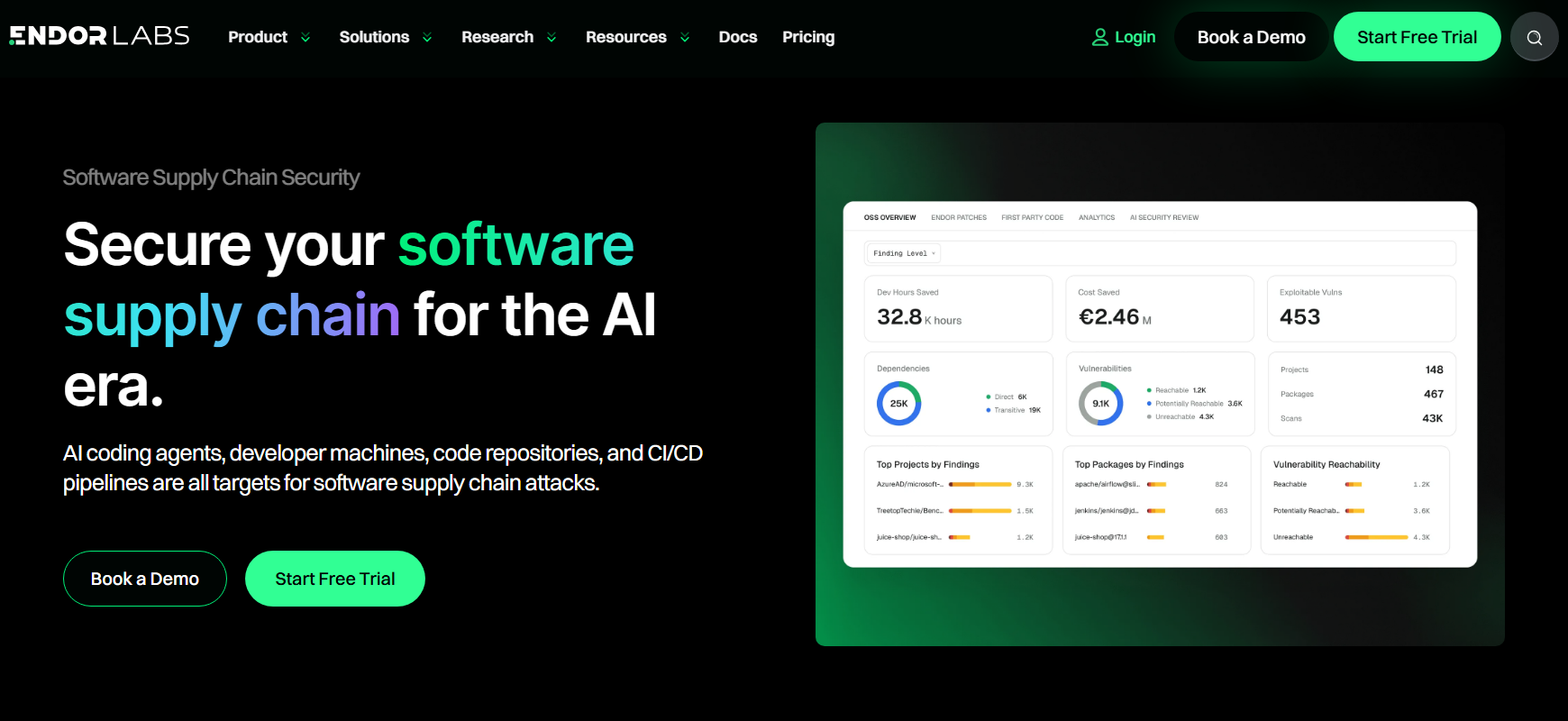
Endor Labs extends package security beyond application security and handles two package-layer tasks: blocking malicious packages before they enter your environment and fixing vulnerable ones without forcing a breaking upgrade.
Key features
Package Firewall blocks malware, typosquats, and dependency confusion at the registry edge before a package reaches a workstation or pipeline. It scans newly uploaded packages on npm, PyPI, Maven Central, and other registries against 150-plus supply chain risk signals, combining SAST rules, malware signatures, and behavioral analysis.
Cooldown policies hold new packages out of builds for a configurable window. CI/CD enforcement blocks compromised packages without requiring a repository proxy, and the firewall also integrates with JFrog Artifactory, Sonatype Nexus, and Google Artifact Registry.
Endor Patches backport security fixes as hermetic, reproducible artifacts when a full upgrade is too disruptive. Patched versions match the upstream version number, so you can use them without code changes.
Automated remediation pull requests for Java, Go, Python, .NET, and JavaScript, along with reachability analysis, are part of Endor’s broader platform.
Pricing
Endor Labs quotes seat-based pricing, and its products are sold separately, so the package firewall and patches are separate line items.
Where Endor Labs Shines
The firewall stops malicious packages at the registry edge, ahead of the workstation and pipeline. Cooldown policies cover the first hours and days after publication, when malware is most likely to slip through. Endor has open-sourced two patches so anyone can review their code changes, reproduce the builds, and verify the published artifacts. Reachability analysis, remediation pull requests, and SBOM tooling run alongside the package controls.
Where It Falls Short
Endor offers a firewall and a repository of patched versions rather than a full catalog of packages rebuilt from source. It builds only the versions it patches, and your other packages still come from public registries through the firewall. The package controls are part of a larger application security platform.
Endor doesn’t state which ecosystems Patches covers or how fast a patch ships. Pricing isn’t published.
Best for: Teams that want package blocking, backported patches, and reachability analysis from one vendor, and already see application security as a platform purchase.
5. Aikido
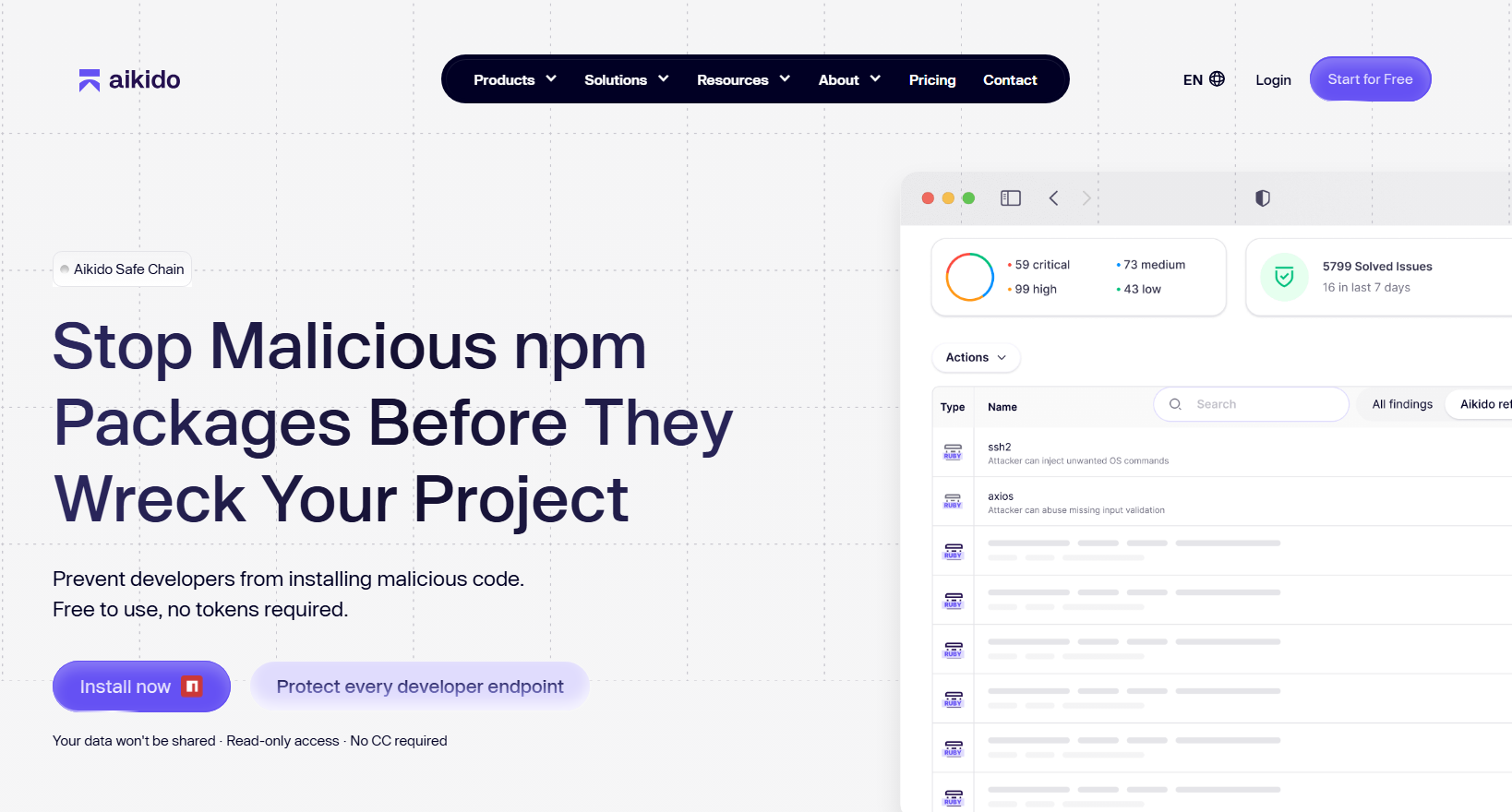
Aikido covers the package layer with two products. Safe Chain is a free install blocker, and Aikido Libraries came from its June 30, 2026, acquisition of Root, a patching startup. Both sit inside a broader application security platform. Aikido is also a TuxCare partner. Since July 2025, its AutoFix feature can suggest Endless Lifecycle Support packages maintained by TuxCare for end-of-life libraries.
Key features
Safe Chain wraps npm and Python package managers, installing packages and blocking malware, typosquats, dependency confusion, and compromised releases before they run. It’s free to use, requires no tokens, and integrates with GitHub Actions and Azure Pipelines.
By default, Safe Chain holds back npm and PyPI packages published in the last 48 hours until they’ve been validated against malware. The enterprise version, Aikido Device Protection, is deployed through your MDM, with centralized policy management and request-and-approval workflows.
Aikido Libraries replaces vulnerable versions with secured, drop-in replacements that keep the same package name and base version you run today. Patched versions carry a suffix, so starlette 0.27.0 becomes starlette 0.27.0+aikido.1, and npm versions use a hyphen: 2.5.0-aikido.1.
Fixes arrive through Aikido’s AutoFix feature, which opens a daily pull request that updates the manifest and lockfiles, and coverage includes pinned transitive dependencies you don’t control.
Aikido publishes patch targets of 48 hours for known-exploited vulnerabilities and 7 days for critical and high CVEs, with commercially reasonable efforts for medium and low CVEs. The targets cover new CVEs in repositories enrolled via Bulk Rollout, and the clock starts once a fix candidate is available upstream.
Pricing
Safe Chain is free. Aikido Libraries is sold as a one-year subscription per protected repository and is paid with Aikido credits. The credit cost is shown before you commit, and the subscription renews each year until you cancel. Aikido has also committed to backporting fixes for critical, actively exploited vulnerabilities to the open source community for free.
Where Aikido Shines
Safe Chain needs no account tokens and no budget conversation, so one developer can try it today. Aikido Libraries patches the exact version in your lockfile, so you can close a CVE without upgrading, even in dependencies you don’t control. Aikido says every patch is human-verified before it ships.
Where It Falls Short
The free Safe Chain covers only npm and PyPI, while Aikido Device Protection extends blocking to Maven, NuGet, Go, Ruby, Rust, and PHP. Safe Chain protects the machines and pipelines where it’s installed.
Fixes arrive as pull requests that repoint your manifests and lockfiles to Aikido-hosted patched variants, and the rest of your dependency tree still comes from public registries.
Best for: Teams with pinned npm, PyPI, or Maven dependencies where upgrading is the blocker, and teams that want a free install blocker before they commit budget.
Reasons to Consider an Alternative to Chainguard
Chainguard Libraries is generally available for JavaScript, Python, and Java, and it scans every package for malware and greyware. Its paid plans add zero-day patches on the day of disclosure through Athena, Chainguard’s industry coalition. Teams still switch over remediation scope, pricing, language coverage, or a need for only part of the job.
Remediation is selective
Chainguard’s CVE remediation backports critical and high-severity fixes for a subset of JavaScript and Go libraries. In Python, it applies to select critical and high CVEs in popular dependencies. Java remediation began with critical and high-severity CVEs in the Spring Boot ecosystem, with backported fixes so far across spring-boot, spring-framework, spring-security, and h2database. A pinned library outside the remediated set, or a medium-severity CVE, falls outside what Chainguard has announced, and Chainguard publishes a remediation SLA for its container images but none for Libraries.
Watch Out: A backported patch only helps if the vendor covers the exact version you run. Ask each vendor which of your pinned libraries, at which versions and severities, it patches today.
Pricing follows Chainguard’s plan tiers
Chainguard sells Libraries in plans metered by package pulls. Only paid plans include CVE-remediated versions, up to 5 on Team and unlimited on a quoted Enterprise contract. The alternatives here use other pricing models. SecureChain is sold as a single enterprise license; Google Assured OSS has a free tier; Aikido Libraries is priced per protected repository; and Endor quotes each product separately, priced per seat. Get quotes against your actual headcount, repository count, and package pulls before you compare.
Language coverage has gaps
Go and .NET entered beta on October 14, 2026, so for those two, the product is new. If your stack includes Rust, PHP, or Ruby, Chainguard Libraries doesn’t cover them today.
You may only need part of the job
Several tools on this list cover one or two of the three jobs, at different price points. Aikido’s Safe Chain is free, Google’s free tier covers three ecosystems, Endor sells patching as a separate product, and Aikido sells it as a per-repository add-on to its paid plans. A narrower tool can close today’s gap. The versions you pin keep collecting CVEs, though, and upstream eventually stops fixing them, so check whether that tool will still patch them then.
If You’re Looking for Hardened Container Images
Chainguard Containers and Chainguard Libraries are separate products, and this guide compares the package side. If your search is about base images, these are the vendors to research:
- Docker Hardened Images: Docker made its catalog free and open source on December 17, 2025, with paid tiers for SLAs and extended lifecycle support.
- Red Hat Hardened Images: Generally available since May 12, 2026, with every image free to use on any Linux distribution, Kubernetes version, or container engine.
- Echo: It covers containers, libraries, OS packages, VMs, and Helm charts and uses AI agents to help patch and maintain them. Echo acquired key assets of Minimus, a hardened image vendor, in August 2026 as Minimus wound down, so current Minimus customers may be evaluating it.
- RapidFort: It sells curated images, with more than 35,000 near-zero-CVE images by its own count, plus runtime hardening.
- Distroless: This is Google’s GoogleContainerTools project. Its images are minimal, with no shell by default, and built on Debian 13. It tracks Debian’s standard support timeline, so the fix timing follows Debian.
Putting the Options in Context
The tools above split the three jobs differently. Google Assured OSS covers provenance with packages it builds from source, RapidFort covers malware screening, and Endor and Aikido pair blocking malicious packages with patched versions of the libraries you already run. SecureChain covers all three: it screens and rebuilds every package, then keeps patching the versions you run, even after upstream support ends.
Hardened images secure the layer underneath, so package tools and hardened images tend to sit side by side. To find out whether SecureChain covers the packages and versions in your stack, check TuxCare’s pricing page or ask the team a question about your ecosystem.
FAQs
Chainguard Containers are hardened container images. Chainguard Libraries are open source packages that Chainguard builds from source and serves through a registry, covering JavaScript, Python, and Java, with Go and .NET in beta. Chainguard’s plans include both, with separate limits for container images and package pulls.
They’re built to ship with no known CVEs, and Chainguard’s paid container plans carry a contractual SLA of 7 days for critical CVEs and 14 days for other severities. New CVEs are published daily, so images can pick up findings between rebuilds. Judge a vendor by how fast it fixes, and treat the day-one count as a snapshot.
Yes. Chainguard Starter is free and covers five non-FIPS container images plus up to 50,000 Chainguard Libraries package pulls a month. It carries no contractual CVE SLA and no CVE-remediated library versions.
They overlap. Distroless images are minimal by design, with no shell or package manager, and they track Debian’s support timeline. Commercial hardened image vendors usually layer remediation SLAs, compliance variants, and support on top.
A firewall such as Endor’s Package Firewall or Aikido’s Safe Chain checks packages as they’re requested or installed from public registries. A registry such as SecureChain’s or Google Assured OSS serves packages that the vendor built itself. The two can sit together.
Yes. They secure different layers, so you can run a hardened base image for the OS layer and use SecureChain as the source for your open source packages.