Tech Support
 Documentation
 Login
 Contact Us
Secured before it enters your stack – continuously until the end-of-life date.
All the ecosystem benefits. None of the blind trust.



SecureChain replaces the public PyPI repository with a verified, rebuilt-from-source alternative. It screens every package for known threats before install, delivers ongoing vulnerability fixes, and keeps Python dependencies protected even after maintainers stop releasing updates.



PyPI powers millions of Python applications.
It’s also a growing target for supply chain attacks.
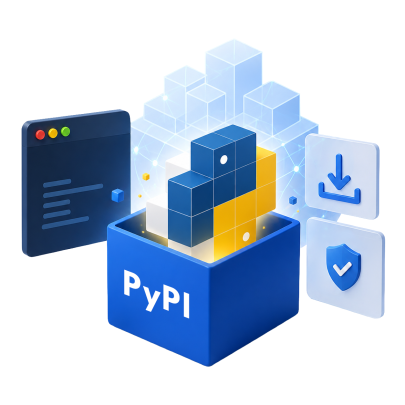
Typosquatting, dependency confusion, and malicious uploads continue to rise – exploiting trust in pip install.

A malicious release of a widely used ML package, exposing how easily trusted packages can introduce credential theft and remote code execution.

The internal torchtriton dependency replicated on public PyPI, hijacking nightly builds through pip's index resolution.

This is the reality of modern Python development – not the exception.
Your exposure is built into how PyPI works.

Every pip install pulls from a public ecosystem built on trust.
That trust is routinely exploited.

Every pip install pulls from a public ecosystem built on trust.
That trust is routinely exploited.
Your application keeps running – but protection fades.
Python security comes in pieces.
Each tool drops you somewhere along the way.
SecureChain doesn't.
SecureChain is different because it's not advisory – it's active.
And it doesn't stop when the maintainer does.

for Open Source Software
From the moment you install a package – to long after maintainers stop.



All the ecosystem benefits. None of the blind trust.
Point your repository manager – or your package manager directly – to
SecureChain and keep working.
Same packages, same APIs, same workflow.
Compatible with:



Ask us how SecureChain verifies packages at install, patches vulnerabilities continuously, and protects your dependencies long after maintenance ends.
Ask Us a Question
With SecureChain, every package is:

Every package is rebuilt from source in hardened, isolated environments — no inherited binaries, no opaque upstream artifacts. What you install is what was built, verified end to end.

Every package is screened for known malware, suspicious code patterns, and supply chain risks. Anything that fails inspection is blocked before it reaches your environment.

Active components are monitored and patched under SLA as CVEs emerge. When upstream maintenance ends, Endless Lifecycle Support (ELS) keeps delivering fixes for as long as you depend on the package.

Know exactly what’s running and what’s been patched. SLSA Level 3 provenance, SBOM, and VEX deliver complete supply chain assurance — the evidence your auditors need on demand.
If a package you depend on isn’t in the catalog yet, we’ll add it
at no additional cost: verified, patched, and supported like every other.

Verified components at install, continuous protection after. No blind spots across the lifecycle.

No workflow changes. No forced rewrites when dependencies reach end-of-life.

Built-in SBOMs, VEX, provenance, and patch coverage – audit-ready by design.







Yes. Packages can execute code during installation through setup.py or at import time, making pip install a common Python supply chain risk. Attackers have used this behavior for credential theft, environment inspection, and payload delivery. SecureChain analyzes the source code of Python packages before delivery, flagging suspicious behavior and blocking malicious packages before they reach your environment.
By default, you usually don’t. Public PyPI distributes wheels and source distributions without guaranteeing they match the upstream repository or build process. That creates a gap between reviewed source code and installed artifacts. SecureChain rebuilds packages from verified source in a controlled environment, so what you install is traceable, auditable, and consistent with upstream code.
Much of it comes from dependencies you didn’t choose directly. One Python package can pull in dozens of transitive dependencies through pip’s resolver. Many are never reviewed, yet they can still execute code in your environment. SecureChain secures the full dependency graph, applying verification, malware scanning, and patching controls to every package, not only top-level dependencies.
You need control over what enters your environment, not only scanning after install. SecureChain verifies Python packages before installation, blocks malicious packages, and continuously patches vulnerabilities over time. This gives production teams a controlled, auditable source of Python packages that remain secure throughout their lifecycle.
No. SecureChain continuously monitors Python packages for newly disclosed CVEs and delivers validated fixes aligned with your pinned versions. That reduces the need to manually track advisories, vulnerability databases, or pip audit outputs.
Risk increases because vulnerabilities can still be discovered after maintenance stops. SecureChain continues patching through Endless Lifecycle Support, backporting critical fixes so you can stay secure without forcing an upgrade or application rewrite.
No. SecureChain works as a drop-in replacement for PyPI. Developers continue using the same tools, commands, and workflows without changing build pipelines or development practices.