Tech Support
 Documentation
 Login
 Contact Us



Go straight to an AI summary of this blog post instead 


Key takeaways
- MariaDB Community Server 10.6 reaches end of life on July 6, 2026. After that date, the MariaDB project stops shipping security patches and bug fixes for 10.6.
- Running an unpatched database in production is a security and compliance problem. PCI DSS, HIPAA, SOC 2, and FedRAMP all expect timely patching of known vulnerabilities.
- Upgrading to 11.4 or 11.8 LTS is the right long-term move when you can do it cleanly. When the timeline is tight, TuxCare Endless Lifecycle Support for MariaDB keeps 10.6 patched so you can upgrade on your own schedule.
If you run MariaDB Community Server 10.6 in production, you have a date to put on the calendar: July 6, 2026. That is when the 10.6 branch reaches end of life, and the MariaDB project closes it. After that, the project stops shipping releases, bug fixes, and security patches for that branch.
After July 6, your database will keep serving queries exactly as it did the day before. The problem is what happens underneath it over the following months, as new vulnerabilities are found and never patched, auditors start asking questions, and the ecosystem around 10.6 quietly moves on.
This post covers the 10.6 timeline, what end of life actually changes for your environment, and the realistic options in front of you. If you are looking for a quick “just upgrade, it is fine” answer, this is not that. Upgrading a production database is rarely as simple as it looks from a distance, and the goal here is to help you choose the path that fits your situation.
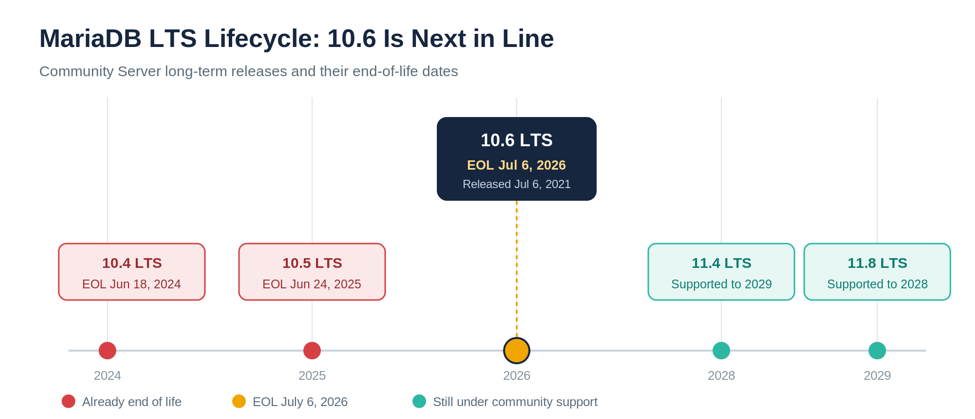
Figure 1. MariaDB LTS releases and their community end-of-life dates. 10.6 is the next to expire.
MariaDB Versions and Lifecycles, Briefly
MariaDB ships two kinds of releases. Rolling releases come out roughly quarterly and are supported only until the next release. Long-term support (LTS) releases come out about once a year and get a longer maintenance window with bug and security fixes. Production systems should run an LTS release.
MariaDB 10.6 is an LTS release. It first shipped on July 6, 2021, with a five-year maintenance window, which puts its end of life at July 6, 2026. MariaDB has since moved Community Server to a yearly LTS model with a three-year maintenance window, starting with 11.8 (11.4 remains a five-year LTS). Here is where the recent LTS releases stand as of June 2026:
| Release | First released | Community support ends | Status (June 2026) |
| 10.4 LTS | Jun 18, 2019 | Jun 18, 2024 | Past end of life |
| 10.5 LTS | Jun 24, 2020 | Jun 24, 2025 | Past end of life |
| 10.6 LTS | Jul 6, 2021 | Jul 6, 2026 | End of life in weeks |
| 10.11 LTS | Feb 16, 2023 | Feb 16, 2028 | Supported |
| 11.4 LTS | May 29, 2024 | May 29, 2029 | Supported |
| 11.8 LTS | Jun 4, 2025 | Jun 4, 2028 | Supported |
| 12.3 LTS | May 28, 2026 | ~Jun 2029 | Supported (newest LTS) |
Two things stand out. First, 10.4 and 10.5 have already passed end of life, and 10.6 is next, so most of the 10.x line is out of runway – 10.11 LTS, supported into February 2028, is the lone exception. Second, the supported LTS targets are 10.11 (into February 2028), 11.4 (into May 2029), 11.8 (into June 2028), and 12.3 (the newest LTS, into 2029). For teams moving off 10.6, 10.11 is the smallest compatibility step but the shortest runway, while 11.4 and 12.3 offer the longest support and are where most upgrade conversations land.
What Happens After MariaDB 10.6 Reaches End of Life
End of life means that any maintenance work stops. For MariaDB 10.6, that creates three problems that compound over time:
1. Security patches stop shipping
This is the one that does real damage. After July 6, 2026, vulnerabilities affecting MariaDB Community Server will be fixed only in supported community branches, while 10.6 Community Server will no longer receive those fixes. The database engine is a high-value target – it holds the data, it is often reachable from application servers – and a single flaw can expose everything behind it.
The exploitation pattern across end-of-life versions is well known. When a project patches a supported version, the fix is public, so attackers can see exactly which code changed and work out the underlying bug from it. They then hunt for that same flaw in the EOL versions that will never be patched. Automation and AI-assisted analysis can speed up that reverse engineering, so the gap between a public patch and a working exploit can shrink quickly. An EOL database is exactly the kind of target that pattern rewards.
2. Compliance and audit risks rise
Most security frameworks require the timely patching of known issues. PCI DSS Requirement 6 expects organizations to identify, risk-rank, and remediate vulnerabilities, with critical and high-severity patches installed within one month of release (6.3.3 in v4.0.1). SOC 2 auditors may flag unsupported components when they create unresolved vulnerability-management or change-management risk. For HIPAA-regulated environments, unsupported software can raise questions about whether technical safeguards and risk-management practices remain reasonable. FedRAMP and similar regimes expect continuous patching with documentation to match.
The frustrating part is that the database can be the only EOL component in an otherwise clean stack and still cause an audit finding. Cyber-insurance reviews may also scrutinize unsupported software, especially when an incident or renewal process exposes gaps in patching and vulnerability management.
3. The ecosystem drifts away
Once a version reaches EOL, the software around it gradually stops supporting it. Over time, Linux distributions, container images, and third-party repositories tend to move their default MariaDB packages toward newer supported versions. And six months in, it shows up as a growing pile of pinned versions and workarounds, and the upgrade you were putting off has quietly become harder, not easier.
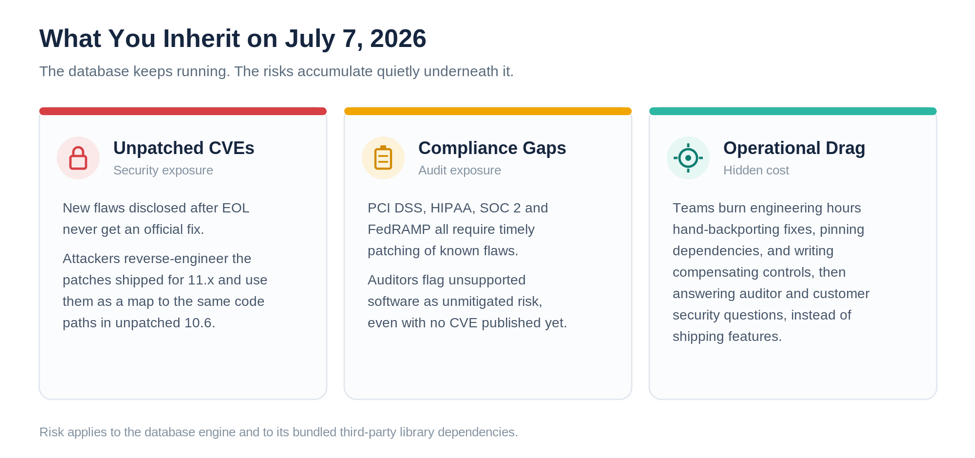
Figure 2. The three risk areas that accumulate after a database reaches end of life.
What Are Your Options After MariaDB 10.6 EOL?
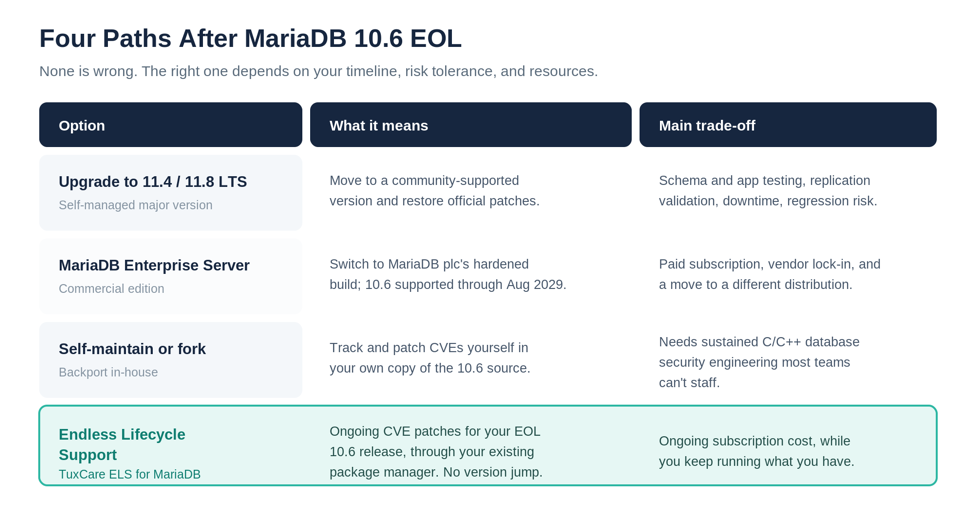
Your optimal path depends on how critical the database is, how much operational overhead you want to incur, and your realistic upgrade timeline. There are four options worth considering.
Figure 3. Four paths after MariaDB 10.6’s end of life, with the main trade-offs for each.
Option 1: Upgrade to a supported LTS release (10.11, 11.4, 11.8, or 12.3)
This is the textbook answer and the right call when you can execute it cleanly. Moving to a supported LTS release restores official security patches and, depending on the target version, can bring improvements in areas such as the optimizer, JSON handling, replication, and operational tooling. MariaDB generally maintains client-server protocol compatibility, but application behavior, SQL semantics, replication, and binlog format, connector versions, and configuration settings still need testing before a major upgrade.
The problem is that a major version jump on a production database requires schema and configuration review, validating replication topologies, testing application behavior against the new release, and planning a downtime or cutover window. MariaDB 11.0 introduced a new optimizer cost model – and some queries can get slower – so it is worth running your real workload against a staging copy to catch any execution-plan changes before they reach production. A common lower-risk approach is to validate the target version against a replica or restored staging copy under real traffic, then plan the cutover and rollback path before promoting it. The exact replication and promotion strategy depends on your topology and how many major versions the jump crosses, so confirm the supported upgrade path first.
Option 2: Move to MariaDB Enterprise Server
MariaDB plc sells a commercial Enterprise Server build of 10.6 that is supported through August 23, 2029, roughly three years beyond the community cutoff. Because it remains on the 10.6 series, the move is closer to a distribution change than a major-version upgrade, and it adds enterprise features and vendor support.
The trade-offs are a costly paid subscription, a degree of vendor lock-in, and a move from the community distribution to a different binary distribution. For teams that specifically need vendor-backed MariaDB Enterprise Server 10.6 with STIG compliance support, it can be a reasonable fit. For teams whose main goal is to keep their existing open-source deployment patched, it can be more change than the problem requires.
Option 3: Self-maintain or fork
In principle, you can take the open-source 10.6 source, track CVEs yourself, and backport fixes into your own build. In practice, this is hard to sustain. Database security backporting calls for engineers who can read and patch a large C and C++ codebase correctly, validate the fixes, and do so on the schedule set by new vulnerabilities rather than the one you would prefer. Most teams cannot staff that reliably, and a half-resourced effort is worse than no plan because it creates a false sense of coverage.
Option 4: Extended security with Endless Lifecycle Support
This is the pragmatic middle ground that teams tend to undervalue. TuxCare Endless Lifecycle Support for MariaDB keeps your current 10.6 deployment patched against new vulnerabilities after the community end-of-life date. TuxCare tracks CVEs in MariaDB, backports the fixes to your open-source release, and delivers them as drop-in package replacements through the package manager you already use. There are no application rewrites, and the goal is to preserve existing replication and backup workflows with minimal operational disruption.
The point of this option is to decouple security urgency from engineering capacity. Patches keep coming, the application keeps running, and your team upgrades on a timeline driven by engineering reality rather than a fixed calendar date. It fits when your upgrade will not realistically finish before July 6, 2026, when you have compliance obligations that require continuous documented patching, or when the deployment is stable and simply does not justify a rushed major upgrade right now.
| An approach that works
Run the upgrade and extended support together. Use ELS to remove the deadline pressure, then execute the 11.x upgrade on a sane timeline. In many environments, the cost of a year of coverage can be far lower than the cost of bugs, downtime, and incident response caused by a rushed migration. |
Why Upgrading Is Not Always the Immediate Answer
Upgrading is the clean answer on a whiteboard. The real-world version is more complicated, for a few reasons that are easy to underestimate.
Dependencies and integrations are usually the real blockers. The MariaDB engine itself rarely slows down upgrades. What slows them down is the application code, the stored procedures, the replication setup, and the surrounding tools, all of which assume the behavior of your current version. Working through those takes time that a fixed EOL date does not respect.
Rushed upgrades are very expensive. They ship bugs, miss edge cases, and cut corners on testing. The cost shows up the next quarter in incidents and on-call load, and it often exceeds the cost of a slower, planned upgrade even after factoring in extended support.
Some systems do not justify the effort right now. A database behind an application scheduled for replacement, or one running a fixed workload with no new feature plans, may not warrant a major upgrade this year. For those systems, patching the current version until the planned change is a defensible engineering call rather than a shortcut.
Secure MariaDB 10.6 Without Upgrading, with TuxCare
MariaDB 10.6 has a hard date: July 6, 2026. After it, the project stops shipping patches, and every new vulnerability starts accumulating against every host still running 10.6. Upgrading to a supported LTS release – 10.11, 11.4, 11.8, or 12.3 – is the right answer when you can do it cleanly and on a reasonable timeline. When you cannot, because dependencies are not ready, the deadline is too tight, or the deployment does not justify the disruption, extended support keeps you secure without forcing a bad migration.
TuxCare Endless Lifecycle Support for MariaDB closes that gap with ongoing, SLA-backed security patches for EOL MariaDB releases, delivered through your existing package manager with no code changes. If you want to see how it fits your environment, talk to a TuxCare expert. The goal is to give you control of the upgrade timeline, not to replace it.