Tech Support
 Documentation
 Login
 Contact Us

Got 12 minutes? Tell us how you use open source and enter to win a Flipper Zero, LEGO set or $100 Amazon gift card. Start Survey →
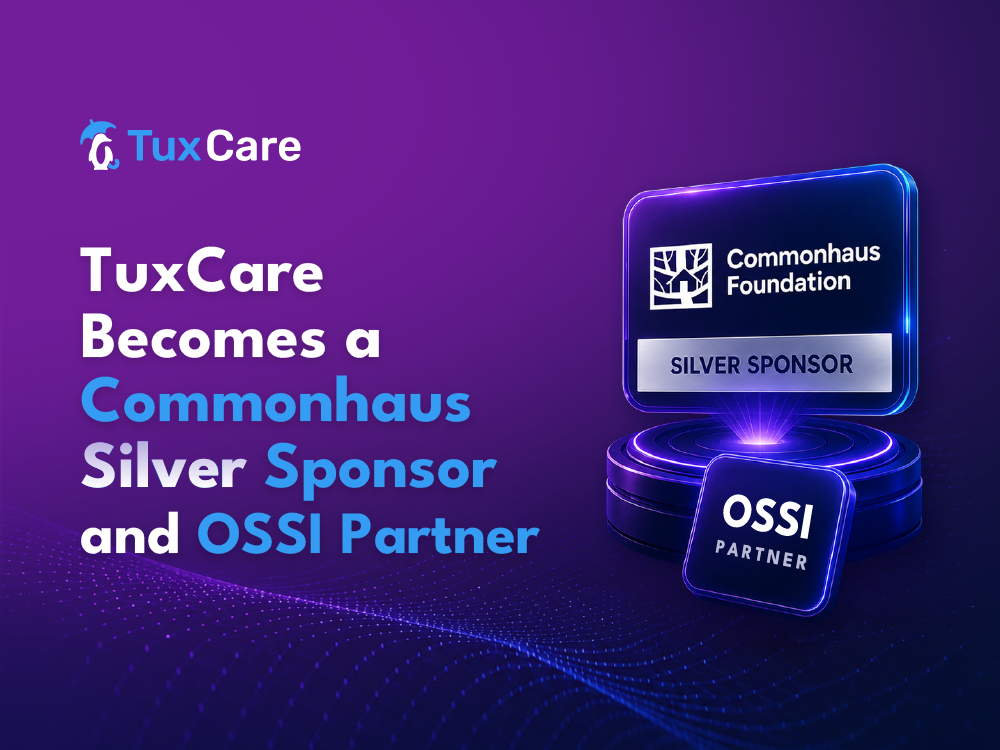
TuxCare has joined the Commonhaus Foundation as a Silver Sponsor and a partner in the Open Source Sustainability Initiative (OSSI), supporting a more sustainable approach to the full open source software lifecycle.
OSSI recognizes organizations that take responsibility for the security and stability of open source software beyond its end-of-life (EOL) date, which kicks off the stretch of the lifecycle that gets the least attention and carries some of the most persistent risk. That work has been TuxCare’s focus for years, so formalizing it within a foundation-led initiative was a natural step.
Here is what the partnership involves, and what it means if you depend on open source software that has outlived its official support.
The gap after EOL
Open source projects are foundational to modern software, but the lifecycle of a widely adopted project rarely ends when community or vendor support for a given version stops. Older releases remain deeply embedded in production environments long after maintainers have moved their work forward – held in place by complex dependencies, compatibility requirements, testing demands, or broader modernization plans that take months or years to complete.
During that time, the math turns uncomfortable: those versions keep accumulating newly discovered vulnerabilities, but no longer accumulate upstream fixes. Until now, the documented options were a rushed migration or accepted risk, and neither serves anyone well.
EOL dates are an important and necessary boundary. Maintainers cannot reasonably develop, test, and release fixes for every historical version of a project indefinitely, nor should they be expected to. The security work simply does not end when official support does. It loses its owner.
OSSI gives that work a home. Created by the Commonhaus Foundation, a nonprofit that provides open source projects a neutral, long-term base with minimal governance, the initiative brings together maintainers, foundations, commercial partners, and the organizations that rely on open source software – each with a distinct role in keeping the full lifecycle secure. Projects clearly mark their out-of-support releases and direct users to certified partners for continued support, while retaining full independence over their own roadmaps and governance.
Extending security beyond active support
For teams running EOL software, the practical guidance is unchanged: extended support is a bridge, not a destination, so if you can upgrade on schedule, upgrade.
If you cannot, TuxCare and OSSI provide a documented path to certified, ongoing remediation while you migrate on your own timeline. Community maintainers keep projects moving forward, while organizations with post-EOL expertise – like TuxCare – cover the users still depending on older releases.
As an OSSI partner, we commit to remediating vulnerabilities in the EOL software we cover, delivering security and compatibility fixes to users who cannot yet upgrade, and coordinating vulnerability disclosure with the relevant projects and upstream maintainers.
Our engineers monitor EOL open source versions for newly disclosed vulnerabilities, evaluate whether those versions are affected, and backport fixes when upstream patches are no longer available – for software that is no longer maintained by its original vendor or community.
Within the Commonhaus family, TuxCare’s security coverage includes out-of-support versions of Hibernate ORM, Hibernate Search, Okio, Jackson, Undertow, and WildFly. It sits within our Endless Lifecycle Support for Open Source Software, which delivers patches to EOL operating systems, libraries, runtimes, and applications across the enterprise open source stack.
“Open source projects need the freedom to move forward, even when older versions remain in use across production environments, which is exactly what we do at TuxCare” said Michael Canavan, Chief Revenue Officer at TuxCare. “By providing continued security maintenance after community support ends, we can give users a responsible path forward while supporting a clearer and more sustainable open source lifecycle.”
Through this partnership, TuxCare will work alongside Commonhaus, its project communities, and fellow OSSI partners to advance a practical model for long-term open source sustainability.
To learn more about the Open Source Sustainability Initiative, visit https://www.commonhaus.org/about/ossi.html