Tech Support
 Documentation
 Login
 Contact Us


Go straight to an AI summary of this blog post instead 


Some hackers are remembered for the code they wrote. Kevin Mitnick is remembered for something a lot harder to patch, which is his ability to talk people into handing over what no exploit could reach.
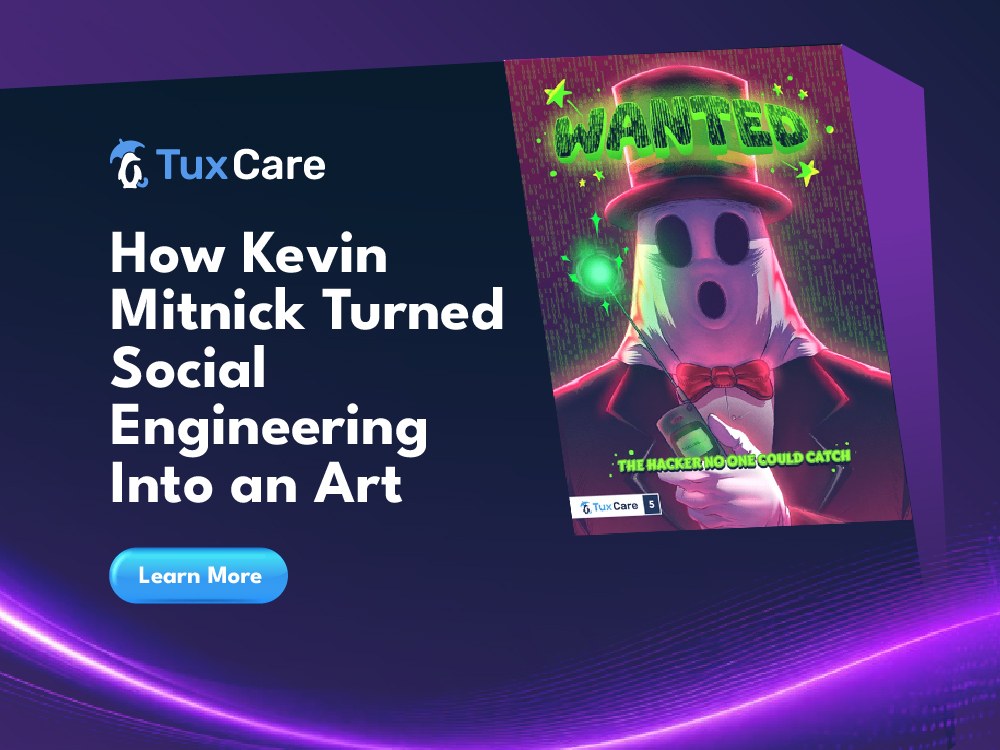
It started with a card trick. He was about ten, a neighbor’s father did magic, and that was that. Mitnick put it plainly in his memoir years later: “Magic was my original doorway into the art of deceiving people.” Wanted, Issue 5 of TuxCare Comics, takes him at his word and draws him as a stage magician working the era of cloned handsets, borrowed identities, and a federal manhunt that turned his hobby into front page news.
It is also the newest chapter in an award-winning series. The first two issues took home honors at the Summit Digital Media Awards, with The Worm earning a Leader Award and ILOVEYOU an Innovator Award. Wanted moves the series toward a different kind of security story, the kind where the most interesting exploit is the person on the other end of the phone.
When People Became Part of the Attack Surface
Long before phishing kits turned into commodity tooling, Mitnick was demonstrating a truth that has aged uncomfortably well. Access is not always taken by force. Sometimes it is simply handed over, because the request sounded routine, the caller used the right names, and the story arrived with just enough detail to feel real.
That is the loop he ran over and over. Trust, impersonation, and one scrap of information used to pry loose the next. Authentication has improved since then. Logging has improved. Detection has improved. Convincing somebody that a request is normal is still one of the shortest paths around a well-built system, and there is no CVE for it.
The Trick That Worked on Motorola
In 1992 Mitnick was on the run and wanted a phone nobody could trace, which meant he wanted the firmware source for the Motorola MicroTAC Ultra Lite, the slickest handset on the market at the time. There was no exploit involved. No zero-day, no buffer overflow, nothing a scanner would have flagged.
He called toll-free directory assistance. A receptionist cheerfully pointed him at Motorola’s Cellular Subscriber Group in Schaumburg, Illinois. He rang that number, introduced himself as Rick from research and development over in Arlington Heights, mentioned that Pam was away on vacation and had told him to call, and asked a woman named Alisa whether she could send the source code across. She could. She did. She handed him a server name and a login on the way through.
Then he deleted her shell history so the trail would not be sitting there in the morning. The whole thing plays like a card force, and the comic draws it as one, splitting the panel down the middle so you watch the magician’s suit turn into a Motorola polo shirt mid-sentence.
The Man Who Took It Personally
Every good act needs somebody in the audience who is not enjoying it.
On Christmas Day 1994, someone broke into the home systems of Tsutomu Shimomura, a computational physicist at the San Diego Supercomputer Center, and copied his files. Taunting voicemails followed, though Mitnick denied for the rest of his life that they were his. Either way the message landed, and Shimomura stopped being a bystander.
What came next was less magic and more radio direction finding. Working with federal investigators and the phone company, Shimomura followed the cellular signal to a neighborhood in Raleigh, North Carolina, narrowed it to an apartment complex, and then narrowed it to a single door. Agents went through that door at 1:30 in the morning on February 15, 1995. Inside were cloned cellular phones, more than a hundred clone codes, several sets of false identification, and, in a detail Raleigh has never quite let go of, a Denny’s napkin.
That is where this post stops. What the courtroom did next, and what Mitnick did with the two decades after it, is the back half of the issue and it deserves to be read cold.
Why This One Belongs in a Comic
Incident write-ups are useful and nobody reads them twice. A magic act is a better teaching tool, because the entire point of a trick is that you were watching the wrong hand. That is social engineering in one sentence. It is less a technical failure than a permissions failure running on wetware, and drawing it as sleight of hand makes the mechanism visible in a way a timeline never manages.
It also happens to be the uncomfortable half of the job. Teams get good at the patching, the CVE triage, the end-of-life migrations, all the parts that generate a ticket. Then somebody named Rick calls from Arlington Heights and none of it matters, because the front door opened from the inside.
Read Wanted at the TuxCare Comics hub, alongside issues on the Morris Worm, ILOVEYOU, Project Rivolta, and WannaCry.