Tech Support
 Documentation
 Login
 Contact Us

Keep your apps running safely on the runtimes they were built for, without rushed upgrades or broken code – even after official support ends.

Got 12 minutes? Tell us how you use open source and enter to win a Flipper Zero, LEGO set or $100 Amazon gift card. Start Survey →

Endless Lifecycle Support for Debian 10
Keep Debian 10 secure after
the project moved on
CVE patches for Debian 10 (Buster) past its June 2024 end-of-life date.
Delivered through apt. Stay secure on Buster without a disruptive upgrade to
a newer Debian release
TuxCare has successfully resolved more than 14,000 CVEs in open-source products to date (and counting), ensuring robust security and compliance for enterprise systems.

Debian 10 patches delivered
by TuxCare since EOL
12069
Debian 10 (Buster) reached end of life on June 30, 2024, which means free security updates from the Debian Security Team have officially ended. To remain supported, you’d need to migrate to a newer Debian release – a process that can be time-consuming, disruptive, and risky for production environments that can’t easily upgrade.
Without extended support, Debian 10 systems are now exposed to new vulnerabilities, potential compliance violations, and operational instability.
TuxCare’s Endless Lifecycle
Support for Debian 10 has
your back.


Not ready to upgrade?
With TuxCare’s ELS for Debian 10, you get precision-engineered patches for
high and critical vulnerabilities delivered on your schedule. No rushed
migrations, no downtime, no compromise – just seamless protection.
With Endless Lifecycle Support, you can:

Ensure security and compliance beyond the EOL date with ongoing long-term updates for Critical and High-risk vulnerabilities

Achieve maximum security for your Debian systems with support for a comprehensive list of essential server packages

Track security updates, selected bug fixes, and affected packages across all architectures with qualified errata advisories

Verify your Debian systems update status using our OVAL patch definitions with OpenSCAP or other OVAL-compatible tools
Precision-Engineered Patch
Development
Our patches are designed with surgical precision and are rigorously tested to provide businesses with the assurance that their legacy systems remain secure, stable, and compliant in the face of increasingly sophisticated cyber threats.

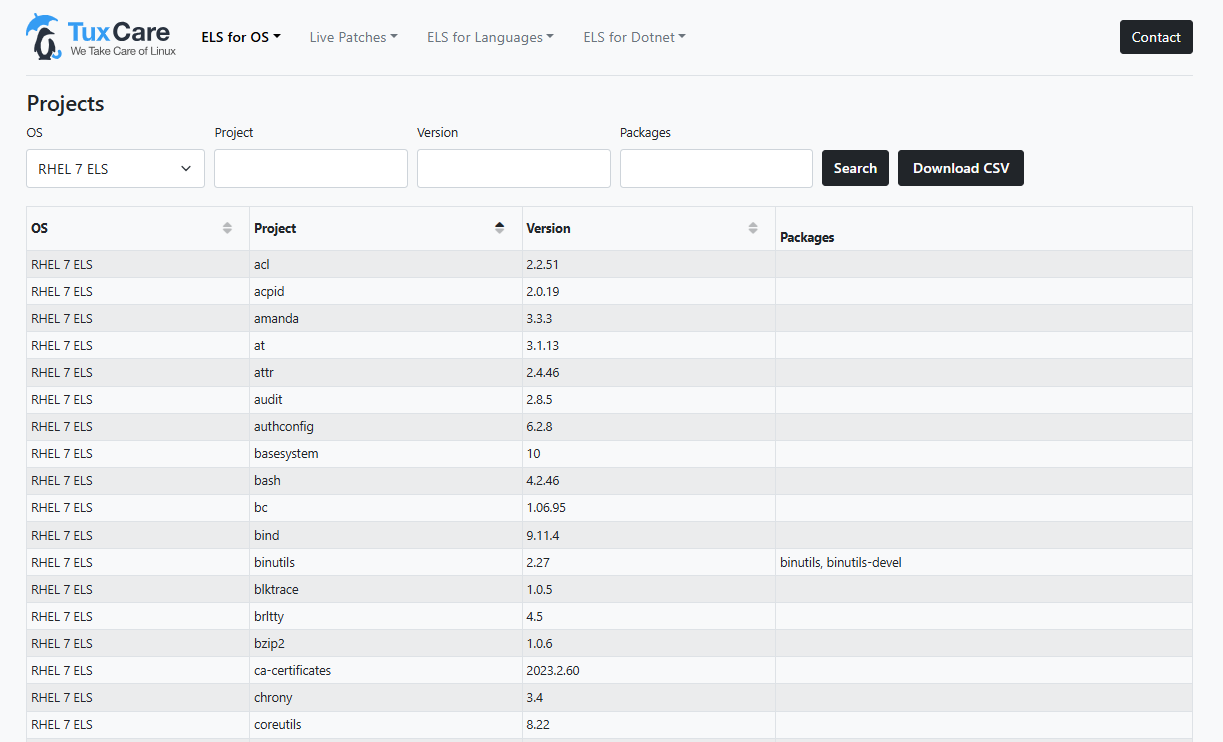
Support for a Comprehensive List of Packages
When you sign up for TuxCare’s Extended Lifecycle Support, you’ll get patches for an
extensive package list, providing maximum security for your operating system
Switching to TuxCare for Debian
Support is Simple

Step 1
Connect to the TuxCare repository with a simple
script – and no reboot
Step 2
You’re fully protected with regular ongoing security
patches for up to four years past the end-of-life date!
Why TuxCare?
The TuxCare team combines 450+ years of in-depth
technical knowledge of Linux and kernel development

We have a proven track record of security patching with over 5000 CVEs patched to date – and growing

You can request support for additional server packages that are not currently on our list

ELS gives you an affordable option to maintain the security and stability of your EOL systems

TuxCare can support environments that run multiple types of end-of-life Linux distributions
Still Relying on End-of-Life Runtimes,
Libraries or Applications?
TuxCare’s ELS extends critical security patching and compliance to your language
runtimes, libraries and production apps, keeping your entire open-source stack secure,
stable, and compatible for as long as you need.

Endless Lifecycle Support
for Runtimes

Endless Lifecycle Support
for Libraries
Keep securely running your apps on EOL libraries – without rushed upgrades, costly code rewrites, or disruption to your roadmap.

Endless Lifecycle Support
for Applications
Ensure your EOL apps stay secure and operational while avoiding outages, broken workflows, and code rewrites.
Frequently Asked Questions
ELS for Debian provides security updates for Debian 10 "Buster" and Debian 11 "Bullseye" after their Debian LTS periods end. TuxCare hosts the patched packages in its own repository, so existing servers keep receiving fixes through apt with no reinstall and no jump to a new release.
Debian 10 LTS ended on June 30, 2024, and Debian 11 LTS ended on August 31, 2026. TuxCare keeps patching both for as long as you need them and commits to a support term of 25 years from those dates, so Debian 10 ELS runs to June 30, 2049 and Debian 11 ELS to August 31, 2051.
Debian 10 and 11 ELS support x86_64 (amd64), arm64 and armel. The armel support matters for embedded and appliance deployments, where Debian is common and hardware refreshes take years. For other architectures, TuxCare's sales team can discuss options.
Coverage includes the kernel and 100+ packages integral to running a server. The full list for each release is published in the TuxCare CVE Tracker alongside every fixed CVE. If your stack depends on something outside that list, support for additional packages can be arranged on request.
TuxCare aims to deliver fixes for high and critical vulnerabilities (CVSS 7.0 and above) within 14 days of public disclosure. Medium-severity issues can also be patched when mitigations aren't available and there's sufficient demand. Customer-directed patch requests for CVEs outside the standard scope are reviewed within three working days.
Download the install script for your release from repo.tuxcare.com, run it with your license key, and confirm the setup with apt-cache show els-os-release. The script registers the server and adds TuxCare's PGP key. After that, a standard apt upgrade pulls patched packages. Outbound port 443 must be open to cln.cloudlinux.com and repo.tuxcare.com.
If an upgrade is straightforward, upgrading is usually the right call. ELS earns its place when it isn't: appliances with certified software stacks, tightly pinned dependencies, or fleets too large to move at once. It keeps those systems patched so the migration can happen properly instead of in a rush.
Talk to a TuxCare Expert
Tell us your challenges, and our experts will help you find the best approach to address them with the TuxCare product line.