
 Tech Support
 Documentation
 Login
 Contact Us

2,700+
Enterprise Clients


Supported Versions: 1.7.0 1.8.0 11 and 17
CVE fixes for OpenJDK 7, 8, 11, and 17 past end of life. Delivered through your existing package manager. Keep enterprise Java applications secure without paying for a commercial JDK distribution.


Buy, install, and activate on your own - no delays, no hassle.
 TuxCare has successfully resolved more than 14,000 CVEs in open-source products to date (and counting),
ensuring robust security and compliance for enterprise systems.
Maintain operational continuity and avoid downtime without OpenJDK
reinstallation – just swap your update repositories.
OpenJDK versions follow a fixed support cadence. Once they
reach end of life, the OpenJDK community stops providing
security fixes – leaving your systems exposed.
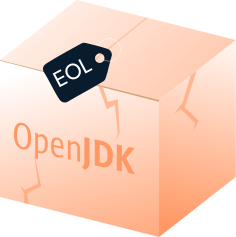
With Endless Lifecycle Support (ELS) for OpenJDK, you can keep your systems running smoothly and avoid
large-scale code rewrites while using your existing versions of OpenJDK for years to come.


Rapid SLA-backed security patches for OpenJDK for as long as you need

Extensively tested updates designed to work flawlessly with your existing code

Drop-in OpenJDK security updates with no disruption to existing workflows

Signed, tamper-proof OpenJDK security updates delivered from trusted, TuxCare-hosted repositories

24/7 expert assistance with OpenJDK vulnerability triage, security patch requests, and troubleshooting
 Red Hat
 CentOS
 AlmaLinux
 Rocky Linux
 Oracle Linux
 Debian
 Ubuntu

We onboard new projects and enable 24/7 automated CVE tracking – monitoring the NVD, vendor, and GitHub security advisories, and other sources.
Once CVEs are detected, we backport upstream fixes using algorithmic and AI-assisted automation, with expert validation to ensure accuracy.

Patches are compiled in a binary format, extensively tested (for integrity, functionality, and regression), signed, and deployed to ELS repositories.

Your package managers, build tools, or orchestrators check for updates, then automatically pull and install them.
If It’s Open Source
and Not on Our List,

2,700+
Enterprise Clients

70,000+Packages Curated

420,000+
Patches Delivered

14,000+
Vulnerabilities Fixed

11,000+
Kernels Supported

70+
Linux Distro Versions Supported
15 years of proven excellence in open-source patching have created highly
automated processes and systems, providing:
We provide long-term security across your entire stack, supporting a wide and continually expanding set of open-source projects, libraries, and runtimes – all from a single, trusted partner.
We utilize advanced automation across CVE discovery, backporting, building, and release workflows to accelerate delivery and ensure the highest possible quality of security patches.
We go beyond surface-level scanning to uncover and fix hidden vulnerabilities deep in your dependency trees, securing the entire software supply chain with precision and scale.
Automated pipelines and mature workflows ensure rapid, reliable patch delivery backed by SLAs – giving you confidence in your risk management and compliance posture.
It depends entirely on your build. Oracle's free public updates for Java 7 and 8 ended years ago, most vendors now gate older JDK lines behind paid subscriptions, and distro-packaged OpenJDK inherits your OS lifecycle — so an EOL operating system usually means an unpatched JDK. ELS supplies patched OpenJDK builds independent of your OS vendor's schedule.
OpenJDK 7, 8, 11, and 17 as RPMs across EL 6, EL 7, EL 8, and EL 9 — CentOS, CentOS Stream, CloudLinux, Oracle Linux, RHEL, and AlmaLinux — on x86_64. Other versions and architectures are available on request.
No. Fixes are backported into the same OpenJDK version you already run, so bytecode compatibility, JVM flags, GC behavior, and vendor-specific tuning all hold. You skip the regression cycle a major JDK jump forces.
Sometimes that's the right call — but Java 8 to 17 crosses the module system, removed internal APIs, and reflective-access restrictions, and routinely breaks application servers, agents, and older frameworks. ELS keeps you patched while you sequence that work properly.
Through your existing package manager. You run TuxCare's installer script with an ELS license key to register the repository, then install and update OpenJDK with standard yum commands. No new tooling, no agent, and the packages are Docker compatible for containerized workloads.
Critical, high, medium, and low-risk CVEs, scored against both NVD and vendor CVSS ratings with the higher score taking precedence. Target delivery is 14 days from disclosure for CVSS 7.0+, 60 days for medium, and 90 days for low.
Tell us your challenges, and our experts will help you find the best approach to address
them with the TuxCare product line.