
 Tech Support
 Documentation
 Login
 Contact Us



Go straight to an AI summary of this blog post instead 


Key Takeaways:
- End-of-life software is an inevitable reality in enterprise systems. Critical platforms often outlive the open-source components they depend on, and those components continue to accumulate vulnerabilities long after official support ends.
- Running EOL software securely requires continuous, complex effort. You must track vulnerabilities across scattered databases and complex dependency graphs, then patch, rebuild, and test components your team inherited – repeatedly, for years.
- Long-term open-source reliability isn’t defined by the absence of vulnerabilities, but by the maturity of processes that handle them. Standardized patching workflows and institutional expertise – like those provided by TuxCare’s Endless Lifecycle Support – make consistent, reliable open-source security possible over time.
The software you build today will likely run for years, a decade or more. Critical systems don’t get replaced on a whim. They are maintained, patched, and kept alive because they’re too essential, too expensive, or too deeply integrated to be replaced.
But here’s what most teams don’t think about during development: the open-source components your software depends on won’t necessarily last as long as your software does. Libraries reach the end of life. Frameworks stop getting updates. Language runtimes move on to newer versions—much like the challenges faced during a Node.js end of life transition. This reality impacts popular frontend frameworks too, and teams often look for ways to manage a next.js EOL cycle without disrupting their production roadmaps. And when that happens, you’re left maintaining production systems that depend on software nobody’s officially supporting anymore.
The vulnerabilities don’t stop when official support ends. They keep appearing, year after year, scattered across complex dependency graphs.
Fixing them once or twice is manageable. Fixing them reliably, repeatedly, and correctly over five or ten years? Well, that requires something most organizations underestimate: a mature, disciplined patching process that works the same way every time, regardless of where the vulnerability appears or when it’s discovered.
How Organizations End Up Running EOL Software
If your software stays in production for five, seven, or ten years, the open-source components inside it eventually reach their end of life long before your system does. Their maintainers move on, official support stops, and suddenly you’re running something that’s no longer getting security updates. It isn’t a mistake or a sign of poor planning. It’s what often happens in enterprise environments where system stability and controlled change are top priorities.
And it happens more often than you’d think. You may be running a stable version that’s been in production for years and works perfectly. You could have built integrations on top of it that would be expensive to redo. You may have gone through a lengthy compliance certification process that you’re not eager to repeat. Or the newer versions introduce breaking changes that would ripple through your entire system.

However, while your systems are designed to operate for the long haul, the vulnerability landscape continues to shift. Open-source dependencies that were once safe and actively maintained begin to accumulate vulnerabilities that no one is going to fix. And many of those issues stay entirely out of sight. They’re buried in the layers of dependencies underneath the components you actually interact with.
For a deeper look at how vendor support timelines differ from final product sunsets, check out our guide on end of life vs end of support.
The Dependency Graph Problem
Most teams consider the open-source components they depend on as a neat list in a manifest file. But each of those libraries brings along its own dependencies, and those dependencies bring theirs.
Even a lightweight library may rely on a handful of direct dependencies and a long tail of transitive ones you never think about. And when a vulnerability hits, it could be anywhere: in the top-level component you’re actually using, in some secondary library two layers down, or in a deeply nested dependency you’ve never even heard of.
Consider spring-boot-starter-web, a common choice for Java web applications. Adding this single dependency to your project automatically pulls in over 25 transitive dependencies: the entire Spring® Framework stack, an embedded Tomcat server, Jackson for JSON processing, multiple logging libraries, validation libraries, and more.

Figure. Spring® Boot Starter Web dependency tree.
So once you commit to maintaining an open-source component, you’re on the hook for its entire dependency graph. A vulnerability anywhere in that graph becomes your problem to solve. And there isn’t a single standard channel you can routinely track to obtain timely information about vulnerabilities in all these numerous dependencies.
CVEs get published across dozens of different security databases, mailing lists, and project repositories. A critical issue might surface in an obscure transitive dependency you’ve never directly interacted with.
You need continuous monitoring across the entire graph, tracking not just the components you use directly, but every dependency several layers deep, watching for new disclosures, and determining which ones actually affect your specific EOL versions.
What Fixing a Vulnerability Actually Involves
When a vulnerability lands anywhere in that dependency graph, fixing it is never just a matter of applying a patch. You need to update and rebuild the vulnerable component itself, rebuild all libraries that depend on it, run the whole test suite, and confirm that nothing in the integration or packaging has shifted.
Even when the security fix is minimal and designed to preserve behavior, the rebuild is unavoidable. It’s the only way to produce an artifact you can trust to deploy.
Sometimes you can apply the patch as is. At other times, the patch was written for a newer version and needs to be adapted to work with the older code and dependency versions that your frozen component relies on. Get that adaptation wrong, and you either fail to close the security hole or break compatibility with the systems depending on that component.
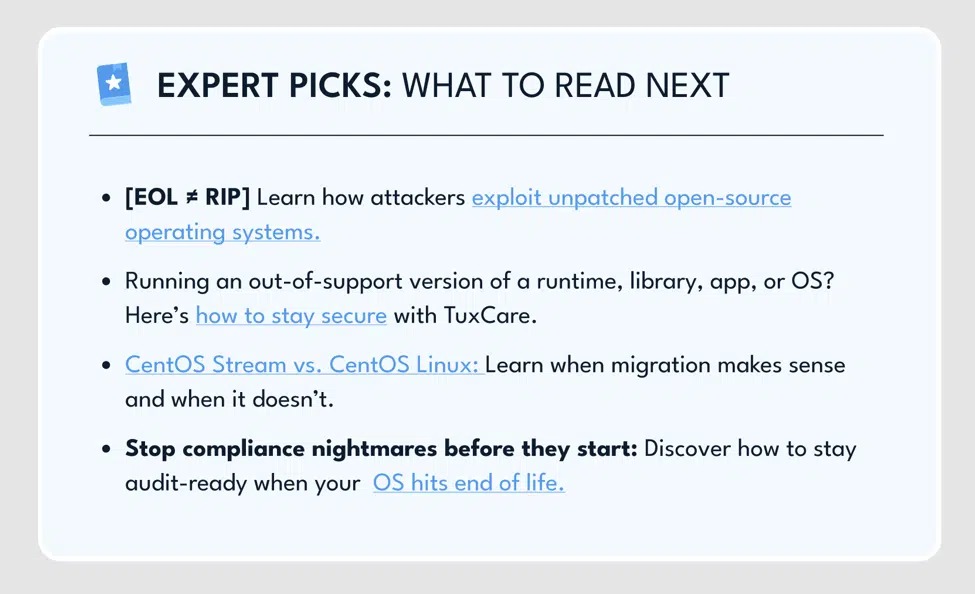
Over a five-year EOL support period, you might see dozens of vulnerabilities, each one triggering work across the entire dependency chain of the vulnerable library. And, because new vulnerabilities show up constantly, you’re going to do this over and over again for as long as you’re stuck on that EOL version. Each time you do, it requires the same workflow: patch, rebuild, test, validate, deploy. And each rebuild brings its own complexity.
Why “Frozen Code” Doesn’t Mean “Frozen Builds”
You might think that if the source code is frozen and the dependencies are locked, rebuilding should always produce the same artifact. But, in practice, that’s not how it works.
If you’re supporting something for five or ten years, the environment in which you’re building it has to evolve. Operating systems get patched. Base images update. Compilers change. Certificate chains rotate. CI/CD tooling gets upgraded. Container runtimes move forward. These updates occur for good reasons, such as security, compliance, and operational necessity, and they happen regardless of whether your EOL software changes.
Each of those updates introduces small differences in the build environment, and these differences can show up in the final artifact. Build tools evolve alongside everything else. Their dependency resolution and artifact packaging algorithms change. As a result, the packaging format may shift slightly, or metadata might get structured differently. None of this alters what the component actually does, but it can affect how other libraries integrate with it or how runtimes load it.
The world keeps moving even when your EOL component doesn’t, so every rebuild needs the same level of validation you’d give a brand-new release. A mature patching process must account for this, as well as for the evolving team responsible for maintaining this software over time.
The Knowledge Decay Problem
When you’re maintaining EOL open-source components for five to ten years, you’re working with software your team didn’t write. The original maintainers have moved on. The project’s community has dispersed. Documentation, if it exists at all, may be incomplete, outdated, or focused on newer versions rather than the EOL release you’re maintaining.
Your team inherits components they didn’t build, with architectural decisions they didn’t make, and dependency choices they didn’t control. Understanding how to patch these components safely means learning unfamiliar codebases and build processes that were designed years ago by people who are no longer available to ask.
Without that foundational knowledge, every patching cycle becomes more difficult and carries greater risk. Teams spend more time investigating than fixing, and the chances of introducing subtle breaking changes increase. This is why mature patching processes must account for knowledge decay through comprehensive documentation and standardized procedures that don’t depend on individuals remembering how things work.
What Process Maturity Actually Looks Like
A mature patching process isn’t just about fixing vulnerabilities faster or more carefully. It’s about building systems and discipline that work reliably regardless of when, where, or how often vulnerabilities appear. Here’s what separates mature operations from reactive ones:
- Comprehensive monitoring across the entire graph. Mature processes don’t wait for customers to report CVEs. They actively monitor the vulnerability landscape across every layer of every dependency graph they support. They know what’s underneath the components they maintain, and they catch issues early.
- Standardized rebuild and validation procedures. Every patch triggers the same workflow: patch, rebuild, test, validate, package, publish. The procedure remains unchanged regardless of the severity of the CVE or the affected component. This consistency is what makes the process reliable. When you do something the same way a hundred times, you get good at it. When you improvise each time, you miss things.
- Rigorous compatibility testing. Mature processes validate not just that the patched component works in isolation, but that it integrates correctly with all other libraries that depend on it. They account for environment drift and test against the conditions customers actually run in, not just the ideal lab setup.
- Predictable cadence and communication. Customers relying on EOL software need to know that security issues will be consistently addressed. Mature processes establish clear SLAs, maintain transparent communication about what’s been patched and when, and deliver updates through reliable channels.
- Institutional knowledge and documentation. When you’re maintaining dozens of EOL components over the years, you can’t rely on individual heroes who happen to know how to rebuild a specific library. Mature processes document everything: build procedures, test requirements, known quirks, and integration gotchas. This knowledge persists even as team members change.
Why Perfection in Process Defines Long-Term Reliability
You can write a perfect patch – with minimal changes, behavior-preserving, and thoroughly tested – and still create problems if the process surrounding it is sloppy. You might miss a transitive dependency that also needed updating. Your rebuild could introduce a packaging change that breaks downstream integrations. Or you might fix one CVE but overlook the other two that landed the same week in different parts of the graph.
The hard part of long-term open-source support isn’t just writing good patches. It’s maintaining the discipline to deliver them reliably, repeatedly, and correctly across years of continuous vulnerability disclosures. Over five years of post-EOL support, that might mean fifty or more patches across a complex dependency graph. Organizations that try to handle this reactively burn out their teams and ship unreliable patches. Organizations that invest in process maturity deliver consistent security without the chaos.
That discipline only comes from mature processes: standardized workflows, comprehensive monitoring, rigorous validation, and institutional knowledge that persists beyond individual contributors. TuxCare’s Endless Lifecycle Support is built on exactly this foundation. Our decade-refined patching process handles the entire complexity of long-term EOL maintenance, from monitoring complex dependency graphs to delivering validated, compatibility-preserving patches for as long as your systems need them.
Perfection in process means that when a CVE lands (and it will land, again and again), you respond the same way every time. The patch gets applied correctly. That’s what defines true open-source reliability in the long term: not the absence of vulnerabilities, but the presence of processes mature enough to handle them, no matter how many appear or where they hide.

