Tech Support
 Documentation
 Login
 Contact Us



Go straight to an AI summary of this blog post instead 


Key Takeaways
- Most jQuery risk comes from old versions still sitting in production, not from anything newly discovered.
- XSS dominates the list through CVE-2020-11022, CVE-2020-11023, and CVE-2015-9251, with prototype pollution close behind.
- jQuery 1.x and 2.x are unsupported, 3.x gets critical fixes only, and 4.x is the current branch.
- If upgrading isn’t realistic yet, vendor-backed patching keeps an old version from turning into a liability.
A security scanner flags jQuery 3.4.1 in an app nobody has touched in three years, and suddenly you own a CVE you didn’t know you had. That’s the whole jQuery vulnerability story in 2026. The flaws are old, the fixes exist, and the risk is hiding in a version nobody remembered was still in production.
This guide walks through the actual CVEs, what they let an attacker do, why they keep surviving audits, and how to close them whether or not you can upgrade.
jQuery Vulnerabilities Overview
jQuery vulnerabilities are security flaws in specific library versions that can let an attacker execute untrusted JavaScript in the browser, pollute shared object prototypes, or knock a page over. They get tracked as CVEs, like any other reported flaw.
The tricky part is that jQuery is almost never something a team actively maintains. It gets bundled, pinned to a version that works, and forgotten. That gap between “a patch exists” and “the patch is applied” is where real exposure lives.
Types of jQuery Vulnerabilities
The flaws fall into three categories across the five CVEs below. XSS dominates, though prototype pollution and denial-of-service round out what actually shows up in scan results.
| CVE | Type | Affected versions | Fixed in |
| CVE-2020-11022 | XSS (htmlPrefilter) | 1.2 – 3.4.x | 3.5.0 |
| CVE-2020-11023 | XSS (select/option) | 1.0.3 – 3.4.x | 3.5.0 |
| CVE-2019-11358 | Prototype pollution | 1.1.4 – 3.3.x | 3.4.0 |
| CVE-2015-9251 | XSS (cross-domain Ajax) | Before 3.0.0 | 3.0.0 |
Cross-Site Scripting (XSS)
XSS is the headline jQuery problem. CVE-2020-11022 covers general untrusted HTML passed to jQuery’s DOM manipulation methods, and it traces back to how jQuery.htmlPrefilter normalized markup. CVE-2020-11023 covers HTML containing option elements. Between them they reach every release from 1.0.3 up to anything before 3.5.0, which takes in jQuery 3.4.1, still very much alive in the wild. Under the vulnerable conditions, attacker-controlled markup handed to one of those methods can end up executing script in the page, even after it has been sanitized. On anything older than 3.0.0 you also carry CVE-2015-9251, the cross-domain Ajax XSS, where 1.12.2 is the one patched exception in that range.
Prototype Pollution
CVE-2019-11358 affects releases from 1.1.4 up to but not including 3.4.0. A crafted object passed through jQuery.extend(true, {}, …) can write to Object.prototype, so attacker-controlled properties get inherited by other objects that rely on that prototype chain. On its own that is a manipulation primitive. Depending on how the polluted properties are used further down, it can be chained into XSS or other application-specific impacts. It showed up prominently in Drupal and Backdrop CMS, which is part of why you meet it well outside hand-written jQuery code.
Denial of Service (DoS)
The quieter category. CVE-2016-10707 affects jQuery 3.0.0-rc.1 and nothing else. That release candidate mishandled mixed-case boolean attribute names, so the affected getter fell into infinite recursion and exhausted the call stack. A different kind of impact from the XSS pair, and reaching that code path still hangs the page it runs on. The 3.0.0 final release fixed it.
Did You Know: The 2026 OSSRA report (Black Duck) found four jQuery CVEs sitting in its top 10 most prevalent vulnerabilities, together affecting 25% to 28% of audited codebases. Years-old flaws with patches long available, still turning up in more than a quarter of commercial software.
Risks of Not Securing jQuery Vulnerabilities
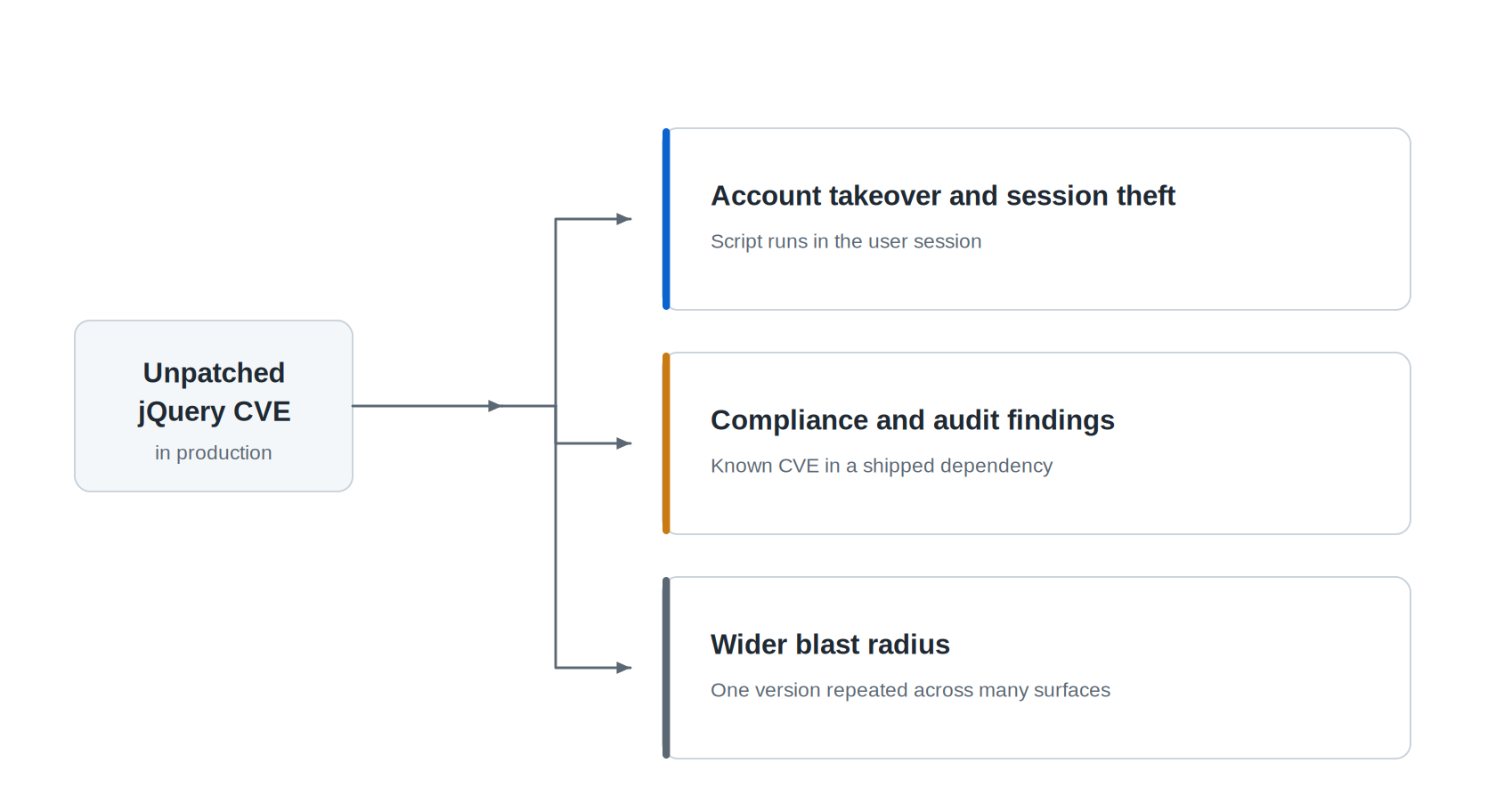
A jQuery CVE is not an abstract risk. The library sits on the front end of an enormous amount of the web, and depending on which CVE you are carrying and how your application uses it, the fallout runs from code executing in your users’ browsers to a finding on an audit report or a page that stops responding.
Account Takeover and Session Theft
XSS is the main impact of the most prevalent jQuery CVEs, and XSS means an attacker gets to run JavaScript in your user’s browser. In practice that means credential capture on a login form, theft of whatever session data JavaScript can reach, or actions performed quietly as the logged-in user.
HttpOnly cookies keep the cookie itself out of reach, which helps, but does nothing to stop an attacker acting inside that session. For a smaller SaaS app where the admin dashboard still runs on jQuery 3.4.1, one stored payload is enough to reach an administrator’s session.
Compliance and Audit Failures
Known vulnerabilities in production dependencies surface constantly in PCI DSS assessments, vulnerability scans, and enterprise security reviews, and “it’s only the front-end library” does not clear the report. You still have to show that the component was patched or otherwise remediated. The underlying CVEs here are genuine rather than false positives, though an individual scanner finding still needs checking against your real code and patch state. That distinction is worth having ready before a reviewer asks for it.
A Wider Blast Radius Than You Think
jQuery is almost never a single instance. Themes, plugins, and CMS cores all pull it in, so one EOL version can repeat across dozens of pages or subsystems. Tracking that spread takes deliberate effort, and reading CVSS scoring correctly matters once you start prioritizing the queue.
Watch Out: Plenty of vulnerability and compliance scanners infer exposure from the jQuery version string they detect. A backported fix that keeps the upstream version number can still trip a finding, so document the patch explicitly.
How Do jQuery Vulnerabilities Occur?
Three patterns cause almost all of it: running an old version, inheriting jQuery you never chose, and feeding it untrusted input.
Outdated jQuery Versions
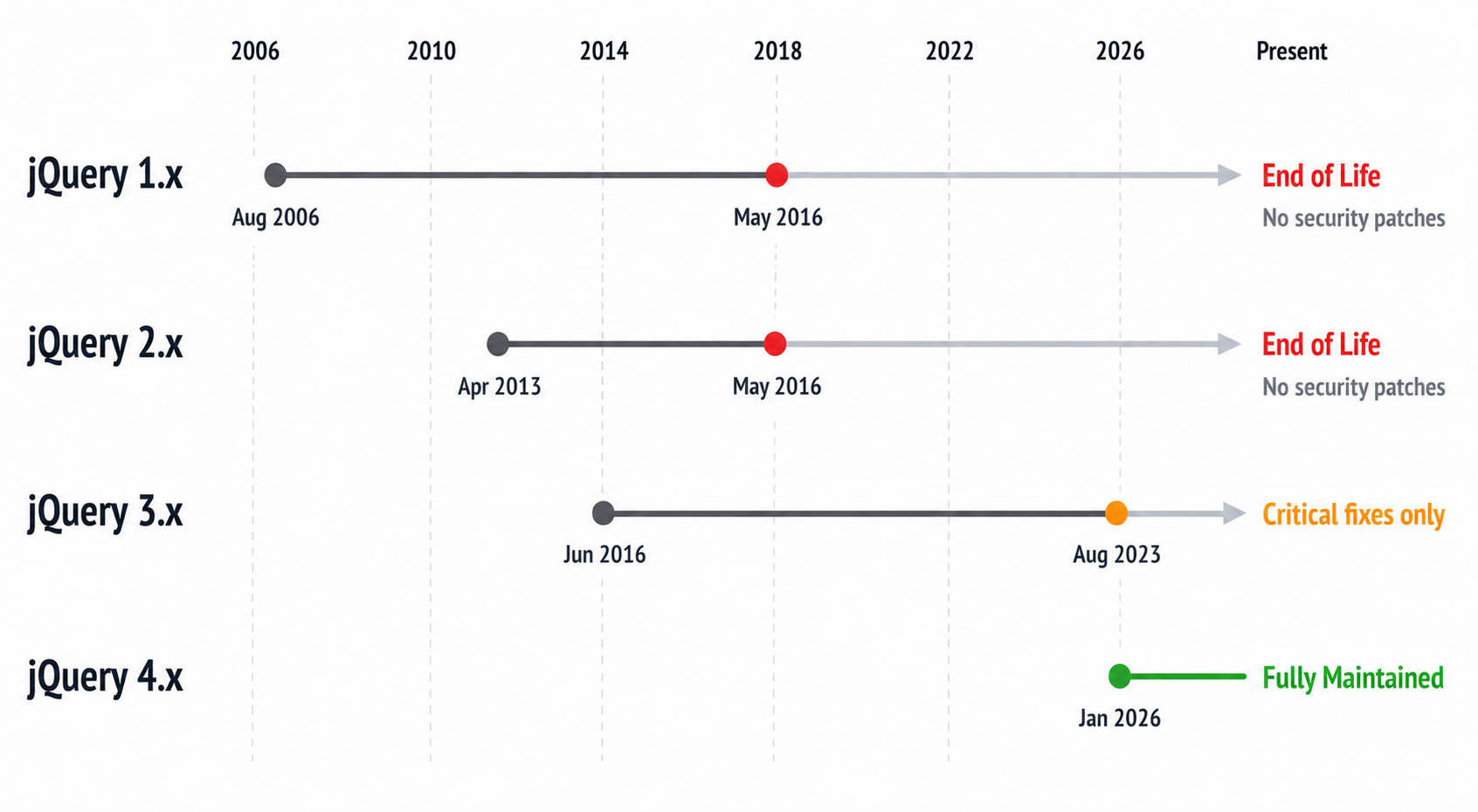
This is the root cause for most teams. jQuery 1.x and 2.x had their final releases, 1.12.4 and 2.2.4, on May 20, 2016, and have had no further upstream releases since. The 3.x branch now receives only critical security patches and bug fixes, with 3.7.1 from August 2023 still its most recent release, and the project tells everyone to move to 4.x.
Once a release drops off upstream support, newly discovered flaws in it will not get fixed by the jQuery project unless you upgrade or bring in patches from another supported source. Same story as any end-of-life software. The upstream maintainers stop looking at it, and your production systems carry on regardless.
Inherited and Transitive jQuery
You rarely install the risk on purpose. WordPress, Drupal, and a long list of themes and UI plugins pull jQuery in automatically. It lands in your stack without anyone deciding anything, usually pinned to whatever version the plugin author tested against. Finding those copies takes scanning, not just a look at your own package.json. Same hidden-dependency problem that shows up in PHP vulnerability management and plenty of other ecosystems.
Unsafe DOM Patterns
Even on a current release, pushing untrusted HTML through .html() or .append() can still produce application-level XSS. The library does exactly what you asked. The bug is in the input you trusted.
Deep merges of untrusted objects deserve the same scrutiny, though a patched release handles CVE-2019-11358 itself, so the risk with $.extend is what you hand it rather than the function. Patching the version closes the library-side flaw. Code review still has to catch the pattern.
Reality Check: “We’re on jQuery 3, so we’re fine” is the most common wrong assumption. CVE-2020-11022 and CVE-2020-11023 aren’t patched until 3.5.0, so 3.4.1 and all earlier 3.x releases are still exposed.
How to Secure jQuery Vulnerabilities
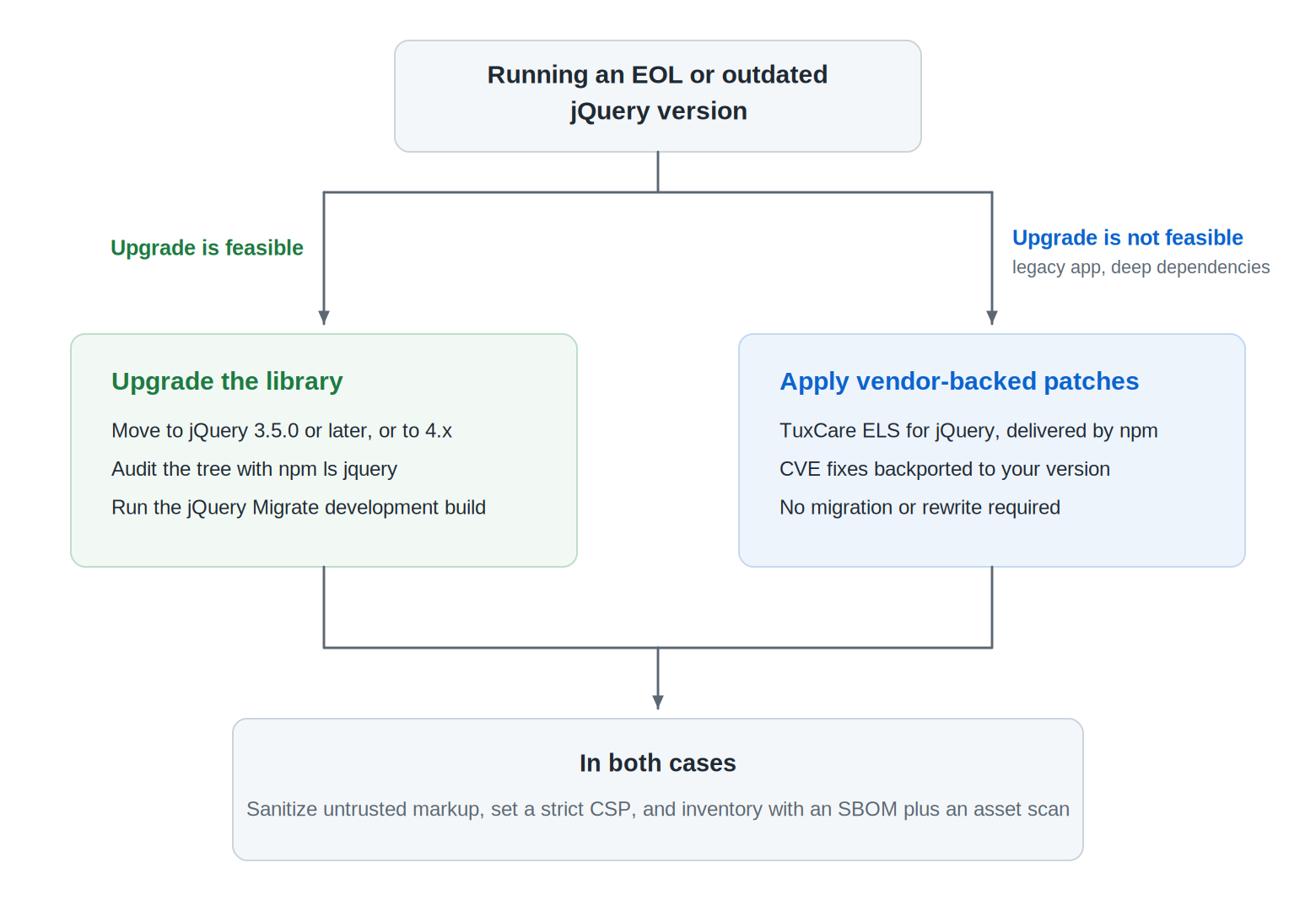
There’s a clear order of operations. Upgrade if you can, get vendor-backed patches if you can’t, and layer defenses underneath either way.
1. Upgrade to a Supported Version
The cleanest fix. Moving to jQuery 3.5.0 or later closes the XSS pair, and moving to the latest 4.x release puts you on the current branch with full upstream support. The catch is breaking changes, since 4.0 removed deprecated APIs like jQuery.trim and jQuery.isArray.
Start with an audit:
npm ls jquery
If the tree is clean, upgrade and run the development build of the jQuery Migrate plugin so compatibility warnings surface before production rather than after. If a legacy app breaks on the bump, option two below is the more realistic path.
2. Vendor-Backed Patching When You Can’t Upgrade
A lot of teams are genuinely stuck. A legacy enterprise dashboard pinned to jQuery 1.x, or a CMS theme that falls over on a major version bump, is not jumping to 4.x on short notice. That is exactly the gap TuxCare’s Endless Lifecycle Support (ELS) for jQuery fills.
ELS backports CVE fixes into the version you are already running and delivers them through npm. Coverage runs to ten releases, from jQuery 1.8.2 through 3.4.1, all long past their upstream end of life. The practical upside is security coverage without forcing an immediate front-end migration and rewrite, so an application with deep jQuery dependencies can stay patched while the team plans the move properly.
That coverage runs wider than jQuery too, across the Java, JavaScript, Python, PHP, and .NET ecosystems.
3. Defense in Depth
Vulnerability patching is the fix. These layers reduce the damage when something slips past anyway. Treat attacker-controlled HTML as unsafe, prefer text-safe DOM APIs where you can, and reach for a proven HTML sanitizer when the application genuinely has to render untrusted markup. Set a strict Content Security Policy on top of that. And generate an SBOM so every jQuery copy your dependency metadata knows about is written down.
Pro Tip: A version-string grep misses minified and bundled copies, and an SBOM built from your manifests and lockfiles will miss the ones that never carried npm metadata in the first place. Run a content-based scanner such as retire.js across your built assets as well, since it was written specifically to catch libraries that were downloaded and committed rather than installed.
Minimize Business Risk on EOL jQuery
The jQuery problem isn’t that the library is obscure. It’s that it’s everywhere, mostly old, and rarely the thing anyone is actively watching. That’s how a CVE disclosed somewhere between 2015 and 2020 ends up in your next audit. W3Techs currently puts jQuery on roughly 66% of all websites, and just over one in five of those sites is still on a 1.x or 2.x branch whose final upstream release dates back to 2016.
Find every instance. Upgrade what you can. For what you can’t, get vendor-backed coverage rather than leaving it exposed. If you’re stuck on an EOL version, TuxCare’s Endless Lifecycle Support for jQuery keeps it patched while you plan the migration, without forcing a rewrite before you’re ready.