Tech Support
 Documentation
 Login
 Contact Us




Go straight to an AI summary of this blog post instead 


Key Takeaways
- NIS2 Article 21 makes supply chain security a minimum measure and has entities weigh each direct supplier’s vulnerabilities.
- ENISA, the EU cybersecurity agency, says in its non-binding hospital procurement guidelines that open source maintainers may not count as direct suppliers.
- Developer-added open source may have no supplier to question, so getting it checked falls to your team.
- Management bodies approve Article 21 measures and can be held liable, so check that these measures cover developer-added open source.
A supplier register built from contracts can look complete and still miss the open source code inside your software. The supply chain security measure in the second Network and Information Security Directive (NIS2) singles out your direct suppliers. The open source code your own developers add, though, may have no supplier to send a questionnaire to.
So who counts as your supplier when the code is open source? The answer determines which questions you can put to a supplier and which checks stay with your team.
Whatever the answer, buying from a supplier doesn’t hand your NIS2 duties to that supplier. The Directive asks covered organizations to manage supplier risk through their own measures, and the European Union Agency for Cybersecurity (ENISA) says in its non-binding Technical Implementation Guidance that outsourcing a risk doesn’t remove your accountability for it.
What the NIS2 Supply Chain Security Measure Asks of You
The measure applies to essential and important entities, the two categories NIS2 defines, based on a sector’s or service’s criticality and the organization’s size. In practice, that generally means medium-sized and larger organizations in the sectors it lists, plus some smaller ones, so not every company is covered.
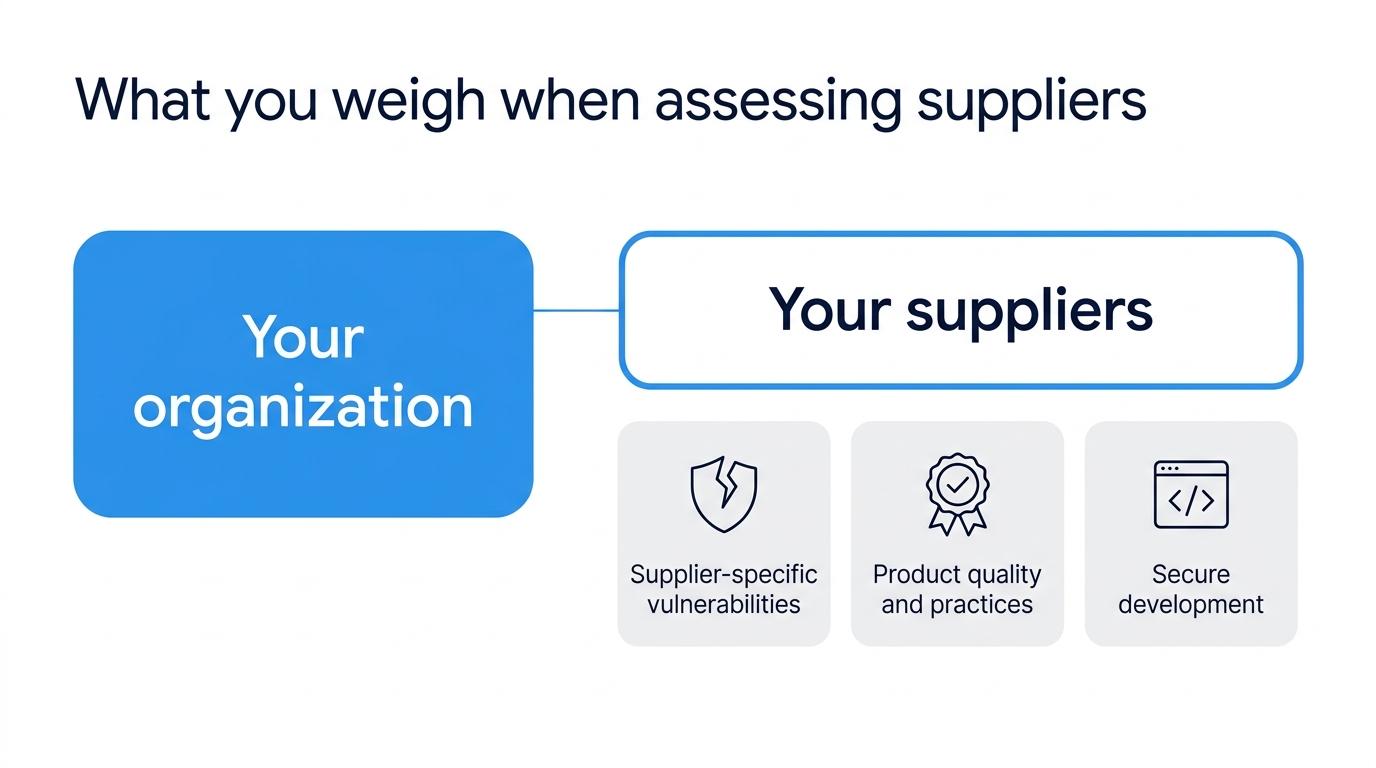
Article 21(2) lists ten measures an entity must take at a minimum. The one in point (d) is supply chain security. It includes the security side of each entity’s relationships with its direct suppliers or service providers. Article 21(3) then spells out what to take into account for that measure: the vulnerabilities specific to each direct supplier and service provider; the overall quality of products and cybersecurity practices of suppliers, including their secure development procedures; and the results of any Union-level coordinated risk assessments of critical supply chains.
Those are the supply chain security requirements as set out in the Directive. A directive binds Member States rather than companies, so these rules reach entities through each country’s national law. Article 21(1) also asks for measures that are appropriate and proportionate to the risks, which leaves part of the design to you.
A recital in NIS2 and several other EU texts also talk about suppliers. The only binding one is a regulation adopted by the European Commission because NIS2 required it: Implementing Regulation (EU) 2024/2690. It sets detailed Article 21 rules, including a supplier policy, for certain digital providers such as cloud and managed service providers.
| Document | What it says on suppliers | Who it covers | Binding? | Basis |
|---|---|---|---|---|
| NIS2 (Directive (EU) 2022/2555), Article 21(2)(d) and 21(3) | Supply chain security, including relationships with direct suppliers; direct suppliers’ vulnerabilities; suppliers’ product quality, cybersecurity practices, and secure development procedures | Essential and important entities | Yes, through national law | EU directive |
| NIS2, recital 85 | Names software editors; encourages contract terms with direct suppliers; other supplier levels could be considered | Essential and important entities | No | Recital, an aid to interpretation |
| Commission Implementing Regulation (EU) 2024/2690, 17 October 2024 | Supply chain security policy for direct suppliers, with selection criteria | Listed digital entity types, such as cloud and managed service providers | Yes, for those types | Implementing act |
| ENISA Technical Implementation Guidance, version 1.0, June 2025 | Practical advice and example evidence for the Implementing Regulation | Listed digital entity types; may inform others | No | ENISA guidance |
| EU ICT Supply Chain Security Toolbox, February 2026 | Common approach to assess and mitigate ICT supply chain risk | Member States and public and private actors | No, voluntary | NIS Cooperation Group guidance |
Open Source Maintainers May Not Count as Direct Suppliers
Recital 85 of NIS2 names software editors among the suppliers whose risks matter, and it treats looking beyond direct suppliers as something entities could consider. Recitals don’t create obligations on their own, though, and the supplier relationships Article 21 names are those with direct suppliers.
ENISA’s July 2026 Procurement guidelines for the cybersecurity of hospitals and healthcare providers take on whether an open source maintainer is a direct supplier, at least in the health sector.
From ENISA: “For free and open-source software (OSS), the entities that maintain and distribute software openly may not be considered direct service suppliers.”
That holds, the guidelines add, when there’s no contractual relationship with the project beyond a standard copyright license, or when the contract is with an open-source software steward. That term is defined in a different law, the Cyber Resilience Act, and means a legal person, other than a manufacturer, that supports the development of certain open source products on a sustained basis.
The guidelines are non-binding and written for health-sector procurement, so they don’t settle how a national authority will read Article 21. They are consistent with the Directive’s text, which nowhere expressly requires an entity to vet an open source project’s maintainers. The risk the code itself brings still falls under your Article 21 measures, though not necessarily under the supply chain security measure.
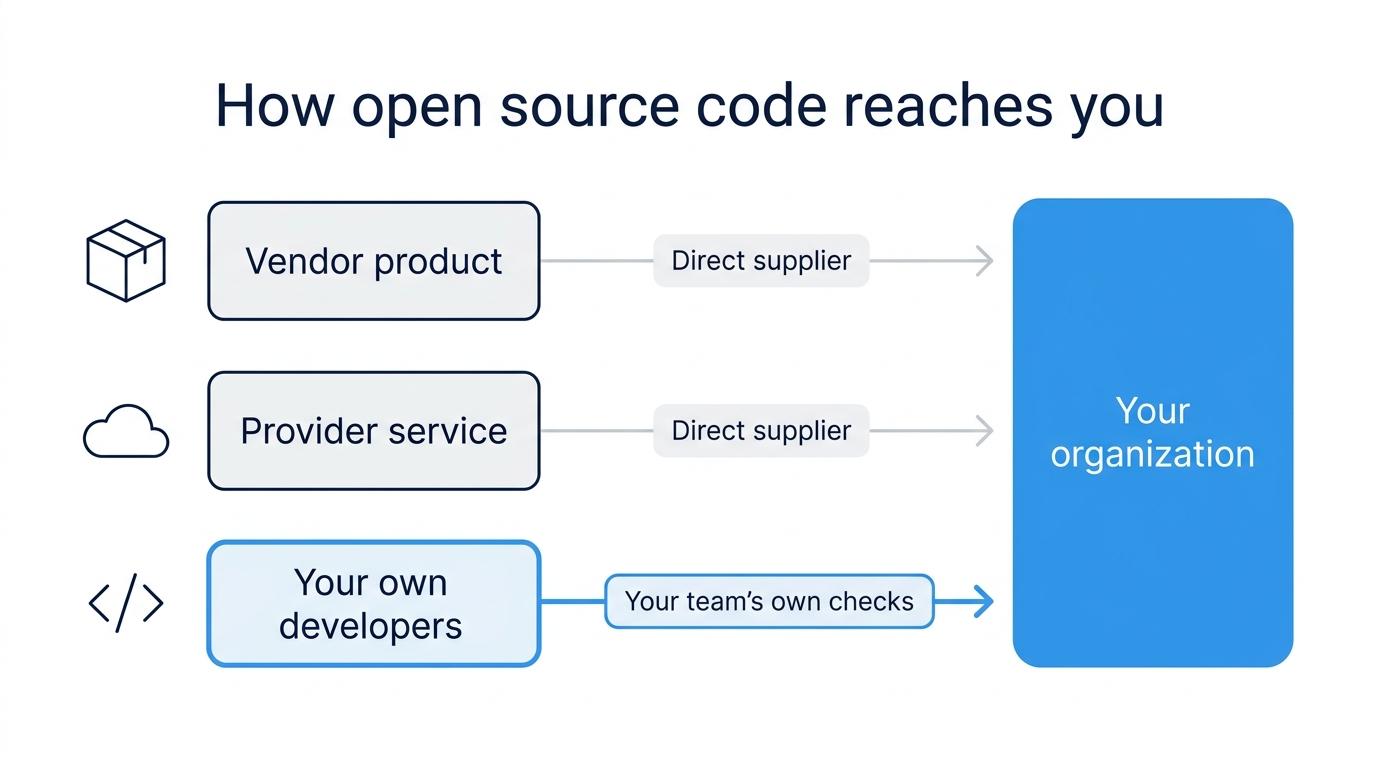
A vendor may ship open source inside a product, a service provider may deliver it as part of a service, or your own developers may add it to software you build. The vendor or provider is normally your direct supplier, so the Article 21(3) factors, including secure development, apply to it. When your own developers add open source, there may be no supplier in the contractual sense. Article 21(2)(e), on security in the acquisition, development, and maintenance of network and information systems, including vulnerability handling, fits that code better than the supply chain security measure does.
If you sell software, you may be the direct supplier your customers ask about. NIS2 covers organizations by sector and size, so being someone’s supplier doesn’t, by itself, bring you under its scope. You’ll have obligations of your own if your company is itself an essential or important entity. Whatever your status, customers’ own measures may lead them to ask how you build and maintain what you ship.
Where Questionnaires Stop and Your Own Checks Begin
NIS2 doesn’t prescribe specific checks for open source packages. The checks below are practical steps that fit under Article 21(2)(e) and its vulnerability handling..
A supplier review works because you can ask. You send a questionnaire, you hold a contract, and the vendor has a reason to answer. When your own developers add open source, little of that applies to the maintainer, who published code under a license and may never have heard of you. A questionnaire alone can’t verify that the package you run matches the code its maintainers published, and with no supplier to send one to, there’s usually nobody responsible for screening it before it reaches you. A maintainer who has stopped publishing fixes may not answer a security question either.
That leaves checks on the package itself. Does it match its published source? Could anything malicious be in it? Is anyone still fixing the version you run? Your team has to make sure the checks get done, whether it runs them itself or uses a service that does.
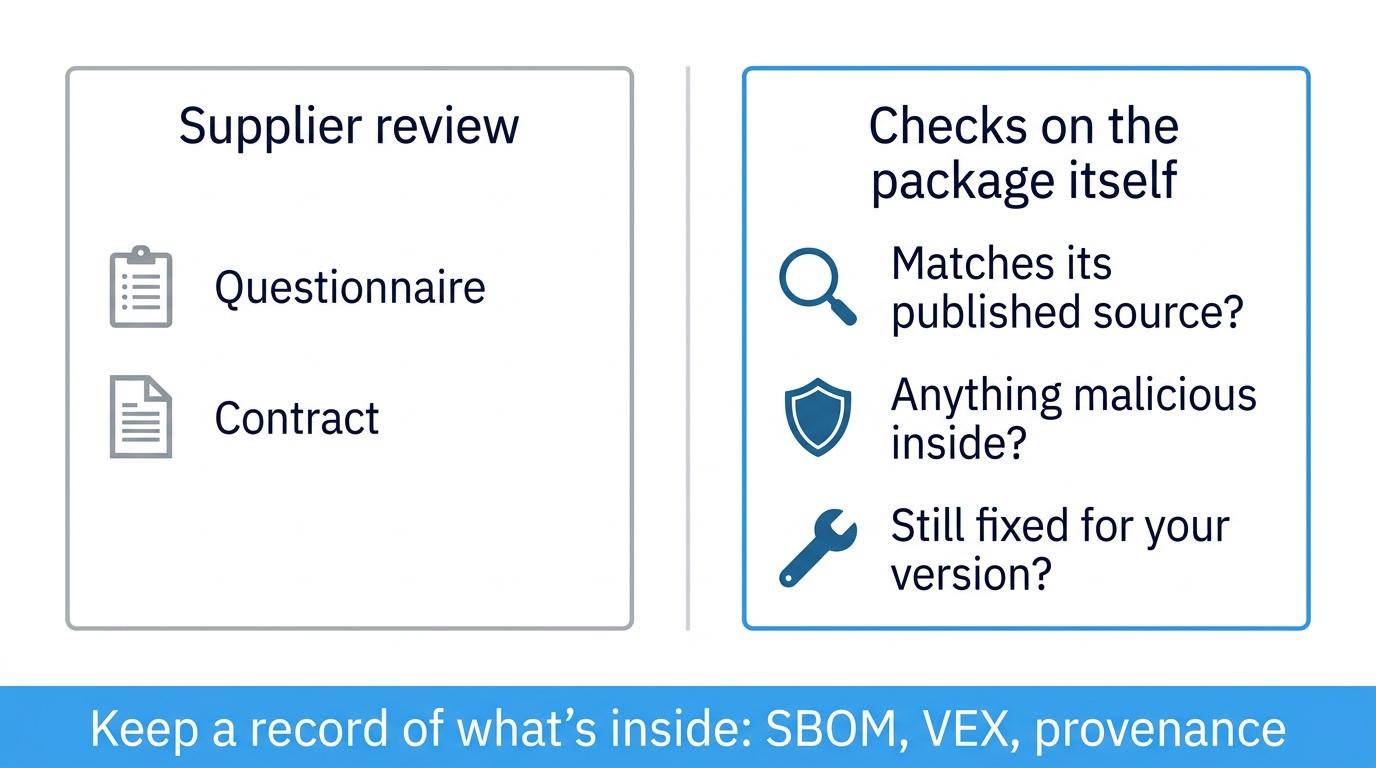
You’ll also want a record of what’s in your software and where each piece came from, because you can’t answer supplier-style questions about components you can’t list. The usual records are a software bill of materials (SBOM) and provenance data showing where an artifact came from and how it was built. A Vulnerability Exploitability eXchange (VEX) statement adds the status of known vulnerabilities in a product. Each is only as reliable as whoever produced it, so check who stands behind it and when it was last updated.
Management Bodies Approve the Article 21 Measures and Can Be Held Liable
Under Article 20(1), Member States must ensure that the management bodies of essential and important entities approve the Article 21 measures, oversee their implementation, and can be held liable for the entity’s infringements of Article 21. The provision doesn’t say whether individual members are personally liable. The explicit rule for individuals is in Article 32(6). Member States must make it possible to hold liable the people with authority to represent, decide for, or control an essential entity when they breach their duty to ensure it complies, and Article 33(5) extends that to important entities.
Training counts too: Under Article 20(2), members of management bodies have to undergo training to identify risks and assess cybersecurity risk-management practices and their impact on the entity’s services.
A management body that approves measures written only for contracted suppliers has approved exactly that scope. The Directive still covers the risk from open source that your developers add. The trouble is that it can end up assigned to neither the supply chain security measure nor the development measure in point (e) when the measures are written, and a management body reading a supplier register may never see it. Ask whoever drafts the measures which one covers checks on that code and who runs them.
Closing the Gap Between Supplier Reviews and Your Builds
For open source code that comes with no supplier contract, SecureChain from TuxCare handles those three checks on the package itself. It screens the open source code for hidden malware, rebuilds the open source packages from that screened code in hardened, isolated environments, and blocks anything that fails before it reaches your environment. Active packages are patched under a service-level agreement (SLA), and once upstream maintenance ends, Endless Lifecycle Support (ELS) keeps the fixes coming. Coverage spans JavaScript, Python, Java, Go, and PHP, and builds come with Supply-chain Levels for Software Artifacts (SLSA) Level 3 provenance, SBOMs, and VEX records.
If you can’t say what went into a build, or vulnerability findings stay open on packages nobody maintains anymore, see how SecureChain records each build and patches those packages.
FAQ
How does NIS2 address supply chain security?
NIS2, the EU cybersecurity directive, lists supply chain security as one of the ten minimum measures in Article 21. That measure includes the security side of an entity’s relationships with its direct suppliers or service providers. Article 21(3) requires entities to weigh each direct supplier’s vulnerabilities, as well as the supplier’s product quality and secure development procedures.
Who has to follow NIS2 supply chain measures?
Essential and important entities. NIS2, the EU cybersecurity directive, classifies organizations into two categories based on the criticality of their sector or service and the organization’s size. It generally covers medium-sized and larger organizations in the sectors it lists, as well as some smaller ones that meet specific criteria.
Does NIS2 put duties on suppliers?
Not directly. In its July 2026 procurement guidelines for hospitals, ENISA, the EU cybersecurity agency, says NIS2 doesn’t directly impose requirements on suppliers of information and communications technology (ICT). Customers covered by NIS2 may still request assurances from suppliers as part of their own measures.
Is ENISA guidance on NIS2 supply chain security binding?
No. ENISA, the EU cybersecurity agency, calls its June 2025 Technical Implementation Guidance non-binding. It supports Commission Implementing Regulation (EU) 2024/2690, which covers listed digital entity types such as cloud and managed service providers. ENISA’s July 2026 hospital procurement guidelines are likewise recommendations.
How large can NIS2 fines be for breaching the Article 21 measures?
Under Article 34 of NIS2, the EU cybersecurity directive, Member States must set maximum fines of at least EUR 10 million or 2% of total worldwide annual turnover for essential entities, and at least EUR 7 million or 1.4% for important entities, whichever is higher. Turnover means the preceding financial year’s figure for the whole undertaking the entity belongs to. The fines apply to infringements of Article 21 or of the Article 23 incident reporting rules, and national laws set the actual figures.
Does NIS2 apply the same way in every EU country?
No. Obligations reach entities through each Member State’s national law, so details differ. Many Member States now have laws in force, though most missed the October 2024 deadline for adopting them. In July 2026 the European Commission referred Ireland, Spain, France and the Netherlands to the Court of Justice of the European Union for failing to notify full transposition. Check the law in each country where you operate.