Tech Support
 Documentation
 Login
 Contact Us



Go straight to an AI summary of this blog post instead 


Key Takeaways
- Cargo source replacement assumes the replacement serves the same crate contents, which is why it needs no project file changes.
- Registry-side screening judges a crate on what it contains rather than on the reputation of its name.
- The verification path is a
.cargo/config.tomlchange, with no edits toCargo.tomlorCargo.lock. - Patched crates are the exception, and opting into one is a deliberate manifest change.
Trusting crates.io by default is rarely a decision anyone makes on purpose. It is just the default – right up until someone looks at it directly. The next question is usually some version of what to do instead, and that is where a private cargo registry stops being one obvious thing.
The term covers at least three different setups, and Cargo treats them differently enough that picking the wrong one causes trouble later. One needs no changes to your project files. Another means touching every manifest that declares the dependencies you want to redirect. Most teams do not find out which is which until they are already partway through trying it.
One exception is worth flagging before anything else, because it is the thing that gets discovered late. Verification is free of project file changes. Patched crates are not, and opting into one is always a deliberate edit.
What a Private Cargo Registry Usually Means
Three approaches get discussed under one banner: vendoring, source replacement (mirroring), and alternative registries including private ones. Cargo’s own docs treat source replacement as distinct from a private registry rather than as a type of one.
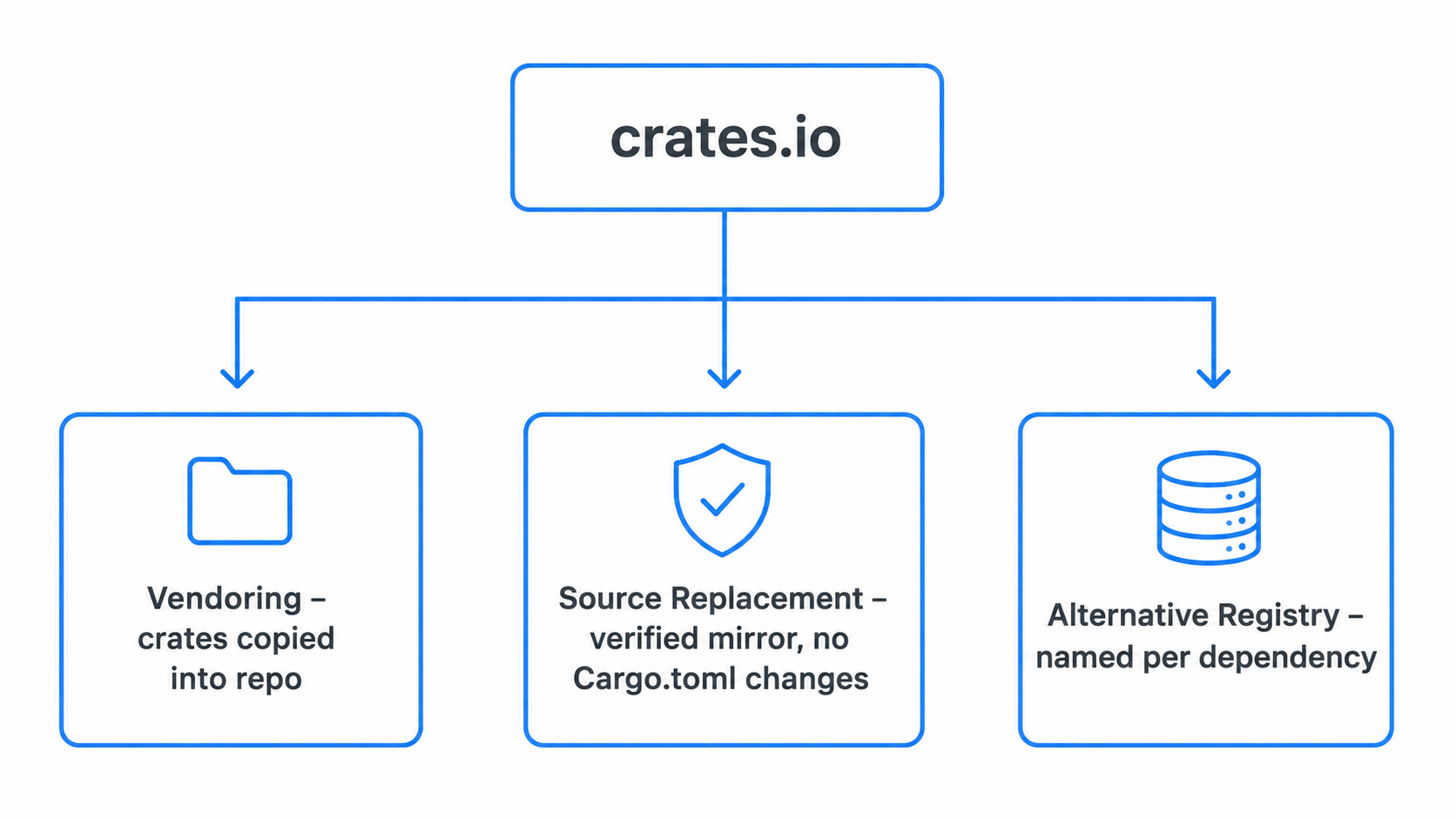
| Architecture | Content may differ from crates.io | Requires Cargo.toml changes |
|---|---|---|
| Vendoring into the repository | Yes, you own it | No, but adds a vendor/ directory |
| Source replacement mirror | No, must be the same | No |
| Alternative registry | Yes | Yes, per dependency |
Source replacement is the one that produces the no workflow change claim, and the reason it holds is that Cargo assumes the crate contents are the same on both sides.
Cargo source replacement is built for mirrors. It assumes the replacement carries the same source as the original, and it does not permit the replacement to introduce crates the original does not have. Worth being precise here, because it is where a lot of vendor copy overreaches.
Cargo does not go back and cross-check the replacement against crates.io. What does the enforcing in a real project is Cargo.lock, since a checksum already recorded there will not match a crate whose contents changed, and the build fails rather than quietly picking up the substitute.
That sounds like a limitation. For a verifying mirror it is the entire point – the replacement is expected to hand your build the same crate contents it already resolved.
SecureChain works the same way in spirit. It rebuilds crates from source, verifies them, and drops in behind your existing setup, so developers keep running the same Cargo commands they always did.
Two Ways Cargo Lets You Redirect Crates
Source replacement lives in .cargo/config.toml and touches nothing in your project.
[source.crates-io]
replace-with = "securechain"

[source.securechain]
registry = "<your SecureChain registry index URL>"
An alternative registry is the other mechanism, and it works differently by design.
[registries.securechain]
index = "<your SecureChain registry index URL>"
With an alternative registry, each dependency has to name it.
[dependencies]
serde = { version = "1.0", registry = "securechain" }
That is a per-dependency edit across every manifest declaring one of those crates, which is exactly the migration cost the source replacement path avoids.
Reality Check: A vendor claiming both that it serves modified crates and that nothing in your project files changes is describing something standard Cargo source replacement does not support. Ask which of the two mechanisms an integration actually uses, and the rest of the evaluation gets a lot simpler.
Why Source Replacement Keeps Your Lockfile Valid
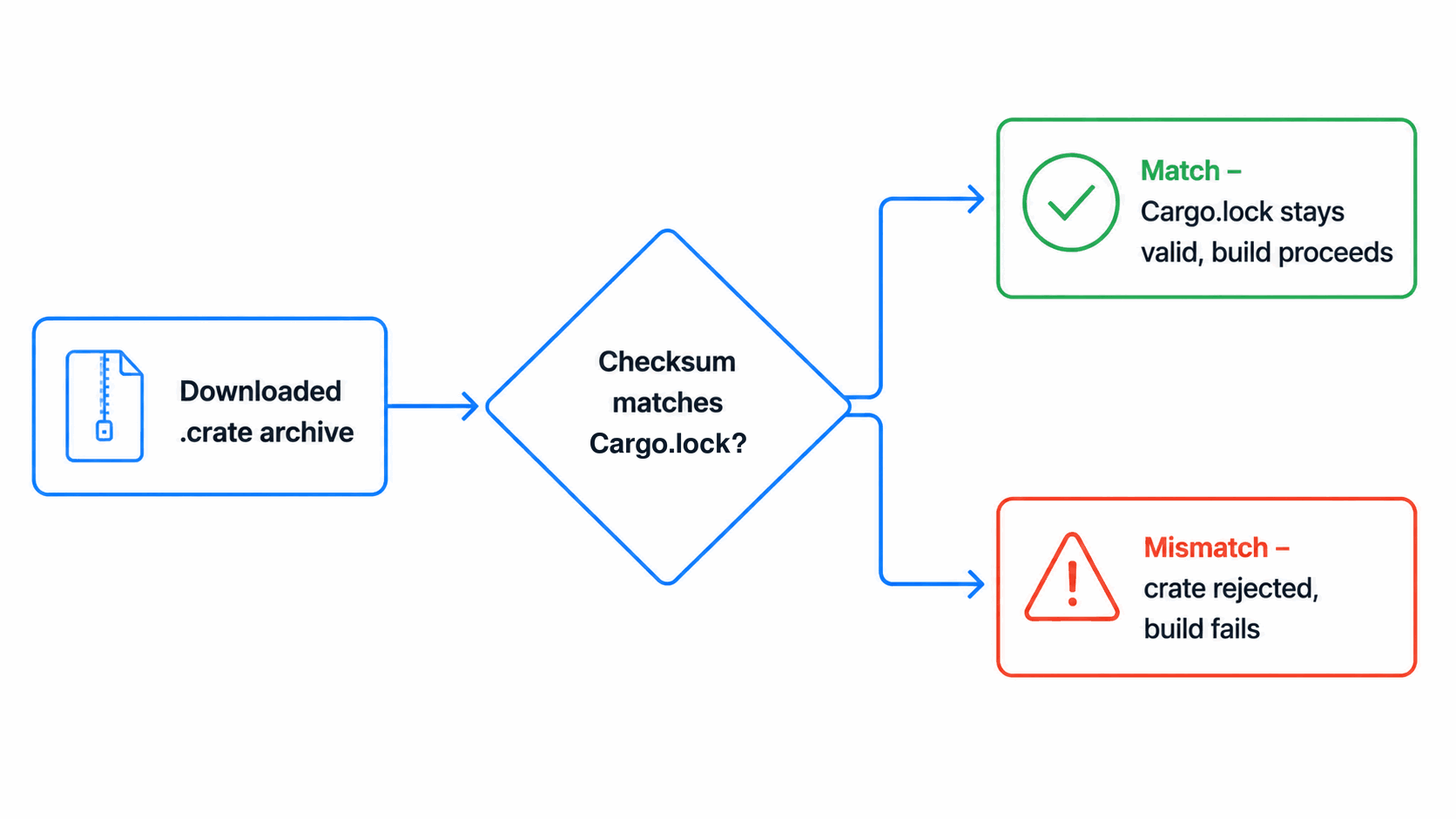
The question a careful Rust engineer asks first is whether Cargo.lock breaks. On the verification path it does not, and the reason matters, because it is also the strongest proof point available.
A .crate file is a compressed tar archive of the packaged crate source. Cargo’s own checksum verification confirms that the downloaded archive matches the checksum it expects from the registry metadata and the lockfile, and that is all it does. It does not rebuild anything. The independent rebuild and compare step happens upstream at a service like SecureChain, before a crate is ever served through the replacement source.
When a rebuild diverges from the published artifact, that mismatch becomes a finding to investigate rather than something passed through quietly. Divergence is not proof of tampering on its own, since packaging quirks and non-reproducible release steps produce it too. The point is that it surfaces instead of disappearing.
So the useful property is not that verification is invisible. It is that verified crates arrive unchanged, while anything unexpected becomes visible rather than being silently accepted.
rm -rf ~/.cargo/registry
cargo build --locked
If a clean registry cache plus --locked produces a successful build against your unchanged Cargo.lock, the compatibility claim is proven in your environment instead of on a slide. --locked is the flag that matters here, because it fails rather than silently rewriting the lockfile. Clearing the cache first is what forces every crate to be fetched and checksum-verified again.
Pro Tip: Run the pilot with --locked and --offline in separate passes. --locked proves the existing lockfile can be used unchanged. --offline confirms the build completes without further network access. To confirm nothing was fetched from crates.io directly, use egress logging or a firewall rule (see Phase 4) rather than relying on --offline alone.
What Screening Catches and What It Doesn’t
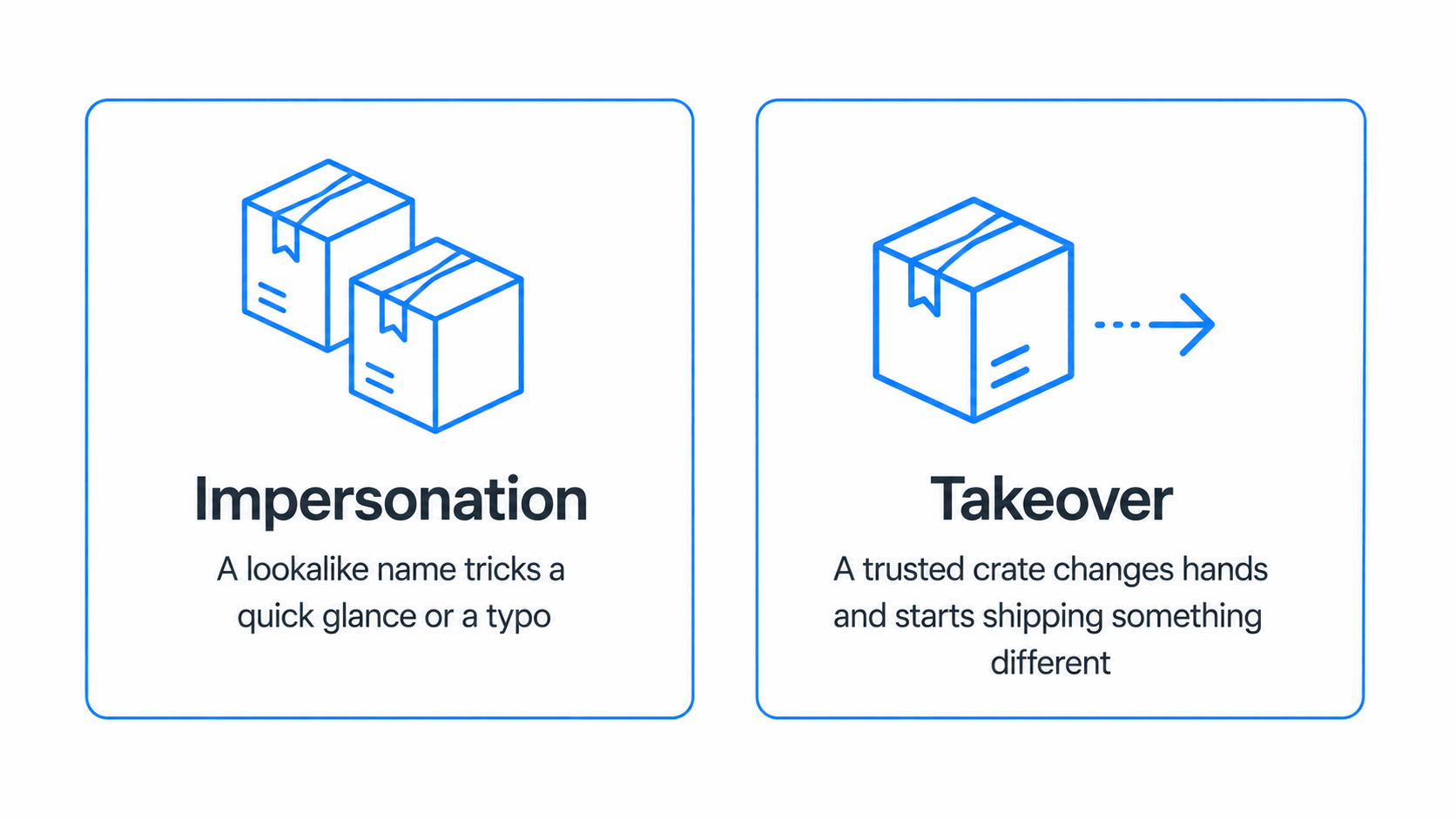
A private cargo registry earns its keep against two related threats, and neither one is settled by checking a name or a checksum.
The first is impersonation, where a crate is published under a name close enough to a popular one that a typo, or a quick glance at a Cargo.toml, gets it installed anyway. The second is takeover, where a crate that has been trusted for years changes hands, through a maintainer stepping away, an account compromise or a quiet ownership transfer, and then starts shipping something different under a name your team already trusts.
Neither depends on a vulnerable line of code sitting somewhere in a dependency tree. Both depend on the default model of crates.io, where anyone can publish and a name with history says nothing about who controls it now.
Screening before a crate reaches your build is aimed at exactly this. The crate is rebuilt from source and checked against known-malware patterns and suspicious behavior, so it is judged on its own contents instead of inheriting trust from its name. That lowers the odds considerably. It is not a promise that every malicious crate gets identified, and any vendor offering that promise is overselling.
It is also a different guarantee from nothing in your build ever executes arbitrary code. Screening happens before the crate arrives. Once it is in your tree, your own cargo build runs the way it always did.
| Layer | Who screens or sandboxes it | What it catches |
|---|---|---|
| Crate at the registry, before install | The registry | Impersonation, takeover, known-malware patterns |
Your own cargo build |
Cargo does not sandbox it | build.rs and proc macros still execute unless you add external isolation |
How Patched Crates Change the Integration
This is also where takeover stops being purely a screening question. A crate whose ownership quietly changes hands is not a one-time detection problem. It is an ongoing maintenance gap, and screening a single release does not close it.
Continued patching for crates that upstream has abandoned is a separate offering from verification, and it produces crates whose contents deliberately differ from what crates.io published. Different contents mean different checksums, and source replacement rejects anything that does not match, by design.
So patching is an explicit opt-in per crate. For a dependency your own manifest declares, naming the alternative registry is enough.
[dependencies]
abandoned-crate = { version = "1.2.4", registry = "securechain" }
For a crate that only shows up transitively, that declaration does nothing, because it governs the one dependency you wrote down. A top-level [patch] override is the mechanism built for the transitive case.
[patch.crates-io]
abandoned-crate = { version = "1.2.4", registry = "securechain" }
Among Cargo.toml manifests, Cargo reads [patch] only from the one at the workspace root, and from there it applies across the whole dependency graph. It can also live in .cargo/config.toml, though Cargo’s docs steer you away from that for anything shared, since config files usually are not checked into version control.
The practical shape of a real deployment is therefore two-tier.
| Need | Mechanism | Project file changes |
|---|---|---|
| Verified crates, unmodified | Source replacement | None |
| Patched abandoned crates | Alternative registry or [patch] |
A small explicit entry per crate |
One thing that table hides is worth saying out loud. Opting into a modified crate can change the source and checksum recorded in Cargo.lock, so the lockfile updates, and that update should be committed and reviewed like any other dependency change. Verification leaves the lockfile alone. Patching does not.
That is a better story than a blanket claim, because a security buyer can see what patching costs before signing anything. A small deliberate change for each crate they chose to have patched is a reasonable ask. Discovering mid-pilot that every manifest needs editing is not.
Industry codebase audits reported by SC Media found that 93 percent of scanned codebases contained components with no development activity in the last two years. For the genuinely abandoned ones in that group there is no upstream maintainer left to cut a fixed release, and backporting means reconstructing context from scratch. Reproduce the bug, write a fix that does not change behavior anyone depends on, and validate it without an active maintainer’s review or judgment to lean on. TuxCare’s position with SecureChain here is long-term stewardship rather than replacement of upstream development, which is why the two capabilities integrate differently.
Rolling It Out
Four phases, ordered so each one produces evidence before the next increases scope.
| Phase | Action | What it proves |
|---|---|---|
| 1 | Source replacement on one service, clean cache | Checksums still validate |
| 2 | cargo build --offline after Phase 1 |
The build completes using only what Phase 1 already fetched |
| 3 | Roll to CI across repositories | Which pipelines had a hardcoded source config |
| 4 | Block egress to the public crates.io index and download endpoints | What was quietly bypassing the config |
Phase 3 is where these rollouts actually go wrong. Cargo merges .cargo/config.toml files from the current directory upward through its parents, then falls back to $CARGO_HOME/config.toml, with the deeper file winning and the home directory ranking lowest. A CI image can still introduce configuration nobody expected, and the directory cargo was invoked from decides which files are even in the merge. Check the effective configuration on the runner rather than reasoning about it.
cargo +nightly -Z unstable-options config get --show-origin sourceThat reports the effective source configuration and where each value came from. Run it on a build agent rather than a laptop, since the two are usually different and only one of them is documented.
Note: This needs nightly Cargo with -Z unstable-options, so it is not something to bake into a stable CI pipeline as-is.
Pro Tip: Run Phase 4 in staging for a week before flipping production. Block the sparse index at index.crates.io and downloads at static.crates.io, and if anything in the fleet still uses the git protocol, the crates.io index repository on github.com needs blocking too. The pipelines that break will usually expose paths nobody knew were still pulling from crates.io directly, and that list is worth more as a document than as a postmortem.
Where a Private Registry Alone Falls Short
Verified mirroring, meaning source replacement, solves the is-this-the-same-package problem. The crate that lands in your build is the one your lockfile already resolved. It does not tell you whether the crate deserved trust in the first place, and that is what a lookalike name or a crate takeover actually exploits.
SecureChain for Rust covers both angles. Every crate is rebuilt from source and verified for integrity, then screened for malicious and suspicious behavior before it reaches you, so typosquatted and takeover-poisoned releases get judged on what they contain rather than trusted on name and history.
It also keeps patching what is already in your stack after maintainers go quiet, and once a crate reaches end of life, Endless Lifecycle Support delivers the continued backported fixes so an abandoned dependency does not quietly become the unpatched one.
See what verified, patched coverage costs for your actual dependency tree and request a quote.
FAQ
What is a private cargo registry?
A private cargo registry is an internal or vendor-operated alternative registry for Rust crates. It is distinct from vendoring crates into your repository and from mirroring crates.io through Cargo source replacement. Those control where crates come from in different ways, but only an alternative registry functions as a private registry in Cargo’s own terms.
Does mirroring crates.io through source replacement break Cargo.lock?
Not when the replacement source serves verified, unmodified crates, because the contents are the same and the recorded checksums still validate against your existing lockfile. Crates with modified content cannot come through source replacement at all.
How do I configure source replacement in Cargo?
Add a [source.crates-io] block with replace-with pointing at a named source, then define that source with its registry index URL, both in .cargo/config.toml. No changes to Cargo.toml or Cargo.lock are needed.
Does source replacement catch typosquatted or hijacked crates?
Source replacement alone does not. Its job is redirecting Cargo to an equivalent source while the crate contents stay the same. Catching a lookalike name or a crate that has changed hands is a screening function, evaluated when a crate is first rebuilt and again as new versions are published, not a property of the redirect mechanism.
How do patched crates work with Cargo?
Patched crates differ in content from what crates.io published, so they cannot be delivered through source replacement. A direct dependency can point at an alternative registry, while a top-level [patch] override substitutes the patched copy across the dependency graph, including transitive uses. Either way the lockfile records the change.
How can I verify the compatibility claim myself?
Clear ~/.cargo/registry, then run cargo build --locked. A successful clean-cache build against your unchanged lockfile shows that the replacement source is compatible with the locked dependency set and that the downloaded packages satisfy the checksums Cargo expects. Running cargo build --offline afterward confirms the build completes without further network access, though it will not confirm the source of what is already cached, so use egress logging or a firewall rule for that.