Tech Support
 Documentation
 Login
 Contact Us



Go straight to an AI summary of this blog post instead 


Key Takeaways
- Six confirmed supply chain campaigns hit npm, PyPI, Go modules and Packagist between March and July 2026.
- None of them needed a bug in anyone’s application code, just one trusted step in the distribution chain.
- Three of the six came and went in a matter of hours, which is faster than most scan schedules run.
- Post-install detection was built for a slower attack than the one teams are getting now.
Two of this year’s fastest campaigns show how little time an attacker needs. Two poisoned axios releases sat on npm for roughly three hours on March 31 before anyone pulled them. The Mastra takeover moved faster still, republishing more than 140 packages in about 88 minutes on June 17. Microsoft attributes both to Sapphire Sleet, while Google ties the axios compromise to the North Korean cluster it now calls Midnight Neptune, formerly UNC1069. Neither compromise was stopped before the malicious versions reached users, and in neither case did anyone touch the package’s source code. The attacker added a single dependency to package.json and let npm install do the rest.
Traditional CVE-focused SCA and SBOM workflows were never built to stop either one, because at the moment it mattered there was nothing to match against. Both windows opened and closed in less time than plenty of nightly builds take to finish.
That is the shape of 2026 so far. Not one enormous breach everyone is still arguing about months later, but a steady run of short, fast, competently executed campaigns hitting public registries one after another, while most defenses still sit at the far end of the pipeline waiting to report what already ran.
What Changed Between 2025 and 2026
Line the dates up and the pattern is not subtle. Six confirmed campaigns landed in a five-month stretch, March through July 2026, across four ecosystems. That works out to roughly one major, independently confirmed campaign a month, several of them with named threat actors attached.
And the broader threat data says this was more than one unusually bad stretch. Wiz’s H1 2026 cloud threat report found the volume of significant incidents it flagged to customers up 60% from H2 2025, the highest of any period it has tracked, with supply chain attacks climbing from about 10% of those incidents to 25%. Wiz counts cloud incidents rather than registry hygiene, so that reads as an outside check on the trend instead of a vendor confirming its own thesis. Google’s Threat Intelligence Group assesses with high confidence that the growth in very large-scale open-source supply chain campaigns across 2025 and early 2026 represents a real expansion of the tactic rather than better detection, and the OpenSSF figures it cites put the rise in identified malicious open-source packages at more than 1,400% between 2024 and 2025.
The clock on the individual campaigns is the part worth staring at. Mastra ran for about 88 minutes. axios lasted around three hours. The five malicious jscrambler versions went out over roughly the same span. The other campaigns ran the opposite way, quietly, for weeks, which is arguably worse. Either end of that range is awkward for tooling built to catch things on a nightly cadence.
Reality Check: A campaign a month does not mean a matching jump in the number of attackers. Automation explains a lot of it, and 2026 handed over a clean example. TeamPCP published the full Mini Shai-Hulud worm source on GitHub on May 12, and derivative campaigns using that toolchain showed up within weeks. Publishing a package is scriptable, stealing a credential is scriptable, and namespace impersonation has been scriptable for years.
You can also learn more about slopsquatting and AI package hallucinations in our detailed overview.
The Six Campaigns That Set the Pattern
The six below are not a top six by package count. They are the six that best cover the range of what happened this year, from stolen-credential hijacks (axios, jscrambler) to a self-propagating worm, a dormant account brought back to life, prompt injection aimed at AI reviewers, and account takeover driven by social engineering.
| Campaign | Date | Package ecosystem | What made it work |
| axios hijack | Mar 31 | npm | Lead maintainer’s machine compromised through social engineering, then two poisoned releases pushed straight to npm, live for about three hours. Attributed to Sapphire Sleet by Microsoft and to Midnight Neptune by Google. |
| Mini Shai-Hulud | Apr 29 onward | npm | Self-propagating worm that harvested npm and CI credentials, then republished itself into every package its victims could publish. Attributed to TeamPCP. |
| Hades | Jun 7–8 | PyPI | 19 packages shipped 37 malicious wheels carrying .pth startup hooks, with prompt-injection text aimed at LLM-based review. Part of the Miasma line, itself derived from Mini Shai-Hulud. |
| Mastra takeover | Jun 17 | npm | Dormant contributor account, idle since February 2025 with scope access never revoked, used to republish 140+ packages with one injected dependency. Same actor as axios. |
| jscrambler | Jul 11 | npm | Stolen publishing credential used to push five versions carrying a cross-platform infostealer, the first three of them through a preinstall hook. |
| PolinRider | Mar onward | npm, Go, Packagist | Maintainer accounts taken over through malicious developer tooling and account-recovery paths, then used to plant obfuscated loaders in 108 packages and extensions. Tallied in early July and tied to the Contagious Interview cluster. |
Line those six up and one thing holds across all of them. Not one needed a vulnerability in the victim’s own code. Every one abused a trusted step somewhere between a maintainer’s keyboard and your install command, and in four of the six that step was a legitimate maintainer account.
The shared attribution between axios and Mastra is not a coincidence of style. Microsoft put the same actor behind both, so at least two of the six were one group refining its approach between hits rather than two crews landing on the same idea. Hades and Mini Shai-Hulud share a family tree as well. Six campaigns, then, but closer to four distinct clusters, which is worth saying out loud before anyone reads the count as six independent groups.
Hades is the one worth sitting with for a minute. Its packages carried plain-text prompt injection meant to talk an LLM-based analyzer into marking them safe, which researchers described as a novel evasion technique, and it only works as a strategy if attackers assume AI tooling now sits between the package and the engineer. By mid-2026 that is not a stretch. The Maven Central case in December used similar noise against machine-learning analysis, so the technique had been quietly maturing for months. Hades also ran a token monitor that threatened destructive action if the stolen GitHub tokens were revoked, which quietly rearranges the order of operations for anyone cleaning up.
PolinRider is the one to worry about, for a different reason. This was not opportunistic squatting on abandoned names, and the reported entry path is stranger than a credential dump. Researchers say stolen GitHub credentials were not the vector at all. Victims were compromised first through a malicious VS Code extension or npm package, with maintainer takeover then coming through expired-domain or other account-recovery paths, all of it wrapped in the social engineering that the Contagious Interview crew is known for. Clean publishing hygiene does not make that risk disappear – the weak link sits in a maintainer’s tooling and account recovery rather than in the release process.
Two more 2026 campaigns come up later in this piece. TrapDoor planted 34 malicious packages across npm, PyPI and Crates.io, and Laravel-Lang had more than 700 versions poisoned through rewritten Git tags. TeamPCP is a different case. It gets no row of its own because the Mini Shai-Hulud row already is TeamPCP. The wider operation, which Google tracks as UNC6780, ran from February to May and chained CI/CD compromises against security tooling including Trivy, Checkmarx and its KICS Docker images, plus LiteLLM, into one long credential-harvesting spree. Bigger than a table row – same mechanism.
The Attack Surface Moved to Install Time
The thread running through all of 2026 is timing.
Attackers hit the same weakness in npm, PyPI and Cargo from three different angles, and TrapDoor is the clean example because one campaign used all three. A postinstall hook on npm, import-time execution on PyPI, and a build.rs script that fires during cargo build on Crates.io. Different triggers, same idea. The code runs as part of acquiring the package, not as part of using it. PolinRider’s Go side works differently again, since the payload sits in build-tool config files and VS Code tasks rather than an install hook, so it fires when a developer’s tooling opens the project instead of on go get. Same abuse of trust, different point in the pipeline.
Standard tooling assumes a window exists between a dependency showing up and that dependency running, long enough for a scan to catch something first. Install-time execution removes that window for anything that only inspects artifacts after resolution.
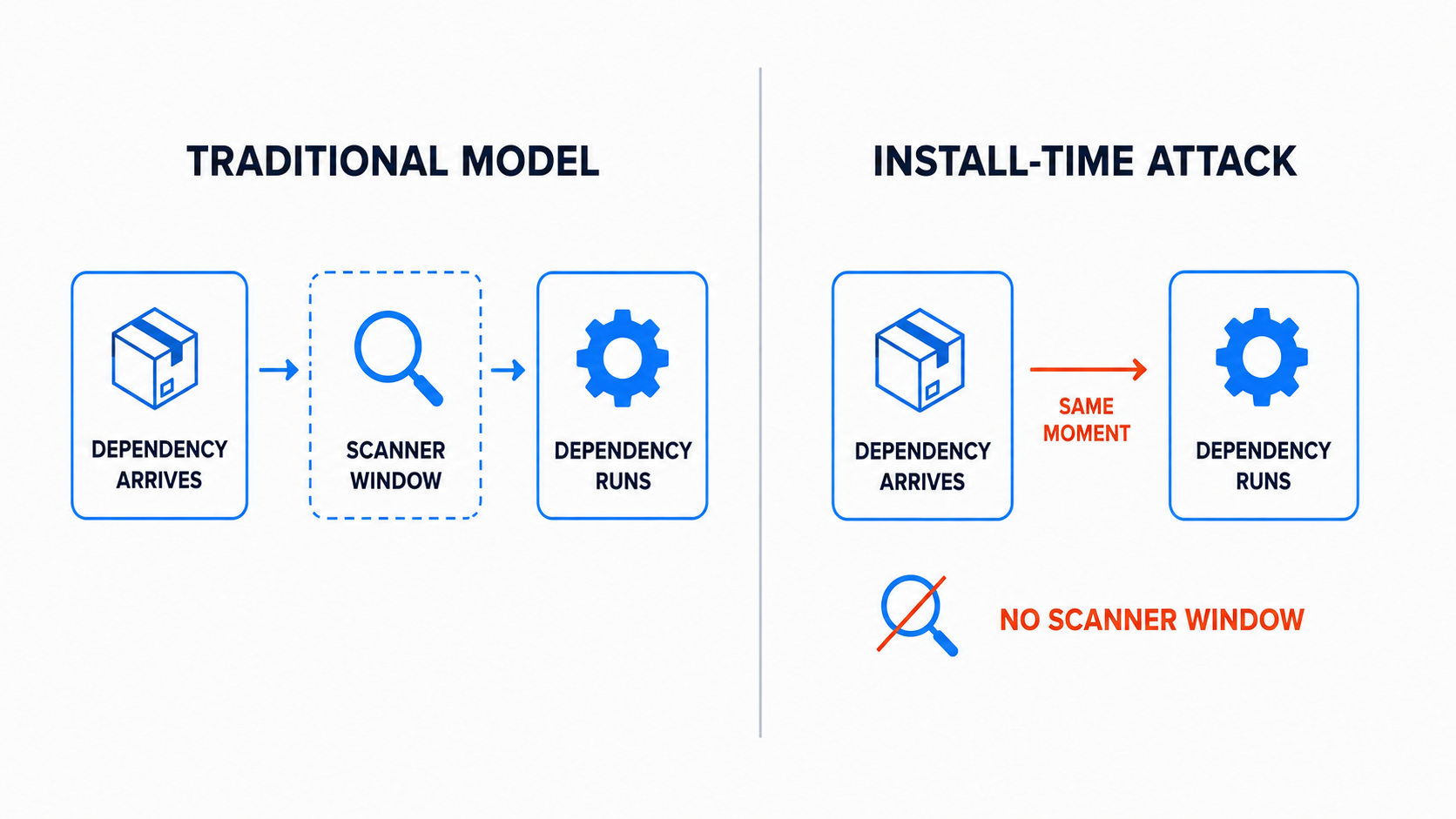
Picture a 40-person engineering org with a reasonably mature pipeline. Dependabot opens PRs, an SCA tool scans the lockfile, CI blocks on anything high severity, an SBOM gets generated at build time. That setup handles known-vulnerable dependencies well. It does much less against a version published an hour ago that looks like an ordinary patch bump, executes during install, and gets yanked before lunch. There was no advisory for anything in that chain to match, and in the axios and Mastra cases the payload sat one level down, inside a dependency the scanner had no reason to look at twice.
Watch Out: Exact pinning does more than people give it credit for and less than people hope. Anyone pinned to a clean axios who did not run a fresh install during the three-hour window came out fine. What pinning will not tell you is whether the version you deliberately bump to is trustworthy, and it does nothing when a loose range on a transitive dependency does the resolving for you. That is exactly how Mastra landed, since the injected easy-day-js dependency was declared as a caret range and npm cheerfully upgraded to the armed patch release. Pinning also assumes the artifact behind a version cannot change, which Laravel-Lang disproved by rewriting historical tags to point at a new commit.
Screening packages before they reach a developer’s machine or a build agent is one of the few places in the chain where install-time code can be stopped instead of reported afterward. That is the gap SecureChain for OSS is built to close, which is also why it sits at the registry level rather than adding one more scanner to the end of the pipeline.
Why Your Scanner Is Always Late
Traditional CVE-focused software composition analysis is good at one question. Which known-vulnerable components made it into this build. Really good at it, and worth keeping.
By itself, though, it does not answer a different question. Is this artifact, right now, the thing its maintainer published?
That is a data problem more than a product problem. Vulnerability-focused SCA maps your dependency inventory against advisory data, and an advisory only exists once somebody found the malicious package, reported it, and got the advisory published. Detection is often quick. Socket flagged the malicious jscrambler release six minutes after publication, and the TrapDoor packages averaged under six minutes from publication to detection. The advisory your scanner queries is the slow part, and plenty of these incidents never produce a CVE at all, which is also why none of them will ever turn up in the CISA Known Exploited Vulnerabilities Catalog. Advisory feeds are, by nature, a record of what has already been discovered.
Worth Knowing: Several 2026 campaigns published malicious versions that looked like ordinary patch bumps, with no matching commit, pull request or tag behind them. jscrambler 8.14.0 is the clearest case, since researchers found no commit, tag or PR for it in the project’s GitHub repository, where the latest tag was still 8.13.0. Conventional updaters do not check whether an artifact corresponds to a source change. They see a new version number, open a pull request, and some teams merge it automatically. A version bump and a verified change are not the same thing.
Where the Ecosystem Numbers Point Next
Through 2024 and most of 2025, npm soaked up the attention, thanks to its adoption numbers and lifecycle scripts that run automatically during install. That concentration is over.
TrapDoor hit three ecosystems in the same week in May, with 34 malicious packages and 384+ versions across npm, PyPI and Crates.io. These were fake tools rather than hijacked ones, named to read like utilities a crypto or AI developer would install without a second thought, and each registry got its own execution path. It also dropped .cursorrules and CLAUDE.md files to steer AI coding assistants, which is a decent preview of where this goes next.
Packagist had a rough May of its own. Attackers rewrote every Git tag across four Laravel-Lang localization repositories inside a window of about 90 minutes on May 22 and 23, and more than 700 historical versions ended up pointing at a malicious commit that Composer’s autoloader then ran on every request. The way in was a leaked GitHub token, and the project source was never touched. Separately, an eight-package campaign hid its payload in package.json rather than composer.json, which put it exactly where PHP-focused review was least likely to look.
You can also explore best practices for protecting your PHP ecosystem in our comprehensive guide to Laravel security.
And in December 2025, just before the window this piece covers, a typosquatted Jackson lookalike landed on Maven Central carrying a Cobalt Strike beacon. The trick was a prefix swap, org.fasterxml where the real library uses com.fasterxml, which Java’s reverse-domain convention does nothing to catch. Aikido, which found it, called it the first sophisticated malware its team had detected on Maven Central, so read that as a first for those researchers rather than for the whole ecosystem. Takedown was fast, at least, roughly 90 minutes from the report.
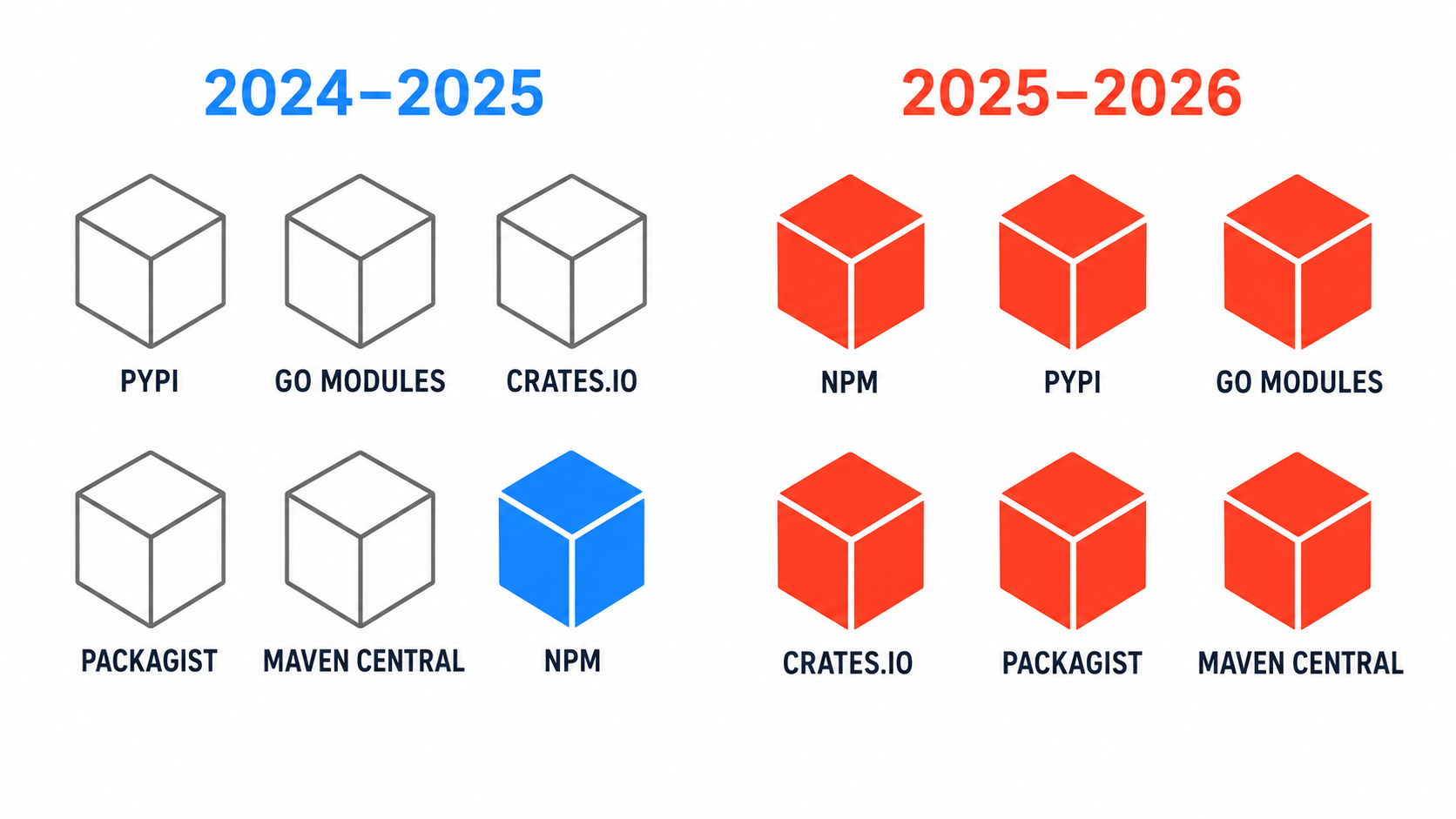
Read that as a shift in where the headline campaigns are aimed rather than a clean before and after, since malicious packages had turned up in most of those registries earlier. For a polyglot shop the practical takeaway is that per-ecosystem defenses stop adding up to real coverage. Solid npm controls, loose PyPI habits and no Go or Rust story at all leaves you with a locked front door and several open side entrances, and this year’s data says attackers are already trying them.
What to Do About It
None of this requires a re-architecture. All of it is doable this quarter.
If You Have One Primary Ecosystem
Close the install-time gap there first. Set ignore-scripts=true in .npmrc anywhere your build tolerates it, and route installs through a registry layer that screens packages before they resolve. Do not treat script blocking as the whole answer, though. Two of the five malicious jscrambler versions moved the dropper out of the preinstall hook and into the package’s main code and CLI, where –ignore-scripts does nothing at all.
If You’re Polyglot
Work out which ecosystems have no controls before going deeper on the ones that already have some. Coverage gaps beat depth gaps under this threat model. TrapDoor and PolinRider both showed that a single blind ecosystem is enough to undo the work everywhere else.
If You Lean on Automated Dependency Updates
Add a delay window on new releases. Unit 42’s mitigation guidance suggests blocking any version published in the last 24 to 72 hours, on the grounds that most malicious packages are identified and removed inside that window, and Wiz lands in much the same place with a 24-hour cooldown. A short quarantine turns a good chunk of these attacks into a non-event, at the cost of running slightly behind on patches.
Moving a control earlier beats bolting another one onto the end. Two things matter more than the rest here. Catching a package before it resolves, and verifying that the artifact you received corresponds to the source and build it claims to come from.
Provenance is worth switching on, with one caveat. Mastra generated provenance on CI publishes but did not require it, so a stolen token could still publish without attestations, while the TanStack wave of Mini Shai-Hulud produced packages with valid SLSA provenance because the pipeline itself was poisoned. Requiring attestations would have stopped the first and not the second.
Mileage varies by ecosystem, too. Go account takeovers and PyPI startup hooks are different problems needing different fixes, so any control worth paying for has to account for how each ecosystem actually executes code.
Where This Leaves You
Nothing here is exotic. 2026 did not invent a new class of vulnerability. It moved the fight to a place most teams were not watching, which is the moment a package resolves and runs rather than the moment someone finally scans it. Every campaign on this list, from a three-hour npm hijack to a Go module reached through a hijacked maintainer account, worked because trust was granted before any control had a chance to look, whether that was during resolution, install, build, or the moment an editor opened the project.
So the real question is not whether to keep post-install detection. Keep it. The question is whether prevention moves earlier, so that a scan running after the payload already had your CI secrets is not the first thing to tell you about it. SecureChain for OSS exists for teams that want that without building it themselves.
FAQ
What is a software supply chain attack?
An attack that compromises software through a trusted dependency, build system, repository or distribution channel instead of going after your application directly. The 2026 campaigns overwhelmingly targeted public package registries and the accounts that publish to them.
How many software supply chain attacks happened in 2026?
There is no authoritative total. This piece covers six major campaigns confirmed between March and July 2026, and several more sit just outside that set, including TrapDoor, Laravel-Lang and the wider TeamPCP operation.
Does an SBOM prevent supply chain attacks?
No. An SBOM inventories what went into a build, which is valuable for response and audit. It does not establish that a listed artifact is the one its maintainer published, and it does not stop code from running during dependency acquisition.
Which package ecosystems were hit hardest?
npm carried most of the high-profile 2026 incidents, while PyPI, Go modules, Crates.io and Packagist all saw dedicated multi-package campaigns by mid-year. Maven Central had its own moment just before the year began.