Tech Support
 Documentation
 Login
 Contact Us




Go straight to an AI summary of this blog post instead 


Key Takeaways
- Without a third-party assessment, the CEO or an employee designee authorized to bind the corporation signs the form.
- The signer attests, to the best of their knowledge, that the producer presently makes consistent use of the form’s practices.
- Under OMB memo M-26-05, each federal agency now decides whether to ask for the form, so an agency you sell to can still require it.
- Third-party open source sits outside the form’s direct coverage, yet producers still attest to managing the risks associated with it.
If a federal agency asks for the secure software development attestation form and your company self-attests rather than attaching a third-party assessment, the signer has to be your chief executive officer (CEO) or a designee who is an employee of the company and has authority to bind the corporation. Whether an agency asks at all is now its own call under Office of Management and Budget (OMB) memo M-26-05, dated January 23, 2026.
That signer may never have looked at how open source dependencies get into your builds, yet their name ends up under a statement about how your company manages the risk of code your team didn’t write.
The form asks one person to attest to practices that several teams carry out. That attestation comes with qualifiers, and several of its terms leave the producer to decide what meets them. A signer who understands both the qualifiers and the open terms is in a much better position to sign something accurate.
How the Secure Software Development Attestation Form Became Optional
The Cybersecurity and Infrastructure Security Agency (CISA) released the form on March 11, 2024. Software producers, meaning the companies that make or compile the software, use it to attest that what they ship is developed in conformity with specified secure development practices.
For a few years, OMB made the attestation mandatory. Memo M-22-18, issued September 14, 2022, and updated by memo M-23-16 on June 9, 2023, allows an agency to use covered software only after its producer attests to secure development practices aligned with the Secure Software Development Framework (SSDF).
Then, on January 23, 2026, M-26-05 rescinded both memos. Agencies may now choose whether to use the CISA form. They may also include contract terms requiring a producer to provide a current software bill of materials (SBOM) upon request. The form itself hasn’t been revised and still cites the two rescinded memos as its authority, so some of its instructions no longer apply.
For a producer that can’t attest to every practice, the form still describes a plan of action and milestones (POA&M) to close the gaps, backed by an extension or waiver from OMB. M-26-05 sets up no replacement for that process, so a producer in that position should ask the requesting agency what it accepts instead.
What the Signer States and What Stays Open
Section III of the form, headed “Attestation and Signature,” asks one person to state, on the producer’s behalf, that the software is developed in conformity with the practices it lists. It sets out four numbered statements and opens them with two qualifiers. The signer attests that, “to the best of my knowledge,” the producer “presently makes consistent use” of those practices in developing the software named in Section I. Those practices cover the build environment, the code supply chain, provenance (records of where code came from and how it was built), and how the producer finds and handles vulnerabilities. Nothing in Section III requires the signer to state that the software is free of vulnerabilities.
Both qualifiers narrow the claim. “Presently” covers the practices in use when the form is signed, and “to the best of my knowledge” limits the statement to what the signer knows. Neither the instructions nor Section III says what a signer has to do to confirm the practices are in place, and the designee doesn’t need any particular job title. So the producer decides who vouches for the practices, such as the teams that run the builds, before anyone signs. A signature on that basis is only as informed as those teams are.
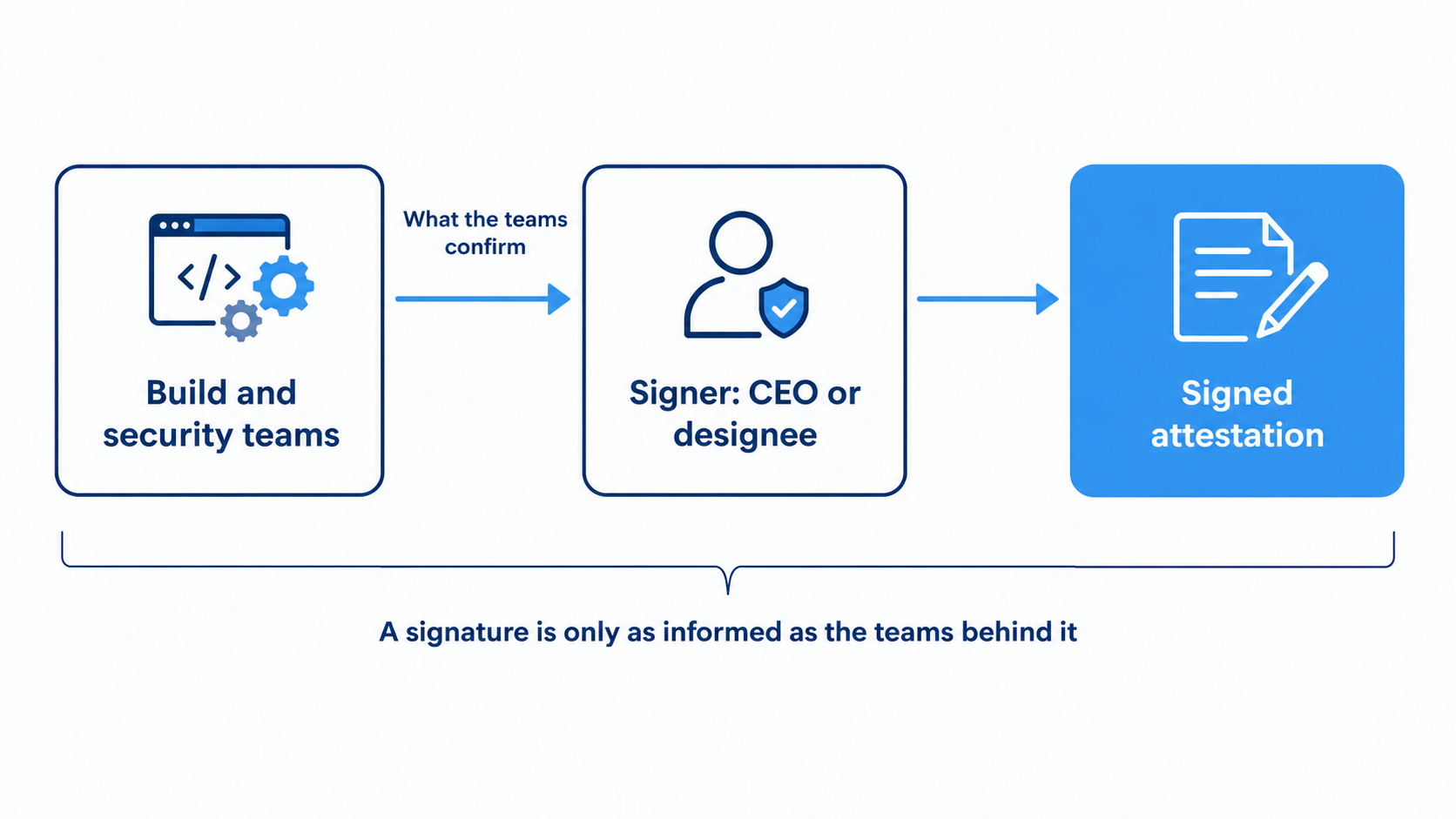
Table 1. What the form specifies about the signature
| Item | What the form says | Basis |
|---|---|---|
| Signer | The CEO of the software producer, or a designee who is an employee with authority to bind the corporation | Form instructions |
| Scope | Company-wide, individual product, multiple products, or specific product versions | Form, Section I |
| Alternative | A third-party assessment is attached to the form, in which case the producer doesn’t sign | Form instructions and Section III |
A producer can attach a third-party assessment instead of signing. The assessor has to be a Third Party Assessor Organization (3PAO) that is either certified under the Federal Risk and Authorization Management Program (FedRAMP) or approved in writing by an appropriate agency official. It also has to assess against relevant guidance from the National Institute of Standards and Technology (NIST) that includes every element on the form. FedRAMP now refers to these organizations as independent assessors, though the CISA form still uses 3PAO. To use an assessment, the producer checks a box in Section III and attaches it.
Where Third-Party Components Sit in the Statement
Section I lists four categories the form doesn’t cover. One of them is what it calls third-party open source and proprietary components, meaning the ones incorporated into the software end product an agency uses. A note in the same section says signers attest to the Section III practices for code developed by the producer. The instructions, though, say producers who use third-party components must attest to having taken specific Section III steps to minimize the risks of relying on them. Read together, the exclusion and the instructions mean the signer doesn’t vouch for third-party code itself, only for the producer’s steps to manage that risk.
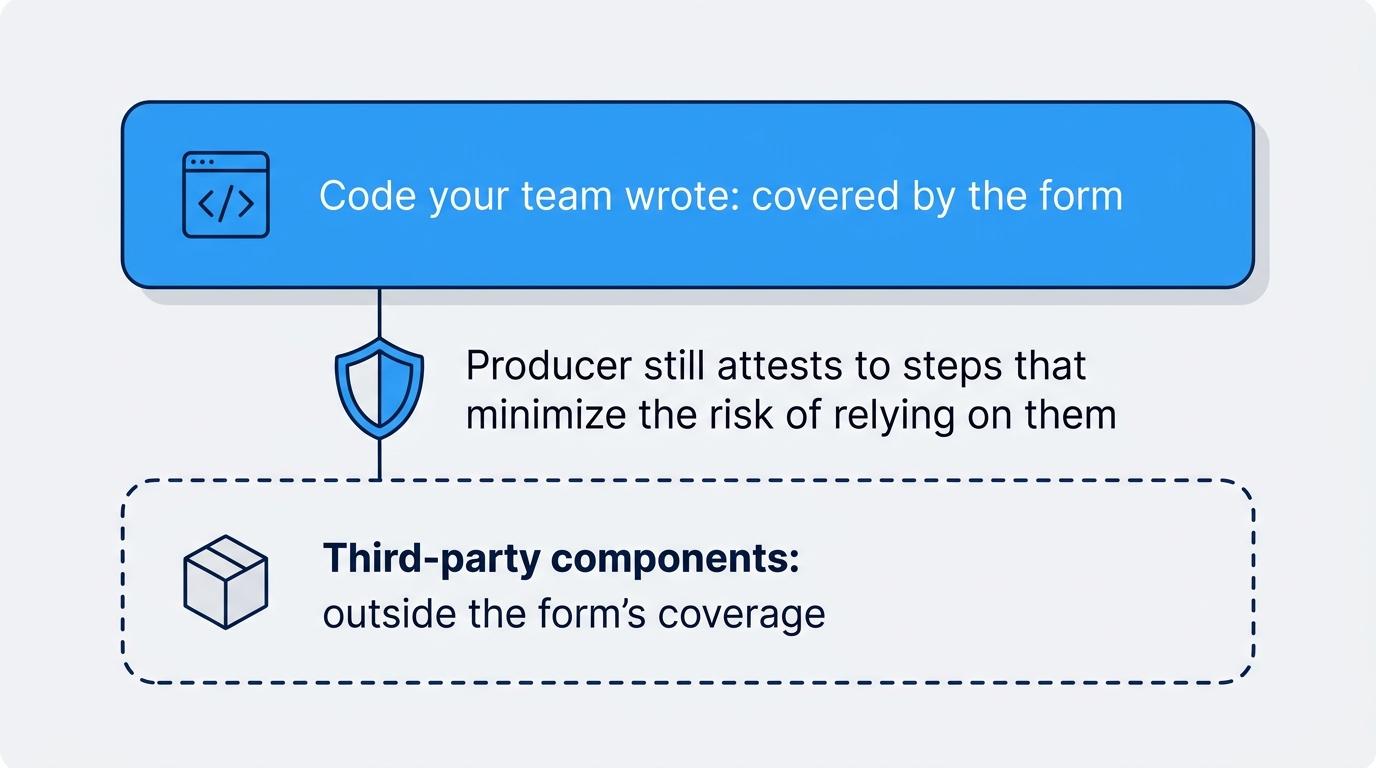
Statements 2 and 3 are where third-party components come up by name. Statement 2 asks for a “good-faith effort” to maintain trusted source code supply chains, using “automated tools or comparable processes” to address the security of internal code and third-party components and manage related vulnerabilities. Statement 3 asks the producer to maintain provenance for internal code and third-party components “to the greatest extent feasible.” For reference, the form’s appendix maps both to SSDF tasks, including the task of verifying open source components.
Both statements leave room for judgment. The form never defines “trusted source code supply chains” or “comparable processes,” and it doesn’t specify how much provenance is considered feasible. Each producer has to work out what those terms mean for its own software, and the signer attests to the result only to the best of their knowledge.
They also depend on knowing what third-party code a build contains, and the form leaves the method up to the producer. A producer unable to list that code has no way to know whether it meets either one.
Section III also says nothing about components whose upstream maintenance has ended. Statement 4 still asks for a policy or process to address discovered vulnerabilities before release. For a component whose maintainers have stopped shipping fixes, that policy can’t count on an upstream release. That leaves options like replacing the component or patching the version in use, either in-house or through a vendor that backports fixes.
What Follows the Signature
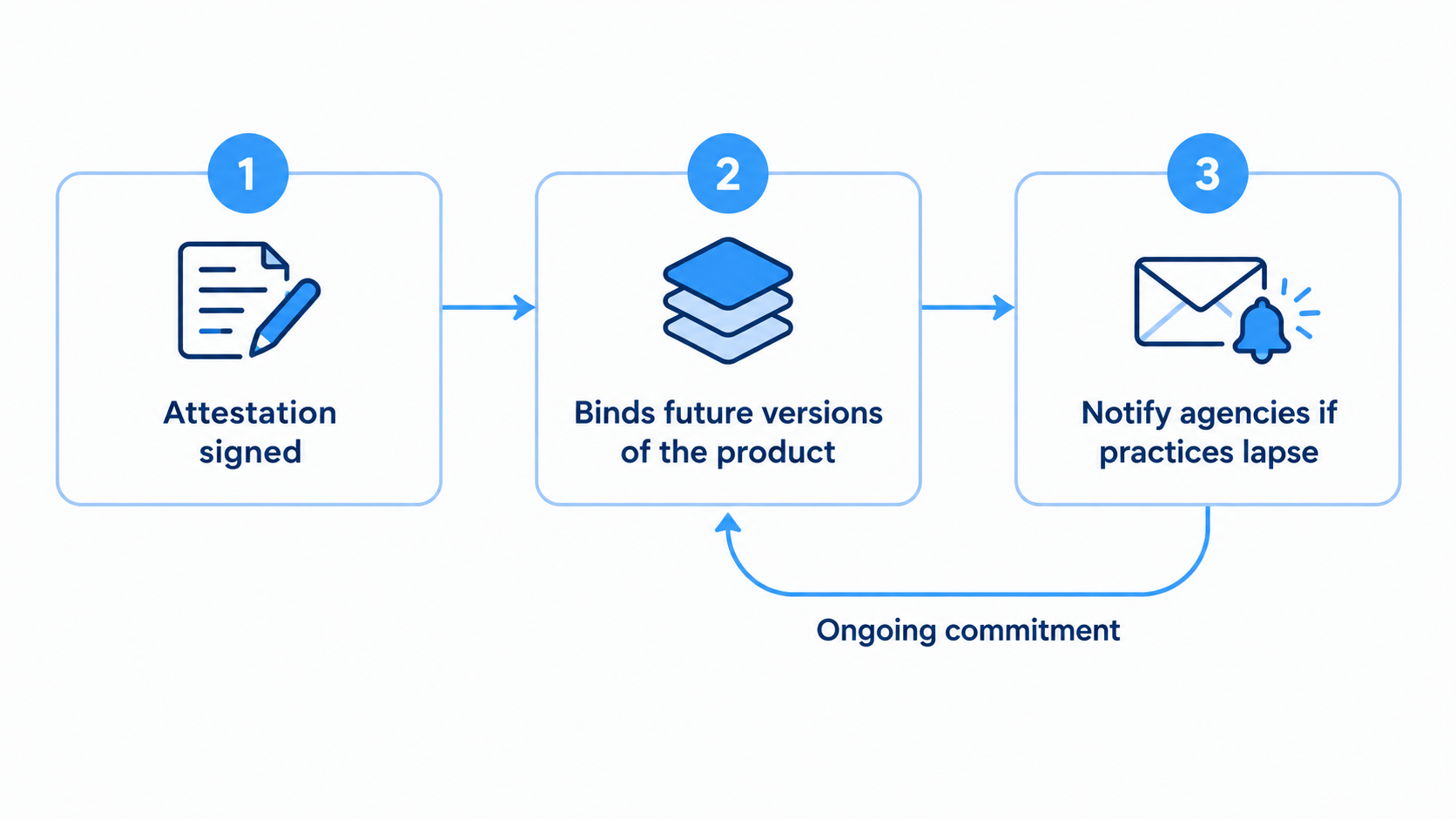
Signing the form initiates commitments that extend beyond the signing date. Section III includes an attestation that the producer will notify any agency that received the form “if and when” it stops making consistent use of the practices. A footnote adds that an attestation binds future versions of the named product until the producer tells those agencies its development practices no longer conform. The notification promise runs from the producer to the agencies, and the form doesn’t say how news of a lapse reaches the signer. The teams that run the practices are likely to see a lapse first. The producer needs a process for those teams to report it to the signer.
The form’s Privacy Act statement, written for the Department of Homeland Security, spells out two consequences. Failing to provide the requested information may lead the agency to discontinue use of the software. Willfully providing false or misleading information may violate a federal criminal statute, 18 U.S.C. § 1001.
Note: Each agency that uses the form has to provide its own Privacy Act statement, so the consequence wording a signer sees may differ by agency.
A signer who wants the attestation to remain accurate should find out, before signing, which teams vouch for each practice, how the producer has defined terms such as “comparable processes” and “feasible,” and how those teams will report a lapse.
Knowing What Enters Your Builds
SecureChain from TuxCare screens each open source package’s code for hidden malware and rebuilds the package from source inside hardened, isolated environments. A package that fails the screening is held back from your environment. Each package you receive comes with an SBOM listing its contents and a provenance record. While upstream still maintains a package, SecureChain patches it under a service-level agreement (SLA), and Endless Lifecycle Support (ELS) continues to provide fixes after upstream maintenance ends. SecureChain covers open source dependencies across JavaScript, Python, Java, Go, and PHP.
If your team can’t say what’s inside the open source dependencies entering your builds, or who patches them once upstream stops, SecureChain answers both questions.
FAQ
What Is the CISA Secure Software Development Attestation Form?
It’s the form software producers use to attest that their software is developed in conformity with practices drawn from the Secure Software Development Framework (SSDF). The Cybersecurity and Infrastructure Security Agency (CISA) released it on March 11, 2024. When the producer self-attests, the chief executive officer (CEO) or a designee who is an employee with authority to bind the corporation signs it. A producer can attach a third-party assessment instead.
Is the Secure Software Development Attestation Form Optional or Still Mandatory?
It’s no longer a government-wide requirement. Memo M-26-05 from the Office of Management and Budget (OMB), dated January 23, 2026, rescinded memos M-22-18 (September 14, 2022) and M-23-16 (June 9, 2023), which had allowed agencies to use covered software only after a producer attested. Each agency now decides whether to use the form, so a particular agency can still ask you for one.
Which Software Does the Form Cover?
The instructions cover software developed after September 14, 2022 (the date of OMB memo M-22-18), older software that underwent a major version change after that date, and software whose producer delivers continuous changes, such as software-as-a-service. Those rules came from M-22-18 and M-23-16, which M-26-05 rescinded, so an agency that asks for the form now can set its own scope. The requesting agency’s instructions and contract terms are the place to check. The form’s Section I also lists four categories the form doesn’t cover, including third-party components built into the product.
How Does the Form Treat Third-Party and Open Source Components?
It excludes third-party open source and proprietary components built into the product from its coverage. Its instructions also say producers who use third-party components attest to having taken steps listed in the form’s attestation section, Section III, to minimize the risks of relying on them. Two of those steps, on supply chain security and on provenance, name the components directly.
What Does the Form Say About False or Missing Information?
Its Privacy Act statement, written for the Department of Homeland Security, says failing to provide requested information may lead the agency to stop using the software. Willfully providing false or misleading information may violate 18 U.S.C. § 1001, a criminal statute. Each agency using the form provides its own Privacy Act statement.
Can a Third-Party Assessment Replace the Signature?
Yes. A producer can attach an assessment by a Third Party Assessor Organization (3PAO) that is certified under the Federal Risk and Authorization Management Program (FedRAMP) or approved in writing by an appropriate agency official. The 3PAO has to assess all the form’s elements against relevant NIST guidance. The producer then checks the box in Section III, attaches the assessment, and doesn’t sign.
What Happens to an Attestation When the Software Gets a New Version?
An attestation binds future versions of the named product until the producer notifies the agencies that its development practices no longer conform. That lines up with a promise in the signature section itself, where the producer agrees to notify any agency that received the form if it stops making consistent use of the practices.