Tech Support
 Documentation
 Login
 Contact Us


Go straight to an AI summary of this blog post instead 


The patch went out. The ticket closed. The post-mortem was filed. And yet, more than four years later, scanners keep flagging it. This is about the gap between “patched” and provably safe – and what Log4j actually revealed about the systems underneath.
There is a specific kind of exhaustion that follows a major security incident. The sprint to patch, the all-hands calls, the frantic inventory of affected systems, and then, finally, the moment when someone closes the tracking ticket and writes “resolved” in the status field. That feeling of closure is real. It is also, in many cases, slightly premature.
Log4Shell – the critical remote code execution vulnerability disclosed in December 2021 in the Apache Log4j library – remains the sharpest example in recent memory of what happens when a deeply embedded component of the Java ecosystem turns out to be universally present and universally dangerous. The response was enormous. Thousands of organizations patched within days. Government agencies issued emergency directives. Security teams worked through weekends.
And yet the Java security issue Log4j exposed has not gone away. Not the specific CVE, but the conditions that made it possible, and the residual uncertainty that lingers even after patches are applied. Understanding that uncertainty is the real lesson, and it applies far beyond any single library.
What “Patched” Actually Means
When an organization announces it has patched Log4j, that statement carries an implicit assumption: that every instance of the vulnerable library has been identified and updated. In practice, this assumption is extraordinarily difficult to verify in complex Java environments.
Java applications ship as packaged artifacts – JAR files, WAR files, fat JARs assembled with tools like Maven Shade or Spring Boot’s embedded packaging. These packages bundle their dependencies at build time. A vulnerable version of Log4j does not just appear in your dependency manifest; it may be physically embedded inside another JAR, which is itself inside a WAR, which is deployed to an application server that your security team did not realize was running Java at all.
To learn how to systematically identify and resolve these deeply embedded dependencies, see our complete guide on applying a Log4j vulnerability fix.
This is not an edge case. During the Log4Shell response, security researchers discovered vulnerable Log4j instances nested four and five layers deep inside enterprise software from vendors who themselves had not realized the library was present. CISA’s guidance at the time stressed identifying every affected asset and cautioned that initial scanning alone was not enough to confirm a complete inventory. The problem was structural.
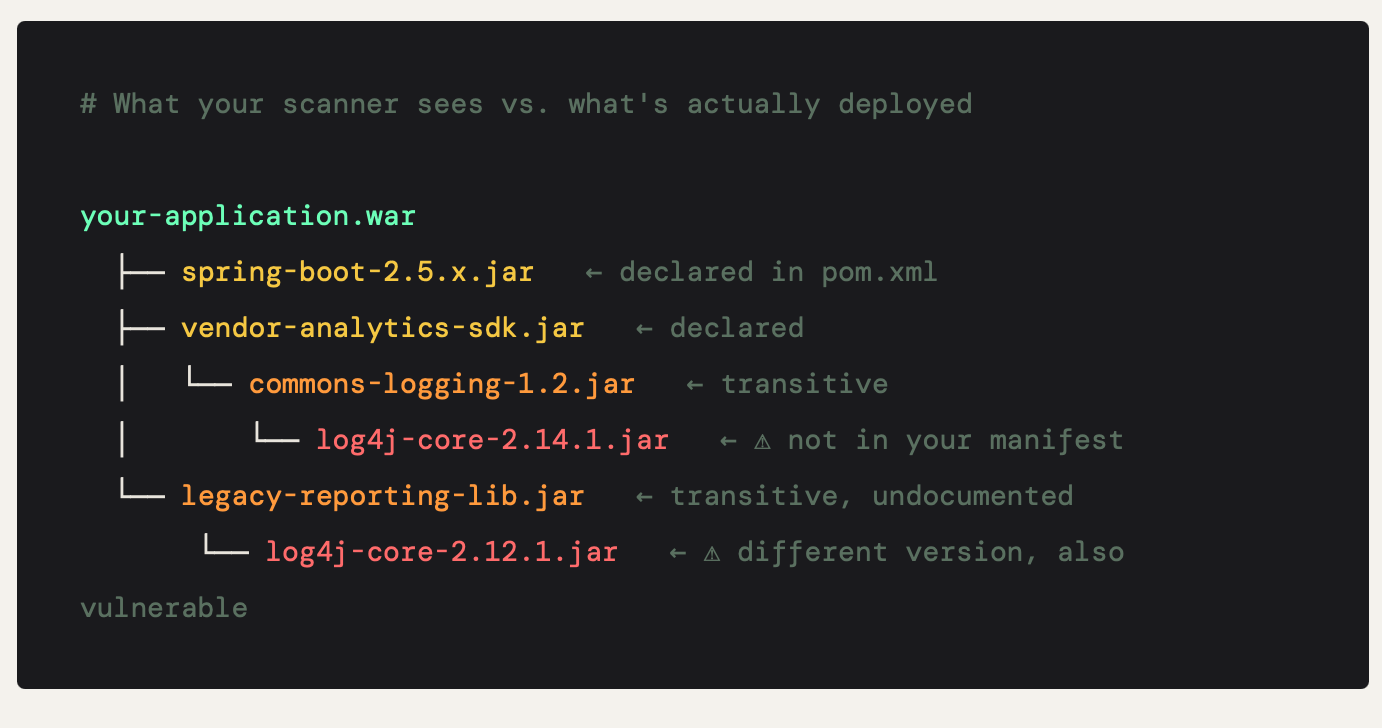
The gap between what a dependency manifest declares and what is actually running at runtime is not a minor discrepancy. It is a fundamental visibility problem in Java dependency management, and Log4Shell made it impossible to ignore.
The Long Tail of a Major Incident
Security incidents of Log4j’s magnitude do not resolve cleanly. They have long tails – extended periods during which patching is technically complete in the systems anyone thought to check, while vulnerable instances persist in the systems nobody remembered.
The Log4j long tail has been unusually persistent. This is partly because Java is an unusually sticky runtime. Java applications are deployed in environments that were not designed for frequent updates: embedded industrial systems, legacy financial platforms, medical device software, vendor-supplied enterprise applications where the customer does not control the build. These are not obscure contexts. They represent a significant fraction of Java’s installed base.
DECEMBER 2021
CVE-2021-44228 disclosed. Emergency patch response begins globally. Log4j 2.15.0 released – later found to be an incomplete fix in certain configurations.
DECEMBER 2021 – JANUARY 2022
Three additional CVEs follow, all disclosed in December 2021: CVE-2021-45046, CVE-2021-45105, and CVE-2021-44832. Teams that patched to 2.15.0 patch again. Inventory exercises reveal unexpected instances in vendor software and embedded systems.
2022
CISA added Log4Shell to its Known Exploited Vulnerabilities catalog, and threat actors continued folding it into standard toolkits alongside newer CVEs. Exploitation of unpatched legacy systems persisted.
2023 – PRESENT
Log4Shell scanning and exploitation activity still surface years after disclosure; one 2026 longitudinal telescope study observed related traffic continuing through October 2025. Embedded and vendor-supplied Java applications remain a persistent gap. The incident is “resolved” in most organizations’ formal tracking – but not in the wild.
This timeline illustrates something important: major vulnerabilities do not respect the closure of incident tickets. They persist in the parts of the infrastructure that received the least attention during the initial response: the legacy system that IT forgot about, the vendor appliance whose manufacturer took six months to issue a patch, and the containerized service that was rebuilt from an old base image.
What Log4j Changed About Internal Security Conversations
If Log4Shell had a lasting organizational effect beyond the patches, it was this: it forced a reckoning with how little most engineering organizations actually knew about their own software.
The question “do we use Log4j?” turned out to be much harder to answer than anyone expected, and that difficulty was embarrassing in a productive way. Security architects tend to describe the same realization after the fact. They thought they had good inventory because they had a manifest – but a manifest is a list of what you think you put in, not a list of what is actually running.
Before Log4Shell, software bills of materials (SBOMs) were a niche concern – something compliance teams discussed, not something engineering teams prioritized. After Log4Shell, the SBOM conversation moved into mainstream security practice. The U.S. government’s executive order on software security, signed in May 2021, months before the Log4j disclosure, had already called for SBOMs as a baseline expectation. Log4Shell demonstrated why that expectation was reasonable.
The conversation also shifted around ownership. In large organizations, the question “who owns this application’s dependencies?” often has no clean answer. The engineering team that built the application may have moved on. The platform team runs the infrastructure. The security team can flag the vulnerability but cannot merge the fix. Log4j created situations where three different teams were each waiting for the others to act, while the clock ticked.
Trust and the Vendor Problem
Log4Shell also damaged something harder to quantify: trust in vendor-supplied software. Many organizations discovered that commercial applications and appliances they had purchased, and were paying support contracts for, contained vulnerable Log4j instances that the vendor had not disclosed and could not patch on any reasonable timeline. The organizations had no visibility into what those products contained and no leverage to accelerate the vendor’s response.
This is the vendor dependency problem at its starkest. When you deploy a third-party application, you inherit its entire dependency graph, including components you cannot see, cannot update, and cannot replace. For security teams, this means your attack surface extends beyond the code your engineers wrote into the code your vendors wrote, and the code their vendors wrote, and so on.
THE VISIBILITY PROBLEM, STATED PLAINLY
Most organizations do not know everything that is running in their environments. They know what they deployed. They do not always know what was inside what they deployed. Log4j made this gap consequential in a way that is difficult to walk back from.
The Broader Lesson: Log4j Was Not a Unique Event
It would be comfortable to treat Log4j as an anomaly – a once-in-a-decade catastrophe caused by an unusually dangerous feature in an unusually ubiquitous library. This framing is accurate in degree but misleading in kind. The conditions that made Log4Shell so damaging exist in the Java ecosystem broadly and will produce future incidents of similar character.
The Java ecosystem has an enormous legacy surface. Libraries that were written fifteen years ago, when security practices were different and threat models were narrower, are still running in production today. Some are direct dependencies of applications that have not been touched in years. Others are transitive dependencies of frameworks that absorbed them long ago and have not found a reason to remove them.
Unlike more modern package ecosystems, Java’s build tooling makes it easy to package everything into a single deployable artifact, which means old, vulnerable code travels with new code, invisibly, until a scanner or an incident surfaces it. The ecosystem’s strength (backward compatibility, stability, wide library availability) is also its security liability.
There is no shortage of candidates for the next Log4j-scale event. Apache Commons Text’s StringSubstitutor class (CVE-2022-42889, disclosed in October 2022) drew comparable alarm because it could enable remote code execution through unsafe variable interpolation, though its real-world exploitability proved far narrower than Log4Shell’s.. The broader Apache Commons ecosystem, various XML parsing libraries, JNDI and RMI-adjacent utilities – these are the kinds of components that have been in Java applications for a long time, receive less security scrutiny than newer libraries, and could plausibly contain the next critical CVE.
How Teams Are Adapting
The response to the uncertainty Log4j exposed has produced a set of practices that are becoming standard in organizations that take dependency risk seriously. None of them fully solve the problem. Together, they represent a meaningful reduction in uncertainty.
01 Software Bills of Materials (SBOMs)
Teams are generating machine-readable SBOMs as part of the build process. Using tools like Syft, CycloneDX, or the Maven SBOM plugin creates an auditable record of every component in a deployment artifact, including transitive dependencies. SBOMs do not prevent vulnerabilities, but they make inventory possible. When the next Log4j arrives, organizations with current SBOMs can answer “are we affected?” in hours rather than days.
02 Continuous dependency scanning in CI/CD
They’re also moving vulnerability scanning from periodic audits to continuous integration checks. Working with tools like Grype, OWASP Dependency-Check, or Snyk shifts the posture from reactive to preventive. New vulnerabilities in existing dependencies surface immediately rather than at the next quarterly review. The challenge is managing alert fatigue; not every flagged CVE is exploitable in context, and undifferentiated scanner output quickly gets ignored.
03 Runtime monitoring and behavioral detection
Static scanning finds known vulnerabilities in known components. It does not catch exploitation attempts against vulnerabilities that were not yet known at scan time. On legacy deployments still running JDK 17 through 23, the Java Security Manager can offer limited controls, but it was deprecated for removal in Java 17 and permanently disabled in JDK 24, so modern runtime protection now relies on RASP agents and network-level monitoring for suspicious JNDI lookup patterns – a detection layer that operates at runtime rather than build time.This is particularly valuable for legacy systems where static scanning is difficult to retrofit.
04 Explicit ownership and remediation SLAs
The ownership gaps that slowed Log4j response in many organizations were not technical problems; they were process problems. Establishing clear ownership for every deployed application, including legacy services, and defining explicit SLAs for critical vulnerability remediation (with escalation paths when ownership is ambiguous) converts the “who fixes this?” question from a recurring blocker into a governed process.
05 Extended security coverage for libraries beyond standard support
For Java applications running older library versions that are no longer actively maintained, the conventional answer is “upgrade.” When upgrades are not realistic due to vendor constraints, regulatory freezes, or brittle legacy systems, teams need a way to receive security patches without advancing to a new major version. Services such as TuxCare’s Endless Lifecycle Support (ELS) for Libraries provide backported security fixes for covered library versions, helping teams keep a known-stable configuration protected against current vulnerabilities while they plan a longer-term migration. This is a bridge, not a destination, but it is a meaningful one when the alternative is running unpatched because an upgrade is months away.
Accepting Residual Uncertainty
There is a version of this conversation that ends with a checklist: implement SBOMs, deploy scanning, establish ownership, manage support windows. Follow the steps and the problem is solved. That version is tidier than the reality.
The honest position is that complex software systems contain residual uncertainty that cannot be fully eliminated, only managed. You will not achieve complete visibility into every dependency in your environment. You will not patch every vulnerable library before the next critical CVE is disclosed. Vendor-supplied software will continue to contain components you cannot see and cannot control.
What you can do is make deliberate decisions about where you invest in reducing that uncertainty, rather than letting it accumulate invisibly until an incident forces the conversation. Log4j was, among other things, a forcing function, a moment when the cost of invisible dependency risk became undeniable.
The teams that came out of the Log4Shell response with improved posture were not the ones who patched fastest. They were the ones who treated the incident as information about their own systems: what they did not know, where their processes had gaps, which parts of their estate had no clear owner. They used the disruption to build something more durable than a patched JAR file.
That question should anchor every post-Log4j security review. The issue is never just whether you are patched, but how confident you are in that answer – and what you are doing about the gap.
Discover TuxCare’s Endless Lifecycle Support (ELS) for Libraries →