Tech Support
 Documentation
 Login
 Contact Us



Go straight to an AI summary of this blog post instead 


Key Takeaways
- CentOS Stream 9 is scheduled to reach end of life on May 31, 2027.
- After that date, the CentOS Project stops shipping security patches and bug fixes for it.
- Migrate, upgrade, or add extended support before then to reduce security exposure and support compliance.
- TuxCare plans to offer Endless Lifecycle Support (ELS) for CentOS Stream 9 once upstream support ends.
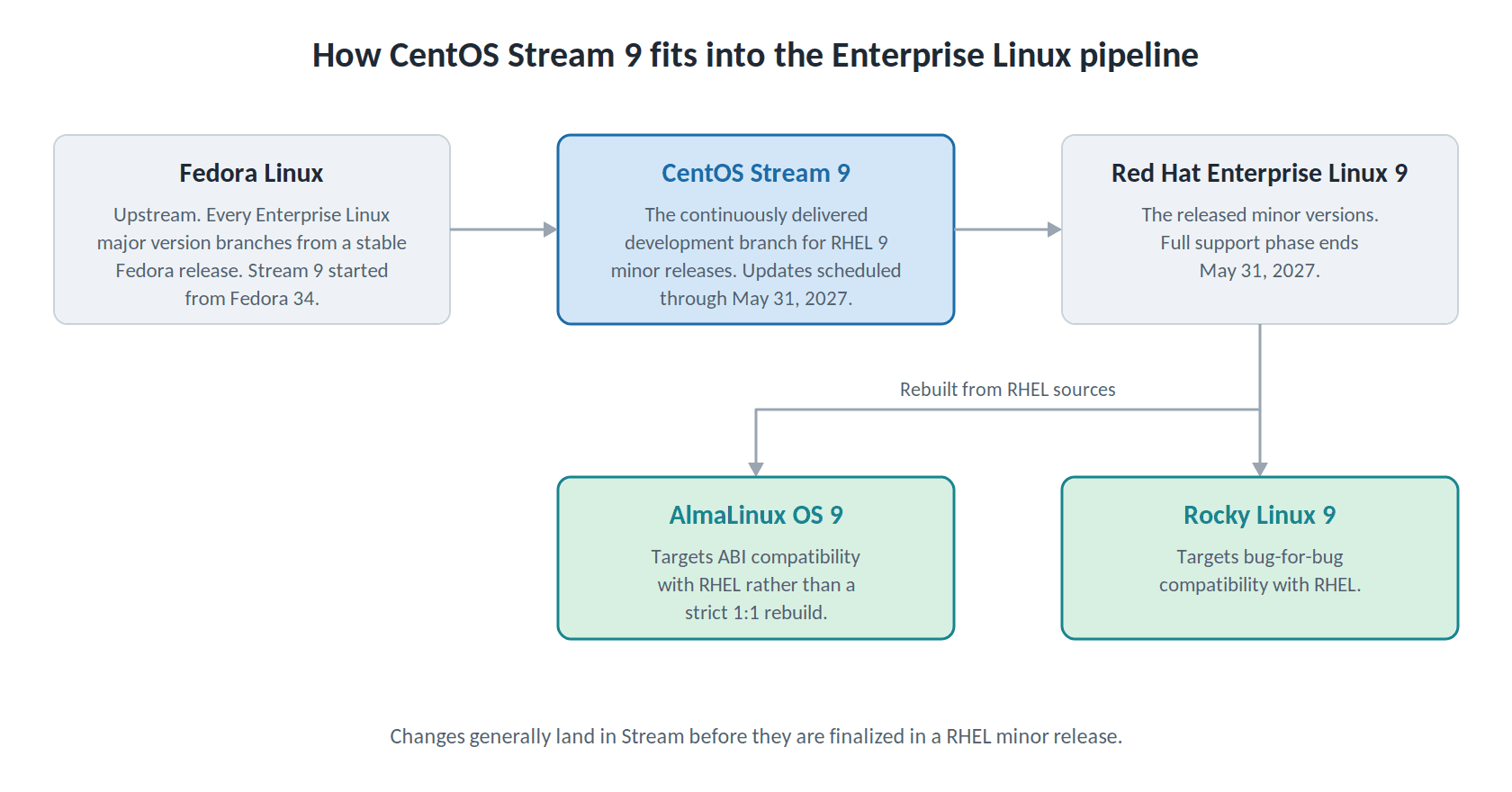
Released on December 3, 2021, CentOS Stream 9 is the second major version of the CentOS Stream distribution. It started from the Fedora 34 code base, the same one RHEL 9 is built from, and it has served ever since as the continuously delivered development branch for RHEL 9 minor releases. In practice, what lands in Stream generally reflects what is headed for a future RHEL 9.x point release, which is why developers and community members get to see upcoming changes ahead of the corresponding RHEL minor release.
This guide covers the CentOS Stream 9 end-of-life timeline, what actually goes wrong if you stay put, and the options in front of you, including how to keep systems patched until you are ready to move.
From CentOS Linux to CentOS Stream
In December 2020, Red Hat announced a major shift of focus from CentOS Linux to CentOS Stream, along with the discontinuation of traditional CentOS Linux. Support for CentOS Linux 8 concluded in December 2021, far earlier than originally planned. The previous release, CentOS Linux 7, got its full ten-year run and reached end of life on June 30, 2024.
CentOS Stream sits between Fedora and RHEL, and it changed how the CentOS community takes part in RHEL development. Each major Stream release starts from a stable Fedora release, and from there the work of building the next RHEL minor releases happens in Stream itself. Packages go through automated and manual testing before they land in Stream, so this is not a scratchpad. It is generally the same content headed for the next unreleased RHEL point release.
Learn How to Upgrade from CentOS 7 to AlmaLinux 9.
What Does CentOS Stream 9 EOL Mean?
CentOS Stream 9 EOL is the point where the standard support lifecycle ends and the CentOS Project stops shipping updates for it. That covers maintenance updates, security patches, and bug fixes. Losing those updates is what affects the security, stability, and compliance posture of the box.
CentOS Stream 9 is scheduled to receive updates through May 31, 2027, which is where the RHEL 9 full support phase ends. The CentOS Project ties the Stream 9 lifecycle to that phase rather than publishing a separate date of its own.
Note: CentOS Stream is not a rolling release in the Arch sense. It follows a continuous delivery model, giving you a stable base with regular updates. Those updates are the same ones headed for future RHEL 9.x releases, which keeps Stream closely aligned with RHEL development.
CentOS Stream Lifecycle Overview
CentOS Stream only has major versions, and each one is tied to a RHEL release. A Stream version reaches end of life when its matching RHEL version finishes its full support phase.
Here is how that plays out across the three Stream releases so far.
| Version | Release Date | End of Life Date |
| CentOS Stream 8 | September 24, 2019 | May 31, 2024 |
| CentOS Stream 9 | December 3, 2021 | May 31, 2027 |
| CentOS Stream 10 | December 12, 2024 | May 31, 2030 |
The Stream 8 date is already history. The other two track the end of the RHEL 9 and RHEL 10 full support phases.
Risks of Running CentOS Stream 9 After EOL
Nothing dramatic happens on June 1, 2027 – your systems keep running. The problem is what stops arriving, and it compounds quietly. Each of the following can hit security, compliance, or day-to-day stability, and together they are what decides whether you migrate, upgrade, or extend support.
Unpatched Security Vulnerabilities
Once the upstream project stops releasing patches, newly disclosed vulnerabilities in that release stay unpatched upstream. That is the whole risk in one sentence. End-of-life systems accumulate exposure over time, and vulnerabilities in widely deployed system packages such as the kernel, glibc, or OpenSSL can sit open indefinitely. Hand-rolling mitigations work for one server and fall apart across a fleet.
Compliance and Regulatory Gaps
Unsupported software makes compliance harder rather than automatically breaking it. Frameworks and standards like PCI DSS, HIPAA, and SOC 2 require organizations to manage vulnerabilities, security risk, and system controls appropriately, and PCI DSS in particular puts a clock on high-severity fixes.
An operating system that no longer gets upstream security fixes leaves you with more to explain and more to remediate at audit time, unless compensating controls or extended security support are in place.
Software and Hardware Incompatibility
Vendors may stop testing or supporting newer releases of their products on an operating system that has reached EOL. Post-EOL, newer versions of tools, drivers, or databases might never be qualified against CentOS Stream 9, which limits your ability to move an application stack forward or to deploy hardware that depends on newer drivers.
Operational Instability
After EOL, the CentOS Project no longer provides official fixes for newly discovered bugs. EOL on its own does not make a stable server fall over, but as applications, dependencies, and surrounding infrastructure keep changing, unresolved issues pile up and the box gets harder to maintain. A system that behaved perfectly for five years turns into the one nobody wants to touch.
What Are Your Options After CentOS Stream 9?
As Stream 9 heads toward end of life, you need a plan. Which one fits depends on your environment, your compliance obligations, and how fast you can realistically move. Most teams land on one of four.
1. Shift to a RHEL-Compatible Alternative
Plenty of organizations move to RHEL-compatible distributions such as AlmaLinux or Rocky Linux. Both offer the traditional stable release cycle that many enterprise users prefer over Stream’s continuous delivery model. Worth knowing the fine print: AlmaLinux now targets ABI compatibility with RHEL rather than a strict 1:1 rebuild, while Rocky Linux still aims for bug-for-bug compatibility. Migration takes planning and testing, but it puts you back on an actively supported lifecycle with ongoing security updates.
For a detailed comparison, see our guide on AlmaLinux vs CentOS Stream.
2. Move to Red Hat Enterprise Linux (RHEL)
Going to RHEL buys you official vendor support, predictable lifecycles, and a broad ecosystem of certified hardware and software. It comes with subscription costs, and in return you get enterprise-grade security updates, certified packages, and the kind of lifecycle commitments and documentation auditors like to see. This is usually the pick in heavily regulated environments, or for workloads where formal vendor support and platform certifications matter to your compliance requirements.
3. Upgrade to CentOS Stream 10
If the Stream model already works for you, moving to Stream 10 keeps you on it. Stream 10 continues the continuous delivery model and tracks RHEL 10 development closely.
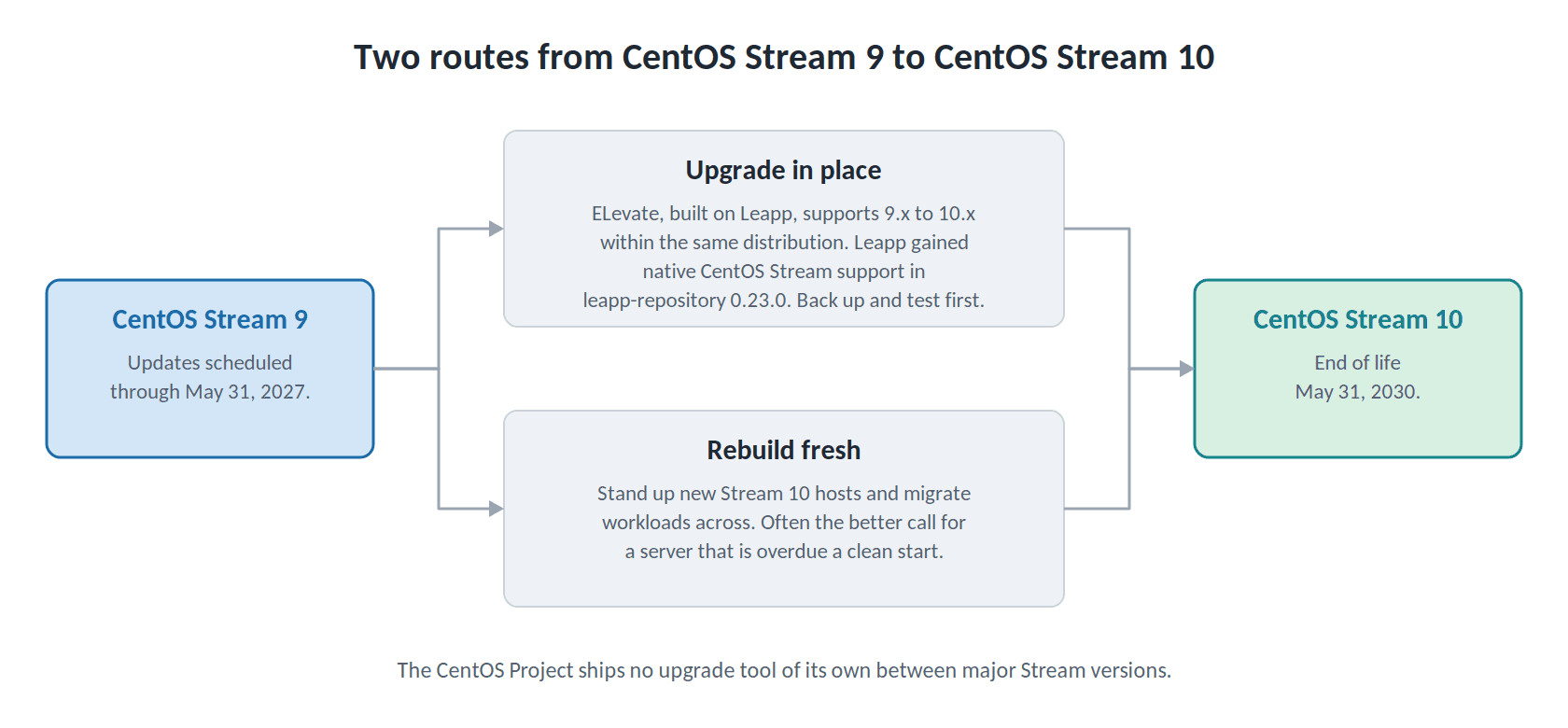
On the upgrade itself, the CentOS Project does not ship its own in-place upgrade tool between major Stream versions, so this is not a one-command affair. It is still doable in place. AlmaLinux’s ELevate project, built on Leapp, supports upgrading 9.x to 10.x within the same distribution, CentOS Stream 9 to CentOS Stream 10 included, and Leapp itself gained native CentOS Stream support in leapp-repository 0.23.0.
ELevate’s own guidance is to take backups or snapshots first and do a trial run in a sandbox before touching a production system. Rebuilding on fresh Stream 10 and migrating workloads across is still a perfectly reasonable choice, especially for a host that is overdue a clean start.
4. TuxCare’s Endless Lifecycle Support
Sometimes the honest answer is that you need more time. Legacy dependencies, awkward hardware integrations, or a team that is already fully booked can all make migrating before the end-of-life date unrealistic.
That is what Endless Lifecycle Support (ELS) is for. TuxCare keeps delivering security patches for covered packages after upstream support ends, so you get room to plan and execute a migration properly instead of at speed, while continuing to receive security updates and supporting your compliance work in the meantime.
In the CentOS ecosystem, TuxCare currently covers CentOS Linux 6, CentOS Linux 7, and CentOS Linux 8, plus CentOS Stream 8. CentOS Stream 9 is planned to follow once its lifecycle ends.
Note: Beyond CentOS, TuxCare provides extended support for other end-of-life Linux distributions including Ubuntu, Oracle Linux, RHEL, and Debian. Here is what is covered in Endless Lifecycle Support (ELS) for operating systems.
What Comes After CentOS Stream 9?
CentOS Stream 10 arrived in December 2024 and is now the development branch for future RHEL 10.x updates. Same pattern as before, where changes show up in Stream first and then get finalized in RHEL.
If you are still on Stream 9, treat that as the early warning. Stream 9 keeps getting updates until May 2027, but new platform work is increasingly happening in Stream 10, and that gap only widens.
Longer term, expect Stream to keep doing exactly this. It is a continuously updated distribution aligned to RHEL development, which means regular change is the deal you signed up for, and planning each upgrade before a version nears end of life is part of running it.
Keep CentOS Stream 9 Secure Post-EOL with TuxCare
If you are not ready to upgrade or migrate yet, the end-of-life date does not have to turn into a fire drill. TuxCare’s Endless Lifecycle Support (ELS) exists for exactly this situation.
After CentOS Stream 9 reaches end of life, TuxCare expects ELS to keep delivering security patches for high- and critical-risk vulnerabilities in covered packages, the ones the CentOS Project no longer fixes. That helps you cut vulnerability exposure, support your compliance requirements, and migrate on your own timeline rather than someone else’s.
For a look at how the previous CentOS migration cycle actually went, see our post on CentOS 8 end of life.