Tech Support
 Documentation
 Login
 Contact Us




Go straight to an AI summary of this blog post instead 


Key Takeaways
- Under FedRAMP’s 2026 rules, recommended remediation timeframes run from 12 hours to 192 days, counted from the provider’s evaluation of the vulnerability.
- New applicants must follow FedRAMP’s 2026 vulnerability rules from December 7, 2026, and existing providers must adopt them by March 7, 2027, at the latest.
- Vulnerabilities that won’t be fully mitigated or remediated within 192 days of evaluation must be labeled as accepted vulnerabilities.
- No FedRAMP remediation timeframe pauses when an open source maintainer stops shipping fixes.
- A vulnerability that misses its timeframe while the provider still intends to fully mitigate or remediate it becomes overdue, and each monthly report has to flag it with an explanation.
FedRAMP sets timeframes for mitigating or remediating vulnerabilities in your service, including those in open source packages. The timeframes keep running whether or not a fix exists.
Without a fix, you can mitigate vulnerabilities, but they will remain in your monthly reports until they’re remediated. Under FedRAMP’s new rules, a vulnerability that isn’t fully mitigated (reduced to negligible risk) or remediated within 192 days after you evaluate it must be labeled an accepted vulnerability. You then have to explain in your reports why it’s accepted.
Those new rules, the Consolidated Rules for 2026, are replacing FedRAMP’s legacy documents. Existing providers must adopt the vulnerability rules by March 7, 2027, at the latest.
The FedRAMP Vulnerability Remediation Timeline Before and After the 2026 Rules
FedRAMP marked its legacy documents as reference only on June 24, 2026. For vulnerabilities, the replacements are two rule sets in the Consolidated Rules for 2026: Vulnerability Detection and Response (VDR) and Vulnerability Evaluation and Reporting (VER). Providers that haven’t adopted these 2026 rules still follow the legacy processes during the transition. The 2026 rules say “certification” where the legacy documents say “authorization.”
The legacy Plan of Action and Milestones (POA&M) page states that FedRAMP requires vulnerabilities rated Critical or High to be remediated within 30 days of discovery, Moderate within 90 days, and Low within 180 days. The legacy Continuous Monitoring Playbook uses the Common Vulnerability Scoring System (CVSS) base score for that rating.
Under the 2026 rules, each certified service has a class, from A, the lowest level of assurance, to D, the highest. The remediation timeframe starts at evaluation. Evaluation should come within 14 days of detection for Class A, and within 2 days for Class D. The timeframe’s length depends on the class and on the N-rating the provider gives the vulnerability, an estimate of how much harm exploitation could do to agencies, from N0 (extremely unlikely to affect agencies) to N5 (debilitating effects on more than one agency).
The length also depends on whether the vulnerability is likely exploitable, meaning a likely attacker could use it to cause harm, and whether it’s internet-reachable, meaning a payload from the internet could trigger it. Vulnerabilities that are both get the shortest timeframe. VDR sets timeframes only for N-ratings N2 through N5 and leaves N0 and N1 to the provider’s routine operations.
| Item | Legacy documents | 2026 rules (VDR and VER) | Basis |
|---|---|---|---|
| Timeframe starts at | Discovery | Evaluation, which should happen within 14, 7, 5, or 2 days of detection for Classes A, B, C, and D | Legacy POA&M page; VER-TFR-EVU |
| Timeframe length | 30, 90, and 180 days by risk level | 12 hours to 192 days by class, N-rating, exploitability, and reachability | Legacy POA&M page; VDR-TFR-PVR |
| Strength | “FedRAMP requires” | SHOULD for timeframes, MUST for the accepted vulnerability label | Legacy POA&M page; VDR-TFR-PVR; VER-TFR-MAV |
| Rating | CVSS-based risk level | Provider’s N-rating estimate | Playbook, page 6; VER-EVA-EPA |
The remediation timeframes in the 2026 rules carry the SHOULD label. FedRAMP defines SHOULD as a rule that a provider may depart from for valid reasons, provided it explains the decision in its security documentation. Even so, FedRAMP’s notice NTC-0014 of June 16, 2026, calls the timeframes maximums and says providers should mitigate or remediate much faster.
Adoption Dates and the Directive Behind Them
Adoption happens provider by provider, according to FedRAMP’s Rev5 Deadlines page. New applicants must adopt both rule sets starting December 7, 2026. Existing providers that haven’t adopted by that date need a corrective action plan, which includes notice to all agencies, and FedRAMP will revoke the offering’s certification if the rules still aren’t adopted by March 7, 2027.
December 7 lines up with Binding Operational Directive (BOD) 26-04 from the Cybersecurity and Infrastructure Security Agency (CISA), issued June 10, 2026. The directive binds federal civilian agencies, which have until December 7 to start meeting its remediation table, and it reaches providers through FedRAMP’s rules and contracts. The table runs from 3 days to 60 days. NTC-0014 says that providers who follow VDR and VER meet the directive’s requirements.
What the Documents Say About a Finding With No Fix
A finding with no fix is handled differently in each set of documents. The legacy documents call it a vendor dependency (VD), which applies when a provider has to rely on a vendor, such as one that supplies a commercial off-the-shelf product, for a patch that isn’t available yet. A VD isn’t a deviation request (the legacy request type an agency approves for false positives, risk adjustments, and operational requirements), so it needs no approval.
A VD stays an open item, and the provider checks in with the vendor at least once a month. Even with no vendor patch, a High-risk VD (one at the legacy High risk level) has to be mitigated to Moderate with compensating controls within 30 days.
An operational requirement covers a finding that can’t be remediated, often because the system wouldn’t function as intended or because a vendor has said it won’t offer a fix. FedRAMP won’t approve one for a High-risk finding, though the provider can still mitigate it.
The legacy POA&M page uses the term “vendor” but doesn’t specify whether a volunteer maintainer counts as one. The VDR and VER rule sets don’t use the term “vendor dependency” at all. VDR says a provider that can’t fully mitigate or remediate a vulnerability should partially mitigate it promptly, progressively, and persistently.
Under VDR-TFR-PVR, a provider meets a timeframe by partially mitigating, fully mitigating, or remediating a vulnerability to achieve a lower N-rating within that timeframe. NTC-0014 adds that, for BOD 26-04 purposes, a provider may mitigate a vulnerability until it’s no longer automatable or internet-reachable, at which point the directive doesn’t require full remediation.
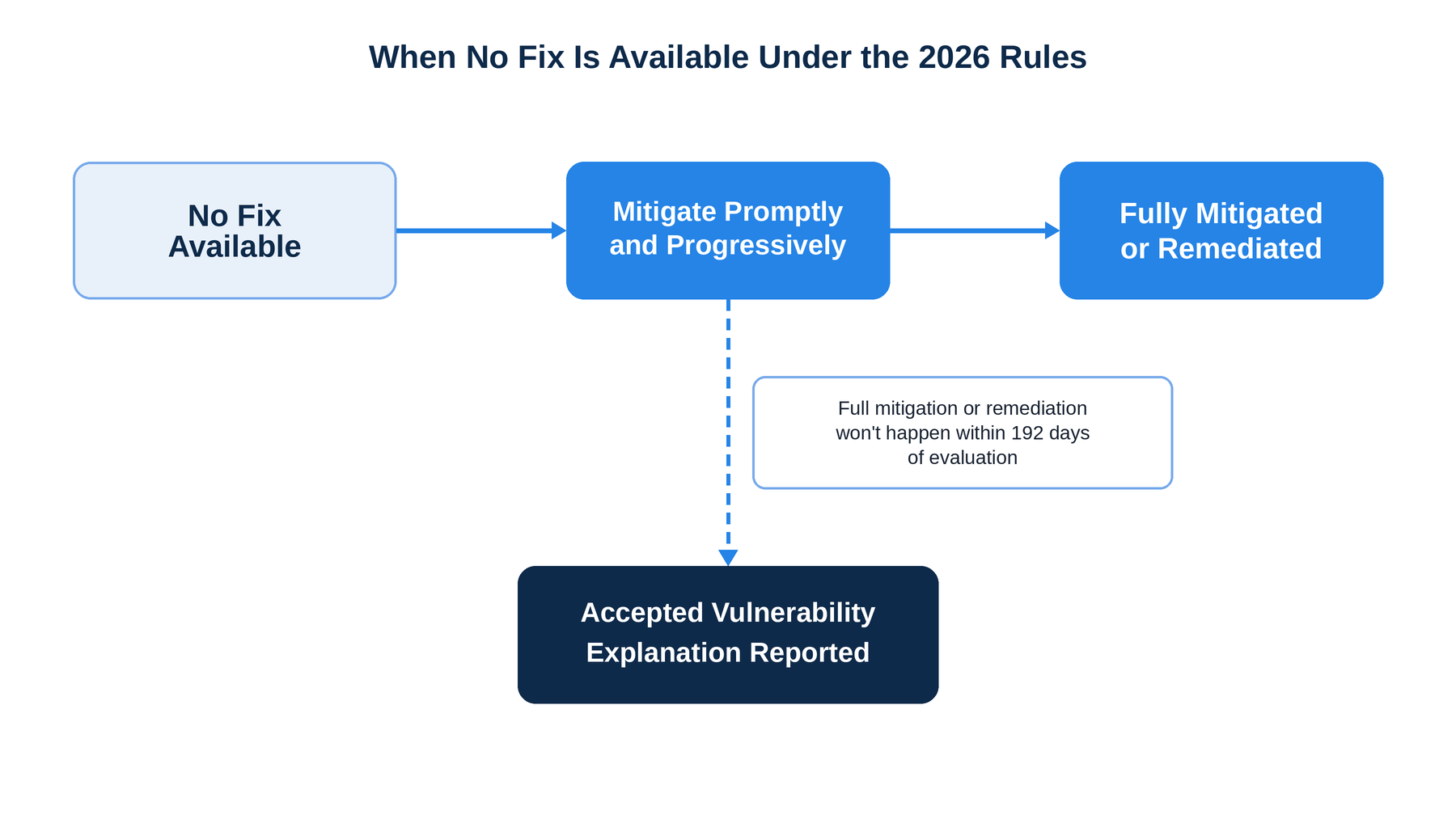
VER requires the accepted vulnerability label if a vulnerability is not, or will not be, fully mitigated or remediated within 192 days of evaluation. Each report then carries the provider’s explanation of why it’s accepted, the vulnerability’s reachability and exploitability, and its current N-rating.
Where Upstream Release Schedules Meet the Clock
Measured against the FedRAMP vulnerability remediation timeline, the patch gap is the portion of a finding’s timeframe during which no fix is available. The legacy POA&M page, the Playbook, the 2026 vulnerability rules, and FedRAMP’s definitions don’t mention open source maintainers or whether a project still gets releases. VDR does list supply chain monitoring among the techniques for finding weaknesses, so what a package brings into a build is part of what a provider can be expected to watch. Beyond the handling above, those documents don’t say what a provider should do when the maintainer isn’t going to fix the finding.
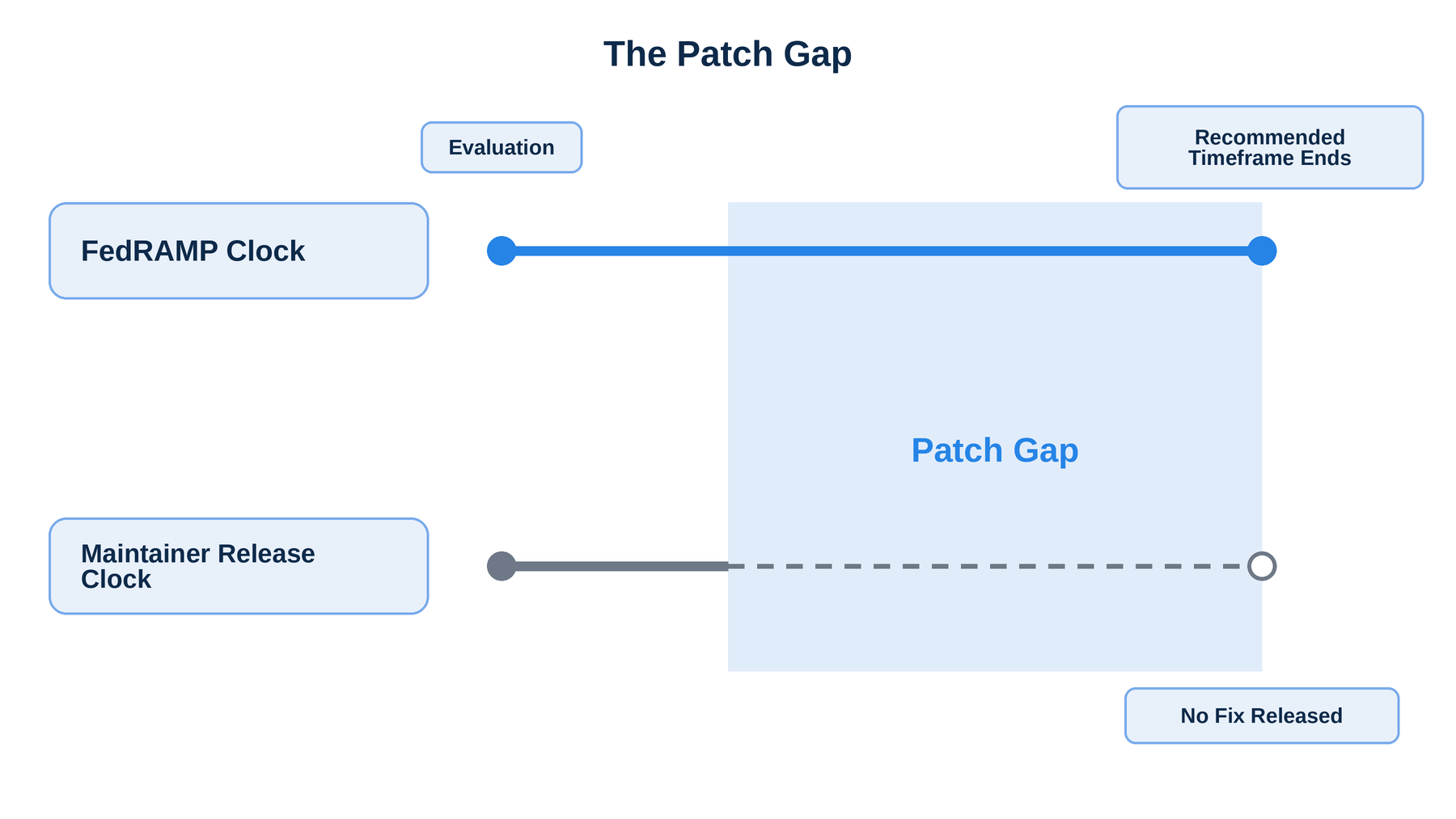
Suppose your service holds a Class C certification and detects a finding on day 0 in an open source package whose maintainers have stopped releasing fixes. Class C providers should evaluate within 5 days of detection, so say the evaluation lands on day 5 and rates the finding N3.
| How the evaluation comes out | Timeframe from evaluation | Day (if evaluated on day 5) | Basis |
|---|---|---|---|
| Likely exploitable and internet-reachable | 16 days (should) | Day 21 | VDR-TFR-PVR, Class C, N3 |
| Likely exploitable but not internet-reachable | 32 days (should) | Day 37 | VDR-TFR-PVR, Class C, N3 |
| Not likely exploitable | 128 days (should) | Day 133 | VDR-TFR-PVR, Class C, N3 |
| Any of the three, if not (or not expected to be) fully mitigated or remediated within 192 days of evaluation | Accepted vulnerability label required as soon as full mitigation or remediation won’t happen within 192 days (must) | As soon as the provider knows, and by day 197 at the latest | VER-TFR-MAV |
Whether the maintainers ever release a fix does not change any of those numbers. Which row applies depends on the provider’s evaluation, and FedRAMP includes a warning about that. Its note on the exploitability rule states that providers who regularly rate vulnerabilities as unlikely to be exploitable without careful consideration are more likely to suffer an adverse impact if one is exploited. Reckless or deliberate under-rating, it adds, will count against a provider’s certification. Providers also have to assume that exploitation can be automated unless they have evidence to the contrary.
CISA’s directive lets changed facts move the timeline. One of its notes says that taking a system off the internet moves it to a different row of the directive’s table. Known exploited vulnerabilities keep their due dates, though. VDR-TFR-KEV says providers should remediate them by the due dates in CISA’s catalog even when they’re fully mitigated, and NTC-0014 leaves room only for valid technical reasons not to.
A maintainer who’s still releasing can give a provider something to apply before the timeframe ends. One who has stopped leaves the timeframe running with nothing to apply, and that gap can show up in any language ecosystem from which a service pulls packages.
What Happens When a Timeframe Passes
The legacy Playbook lists example triggers that agencies can pick from. Five or more High Impact vulnerabilities or POA&M items left unremediated for more than 30 days call for at least a Detailed Finding Review, a request to assess the deficiency and report its cause and remedy. Once five or more pass the 60-day mark, the minimum step is an agency corrective action plan, which asks for a root-cause analysis and a formal remediation plan. From there, an agency can escalate to suspension or revocation of an Authorization to Operate (ATO), a step it has to report to FedRAMP.
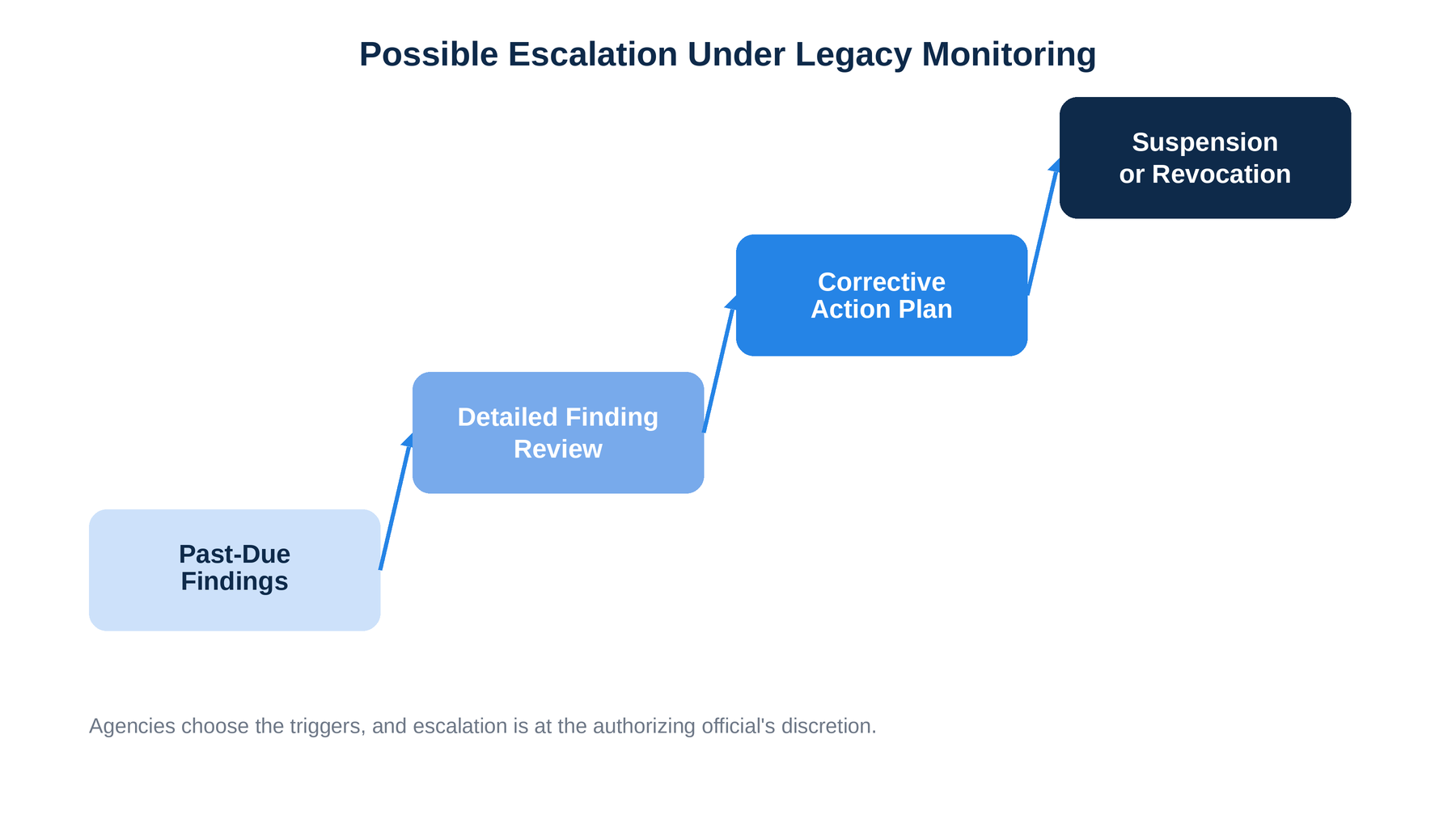
The POA&M discussion at the Playbook’s monthly collaborative meeting with agencies should focus on past-due items, vendor dependencies, and deviation requests, so a finding that remains open tends to resurface.
The VDR and VER pages don’t name a penalty for missing a SHOULD-level timeframe. A provider still has to justify the departure, as any SHOULD requires, and VER adds reporting on top. FedRAMP’s definitions consider a vulnerability overdue when the provider intends to fully mitigate or remediate it but hasn’t done so, or won’t do so, within the recommended or required timeframes. The accepted vulnerability label covers vulnerabilities the provider doesn’t intend to fully mitigate or remediate, as well as any vulnerability past the 192-day limit. VER requires each report to say whether a vulnerability is overdue or likely to become overdue, and to explain if so.
Patching Packages After Maintainers Stop
SecureChain from TuxCare rebuilds the open source packages it covers from source in hardened, isolated environments and screens their source code for known malware and suspicious code patterns. Anything that fails screening stays out of your environment. While maintainers still release fixes, SecureChain patches packages under a service-level agreement, using upstream fixes when available and patches from TuxCare engineers when upstream falls short.
When upstream stops releasing, TuxCare keeps patching the package, which later moves automatically into Endless Lifecycle Support (ELS), with TuxCare engineers backporting fixes to the versions you already run for as long as you use the package.
SecureChain also provides provenance information, software bills of materials (SBOMs), and Vulnerability Exploitability eXchange (VEX) data, which help show what a package brought into your build. Together, SecureChain and ELS cover JavaScript, Python, Java, Go, and PHP.
If you can’t say who patches a package once its maintainers stop releasing fixes while a FedRAMP timeframe keeps running, or what that package brought into your build, see how SecureChain approaches those two questions.
FAQ
Who Is Responsible for Remediation Under FedRAMP?
Under the Consolidated Rules for 2026, the cloud service provider is responsible: the Vulnerability Detection and Response rules require providers to track, mitigate, and remediate all detected vulnerabilities. The legacy Continuous Monitoring Playbook (version 1.0, November 17, 2025, now reference only) also gives the provider primary responsibility, with agency authorizing officials reviewing its monthly Plan of Action and Milestones.
Who Assigns the Rating That Sets a FedRAMP Deadline?
In the legacy Continuous Monitoring Playbook, now reference only, the original risk rating is the National Vulnerability Database’s version 3 Common Vulnerability Scoring System (CVSS) base score. The 2026 Vulnerability Evaluation and Reporting rules require the provider to estimate a vulnerability’s potential agency impact as an N-rating from N0 to N5.
When Does the FedRAMP Remediation Clock Start?
The legacy Plan of Action and Milestones page, now reference only, counts 30, 90, or 180 days from discovery, depending on risk level. The 2026 Vulnerability Detection and Response rules count from evaluation, which the Vulnerability Evaluation and Reporting rules say should follow detection within 14, 7, 5, or 2 days, depending on certification class.
Which FedRAMP Terms Cover a Finding With No Available Fix?
Vendor dependency and operational requirement are legacy terms on the Plan of Action and Milestones page. The first covers a vulnerability awaiting a vendor fix, and the second covers a vulnerability that can’t be remediated. The 2026 Vulnerability Detection and Response rules recommend partial mitigation, and the Vulnerability Evaluation and Reporting rules require the accepted vulnerability label if full mitigation or remediation won’t happen within 192 days of evaluation.
What Counts as Remediated Under FedRAMP’s 2026 Rules?
A remediated vulnerability, in the definitions of the Consolidated Rules for 2026, has been neutralized or eliminated and is no longer detected. A fully mitigated vulnerability is still detected, but its risk is negligible. The Vulnerability Detection and Response rules add that mitigation and remediation aren’t interchangeable.
What Does FedRAMP Call a Vulnerability That Misses Its Timeframe?
A vulnerability becomes overdue when the provider still plans to fully mitigate or remediate it but has missed, or will miss, its timeframe. If the provider doesn’t plan to, it’s an accepted vulnerability instead. Under the 2026 Vulnerability Evaluation and Reporting rules, each report must flag a vulnerability that’s overdue or likely to become overdue, with an explanation.