Tech Support
 Documentation
 Login
 Contact Us




Go straight to an AI summary of this blog post instead 


key takeaways
- Each PHP release branch reaches end of life after its two years of active support plus two years of security support.
- Running PHP 8.1 after EOL increases risks, including vulnerabilities, compliance gaps, and plugin or framework incompatibility.
- Extended support services, like TuxCare’s ELS, allows organizations to keep PHP 8.1 secure while planning a safe upgrade path.
PHP 8.1 reached its End of Life (EOL) on December 31, 2025. After this date, it no longer receives security patches, bug fixes, or official support from the PHP development team.
Many businesses and applications still run PHP 8.1 in production. The EOL status raises real and immediate concerns about security, compliance, and long-term stability for those systems. If your applications rely on WordPress, Laravel, Magento, or other popular platforms, the impact can be immediate.
This article explains what PHP 8.1 EOL means, the risks of staying on it, and the steps you can take to keep your systems secure. You will also learn about your available upgrade paths and extended support options so you can plan ahead with confidence.
What Does PHP 8.1 EOL Mean?
Every PHP release branch receives two years of Active Support followed by two additional years of Security Support for critical issues. After this official support period ends, any new security vulnerabilities remain unpatched, regardless of how severe they are.
With PHP 8.1 EOL on December 31, 2025, the development team has stopped providing security patches, bug fixes, and upstream maintenance.
Organizations often run older PHP versions because of legacy application code or complex systems. In these specific cases, extended support becomes the only way to maintain security and compliance while application teams plan a proper migration. Vendors like TuxCare offer long-term security updates for multiple end-of-life PHP versions. This helps businesses maintain critical protection with ongoing security patching and unload pressure of rushing an immediate upgrade.
PHP 8.1 Support Lifecycle Timeline
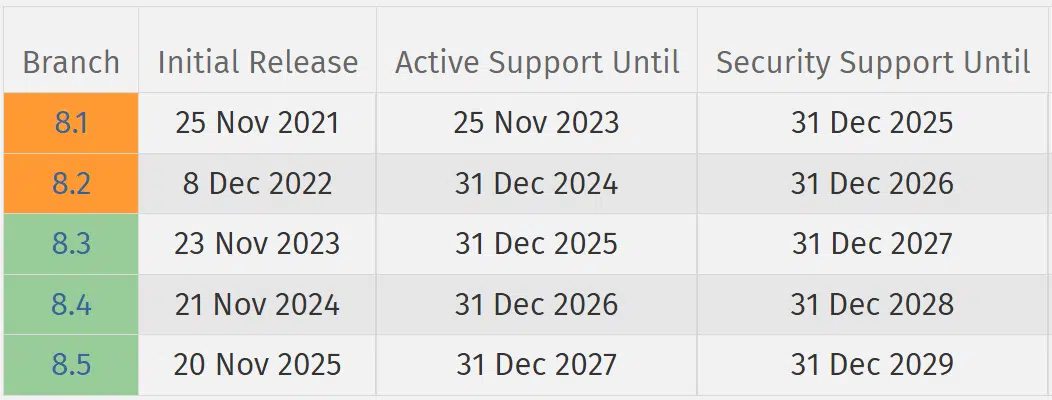
PHP 8.1 was released on 25 November, 2021, and its active support ended on 25 November, 2023. Its security support ended on 31 December, 2025, after which it is marked as the end-of-life branch.
This means any new vulnerabilities remain unpatched unless an organization upgrades or uses an extended support service. This is why many teams review their PHP version roadmap well before the security window closes, especially when applications depend on older frameworks or plugins that delay migration work.
How PHP 8.1 EOL Impacts Real Applications
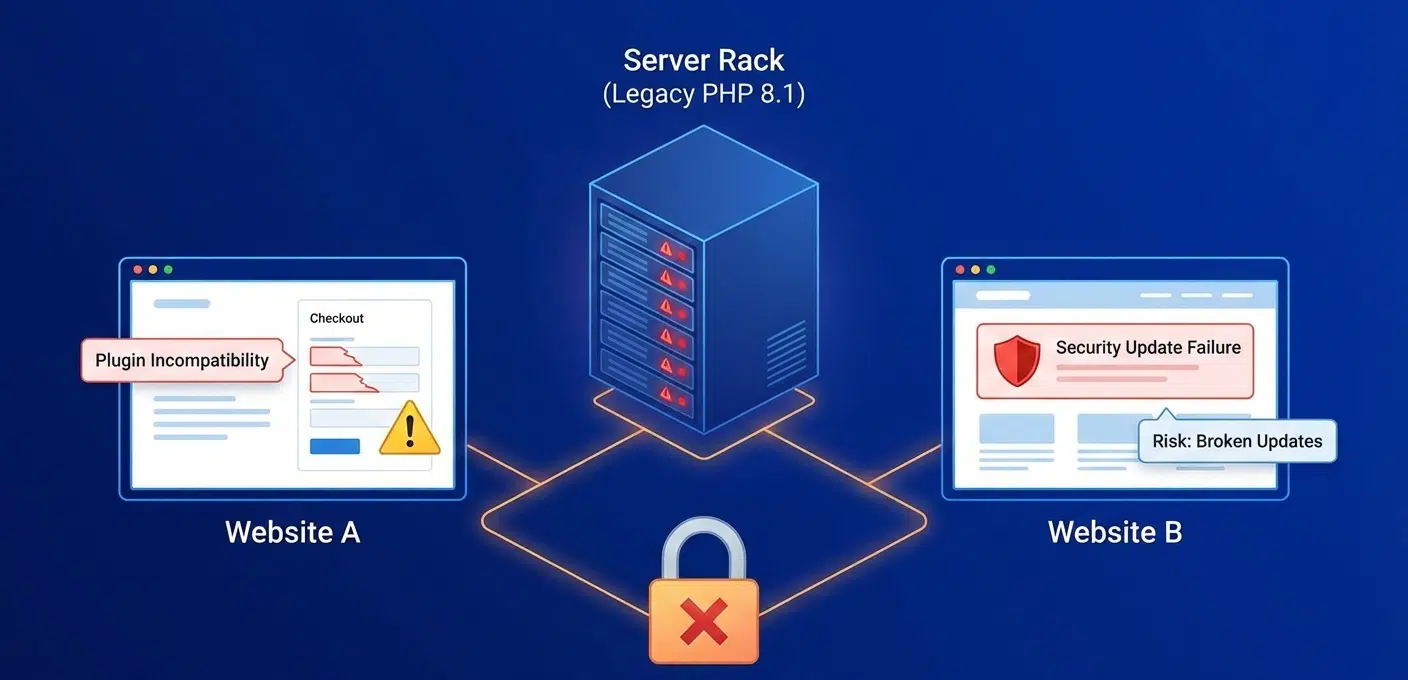
PHP EOL affects more than the core language. Many popular platforms depend on a supported PHP version to receive their own security and feature updates. For example, WordPress, Drupal, Magento, and Laravel continue to drop support for older PHP versions to leverage new language features and avoid maintaining old codebases.
After PHP 8.1 EOL, these tools may stop testing or supporting it. This can lead to broken updates, failed installs, or compatibility issues that are hard to trace. Hosting providers also phase out EOL versions, which can limit deployment options or force unplanned migrations.
According to W3Techs usage statistics, PHP powers over 70% of all websites, and around 40% of these use PHP version 8. Within this group, roughly 60% of sites have upgraded to PHP 8.2 or newer, though PHP 8.2 reaches end of life on December 31, 2026, so those teams are not far behind in the same EOL queue. However, nearly 23% still run PHP 8.1.
This means millions of websites remain on PHP 8.1 and face growing security issues and compatibility risks now that it has reached end of life.
You can also learn more about Laravel security in our in-depth guide.
Why PHP Versions Are Retired
PHP versions follow a predictable four-year lifecycle and retire on a fixed timeline. This helps keep the language secure, stable, and easy to maintain. Older releases become harder to support as new features, performance improvements, and security standards move forward. Retiring a version lets PHP maintainers focus on modern branches that follow current development practices and offer safer defaults.
1. Security Standards Move Forward
Security requirements change over time. Older PHP versions rely on outdated libraries and cryptographic functions that no longer meet current best practices. Retiring old versions reduces the risk developers must manage and prevents them from maintaining insecure code paths.
2. Performance and Feature Growth
New release cycles bring faster execution, improved syntax, and better memory use. Keeping every version active would slow development and spread resources thin. Ending support ensures the community can focus resources on features that matter today.
3. Limited Maintenance Resources
Maintainers must test, fix, and validate security fixes across many platforms. Retiring older versions helps them focus effort on newer branches, where most users and projects operate. This efficient use of resources benefits the entire PHP community.
Note: New PHP versions introduce features, performance improvements, and security changes. They also remove features that were deprecated in earlier releases, which can cause backward compatibility issues for applications that rely on older behavior.
Risks of Staying on PHP 8.1 After EOL
Running PHP 8.1 after its end-of-life date introduces several security and operational risks that grow over time. The core application may continue to run, but the technical environment around it will move forward. This creates gaps that often remain undetectable until they cause outages or security issues.
1. Exposure to Unpatched Vulnerabilities
Attackers actively scan for outdated PHP versions such as PHP 8.1 because known weaknesses remain open and are often documented as public Common Vulnerabilities and Exposures (CVEs). In 2025, the PHP ecosystem saw 12 new vulnerabilities published, with an average severity score of 5.3.
The total number of vulnerabilities varies year to year. However, the key risk after end of life is that newly discovered issues no longer receive official patches. Even a low-severity flaw can become critical over time when no upstream fix is available.
2. Compliance and Audit Failures
Most regulatory frameworks demand the use of supported, maintained software. Standards like PCI DSS, HIPAA, and ISO 27001 treat EOL components as a significant security risk. Running unsupported PHP can increase your audit scope, require expensive compensating controls, or generate findings that delay certification.
3. Breakage in CMS, Plugins, and Frameworks
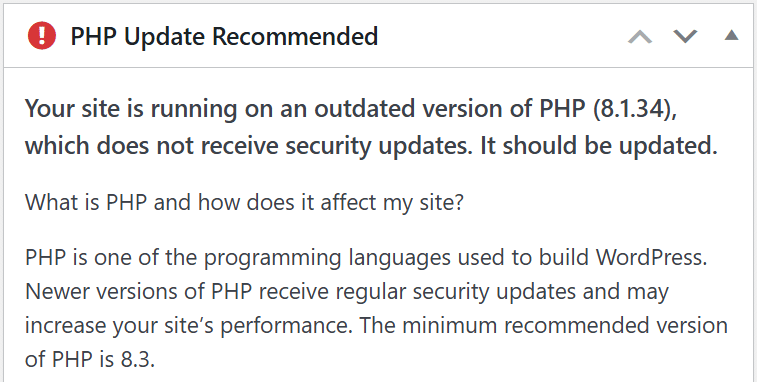
Modern platforms phase out older PHP versions as they release new features and security standards. WordPress, Drupal, Magento, and Laravel often stop testing against EOL releases. Updates may break core functionality, behave unpredictably, or refuse to install. This leaves applications effectively feature-frozen and unable to benefit from platform improvements.
4. Higher Maintenance and Debugging Costs
Unsupported versions inherently increase operational work. Teams must spend time and resources writing custom patches, troubleshooting issues with frozen dependencies, or maintaining highly isolated environments. These steps divert valuable resources away from new product development.
5. Hosting and Vendor Support Limits
Many hosting providers and critical SaaS tools actively remove EOL PHP versions from their supported stacks. This phase-out can force unplanned migrations, block necessary software upgrades, or create unforeseen downtime during mandatory platform changes imposed by the provider.
Your Options After PHP 8.1 End of Life
After PHP 8.1 EOL, organizations must choose a path to keep applications secure and stable. The right approach balances immediate risk reduction with long-term upgrade planning.
1. TuxCare’s Endless Lifecycle Support (ELS)
One way to address the immediate security and compliance risks of PHP 8.1 EOL is to use TuxCare’s Endless Lifecycle Support for PHP.
TuxCare’s ELS provides ongoing security patches for PHP 8.1 and other end-of-life versions beyond their official support dates. This allows organizations to continue running critical applications securely while giving development teams time to plan and execute an upgrade.
ELS supports multiple PHP versions, including 5.2 through 8.1, and offers access to security updates from a single, TuxCare-maintained repository. By removing the pressure to migrate immediately, ELS helps reduce unplanned downtime, rushed code changes, and unexpected upgrade costs.
For additional details on lifecycle options, check out our resource on extended support for PHP.
Visit the CVE Tracker to explore all vulnerabilities addressed in PHP 8.1 by TuxCare ELS.

2. Upgrade to PHP 8.3 or 8.4
Upgrading to a supported PHP version remains the long-term goal. Moving to PHP 8.3 or 8.4 restores official security updates and provides performance improvements and newer language features, though teams should also keep the PHP 8.3 EOL date of December 31, 2027 on their radar when planning the next migration.
However, upgrades often require code changes, dependency updates, and thorough compatibility testing. Using extended support during this period helps teams migrate on their own timeline rather than under security pressure.
Keep PHP 8.1 Patched Beyond EOL Using TuxCare ELS
With PHP 8.1 EOL, security updates from PHP.net have stopped completely. Organizations still running critical applications on PHP 8.1 face increasing risk from unpatched vulnerabilities and potential compliance failures.
TuxCare’s Endless Lifecycle Support (ELS) provides essential security patches for PHP 8.1 beyond the EOL date. By using extended support, you can transition at a controlled pace, keeping all systems secure and preventing disruption to core business operations.
Have questions about PHP end of life or Endless Lifecycle Support? Get in touch with TuxCare experts to get answers.