Tech Support
 Documentation
 Login
 Contact Us


Go straight to an AI summary of this blog post instead 


Key Takeaways
- PHP 8.2 reaches end of life on December 31, 2026. After that date, no security patches will ship from the PHP project for this version.
- EOL PHP is not just a security risk; it can also create compliance problems under PCI DSS, HIPAA, and SOC 2.
- Upgrading to PHP 8.3, 8.4, or 8.5 is the right fix, but dependency issues make the timeline longer than most teams expect.
- If you cannot upgrade before the deadline, TuxCare’s Endless Lifecycle Support for PHP keeps 8.2 patched while you migrate.
If you are running PHP 8.2 in production, the clock is already ticking louder than you might think. PHP 8.2 is past active support and sitting in its security-only window – December 31, 2026, is the hard stop. That date sounds manageable until you actually map out what a real upgrade involves: staging environments, dependency audits, framework compatibility checks, regression tests across hundreds or thousands of routes. Suddenly the runway is not as long as the calendar suggested.
This post covers the PHP 8.2 EOL timeline, what actually happens after that date, and the three options teams realistically have. If you came here hoping for a “just upgrade, it’s fine” answer – fair warning, that is not what this is. Upgrading is rarely as simple as it looks from a distance.

PHP: Versions and Timelines Explained
PHP (Hypertext Preprocessor) follows a fixed four-year support lifecycle: two years of active support, followed by two years where only critical security patches ship. After that, it is EOL – the project closes the branch and moves on. This four-year window was extended from three years in 2024, with all EOL dates now landing on December 31 of the relevant year.
PHP 8.2 shipped on December 8, 2022. Active support wrapped up at the end of 2024, and it is now in that final security-only stretch. The official release schedule and support status for each branch are tracked at php.net.
PHP 8.1 is included below for reference only because it recently crossed into EOL. Here is where PHP 8.1 and the currently supported 8.x branches sit as of 2026:
|
PHP Version |
Release Date |
Active Support Ended |
End of Life |
|
8.1 |
Nov 25, 2021 |
Nov 25, 2023 |
Dec 31, 2025 (already EOL) |
|
8.2 |
Dec 8, 2022 |
Dec 31, 2024 |
Dec 31, 2026 |
|
8.3 |
Nov 23, 2023 |
Dec 31, 2025 |
Dec 31, 2027 |
|
8.4 |
Nov 21, 2024 |
Dec 31, 2026 |
Dec 31, 2028 |
|
8.5 |
Nov 20, 2025 |
Dec 31, 2027 |
Dec 31, 2029 |
PHP 8.1 is already EOL – any CVE disclosed against it now will never receive an official patch for hosts still running it. PHP 8.2 has roughly the same runway as a typical enterprise upgrade cycle, which is to say: not a lot of margin for delay.
Did You Know: According to W3Techs Usage Statistics, PHP powers 71.2% of all websites with a known server-side language. Among sites running PHP 8, version 8.2 is the single most widely used subversion at 32.8% – ahead of 8.3 at 29.1% and 8.4 at 9.9%. PHP 8.1 and 8.0, both already EOL, are still running on a combined 26.6% of PHP 8 sites. Version upgrades happen much slower in production than they do on release blogs.
What Happens After PHP 8.2 Reaches EOL?
After December 31, 2026, the PHP project closes the 8.2 branch and stops shipping anything for it. No official patches, no official fixes, no exceptions from the PHP project. What that means for your infrastructure plays out across four areas.
1. Security Patches Stop Shipping
The most obvious consequence, and the one with the sharpest teeth. Once 8.2 hits EOL, no CVE – critical, high, or low – will get a fix from the PHP project. A remote code execution bug disclosed on January 2, 2027, would be patched in 8.3, 8.4, and 8.5. For 8.2, it stays open.
This is not theoretical. CVE-2024-4577, an argument-injection bug affecting PHP-CGI on Windows under certain code-page configurations, was disclosed in June 2024. It got fixed in 8.1.29, 8.2.20, and 8.3.8. Older EOL branches, including PHP 8.0 and 7.x, were reported as affected in public advisories but received no official PHP project fix because they were already out of support. Mass exploitation followed within days: researchers tracked thousands of attacking IPs deploying cryptominers, web shells, and DDoS infrastructure through that single bug.
The same pattern continued with later PHP CVEs. CVE-2025-14177 and CVE-2025-14180, for example, were fixed in supported branches including PHP 8.1 through 8.5. Once a branch crosses EOL, that official patch stream stops.
The pattern is well-documented: attackers reverse-engineer the patches that ship for supported branches and use them as a roadmap to exploit the unpatched ones. The gap between public disclosure and active exploitation for high-severity bugs is measured in days, sometimes hours. TuxCare’s analysis of CVE-2023-0568 in PHP 7 is a good case study in how reliably this pattern repeats.
PHP sees consistent CVE activity. Stack.watch data sourced from NVD shows 18 vulnerabilities disclosed in 2024, 15 in 2025, and 2026 already at 11 with months still to go. In May 2026, PHP 8.2.31 patched eight vulnerabilities in a single release. Once 8.2 goes EOL, security releases will continue for supported branches – and 8.2 will get none of them.
You can also explore how automated patching solutions maintain security through vendor-backed PHP extended support.
2. Compliance and Audit Risk Increases
Most security frameworks – PCI DSS, HIPAA, SOC 2, FedRAMP, ISO 27001 – require organizations to maintain a defensible vulnerability management process and apply available security patches. EOL software makes that harder by definition. Here is what that looks like in practice:
- PCI DSS: Requirement 6.2 says applicable security patches need to be applied within one month of release. If there are no official patches to apply because the runtime is EOL, you may be pushed into continuous non-compliance unless you have documented compensating controls.
- SOC 2: Auditors often flag EOL components as control weaknesses. Expect a written remediation plan with a deadline attached.
- HIPAA: Running EOL software in systems that handle PHI can raise questions about whether your safeguards remain reasonable and appropriate under the Security Rule.
- Cyber insurance: Carriers are adding exclusions or premium increases for incidents traced to EOL components. This is getting more common at renewal time.
The frustrating part: your PHP runtime could be the only EOL piece in an otherwise clean stack, and it still tanks the audit.
3. Ecosystem Drift Accelerates
The moment 8.2 goes EOL, the ecosystem starts quietly walking away. Frameworks drop it from their test matrices. Composer packages bump their minimum version to 8.3. Hosting providers phase it out of managed stacks. CI runners stop including it in defaults.
This does not happen all at once – that is what makes it insidious. It is a hundred small incompatibilities that accumulate over months. A security patch ships for a library you depend on, but only for 8.3+. An ORM update assumes a feature that 8.2 does not have. A new monitoring agent drops the 8.2 build entirely. None of this is catastrophic on day one. Six months in, you are maintaining a tangle of pinned versions and workarounds, and the actual upgrade has gotten harder, not easier.
4. Hidden Operational Drag
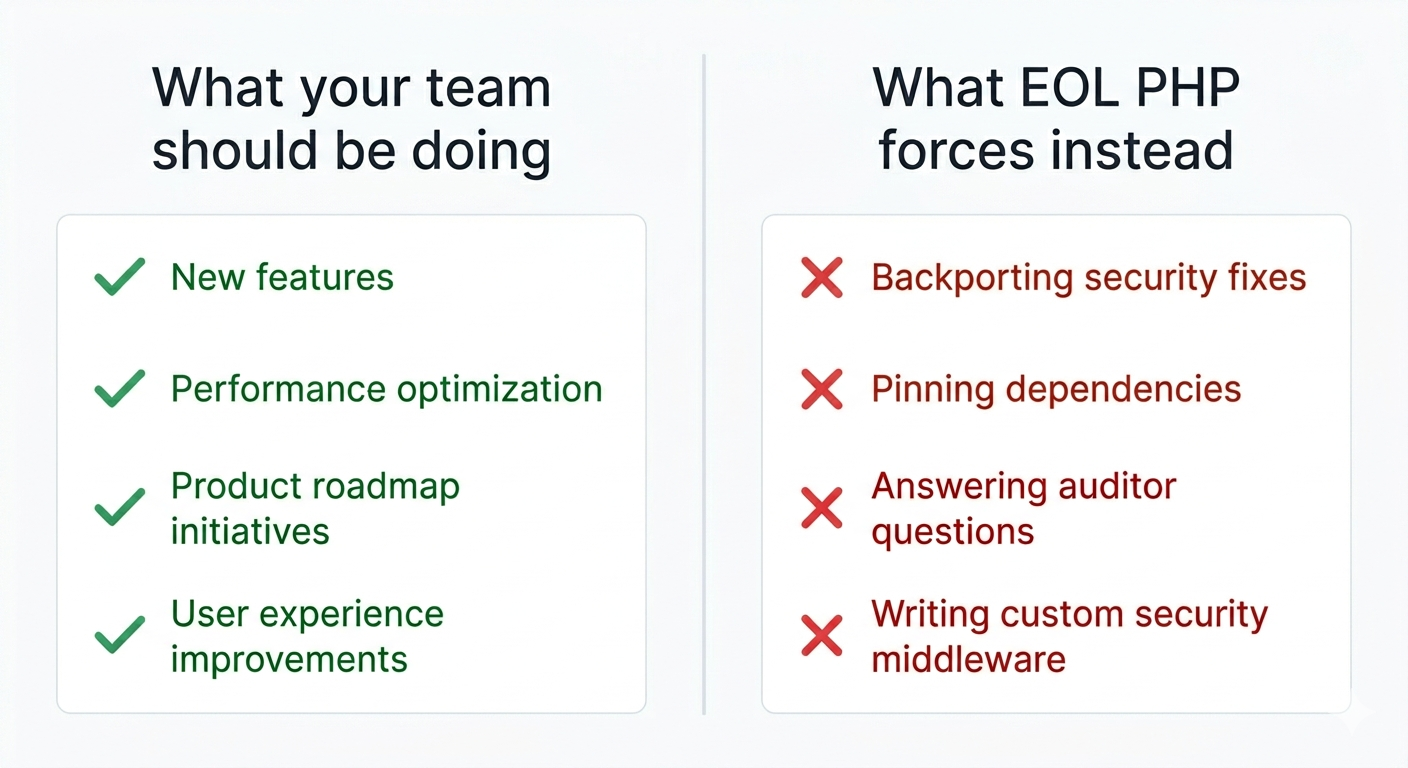
This one tends to be underestimated. Running EOL PHP means your team burns engineering time on things that are not features: manually backporting fixes, pinning dependency versions, writing custom security middleware to cover gaps, fielding auditor questions, and explaining to enterprise prospects why the runtime is out of support.
Multiply that across a year and “we’ll upgrade later” has a real cost that does not show up cleanly in a ticket or a sprint but absolutely shows up in velocity.
Your Options After PHP 8.2 EOL
There are three realistic paths. Which one makes sense depends on your stack, your team size, and how honest you’re willing to be about your actual migration timeline.
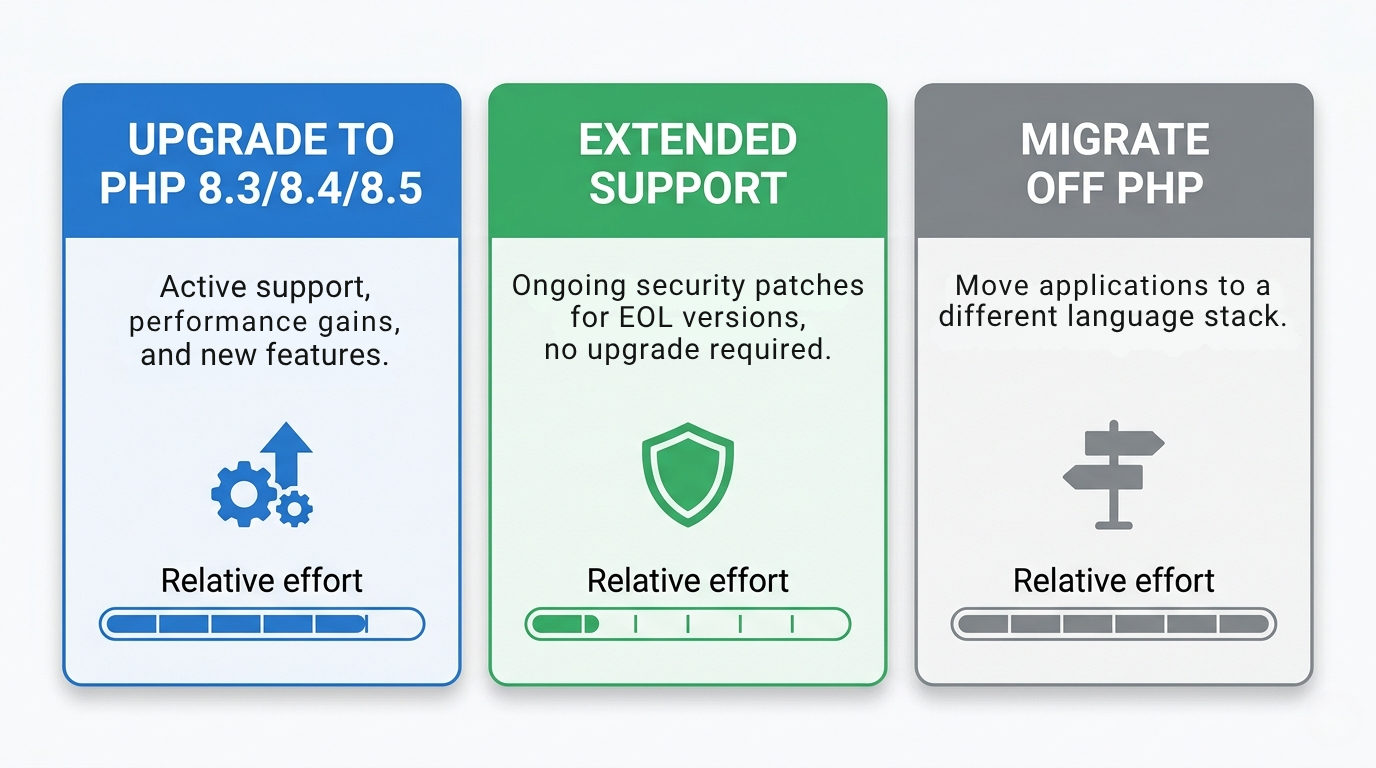
Option 1: Upgrade to PHP 8.3 or Newer
The default recommendation – and the right call when it is actually feasible. Moving to PHP 8.3, 8.4, or 8.5 restores official security support and brings real improvements: typed class constants in 8.3, property hooks and asymmetric visibility in 8.4, and broader performance and runtime gains.
But upgrading is doing a lot of work in that sentence. A PHP version bump in a real production environment typically means:
- Auditing every Composer dependency for 8.3+ compatibility.
- Working through deprecation warnings – including the dynamic properties deprecation that landed in 8.2 and is expected to become a fatal error in PHP 9.0.
- Updating CI matrices, Docker base images, and deployment manifests.
- Running full regression tests across every endpoint.
- Coordinating framework upgrades, including Laravel, Symfony, WordPress, Drupal, and Magento, that often have their own version constraints and plugin compatibility considerations.
Tools like Rector can automate parts of the refactoring work, but they do not eliminate the dependency compatibility problem – they just speed up the PHP-specific syntax changes.
From the Trenches: The PHP runtime change is almost always the easy part. What actually derails upgrade timelines is the third-party package that has not been touched since 2022 and now blocks everything else. Dependency hell, not PHP itself, is where most teams lose weeks.
Decision moment:
- If your codebase is well-tested, dependencies are reasonably current, and you have the capacity – upgrade now and target PHP 8.4 or 8.5.
- If your timeline realistically slips past December 2026 – start the upgrade, but layer in extended support so you are not unprotected mid-migration.
Option 2: Extended Support for PHP 8.2
The pragmatic middle ground, and one that more teams undervalue when they are laying out options. Vendor-backed extended support keeps PHP 8.2 patched against new CVEs after the official EOL date, without requiring an immediate runtime upgrade. Security patches keep coming, your application keeps running, and your team migrates on a schedule driven by engineering reality instead of a fixed calendar deadline.
This is exactly the gap that TuxCare’s Endless Lifecycle Support for PHP is built to fill. It provides ongoing security patches for EOL PHP versions, delivered as drop-in replacements with no application code changes required. Current public TuxCare documentation lists coverage for PHP versions from 5.1.6 through 8.3, depending on OS and distribution.
There’s also a downloadable datasheet on ELS for PHP covering why upgrading is not always the immediate answer and how extended support fits into your environment – worth a read before making an evaluation.
Choose this path when:
- Your migration will not realistically complete before December 31, 2026.
- You have compliance obligations that require continuous, documented patching.
- You want to decouple security urgency from engineering capacity planning.
- You are running multiple PHP versions and need consistent coverage across all of them.
Insider Tip: A pattern that tends to work well in practice: run the upgrade alongside extended support. Buy the extended support to remove the deadline pressure, then execute the upgrade on a sane timeline. The cost of ELS for a year is generally well below the cost of bugs shipped under a rushed migration.
Option 3: Migrate Off PHP
The most drastic option, and rarely the right call purely because of EOL pressure. Some teams use the upgrade-forcing function to rewrite services in Go, Node.js, Python, or Rust – usually components that were already candidates for replacement for other reasons.
This works when the PHP code is already a maintenance burden the team wants to retire, the service is small and well-bounded with stable inputs and outputs, and you have genuine engineering capacity for a multi-quarter migration.
It does not work when EOL is the only motivator. Rewrites driven by deadline pressure tend to ship late, miss edge cases the original code handled silently for years, and reintroduce bugs that took a long time to find the first time. If the PHP upgrade feels too painful and that is what is pushing you toward a full rewrite, that is worth interrogating before you commit.
Why Upgrading Is Not Always the Right Answer
Upgrading is the textbook answer. The real-world answer is more complicated. Three reasons explain why extended support is often the more defensible engineering decision:
Dependencies Are Usually the Real Blocker
The PHP runtime itself is rarely what slows down an upgrade. It is the handful of libraries that have not been updated in two years, the framework version that does not officially support 8.3 yet, the in-house package nobody owns anymore. Forcing an upgrade through that tangle means either freezing incompatible dependencies, which defeats the security purpose, or updating them one by one – which can run into weeks of fix-and-test work per package.
Rushed Migrations Are Expensive
Migrations done on a hard deadline ship bugs. They miss edge cases. They cut corners on test coverage. Anyone who has lived through a forced runtime upgrade knows the pattern: features regress in subtle ways, performance characteristics shift unexpectedly, and the on-call rotation pays for it the next quarter.
The math sometimes favors a slower, planned migration even with the cost of extended support factored in. Engineering hours saved, incidents avoided, and a calmer rollout add up in ways that do not always show up in the initial cost comparison.
Some Codebases Genuinely Aren’t Worth Upgrading Right Now
Not every legacy PHP application has a future that justifies a major migration effort. Some are scheduled for replacement in 18 months. Some are internal tools handling a fixed workload with no plans for new features. Some are products in maintenance mode where the customer base is winding down.
For those systems, patching instead of upgrading is a defensible engineering call. Spending two quarters upgrading a runtime on an app that is being decommissioned next year is a bad trade. Extended support keeps it secure until the lights go out.
Secure PHP 8.2 Without Upgrading – With TuxCare
PHP 8.2 has a hard date: December 31, 2026. After that, the PHP project stops shipping patches, and any new CVE starts accumulating against every host still running it. Upgrading is the right answer when you can do it cleanly and on a reasonable timeline. When you cannot – dependencies are not ready, the deadline is too tight, or the codebase does not justify the investment – extended support is the option that keeps you secure without forcing a bad migration.
TuxCare’s Endless Lifecycle Support for PHP closes that gap with ongoing security patches for EOL PHP versions for as long as needed, with no application code changes required. If you want to see how it fits into your environment, reach out to TuxCare security experts – the goal is to give you control of the upgrade timeline, not to replace it.