
 Tech Support
 Documentation
 Login
 Contact Us


Go straight to an AI summary of this blog post instead 


Key Takeaways
- PostgreSQL 13 has reached end of life, meaning it no longer receives security updates from the community.
- Continuing to run this version increases exposure to unpatched vulnerabilities and compliance risk.
- Moving to a newer version requires significant testing and potential downtime to ensure application compatibility.
- It’s possible to gain ongoing security patches for PostgreSQL 13 beyond EOL from a trusted third-party vendor.
As of November 13, 2025, PostgreSQL 13 has officially reached End of Life (EOL). In the world of high-stakes data engineering, “EOL” isn’t just a lifecycle stage – it’s a liability.
The community has cut the cord. There are no more security patches, no more bug fixes, and no more upstream support. If a zero-day vulnerability hits PostgreSQL 13 tomorrow, your production environment is essentially on its own. For anyone managing sensitive data or regulated workloads in 2026, staying on v13 isn’t just a technical debt issue – it’s a compliance and security ticking clock.
This isn’t about fear-mongering; it’s about operational hygiene. This guide cuts through the noise to detail the specific risks of staying on a dead branch and provides a battle-tested roadmap for your migration strategy in 2026.
The Five-Year Rule: Why Postgres 13 Just Timed Out
Postgres follows a disciplined, five-year heart beat. Every major release gets a half-decade of active community support before hitting the end of life (EOL) date. Once that clock runs out, the “safety net” vanishes, and the total cost of ownership – specifically regarding security and stability – entirely onto your engineering team.
PostgreSQL 13’s lifecycle has officially reached the end of this part of its security support lifecycle as of November 2025. While the Global Development Group continues to push the limits of database performance in newer releases, they have formally stopped maintaining v13. In 2026, running v13 means you’re operating without a roadmap or a rescue squad; it’s time to move to a version that the community is still actively hardening.

You can also learn more about PostgreSQL 12 EOL in our in-depth guide to see how previous release cycles were handled.
The Risk Profile: Why “Wait and See” is a Failed Strategy
Postgres 13 isn’t just old; it’s a liability. In 2026, every day you remain on v13, you are effectively self-insuring against a growing list of threats. Here is the reality of the post-EOL landscape:

Unpatched Security Vulnerabilities (CVEs)
New security flaws appear constantly. Last year, in 2025, PostgreSQL had 8 security vulnerabilities published, with an average CVSS score of 4.5. In 2024, there were 9 vulnerabilities with an average score of 6.24.
Supported versions receive patches to close these gaps, but PostgreSQL 13 does not. When the community fixes a vulnerability in a newer version, like PostgreSQL 17, they often reveal a flaw that also exists in version 13. Attackers use this public information to create exploits. Since you cannot patch version 13 from community updates any longer, your data remains exposed to these attacks unless you source patches from elsewhere.
For additional information about overall PostgreSQL security risks and best practices, check out our detailed guide.
Compliance and Audit Failures
Major security and compliance frameworks like PCI DSS, HIPAA, and SOC2 require you to run supported software. Using an end-of-life database is a critical finding during a security audit. This can result in compliance failures or legal fines. If a data breach occurs on an unsupported system, it is often seen as a form of negligence.
Technical Drift and Incompatibility
The ecosystem moves fast. Modern drivers, ORMs, and backup utilities are optimized for the latest versions. As you drift further from the current standard, you’ll find yourself building manual workarounds and “duct-tape” fixes for tools that simply no longer prioritize v13 compatibility.
High Cost of Emergency Migration
If a critical bug or a breach occurs, you will have to migrate under pressure. Emergency migrations are expensive and prone to error. They often lead to significant downtime and data loss because you lack the time for proper testing. It costs much less to plan a migration or secure a support contract now than to react to a database crisis later.
Note: PostgreSQL 13 is no longer safe to treat as a supported database version. Running it after EOL means accepting these security, compliance, and operational risks unless you take action.
What Must Companies Do Now? Here are the Best Solutions for the EOL of PostgreSQL 13
After PostgreSQL 13 EOL, doing nothing is no longer a neutral choice. Organizations need a plan that addresses security, compliance, and operational stability
Below are the main paths organizations can take after PostgreSQL 13 end of life.
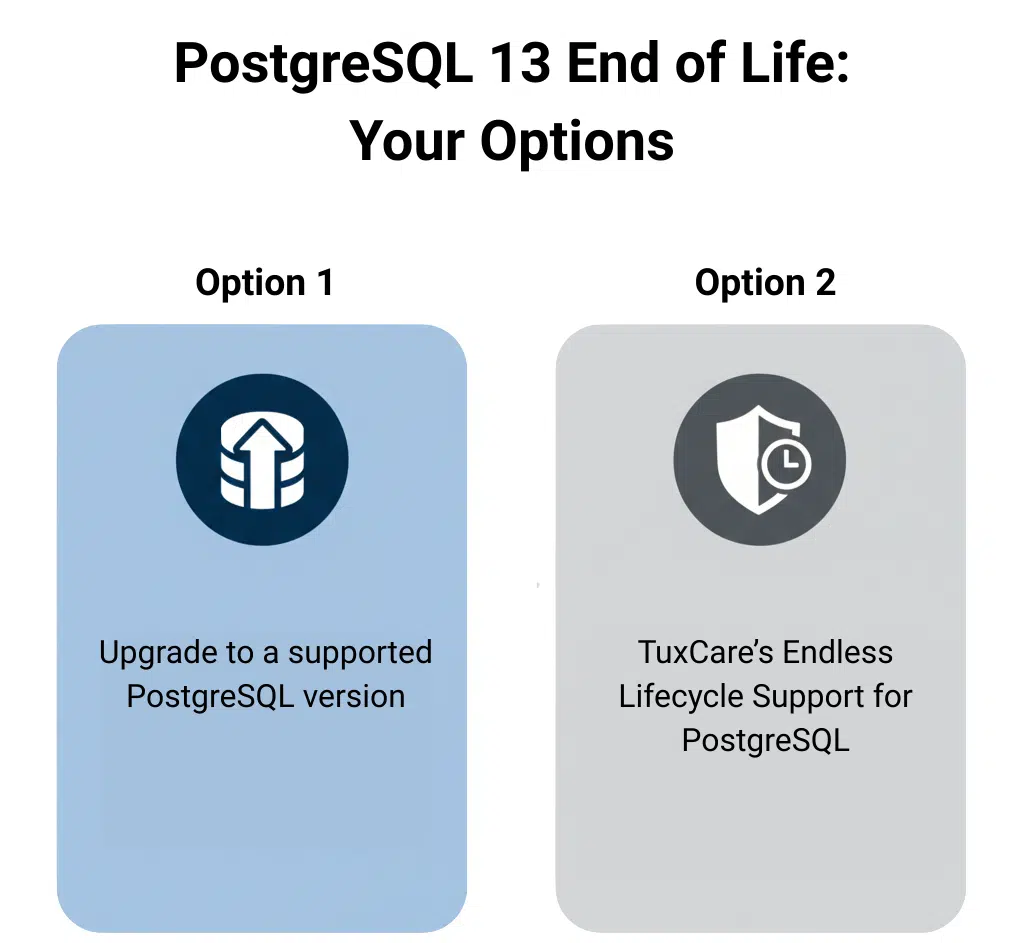
Upgrade to a Supported PostgreSQL Version
Upgrading to a supported PostgreSQL version is the long-term solution after the PostgreSQL 13 end-of-life date. A newer version like PostgreSQL 16 or 17 restores access to community security patches, bug fixes, and ongoing improvements.
However, upgrades require careful planning. You must test your application against the new version to ensure compatibility. You will likely use tools like pg_upgrade or logical replication to move the data.
Pro Tip: This path is the standard way to return to community support. It usually requires a planned maintenance window and thorough testing. Changes in query behavior, extensions, or performance can occur, so you should only attempt this if your development teams have time for validation and debugging.
TuxCare’s Endless Lifecycle Support: Buying Time Without the Risk
When migration isn’t an option today, security cannot be a compromise. Whether it’s a legacy application, a rigid change-control window, or sheer infrastructure scale, sometimes the “just upgrade” advice doesn’t align with reality.
TuxCare’s Endless Lifecycle Support for PostgreSQL bridges the gap. We provide high-fidelity security patches for PostgreSQL 13 well beyond its EOL date. Our security engineers backport fixes from modern versions or develop original patches to neutralize new threats. It requires zero application changes and zero downtime, transforming an unsupported liability into a maintained, compliant asset.
Why ELS is the Strategic Choice for 2026
If you can’t move yet, ELS provides the operational air cover you need to stay secure and compliant:
Continuous Vulnerability Shielding: We don’t wait for “community consensus.” TuxCare monitors every Postgres CVE and pushes patches directly to your v13 instances, closing the exploit windows that attackers rely on.
For a deeper look at the threats organizations need to address, explore our guide to PostgreSQL vulnerabilities
Audit-Ready Compliance: PCI DSS 4.0 and HIPAA don’t care about your EOL software migration hurdles; they care about active patching. ELS satisfies auditors by replacing “End-of-Life” status with a documented, managed security stream.
Migration on Your Terms: A rushed upgrade is a failed upgrade. ELS removes the “ticking clock,” allowing your team to plan, test, and execute a transition to v17 or beyond on a timeline that ensures business continuity.
Secure Your PostgreSQL 13 Environment Today
The community support for v13 is over, but the risks are just beginning. Organizations that cannot modernize today need a reliable way to stay shielded and compliant.
TuxCare’s Endless Lifecycle Support provides a battle-tested safety net, offering ongoing vulnerability patches that allow you to maintain your current infrastructure while architecting your future. By choosing ELS, you eliminate the “negligence” risk, satisfy your compliance officers, and give your engineering team the breathing room they need to upgrade the right way.
Take the next step today: secure your PostgreSQL 13 deployments while preparing for a smooth transition to a supported version.

