Tech Support
 Documentation
 Login
 Contact Us




Go straight to an AI summary of this blog post instead 


Key Takeaways
- Spring Framework 5.3 reached the end of its open-source support on August 31, 2024.
- Running Spring 5 applications since the end of life introduces security, compliance, and operational risks.
- TuxCare’s Endless Lifecycle Support (ELS) provides ongoing security patches for end-of-life Spring 5.3.
Spring Framework 5.3.x has officially reached its open-source end-of-life date. That means no more community-provided security updates, bug fixes, or active support.
As a result, applications still running on Spring 5 face growing risks — including unpatched vulnerabilities, compliance failures, and operational challenges that can impact your business.
In this article, you will learn what the Spring 5 end of life means, why it demands immediate attention, and what your best options are now that the support end date has passed — including upgrading to Spring 6 or extending support with services like TuxCare’s ELS.
What Spring 5 End of Life Means
Spring 5 end of life means the Spring 5.x open-source branch will no longer receive updates — not even critical security fixes or bug patches — from the official maintainers. While commercial support may still be available, community-driven updates and public fixes have ceased.
Why it matters:
- New vulnerabilities will remain unpatched.
- Compliance audits may fail without security updates.
- Spring 5 may become incompatible with future Java releases.
Key Dates and Support Timeline
Spring Framework 5.3, the final Long-Term Support (LTS) release of Spring 5, was released on October 27, 2020, and reached end of open-source support on August 31, 2024. This marks the end of free bug fixes and security updates from the Spring community.
While VMware offers commercial support until June 2029, organizations also have the option to use TuxCare’s Endless Lifecycle Support (ELS) for Spring. TuxCare delivers ongoing security patches for Spring 5.3 beyond EOL as long as needed, ensuring your systems remain protected and compliant.
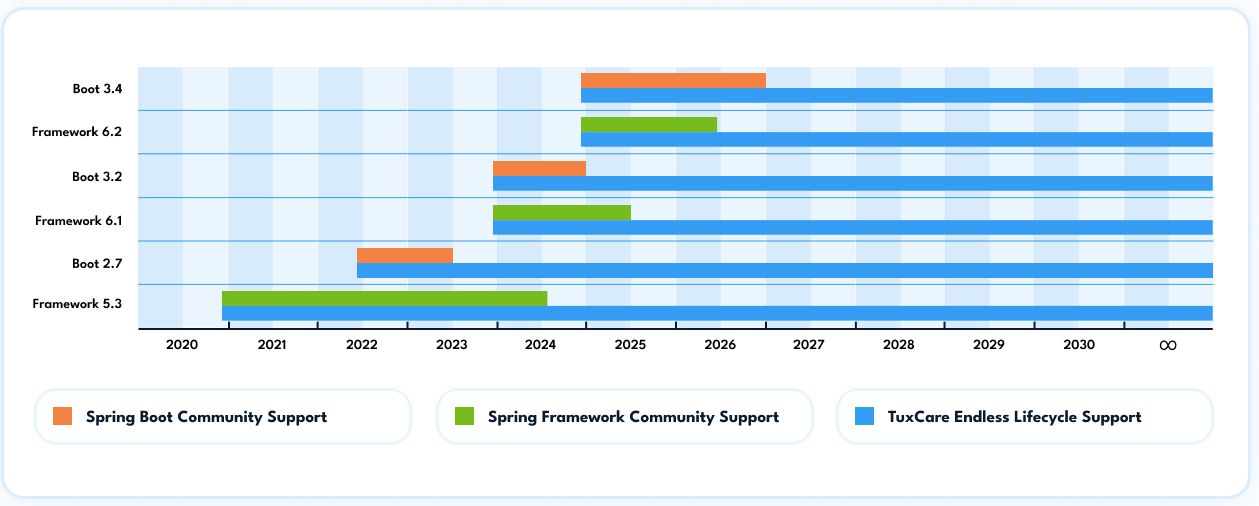
Key Spring Boot and Spring Framework Milestones
Why Older Spring Versions Are Retired
Like all aging frameworks, Spring 5.x is retired because it no longer aligns with modern Java application development standards or platform requirements. Continuing to maintain older versions limits the ability of maintainers to adopt newer technologies and practices.
Here’s why:
- While Spring 5.3 supports older Java versions — including those approaching Java 8 EOL — it lacks native alignment with features and optimizations introduced in Java 17+, now the required baseline for Spring Framework 6+.
- It’s tied to older Jakarta EE specifications and still uses the javax.* namespace, making it incompatible with Jakarta EE 9+.
- Maintaining backward compatibility with outdated APIs increases long-term complexity and slows down overall innovation.
Impact of Spring 5 End of Life
Your Spring 5 applications may still run — but without official support, they are now exposed to unpatched vulnerabilities and increasing operational risk. Here’s what the end of open-source support really means for your environment:
Security and Compliance Exposure
Once open-source support ends, so do free security patches. Any new vulnerabilities in Spring 5 will go unpatched unless you pay for commercial support or manage fixes internally. This opens the door to compliance failures in regulated industries, like GDPR, HIPAA, PCI DSS, and ISO 27001. Many major breaches have been tied to unpatched legacy software.
Rising Maintenance and Support Costs
Commercial support from VMware is available, but it can be costly and is often tailored for large enterprise customers. For smaller organizations with more restraints when it comes to support policies and budgets, the pricing may be difficult to justify. In contrast, TuxCare’s Endless Lifecycle Support (ELS) offers a cost-effective solution, delivering timely security patches for end-of-life Spring versions — helping you stay secure without breaking the bank.
Operational Inefficiencies
Running Spring 5 applications in 2025 introduces friction across your development workflow. While Spring 5.3 supports Java 17, it doesn’t fully benefit from the performance and language enhancements available in Spring 6+.
As the ecosystem evolves with each iteration of dependency upgrades, teams face growing compatibility issues with modern IDEs, build tools, and libraries — forcing manual workarounds and reducing developer productivity.
Navigating Your Options After Spring 5 EOL
With Spring 5.x no longer receiving open-source support following the Spring Framework EOL, organizations face a critical decision.
You have two primary strategic paths:
Migrate to Spring Framework 6.2.x
This is the most direct and future-proof option for leveraging the latest innovations. Spring Framework 6.x and Spring Boot 3.x align with modern Java (17+) and Jakarta EE 9+, offering active community updates and long-term support for their current versions.
Upgrading to newer supported versions ensures you continue receiving free security patches and stay compatible with the evolving Spring ecosystem.
Pros:
- Access to the latest features, performance improvements, and modern APIs
- Long-term community support roadmap (e.g., Spring 6.2.x, Boot 3.5.x)
- Compatibility with modern cloud-native architectures and latest tooling
Cons:
- Requires major code refactoring (e.g., javax.* → jakarta.* namespace changes, deprecated features, and API removals).
- Time-consuming and resource-intensive
- Can be disruptive for large, complex legacy systems
Extended Support
For many organizations, immediate migration to Spring 6+ version is not feasible due to the extensive breaking changes, strict Java 17+ and Jakarta EE 9+ requirements, and the significant code refactoring involved. This is where extended support provides a crucial safety net.
TuxCare’s Endless Lifecycle Support (ELS) delivers ongoing vulnerability patching for Spring 5.3.x, so you can keep existing applications secure and compliant while planning your migration on your timeline.
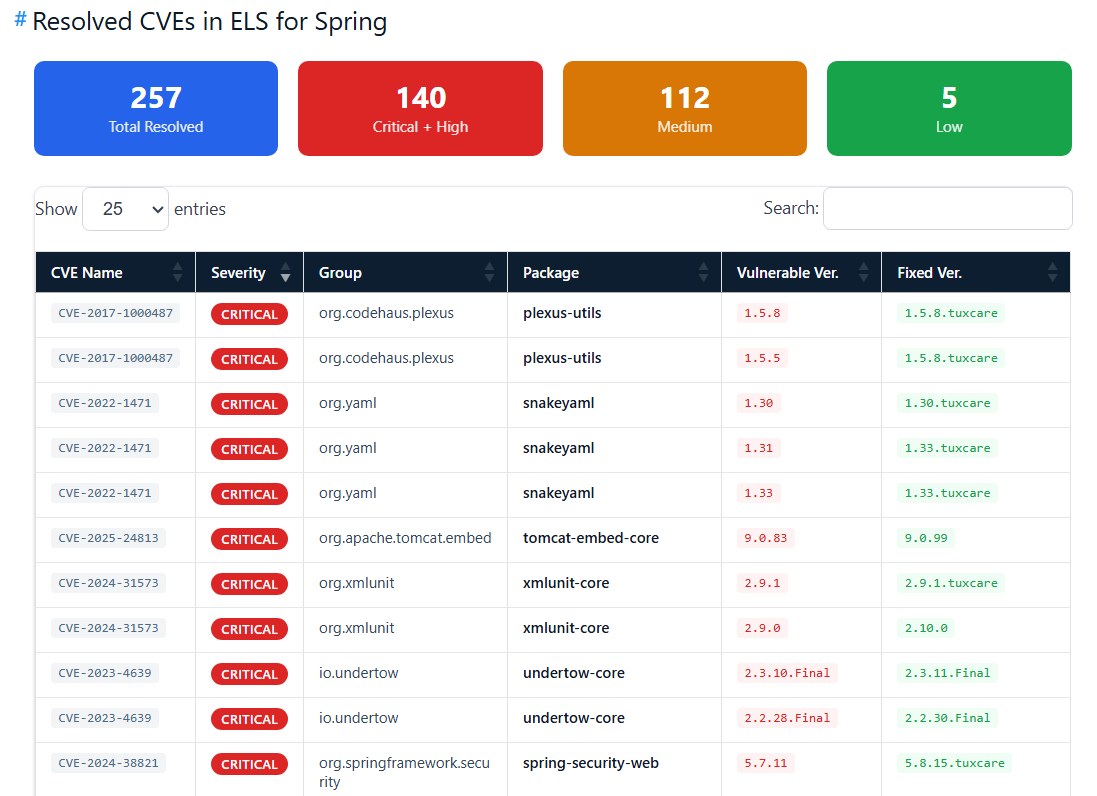
TuxCare currently supports:
- Spring Framework: 5.3, 6.1, 6.2
- Spring Boot: 2.7, 3.2, 3.4
Pros:
- Ongoing security patches for EOL Spring versions
- Continued compliance with security standards
- No need for rushed migration or business disruption
- Cost-effective compared to full code rewrites
Cons:
- Does not include feature updates or API enhancements
- Eventually, migration will still be necessary
Secure Your Spring 5 Applications with TuxCare
Unfortunately, the frameworks we use don’t usually come with never-ending support at an affordable price directly from the vendor. Spring Framework 5.3.x is already past its open-source end-of-life, leaving your systems exposed to security flaws and compliance risks if you are still running that version. Whether you are planning a full migration or need more time, taking action now is essential.
TuxCare’s Endless Lifecycle Support for Spring provides ongoing security patches for your Spring 5.3.x applications — a reliable, cost-effective way to stay secure and compliant while you plan your upgrade on your own schedule.
Don’t let EOL software put your business at risk. Our Spring security experts are here to answer your questions and help you navigate your next steps.