
 Tech Support
 Documentation
 Login
 Contact Us


Go straight to an AI summary of this blog post instead 


Key Takeaways
- Knowing the Spring Framework end-of-life (EOL) timelines helps teams maintain security and compliance while planning future upgrades.
- Most versions reach EOL after approximately 18 months of community support.
- Organizations can choose to upgrade immediately or implement extended Spring security support to protect their EOL Spring applications.
The Spring Framework end-of-life (EOL) date isn’t just a moment on a calendar; for many enterprise teams, it’s a looming security and compliance deadline. When a Spring version reaches end of life, it officially stops receiving security patches, bug fixes, or performance updates from the maintainers.
The reality for many organizations is that while an application might still “run fine” on an outdated version, it is effectively a sitting duck. Every day that passes after an EOL date increases your exposure to Spring vulnerabilities (CVEs) that are discovered after that end date.
In this guide, we’ll look at this Spring platform’s EOL dates, the risks of staying on out-of-support version releases, and (most importantly) how you can secure your applications without a forced, immediate migration.
What Does Spring Framework EOL Involve?
In simple terms, this end-of-life date is the sunset of vendor support. Once a specific version hits EOL, the maintainers stop issuing any further updates for it. This also means no security patches and bug fixes, which is exactly why EOL software is risky for any organizations to continue relying on. From a security and compliance perspective, applications running an unsupported framework version is a liability.
After EOL, your applications may not stop running, but the security posture changes overnight. Without a vendor-backed stream of updates, any new vulnerability discovered becomes an open door in your infrastructure that you cannot close without a complete (and often difficult) upgrade or extended support.
Spring Framework Version Support and EOL Timeline
Spring Framework operates on a major/minor release cadence, now with even shorter support windows of about 19 months compared to earlier timeframes. This is because of new support policy that aligns the framework more closely with the timeline of Spring Boot versions. During this period, it continues to receive security patches, bug fixes, and maintenance updates until it enters the EOL stage.
Spring Framework 3.x and 4.x
Spring Framework versions 3.1, 4.0, 4.1, and 4.3 are long past EOL. It has been years since these legacy versions reached the end of their support roadmap and should be considered high-risk in any production environment when there is a lack of alternative support.
Spring Framework 5.x
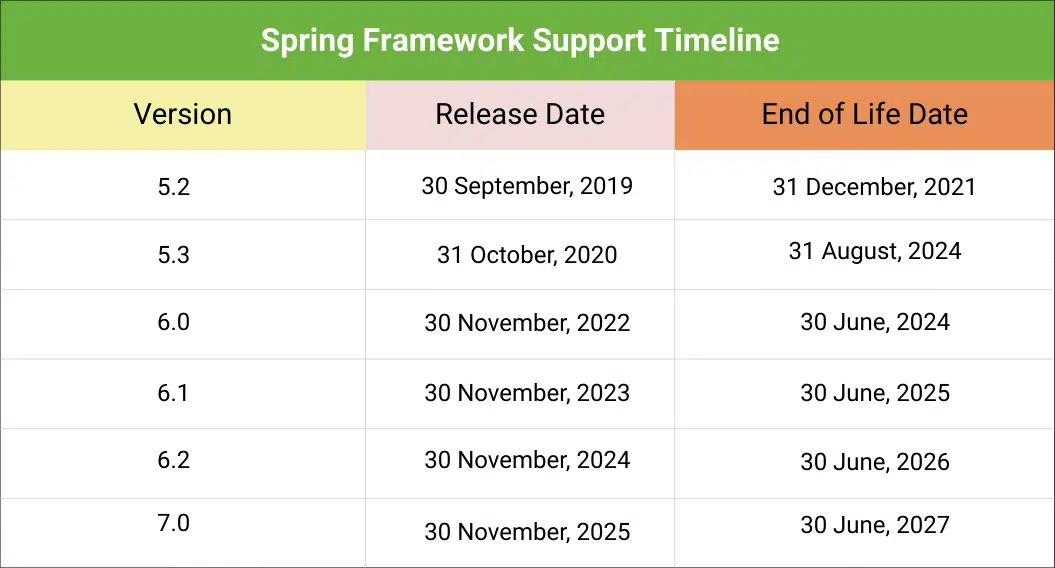
Spring Framework 5.3, the final 5.x branch release, was supported for about four years and reached EOL on 31 August, 2024. Also, it was the last version that supported Java 8 and moving beyond 5.3 requires a significant jump (to Java 17 or newer). As many enterprises couldn’t yet move to Java 17+, they find themselves trapped on 5.3, which is now officially unsupported.
Spring Framework 6.x
Starting with Spring Framework 6.0, this Spring variety follows a faster release cycle with new versions moving fast and retiring even faster. This has created a support trap where teams find themselves on an unsupported version 1.5 years after it was released.
Note: Spring 6.0 and 6.1 have already reached their EOL dates. If you are on Spring Framework 6.2, your open-source support packages will be disappearing soon (if they haven’t already by the time you’re reading this).
The table below shows the current Spring Framework support status and EOL timelines.
How Spring Framework EOL Affects Spring Boot Applications
Spring Boot depends on specific Spring Framework versions. When a Spring Framework version reaches EOL, Spring Boot applications built on it also lose vendor-provided security updates at the framework level.
It is easy to focus only on the Spring Boot version in use. However, Spring Boot is an opinionated layer built on top of Spring Framework. When the underlying framework reaches EOL, security fixes for new CVE disclosures are no longer released.
For example, Spring Boot 2.7 relies on Spring Framework 5.3. Even if application code is fully patched, a vulnerability discovered in the core framework will remain unpatched once the framework is no longer maintained. In practice, this means the security posture of the application depends on the lifecycle of the underlying Spring Framework version.
Key Risks of Spring Framework EOL
As we move through 2026, the gap between legacy Spring versions and modern security requirements is widening. These are three major risks of having an end of life Spring Framework version in your infrastructure.
Unpatched Security Vulnerabilities
The most critical risk of Spring Framework EOL transition is the absence of security updates after vendor support stops. When new vulnerabilities like CVE-2024-38816 and CVE-2024-38819 are disclosed that affect EOL versions, there is no upstream fix coming. Attackers know this and specifically target applications running on older versions of popular frameworks like Spring 5.x or 6.x, where patches are not applied and vulnerabilities remain exploitable.
Over time, these publicly known vulnerabilities accumulate and your environments can become a playground for hackers. Even if your application code is secure, a vulnerability in a core framework can compromise the entire environment.
Compliance and Audit Failures
Many regulatory frameworks like PCI DSS 4.0, HIPAA, and GDPR generally require that all system components are supported by the vendor. Running am EOL Spring Framework version is directly a compliance failure. If a breach occurs on a system running unsupported software, your organization can even face higher fines or legal penalties due to negligent maintenance.
Operational Stability and Technical Debt
As the vendor stops maintaining a version after EOL, compatibility issues grow silently. Modern third-party libraries (for logging, database drivers, or cloud integrations) will eventually drop support for older Spring versions, leaving your developers stuck in dependency hell where they can’t update anything without breaking everything. If any bug arises, you are on your own to fix it. The longer you wait to move off an retired version, the more technical debt you accumulate.
Top Actions You Can Take After Spring Framework EOL
Once Spring versions are past its EOL dates, it becomes critical to manage the risk. While every team has a different appetite for change and different resource constraints, here are the three available paths to handle this EOL conundrum.
1. Upgrade to a Supported Version
The long-term solution is to upgrade to a currently supported Spring Framework release (e.g., Spring Framework 7.x). This ensures you receive community security updates and ongoing maintenance until the support window closes. However, upgrading major version is rarely a simple task and often requires code updates, dependency validation, and thorough testing to avoid production issues due to breaking changes. Moving from Spring 5.x to 6.x, for example, isn’t just a version change; it involves upgrading to Java 17 (or newer) and a transition from javax to jakarta namespaces.
2. Apply Endless Lifecycle Support (ELS)
Many organizations delay upgrades because they require downtime planning and often do not align with operational priorities. Some teams choose extended security support to buy more time until migration becomes practical, while others postpone action altogether. However, doing nothing is simply not an option when practical and cost-effective alternatives exist.
TuxCare offers Endless Lifecycle Support (ELS) for Spring Framework versions that have reached end of life. ELS helps organizations remain secure and compliant on existing EOL versions by delivering production-ready security patches for Spring vulnerabilities.
TuxCare covers both Spring Framework and Spring Boot versions. Here is the list of supported versions:
- Spring Framework: 3.1, 4.0, 4.1, 4.3, 5.2, 5.3, 6.0, 6.1, and 6.2.
- Spring Boot: 2.7, 3.2, and 3.4.

3. Migrate to Another Stack
If an application is so old that upgrading the framework is more expensive than rebuilding it, some teams choose to move to a different language stack (Python, .NET) entirely. While this approach solves the EOL problem, it is a long-term project that can take months or even years. You still need a way to secure the application while the migration is in progress.
Stay Secure Post EOL With TuxCare
Spring Framework going EOL doesn’t have to trigger a migration crisis. TuxCare provides Endless Lifecycle Support (ELS) for Spring that enables organizations to continue receiving security patches for known vulnerabilities, even after official vendor support ends. This also gives teams the flexibility to plan migrations on their own timeline while maintaining stable, protected production environments.
To explore how TuxCare ELS can keep your Spring applications secure and compliant, speak to one of our experts.

