Tech Support
 Documentation
 Login
 Contact Us



Go straight to an AI summary of this blog post instead 


Key Takeaways
- Most software supply chain security tools tell you what already made it into your build, and far fewer stop it from getting there in the first place.
- The label covers five genuinely different functions, and buyers routinely compare them as if they do the same job.
- The question that separates them is what happens during install, not what lights up on the dashboard afterward.
- Two numbers from a sandbox test will sort a shortlist faster than any feature matrix a vendor hands you.
Software supply chain security has moved quickly up security teams’ priority lists this year, and the shortlists keep getting longer. Sit through three vendor calls in a week and the demos start to blur together. Several vendors, several dashboards, all lighting up with vulnerable dependencies in the same tidy sample repo, and no real way to tell which of them would have stopped any of this year’s campaigns.
That’s not a buyer competence problem. It’s a category problem. These tools do fundamentally different jobs while leaning on nearly identical marketing language, and the difference only shows up once someone asks a very specific question about timing.
Why This Category Suddenly Has Everyone’s Attention
Analyst coverage follows spend, and spend follows incidents like these. A week apart in late March 2026, a widely used npm package was hijacked to quietly install a remote access trojan on any fresh build during a three-hour window, and a widely used PyPI package was weaponized to steal credentials the moment Python next started up – no user action required either time. Both attacks were built to execute before post-resolution scanning could do anything useful: one during installation, the other the next time the interpreter ran.
That’s the gap most software supply chain security tools don’t close, and it’s also why the category is so hard to shop for. Vendors sell against wildly different control points, some scanning after the fact and some blocking before install, while using nearly identical language to describe what they do.
Reality Check: A vendor claiming to belong in this category doesn’t mean its product solves the same problem as the vendor next to it. Ask exactly which control point their product covers before assuming overlap.
What Software Supply Chain Security Tools Actually Do
Five distinct functions get sold under this label. Few products cover all five, and most teams end up combining several.
| Function | Question it answers | When it runs |
| Software composition analysis | Which known-vulnerable components are in this build | After dependencies resolve |
| SBOM generation and management | What exactly shipped, and to whom | At build or release |
| Provenance and attestation | Was this artifact produced by the claimed build | At publish and verify |
| Install-time screening | Should this package be allowed to resolve at all | Before and during install |
| Post-EOL package maintenance | Who patches this once upstream stops | Continuously, after upstream EOL |
Composition analysis, SBOMs, and provenance are the more mature, well-understood functions, and many organizations already have tooling covering at least some of them. Install-time screening is where the 2026 attacks actually landed, and it’s the function most shortlists never bother to evaluate directly.
Post-EOL maintenance is the one nobody thinks about until an audit turns up a dependency whose maintainer went quiet back in 2021.
The Difference Between Detection and Prevention
Start with the function nearly every team already owns, since it’s also the clearest place to see where detection ends and prevention begins. Software composition analysis checks your resolved dependency list against advisory databases. It’s genuinely good at that job, and it’s worth owning no matter what else you buy.
The catch is that advisory-driven vulnerability detection only works once the malicious component has been identified and that finding has reached your tool. And it reaches your tool only after someone finds the malicious package, reports it, and gets it published to a feed. For this year’s campaigns, detection was often fast and the advisory pipeline still ran behind it. In the TanStack npm compromise of May 11, 2026, Socket’s scanner flagged the malicious artifacts within six minutes of publication, and the compromise was reported publicly 20 to 26 minutes after the first malicious publish – by an outside researcher, not by the affected project’s own tooling. Six minutes is fast for detection. It’s still six minutes of a malicious package sitting live in the registry, resolvable by anyone’s build, and considerably longer before most tools had anything to match it against.
Now think about where the malicious code actually executes. An npm postinstall script runs during npm install, and this isn’t theoretical. On March 31, 2026, the widely used Axios package was compromised when attackers used a hijacked maintainer account to publish two malicious versions, each quietly including a poisoned dependency, plain-crypto-js, whose postinstall script acted as a cross-platform remote access trojan dropper, pulling platform-specific payloads from a live command-and-control server. Anyone who ran a fresh install during that window pulled the RAT straight into their build, no import statement required.
A PyPI package abusing .pth startup hooks executes the next time the interpreter starts, and the LiteLLM compromise is the clearest example. On March 24, 2026, two versions of the litellm Python package on PyPI were found to contain malicious code, after a compromised release of the Trivy security scanner already in use in LiteLLM’s CI/CD pipeline exposed the project’s PyPI publishing credentials. Both versions carried a payload, and the second went further, installing a .pth file that executed automatically on every Python interpreter startup and triggered a credential-stealing payload without requiring an explicit import at all.
A Rust crate with a hostile build.rs runs during compilation – the same design flaw, just in a different ecosystem. In each case, malicious code runs before any application logic does: during installation, during compilation, or automatically the next time the runtime starts.
For a scanner that only looks after resolution or installation, there’s no useful gap between the dependency arriving and the dependency running. The scan itself isn’t slow. It’s just on the wrong side of the event.
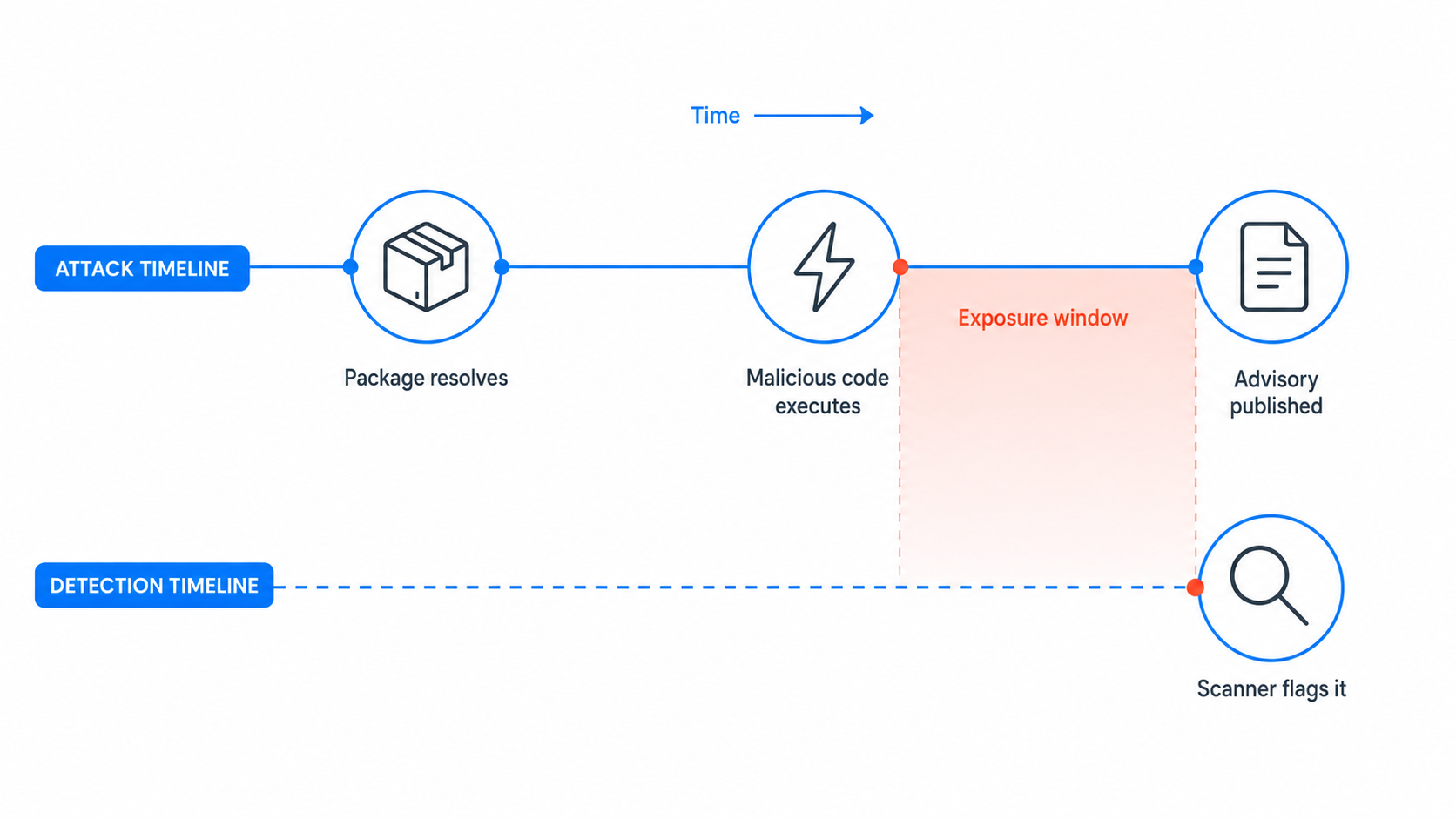
Watch Out: If a vendor demo shows the malicious package landing in a findings list, what you just watched was detection, not prevention. Ask them to rerun the same test with network egress monitored and to show you whether the payload phoned home before that finding ever rendered.
Screening at the point of resolution is one of the few controls that sits earlier than install-time execution, and that’s the design premise behind SecureChain for OSS. Packages are rebuilt from vetted sources with SLSA Level 3 provenance, signed, and published to a single registry you point your existing package manager or repository manager at, so the vetting has already happened by the time a build agent asks for the package.
Provenance on its own doesn’t close this gap. The malicious TanStack versions were published by the project’s own release pipeline under its trusted identity, and they are the first documented case of malicious npm packages carrying valid SLSA provenance. Provenance proves where an artifact was built. It says nothing about whether what went into that build was vetted, which is why rebuilding from verified source is a separate control rather than the same one.
Comparing Snyk, Socket, and Registry-Level Screening
Four architectural approaches dominate current shortlists among supply chain security vendors. Individual products vary quite a bit, so treat this as category-level orientation rather than a feature-by-feature audit. An SCA tools comparison alone won’t surface the difference, since the real split is about control point, not feature checklist.
| Approach | Control point | Stops install-time execution | Typical buyer |
| SCA scanners | CI pipeline, post-resolution | No | AppSec teams with existing CI gates |
| Behavioral package analysis | PR review, pre-merge, and (for some vendors) install time | Yes where install-time firewalling is deployed; PR analysis alone does not | Developer-led security programs |
| Repository firewalls | Artifact proxy, policy-based | Can block before download; depends on detection coverage and policy | Enterprises already running Nexus or Artifactory |
| Curated and rebuilt registries | Package resolution itself | Yes | Teams replacing public registry trust outright |
Snyk sits mostly in the SCA-scanner approach. Socket combines behavioral package analysis with install-time blocking through Socket Firewall, which proxies package manager traffic and stops confirmed-malicious packages before they’re fetched. Nexus Firewall and JFrog Curation occupy the repository-firewall approach. Curated and rebuilt registries are a smaller field because rebuilding packages from source at registry scale requires a materially different engineering model from policy-based screening. It’s the approach SecureChain for OSS is built around: packages rebuilt from source, patched even after upstream goes quiet, and six ecosystems: JavaScript, Python, Java, Go, Rust, and PHP – covered from a single registry.
None of these four approaches says much about what happens once a package’s own maintainer disappears. That’s a separate discipline, layered on top of whichever approach you pick (more on that below).
And none of the four approaches is inherently the wrong answer. The failure mode is buying two products from the same approach and assuming you’ve covered the category.
Pro Tip: Ask each vendor which approach they think they’re in. The ones who answer right away and name their own gaps are the ones worth a second meeting. Test any claim of end-to-end coverage against all four approaches rather than taking it at face value.
An Evaluation Framework You Can Run in Two Weeks
Vendor demos run on sanitized sample repos, which tells you basically nothing. Run this instead.
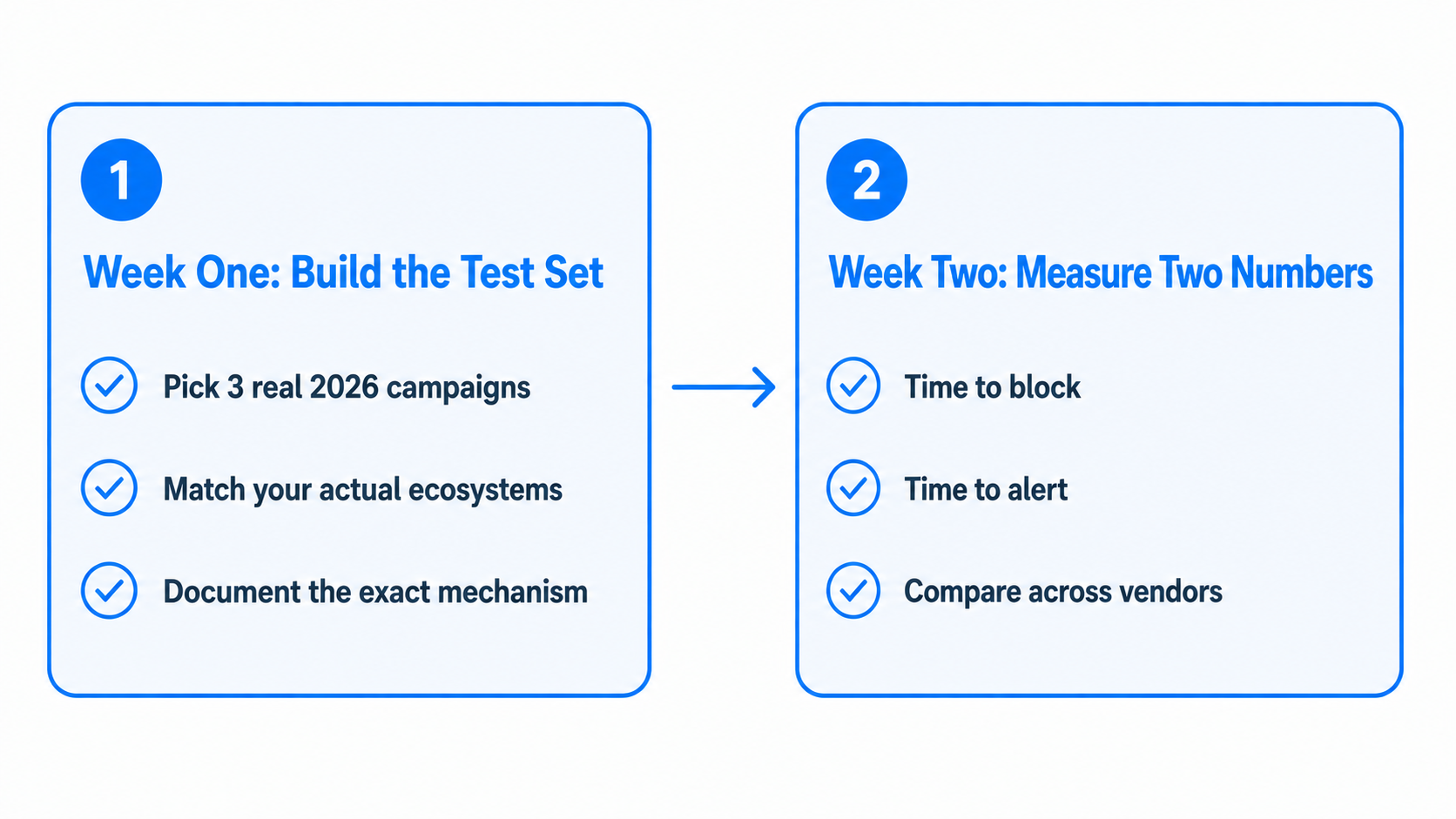
Week one: build the test set. Pick three real 2026 campaigns that hit ecosystems you actually use. These three cover four ecosystems and three distinct mechanisms.
- The Axios compromise on npm: March 31, 2026, a hijacked maintainer account publishing a postinstall RAT dropper.
- The LiteLLM compromise on PyPI: March 24, 2026, a malicious .pth file executing on interpreter startup.
- PolinRider across npm, Go, Packagist, and Chrome extensions: an active North Korea-linked campaign using hidden malware loaders embedded in package files to establish command-and-control and drop credential-stealing payloads.
Week two: measure two numbers. Known-malicious versions are usually removed or quarantined soon after disclosure, so you won’t be able to install the exact Axios or LiteLLM payloads from your test set today. Ask each vendor whether they can provide a safe reproduction artifact – or build your own canary: a harmless package with a postinstall script that phones home to a server you control. In a sandboxed environment, install it and record time to block and time to alert. Those two numbers separate the four approaches above faster than any feature matrix a vendor hands you.
The decision usually falls out pretty cleanly from there.
- No block at all, and time to alert is under a minute? You’re looking at a detection tool. Keep it, but don’t mistake it for your install-time control.
- The package is blocked before it can be fetched or executed, but there’s no usable alert? That’s a prevention control, and you’ll need to bolt on observability for incident response.
- Both numbers look respectable? Check whether blocking depends on an advisory feed. If it does, your protection window is only as good as that feed’s latency.
- Vendor refuses the sandbox test? That refusal is itself the answer.
One practical note on scope. For teams running four or more package ecosystems, coverage gaps can matter as much as depth in any one ecosystem, and PolinRider is the campaign that makes the case directly. As of Socket’s July 1, 2026 analysis, North Korean actors tied to the Contagious Interview cluster had published 162 malicious release artifacts across 108 packages and browser extensions spanning npm, Go modules, Packagist, and the Chrome Web Store, with compromise traces in 80 Go modules. The campaign remains active, and those totals have grown since. Compromised packages included PHP packages published under the sevenspan namespace on Packagist. A team relying on package-level controls that covered npm but not Go would have had no equivalent protection for those 80 Go modules.
Questions to Ask Every Vendor on the Shortlist
Six questions, roughly in order of how much they reveal.
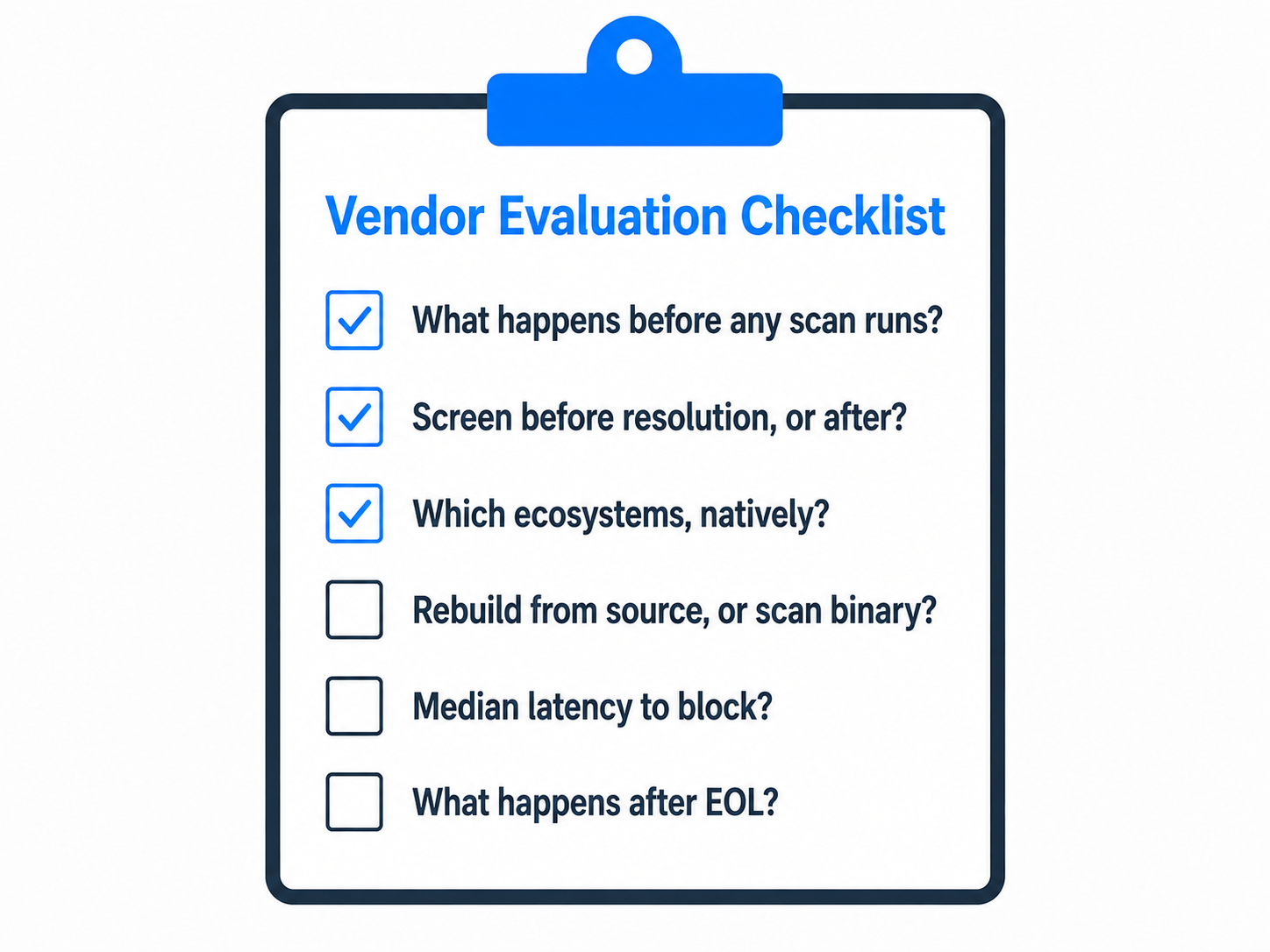
- What happens during npm install or pip install, specifically, before any scan runs?
- Do you screen packages before resolution, or analyze them after?
- Which ecosystems do you cover natively, and which are still on the roadmap?
- Do you rebuild packages from source, or scan the artifact published upstream?
- What’s your median latency between a malicious package appearing upstream and your product actually blocking it?
- When an upstream maintainer abandons a package we depend on, what does your product do?
Question four matters more than its spot on the list suggests. Scanning a published artifact can find malicious code inside it, but it can’t establish that the artifact corresponds to the source it claims to be built from, because the scanner only ever sees the artifact. Rebuilding from verified source with trustworthy provenance is what closes that specific gap, and it’s a real engineering commitment, not a checkbox.
Question six is the one nobody asks during an evaluation and everybody asks eighteen months later. Continuing to patch packages that upstream has walked away from is a separate discipline from screening new installs, and far fewer products treat both as the same problem.
Most dependencies in a typical project are transitive rather than direct, brought in indirectly by the packages you actually chose. That’s most of the dependency graph, which means your evaluation needs to test what each tool does several layers down, not just at the top of your manifest.
Your results are going to depend heavily on your stack shape. A single-language shop with locked-down CI is a genuinely different situation from a polyglot org running forty repos with no central platform team, and any vendor who gives both the same recommendation hasn’t asked you enough questions.
Where This Leaves You
None of this is about picking a winner between Snyk, Socket, and the registry-firewall crowd. It’s about knowing which approach you’re buying into, and being honest with yourself about which one you’re missing.
Many organizations already have some coverage of the mature functions. Composition analysis, SBOM tooling, and provenance are well understood by now, and whatever you already own there isn’t wasted. The control worth checking explicitly is install-time screening, meaning whether anything in your stack can stop a risky package before its code runs. That is the gap the 2026 campaigns walked straight through, and no dashboard full of findings will close it, however good the findings are.
Run the two-week test. If it turns up a real hole at install time, that is the control point worth funding next. SecureChain for OSS screens packages before they resolve across JavaScript, Python, Java, Go, Rust, and PHP, and it keeps up security maintenance after upstream support ends. The first half of that is the install-time coverage most shortlists skip.
Learn more about SecureChain →
FAQs
What are software supply chain security tools?
Products that reduce risk introduced through third-party code across development, build, distribution, and production. The category spans software composition analysis, SBOM management, provenance verification, install-time screening, and post-EOL package maintenance – five different jobs that usually get sold under one label.
Is SCA the same as software supply chain security?
No (and this is where most SCA tool comparisons go wrong). Software composition analysis is one function within the category. It flags known-vulnerable components in the resolved dependency graph, and by itself that isn’t an install-time control against a newly malicious package.
Should we choose Snyk or Socket?
For the comparison here, Snyk Open Source represents the advisory-driven composition analysis approach, while Socket combines behavioral package analysis at pull-request time with install-time blocking through Socket Firewall. Teams evaluating either should confirm exactly which layer (PR review, install-time, or both) applies to their stack before assuming coverage.
What should be on a software supply chain security evaluation checklist?
Ecosystem coverage, control point timing, whether packages get rebuilt from source or just scanned as published artifacts, feed latency, transitive dependency depth, and what happens once an upstream maintainer walks away from a package.
Does a vendor’s category ranking tell us which tool to buy?
It tells you whether an analyst or review site found enough surface-level overlap to compare vendors on a shared rubric. It doesn’t tell you which control point your own architecture is missing, and that’s really the question you’re trying to answer.