Tech Support
 Documentation
 Login
 Contact Us


Go straight to an AI summary of this blog post instead 


Key Takeaways
- Django 3.2, 4.0, 4.1, 5.0, and 5.1 are all already end of life – Django 4.2 is the latest to reach EOL status.
- Running an EOL Django version doesn’t break anything immediately, but unpatched CVEs and compliance failures accumulate fast.
- Organizations do not need to choose between a rushed migration and security exposure; TuxCare provides ongoing vulnerability patching for these EOL Django versions for as long as your migration timeline requires.
When Django 4.2 reached its end of life on April 7, 2026, many production applications continued running without missing a beat – which is exactly the problem. End of life (EOL), or end of support, doesn’t break functionality, but it does mean the Django project has officially stopped issuing security patches. This leaves 4.2 in the same vulnerable category as versions including 3.2 (EOL April 2024), 4.0 (EOL April 2023), 4.1 (EOL December 2023), 5.0 (EOL April 2025), and 5.1 (EOL December 2025). Any vulnerability discovered in these versions from here on stays unpatched – unless you do something about it yourself.
This guide covers everything you need to know about Django EOL, what that actually means for security and compliance, and the realistic paths forward for teams that can’t just drop everything to perform a major version upgrade.
What is Django End of Life (EOL)?
Every Django version has an expiry date, after which the team maintaining Django stops working on it – no security updates, no bug fixes, nothing. That’s end of life.
Your application won’t suddenly crash when a version reaches EOL, but with no vendor patches, the security risks become significant and accumulate over time. For example, if a security researcher finds a SQL injection vulnerability in Django 4.2 tomorrow, there’s no patch coming. The vulnerability gets documented, a CVE gets assigned, and your version stays exposed. For organizations under compliance obligations, this creates an automatic audit finding because your environment is running software with known, unpatched CVEs.
Django Release Cycle and End of Life Timeline
Django follows a predictable release date cadence – a feature release happens every eight months approximately. Each release goes through two security support phases before it’s retired at the end.
Standard Releases (Non-LTS) get eight months of active support, followed by another eight months of security-only support. Sixteen months total. After that, they reach EOL.
LTS (Long-Term Support) Releases work differently – they get the same eight months of active support, but the security-only phase stretches to twenty-eight months, giving a total support window of around three years.
If you’re running a non-LTS version, your window is tight compared to LTS versions. Django 5.1, for example, was released in August 2024 and was already EOL by December 2025 – approximately sixteen months later. Teams that didn’t upgrade during that window are now running unsupported software.
Pro Tip: The last feature release of a major version will be an LTS release. Always anchor your Django version choice to an LTS release. The three-year window gives you actual breathing room for planned upgrades.
Here is the current status of recent Django project versions:

Risks of Django EOL for Your Organization
Running an EOL Django version isn’t an immediate emergency in the way a live breach does. But the risk profile changes fundamentally the moment upstream support ends – and it keeps getting worse the longer you stay on an outdated version.

Unpatched Security Vulnerabilities
This is the obvious one, but it’s worth being specific about what it looks like in practice.
Django has a consistent CVE history. SQL injection via QuerySet methods, denial-of-service through crafted XML input, directory traversal in template commands, log injection via unsanitized request paths – these aren’t theoretical attack classes. They’re vulnerability patterns that have appeared in Django’s own security advisories, some as recently as 2025. For example, CVE-2025-57833, CVE-2025-64460, CVE-2025-59682, and CVE-2025-48432.
When your version is EOL, those advisories still get published. The CVE still gets assigned, but the fixes are only released to supported versions. Your version just doesn’t get them.
In 2024 and 2025 alone, several high-severity security issues were patched across supported versions, while EOL branches like 3.2.x and 5.0.x were explicitly noted as affected but unevaluated in multiple recent advisories.
Compliance and Audit Failures
EOL software creates a specific problem for compliance: it’s hard to argue that your security controls are adequate when the framework your application is built on isn’t receiving security updates.
PCI DSS 6.3.3 requires that all system components are protected from known vulnerabilities by installing applicable security patches. SOC 2 auditors increasingly treat EOL dependencies as a control gap. ISO 27001 requires organizations to manage technical vulnerabilities – running unsupported software is a straightforward failure point against that requirement.
Ecosystem Drift and Compatibility Gaps
End-of-life Django versions don’t exist in isolation – they sit inside a stack. And that stack keeps moving. Python itself has a release cycle. Python 3.8 and 3.9, which Django 3.2 and 4.0 were built around, are already end of support. Python 3.10 support ends in October 2026. Database drivers, authentication libraries, cloud SDKs – they all drop support for older Python and Django versions eventually. The result is a stack that becomes progressively harder to maintain, not because anything breaks all at once, but because the gap between where you are and where the ecosystem has moved keeps widening.
Dependency conflicts that seem minor today tend to compound until the system becomes a maintenance nightmare. A library drops Django 4.2 support in its next major release. A security fix requires a Python version your EOL Django doesn’t support. These are not edge cases – they’re the normal trajectory for any application that doesn’t keep pace with its dependencies.
Rising Maintenance Burden
Here’s something that doesn’t show up in threat models but shows up very clearly in engineering hours: the longer you stay on an EOL version, the more expensive staying there becomes.
Without upstream patches, your team either accepts the exposure or takes on the patching work themselves – monitoring CVE feeds, evaluating whether each vulnerability affects your specific configuration, backporting fixes from supported branches, testing, and deploying. That’s a real workload, and it’s one that grows over time as the gap between your version and the current release widens. Breaking changes accumulate across versions. What could have been a manageable migration becomes a significant project with real risk attached.
What to Do If Your Django Version Is EOL?
Being on an EOL Django version doesn’t mean you’re out of options. It means you need to pick one deliberately – because doing nothing is also a choice, and it’s the one with the worst risk profile.
There are three realistic paths. Which one makes sense depends on your codebase, your team’s capacity, and how much runway you have before compliance or security pressure forces the issue.
Upgrade to a Supported Version
The cleanest option, and the right long-term answer for most teams, is upgrading to a supported Django release. Right now, that means either Django 5.2 LTS – supported until April 2028 – or the latest version, Django 6.0, which runs until April 2027.
That’s the easy part to say. The harder part is that for many production applications, especially ones that have been running on 3.2 or 4.2 for years, an upgrade isn’t a weekend task.
Deprecated APIs get removed between major versions. Third-party packages may not have maintained compatibility. Test coverage that felt adequate on the old version sometimes reveals gaps when you start moving. And if you’re jumping multiple versions – say, from 3.2 straight to 5.2 – you’re crossing several deprecation cycles at once.
Use Extended Security Support
For teams that can’t upgrade on short notice – and there are plenty of legitimate reasons why – TuxCare’s Endless Lifecycle Support (ELS) for Django provides a critical security bridge.
The TuxCare team tracks CVEs affecting EOL Django versions, backports fixes from upstream, tests and verify the patches, and delivers them through TuxCare repositories. No code changes, no migration work, no manual CVE triage on your end.
TuxCare currently supports an extensive list of EOL Django versions (including 3.2.25, 4.0, 4.2.22, 5.0, 5.0.1, 5.0.2, 5.1, 5.1.4, 5.1.9, and 5.1.10) – and support continues for as long as you need it after the official EOL date. ELS provides a practical way to stay patched and compliant while you do the upgrade properly, on a timeline that works for your team rather than one forced by an expiring support window.
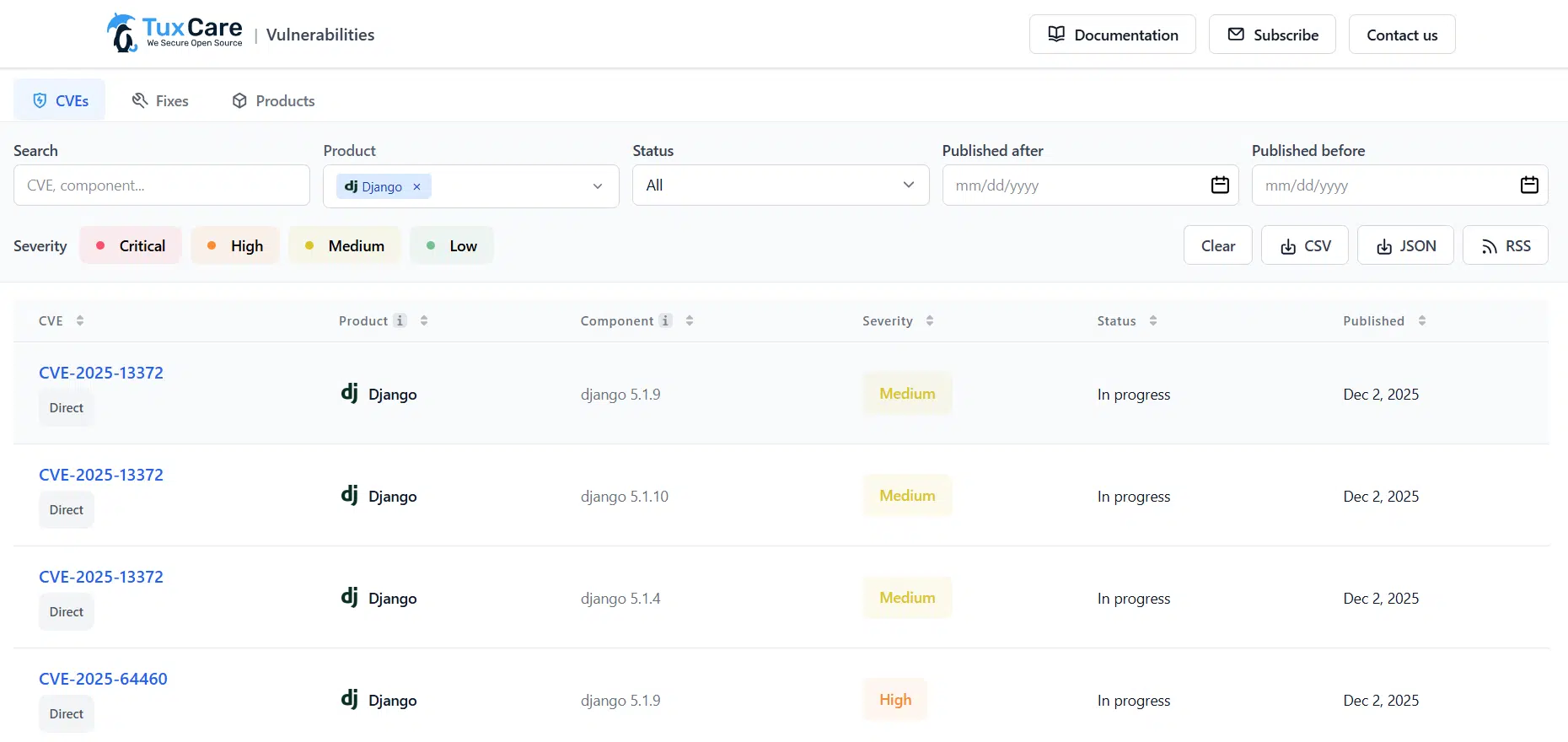
You can visit the CVE Tracker to explore which vulnerabilities have been identified across all supported EOL versions and also confirm that TuxCare’s ELS patches are available and ready for deployment.
Apply Temporary Risk Mitigations
Some teams, usually under very short-term constraints, try to manage EOL exposure through compensating controls rather than vulnerability patching. For example:
- WAF rules to block known attack vectors
- Network segmentation to limit exposure
- Enhanced monitoring and anomaly detection
- Stricter input validation at the application layer
These measures can reduce the attack surface. They don’t eliminate it, and they don’t satisfy most compliance requirements on their own. A WAF rule written to block a specific CVE exploit pattern only works if the attack follows that pattern – and attackers don’t always cooperate.
Pro Tip: Treat this option as a bridge measured in weeks, not months. If you’re using mitigations to buy time for a proper upgrade or to implement ELS, that’s a reasonable short-term posture. If you’re using them to avoid the conversation entirely, the risk simply keeps accumulating.
What Happens If You Do Nothing After Django EOL?
This isn’t really an option – but it’s what happens by default when teams don’t make an active decision.
The application keeps running. Nobody schedules the upgrade. The CVEs accumulate quietly. And because nothing visibly breaks, the urgency never quite materializes until something forces it – a failed audit, a security incident, or a compliance requirement that suddenly has teeth.
The risk here is that exposure compounds silently. Each month on an unpatched EOL version is another month of CVEs your application is vulnerable to, another audit cycle where your software inventory is a liability, and another month of breaking changes accumulating between your current version and whatever you eventually have to migrate to. Essentially, you aren’t just delaying an upgrade; you are unknowingly increasing the difficulty and the cost of the inevitable migration that will eventually be forced upon you.
Stay Secure and Compliant After Django EOL with TuxCare
Upgrading a production Django application takes time – sometimes a lot of it. In the meantime, the security vulnerabilities don’t wait for your development cycle to catch up.
TuxCare’s Endless Lifecycle Support for Django is built around one practical problem: organizations running EOL Django versions that need to stay patched and compliant while they work through a migration plan, not because the calendar says so, but because their codebase actually requires it.
Currently supported Django versions under TuxCare’s ELS include 3.2.25, 4.0, 4.2.22, 5.0, 5.0.1, 5.0.2, 5.1, 5.1.4, 5.1.9, and 5.1.10.
Also, Django is rarely the only EOL component in a stack. It is common for an EOL Django application to be built on an EOL Python runtime or hosted on an end-of-life Linux distribution. TuxCare also covers EOL Python runtimes, open-source libraries, and Linux distributions through Endless Lifecycle Support.
Frequently Asked Questions About Django EOL
It depends on the release. Standard (non-LTS) releases are supported for around 16 months. LTS (Long-Term Support) releases are supported for approximately 3 years.
The core difference is the length of the security-only support timeframe. Standard releases reach EOL much faster, whereas LTS releases receive an extended security-only window of 28 months (a lifecycle totaling 3 years), making them the industry standard for production environments.
No. Django 4.2 LTS officially reached EOL on April 7, 2026. If you are running 4.2, you are no longer receiving upstream security patches.
Yes. TuxCare’s Endless Lifecycle Support (ELS) provides ongoing, vendor-grade security patches for EOL Django versions (including 3.2.x, 4.0.x, 4.2.x, 5.0.x, and 5.1.x). This allows you to maintain a secure and compliant posture while you plan a migration on your own timeline.