Tech Support
 Documentation
 Login
 Contact Us


Go straight to an AI summary of this blog post instead 


Key Takeaways
- TuxCare: Best for full-stack EOL security, covering Linux distributions, runtimes, and applications under a single, unified patch management program.
- OpenLogic: Best for enterprises requiring a Long-Term Support (LTS) model focused on critical infrastructure like backend middleware and legacy CentOS versions.
- ActiveState: Best for teams needing source-compiled, audited language distributions with automated SBOMs to satisfy specific supply-chain compliance requirements.
If you’re looking into HeroDevs, you’ve already hit the wall: an AngularJS app three rewrites away from a sunset that never happened, a Node.js 14 service nobody volunteered to migrate, or a Vue 2 frontend so deeply wired into your customer flows that a refactor feels like open-heart surgery.
HeroDevs sells “Never-Ending Support” (NES) for specific frameworks – an approach that is great if your problem stops at the application layer. But for most infrastructure teams, the problem goes much deeper. In 2026, a patched frontend framework doesn’t do much for your compliance audit if the underlying OS itself is end-of-life and full of holes.
This guide compares the real HeroDevs competitors in 2026 – what each covers, where they fall short, and which fits your actual stack. You’ll get pricing realities, sentiment from G2 and Reddit, and a clear answer to who should pick what.
Top HeroDevs Competitors at a Glance
|
Tool |
Best For |
Stand-Out Feature |
Starting Price |
G2 Rating |
|
TuxCare |
Teams needing EOL coverage across OS, runtimes, libraries, and applications |
One of the broadest ELS catalogs available, including EOL Linux distros and a lot of open-source software |
Custom Quote |
4.6/5 |
|
OpenLogic by Perforce |
Enterprises needing expert human support for mixed open-source infrastructure |
24/7 SLA-backed access to Enterprise Architects with 15+ years of OSS experience |
Custom Quote |
4.4/5 |
|
ActiveState |
Python/Perl/Tcl teams with compliance requirements |
Source-compiled, SBOM-backed runtime distributions with CVE-triggered rebuilds |
Custom (free tier available) |
4.3/5 |
TuxCare
TuxCare and HeroDevs are more direct competitors than most people realize going into an evaluation. Both offer extended lifecycle support for end-of-life open-source software, and their catalogs overlap heavily – Angular, AngularJS, Node.js, Vue 2, Spring, PHP, .NET, PostgreSQL, Apache Tomcat, Django, NumPy, and more are supported by both vendors. If your shortlist has already come down to these two, the decision isn’t really about which software each one covers. It’s about depth of coverage, the OS layer, and how each vendor structures its support.
TuxCare’s extended support program is called Endless Lifecycle Support (ELS). It spans four categories: operating systems, language runtimes, libraries and frameworks, and applications. The full catalog – which runs to several hundred packages and individual library versions – is on the ELS all-products page.
What ELS Covers
Operating systems: This is where TuxCare has no competition from HeroDevs at all. ELS covers end-of-life Linux distributions that NES doesn’t touch: CentOS 6, 7, 8, and CentOS Stream 8; Ubuntu 14.04, 16.04, 18.04, and 20.04; Oracle Linux 6 and 7; Red Hat 7; Debian 10; Alpine Linux 3.18; and Amazon Linux 2. For any team whose infrastructure runs on an EOL distro – and that’s most teams carrying significant technical debt – this category alone justifies TuxCare being on the evaluation list.
Language runtimes: Both vendors cover Node.js and PHP, but TuxCare’s version coverage is more granular and extends into runtimes HeroDevs doesn’t offer at all. ELS covers Python 2.7 through 3.13, OpenJDK 7 through 17, Ruby 2.6 through 3.2, PHP 5.2 through 8.4, .NET 6, 8, and 10, and Node.js versions 12 through 20. Python, OpenJDK, and Ruby are TuxCare-only territory in this comparison.
For teams still running Java 17 in production, you can review the full support timeline and migration options in TuxCare’s guide to OpenJDK 17 EOL.
Libraries and frameworks: This is where the catalogs overlap most. Both vendors support Angular, AngularJS, Vue 2, Bootstrap, jQuery, Express, Next.js, Lodash, Fastify, Knockout, Spring, Hibernate, Struts, CometD, Django, and NumPy. If your infrastructure relies on old JavaScript code, implementing a support plan for Vue 2 EOL versions ensures that your build tools and client-facing interfaces stay fully secure. Where TuxCare pulls further ahead is in the dependency layer underneath those frameworks – packages like Webpack, Vite, PostCSS, React (15.x and 19.x), Flask, FastAPI, SQLAlchemy, and dozens more that rarely appear in competitor catalogs but are exactly where CVEs land in practice. On the PHP side, TuxCare also covers Laravel (versions 5, 8, 10, and 11), Symfony, and Livewire – frameworks with significant enterprise adoption that HeroDevs doesn’t currently list.
You can also learn more about managing Knockout.js EOL risks in our in-depth guide or check out our guide on Fastify EOL and jQuery vulnerabilities.
Applications: Both vendors cover Apache Tomcat and PostgreSQL. TuxCare’s application coverage extends further into the data and observability layer: Apache Kafka, Apache Hadoop, Apache Hive, OpenSearch, Eclipse Jetty, WildFly, Grafana (10.4.1 through 11.5.0), and MySQL 8.0. Most of these are absent from HeroDevs’ NES catalog.
You can also learn more about managing Apache Hive EOL security risks in our in-depth guide.
Pricing
- Modular Model: You don’t buy “The Catalog”; you buy support for the specific OS, runtime, or framework you need.
- Custom Quote: Pricing scales with the number of systems covered and contract length. Contact TuxCare directly for a scoped quote.
Where TuxCare ELS Has a Clear Edge
- The OS Layer: For a team running a legacy app on a CentOS 7 server, HeroDevs fixes the app; TuxCare provides security fixes for the app and the server.
- Compliance Readiness: PCI DSS, FedRAMP, and HIPAA require timely remediation across the full stack. TuxCare ensures your underlying OS remains compliant alongside your apps.
Where TuxCare ELS Doesn’t Fit
- Specific JS/Ruby Niches: If the EOL problem is concentrated in packages that HeroDevs supports but TuxCare doesn’t – Drupal 7, Rails, NestJS, Nuxt, ESLint, Grunt, or a handful of the less common Apache Java projects – HeroDevs is the more targeted tool.
A Note on TuxCare’s Other Products
ELS is one product line in a broader TuxCare portfolio. Teams that additionally need live kernel patching without reboots or shared library patching for OpenSSL and glibc can look at KernelCare and LibCare respectively. Those are standalone products with separate pricing – worth knowing about, but separate from an ELS evaluation.
OpenLogic by Perforce

OpenLogic provides Long-Term Support (LTS) for AngularJS, Bootstrap, CentOS, Kafka, PHP, Spring Boot, Spring Framework, and Tomcat. Their Long-Term Support catalog is small, but they provide enterprise-grade technical support for over 400 open-source packages, including Linux distributions, databases, DevOps tools, and middleware.
Key Features
- Selective LTS Catalog: Focused patching for CentOS 7 (through 2029), CentOS 8, Kafka, Spring Boot, Spring Framework, and Tomcat.
- SLA-Backed Patching: Predictable, tested, and signed patches designed to be “drop-in” replacements for EOL versions.
- Enterprise Integration: Part of a broader ecosystem that includes expert technical support for over 400 open-source packages.
Pricing
- Enterprise Quote: OpenLogic doesn’t publish list pricing. Quotes are scoped by the specific packages and the number of instances covered.
Where OpenLogic Has a Clear Edge
- Infrastructure Depth: If your EOL problem is a “Big Data” or “Middleware” problem (like Kafka or Tomcat), OpenLogic has deeper specialized knowledge than most framework-focused vendors.
Where OpenLogic Doesn’t Fit
- The “Massive Catalog” Requirement: If you have 50 different EOL JavaScript libraries, OpenLogic won’t help you with 48 of them. TuxCare or HeroDevs are better for that “long tail” of dependencies.
- Procurement Speed: Their sales cycle is traditional and thorough; it isn’t built for a “quick fix” procurement.
ActiveState
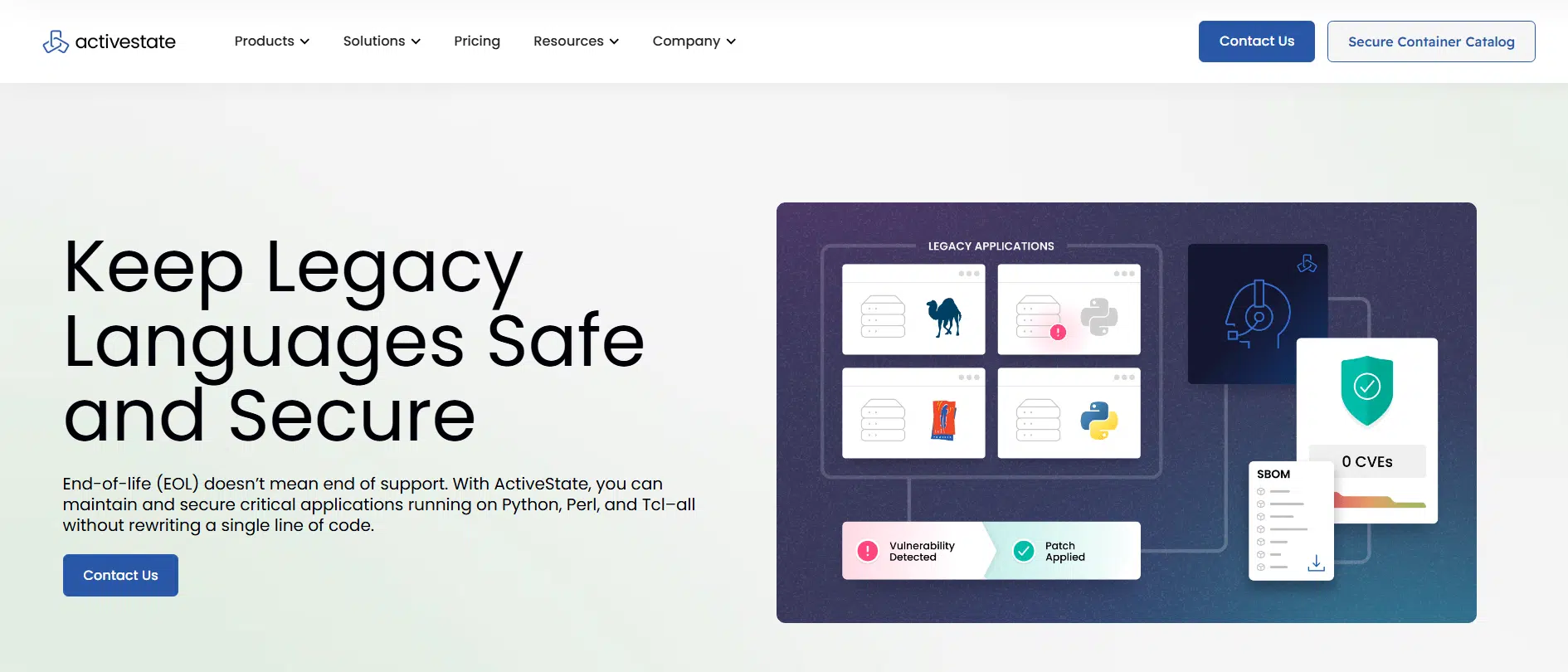
If your HeroDevs evaluation is driven specifically by a legacy Python, Perl, or Tcl stack, ActiveState is the specialist you can’t ignore. They don’t just “send you a patch”; they provide a completely curated, secure, and source-compiled distribution of the language itself.
For teams where pip install has become a security nightmare, ActiveState acts as a “private, secure mirror” for your language ecosystem.
Key Features
- Source-to-Binary Security: They compile the language runtime from source, scan for CVEs, and rebuild when fixes land. You aren’t just getting a patch; you’re getting a fresh, signed build.
- Beyond-EOL Support: They are the go-to for Python 2.7, 3.7, and 3.8 (which is now a major 2026 concern).
- The “Compliance” Bundle: Every build automatically generates a Software Bill of Materials (SBOM), making SOC 2 or FedRAMP audits significantly less painful.
Pricing
- Free Tier: Available for individual developers and small projects.
- Usage-Based: Team and enterprise plans require a quote and scale with build volume and runtime count.
Where ActiveState Has a Clear Edge
- Audit-Ready Provenance: If your CISO needs to know exactly where every byte in your Python distribution came from, ActiveState provides that “Source-to-Ship” visibility.
- Cross-Platform Peace: Unlike Linux-focused tools, ActiveState provides consistent builds across Linux, Windows, and macOS.
Where ActiveState Doesn’t Fit
- The “Language Silo”: They are masters of Python, Perl, and Tcl. If your stack also includes Java, Node.js, Ruby, or PHP, ActiveState leaves you stranded. You would need a second vendor (like TuxCare) to cover the rest of your house.
Reasons to Consider an Alternative to HeroDevs
HeroDevs is good at what it does. The problem is that legacy software risk rarely stays contained to a single layer – and when infrastructure teams start pulling the thread, they usually find more than just an EOL framework.
Here is why teams in 2026 are looking toward a broader alternative:
1. The “Hole in the Floor” (The Missing OS Layer)
HeroDevs’ NES has expanded aggressively into Spring, PHP, .NET, and Django. But end-of-life Linux distributions – like CentOS 7 or Ubuntu 18.04 – are missing from their list.
- The Risk: A perfectly patched AngularJS app running on an unpatched CentOS 7 server is still a massive security liability.
- The Alternative: TuxCare’s ELS specifically covers the OS layer that HeroDevs ignores, ensuring the “floor” of your infrastructure is as secure as the application sitting on it.
2. The Compliance Gap
PCI DSS, FedRAMP, and HIPAA auditors don’t give partial credit. They care whether CVEs have been remediated across every layer – not just the application.
- The Risk: Showing patch notes for a frontend framework while the underlying OS or runtime remains vulnerable doesn’t close the audit finding; it just highlights a different one.
- The Alternative: Using a vendor that covers the OS, runtimes, and applications together provides a much more defensible, unified audit trail.
3. Supply-Chain Risk vs. EOL Support
Sometimes, the problem isn’t that the software is “dead”; it’s that the “living” software you’re using is untrustworthy.
- The Risk: If your primary concern is supply-chain risk at the dependency level – ensuring that the packages entering your build are backed by active maintainers – neither HeroDevs nor TuxCare is the primary tool.
- The Alternative: In these cases, a tool like Tidelift (or Sonar’s integrated supply-chain tools) is the right fit. They enforce maintainer commitments rather than backporting security patches to dead software.
The Bottom Line on TuxCare
If the legacy software problem is purely at the application layer and the infrastructure is current, HeroDevs’ catalog is a reasonable fit. But most teams that start with that assumption quickly realize the application is just the part they can see.
The CentOS 7 server running behind it, the Python runtime in the background service, the MySQL instance nobody has migrated – those layers have their own EOL clocks, and they don’t wait for the application problem to get solved first. TuxCare’s Endless Lifecycle Support (ELS) covers OS, runtimes, libraries, and applications, with one of the widest open-source EOL catalogs available. If the stack has technical debt spread across more than one layer, the end-of-life calculator is a useful starting point for understanding what extending support actually costs versus a forced migration.