Tech Support
 Documentation
 Login
 Contact Us



Go straight to an AI summary of this blog post instead 


Key Takeaways
- WildFly has no EOL calendar, but a version stops getting upstream fixes once the next feature release ships.
- As of October 22, 2026, WildFly 42 is the only release the project still fixes.
- JBoss EAP 8 is a separate Red Hat product, with full support until 2028 and maintenance support until 2031.
- You can patch, upgrade, or move to EAP, but moving off WildFly 26 or older means a javax to jakarta migration.
You look up the WildFly EOL date for your version and come away without a date you can hand to an auditor. The project’s About page describes the maintenance policy and states that all previous releases are no longer maintained, but there’s no EOL calendar or end dates for any of them. WildFly stops fixing a version once the next feature release ships, and that’s the whole rule.
That leaves you to work out where you stand and explain it to people who want a date. This guide covers which versions are out of support today, what running one exposes you to, and three ways to deal with it: patches for the version you run, an upgrade to current WildFly, or a move to JBoss EAP.
What WildFly EOL Means
WildFly is the open source Java application server formerly known as JBoss AS, and it implements the Jakarta EE specifications. With no lifecycle calendar to go on, its release practice is what defines end of life for any given version.
The project targets four feature releases a year, in January, April, July and October, each followed about a month later by a single bug-fix micro release. That schedule is only roughly time-boxed. WildFly 40 was held back to deliver Jakarta EE 11 support and arrived more than a month late. There’s no LTS line and no support window.
In a September 2025 reply on the wildfly-dev mailing list, project lead Brian Stansberry wrote that once the next feature release ships, the project doesn’t intend to produce further bug-fix releases for the earlier one. He added that the policy belonged on wildfly.org, and the About page now spells it out. The one exception he could point to was WildFly 26.1.3, which shipped in January 2023 for a critical Apache CXF vulnerability (CVE-2022-46364) because the move to WildFly 27 and Jakarta EE 10 was expected to take users longer than usual.
So in practice, a WildFly version reaches end of life when the next feature release ships, usually about three months after its own release. The software keeps running, but the project stops patching it. Today that leaves WildFly 42 as the only version the project still fixes, and every earlier one, including WildFly 41, 40, 27, 26 and 10, without upstream fixes.
Red Hat JBoss EAP is a separate product with a formal lifecycle. Red Hat builds it from WildFly code on its own branch, and none of its dates apply to WildFly releases. EAP 8, for example, gets full support through February 5, 2028, and maintenance support through February 5, 2031.
WildFly End of Life Dates by Version
| WildFly version | Released | Last release in the line | Upstream fixes ended |
| 42 | Oct 22, 2026 | 42.0.0 | Not yet |
| 41 | Jul 16, 2026 | 41.0.1 (Aug 27, 2026) | Oct 22, 2026 |
| 40 | May 21, 2026 | 40.0.1 (Jun 19, 2026) | Jul 16, 2026 |
| 27 | Nov 9, 2022 | 27.0.1 (Dec 16, 2022) | Apr 20, 2023 |
| 26 | Dec 16, 2021 | 26.1.3 (Jan 18, 2023) | 26.0: Apr 14, 2022, when 26.1 shipped. 26.1: Nov 9, 2022, with 26.1.3 as a one-off exception |
| 10 | Jan 30, 2016 | 10.1.0 (Aug 19, 2016) | 10.0: Aug 19, 2016, when 10.1 shipped. 10.1: Oct 24, 2017 |
All dates come from the project’s own release announcements. The end dates mark when the next feature release shipped, since WildFly doesn’t publish formal EOL dates.
Did You Know: WildFly 40 and 41 shipped a temporary “WildFly EE 10” variant for teams that weren’t ready for Jakarta EE 11. The project said it would drop the variant with WildFly 42, and it did on October 22, 2026, a little over five months after the variant first appeared.
What Happens When You Run an EOL WildFly
An unsupported WildFly keeps working. It just stops getting upstream fixes, so when WildFly fixes a CVE in the server or in a library it bundles, the fix ships in the current release and no older one. Three consequences follow: security exposure, audit findings, and a migration that gets harder every quarter.
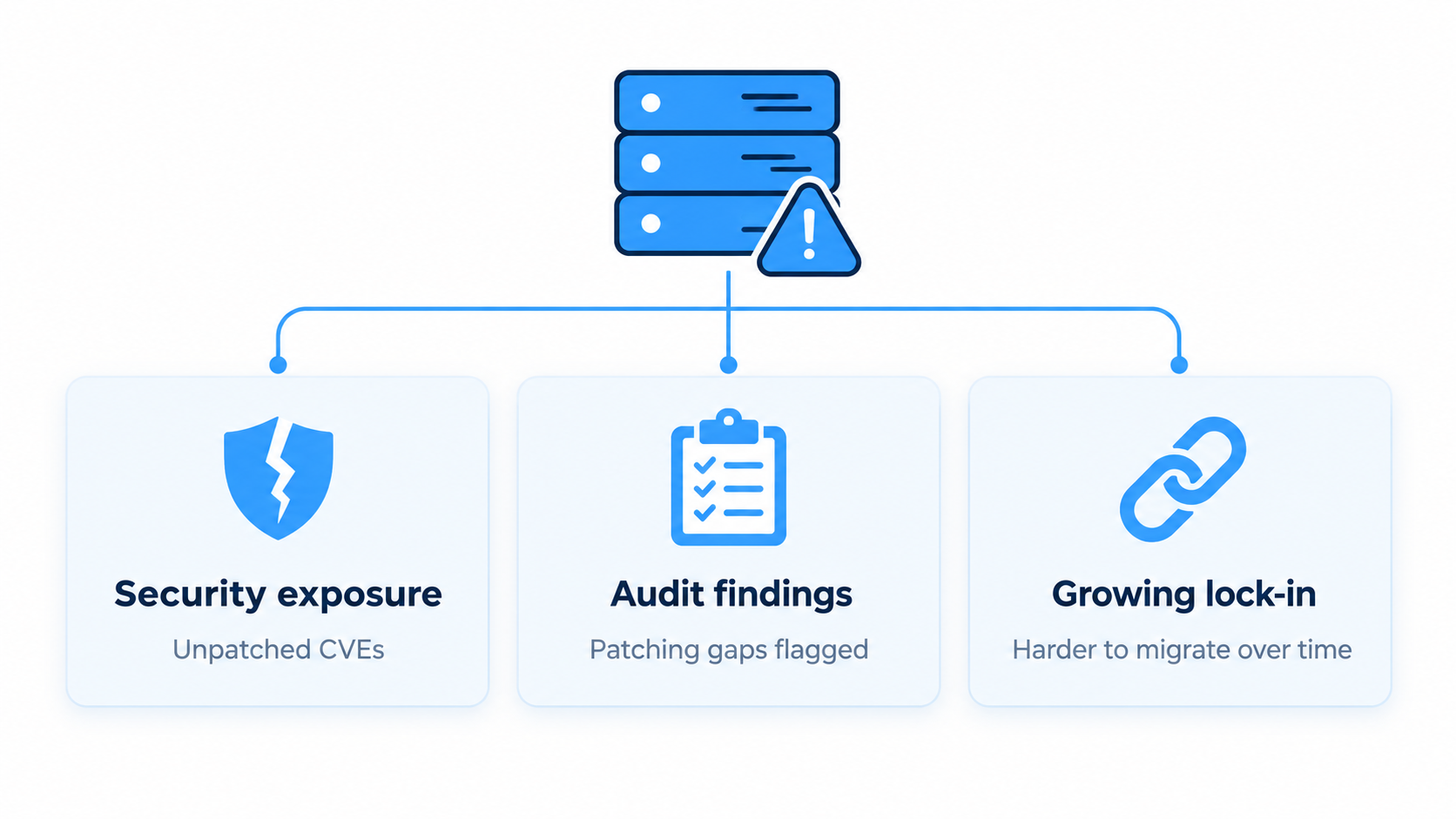
Unpatched CVEs in the server and its components
WildFly bundles Undertow, RESTEasy, Hibernate, Infinispan, JGroups, Apache Artemis, Elytron, Netty, and Jackson, among others, and that code collects CVEs at a steady clip. The WildFly 41 announcement lists dependency upgrades for Apache MINA SSHD, Artemis, CXF, Jackson and Netty that address CVEs, and the WildFly 42 announcement says a large number of its upgrades fixed vulnerabilities too. Within WildFly, every one of those fixes lands in the newest release only.
Two older advisories show what a missing backport looks like in practice. Both are fixed in current WildFly, so they illustrate the pattern and say nothing about the exposure of WildFly 42.
| CVE | Component | Published | Severity by source | Fixed in |
| CVE-2024-1635 | Undertow, the web layer | Feb 19, 2024 | CVSS v3.1: 7.5 High from Red Hat (the CNA). CVSS v4.0: 8.7 High from the GitHub Advisory Database. | Undertow 2.3.12.Final and 2.2.31.Final |
| CVE-2025-23367 | WildFly Core RBAC provider | Jan 30, 2025 | CVSS v3.1: 6.5 Medium from Red Hat and the GitHub Advisory Database. | WildFly Core 27.0.1.Final, which shipped in WildFly 35.0.1 on Feb 6, 2025 |
Picture a 12-node WildFly 26 cluster behind a public load balancer. The Undertow fix exists, but the WildFly 26 line ended with 26.1.3 in January 2023, 13 months before the CVE was published, so no 26 build contains it. You can backport the fix and rebuild the module yourself, add network-layer limits, or accept the exposure. That last option takes no effort, which is exactly how an exposure turns permanent.
Compliance and audit findings
Frameworks such as PCI DSS expect known vulnerabilities to be patched inside a defined window. PCI DSS v4.0.1 Requirement 6.3.3 says patches for critical vulnerabilities must be installed within one month of release, with everything else on a timeline set by the organization’s own risk ranking. A component with no upstream fix path can’t meet that on its own, however well the rest of the stack is run. A WildFly 10 install in the cardholder data environment with an open critical CVE is likely to end up as an assessor finding, and “the project publishes no EOL dates” won’t make it go away.
Operational lock-in that grows each quarter
Old WildFly sits still while everything around it moves. The JDK it runs on ages out. The OS underneath reaches its own end of life. A monitoring agent drops support for the old management API. Then a developer needs a library that requires the jakarta namespace, and an upgrade that looked like a few weeks of work last year turns into a rewrite.
The gap compounds with the release cadence. WildFly 26 is now 16 feature releases behind WildFly 42, and each one adds changes a migration has to absorb. Take a claims application on WildFly 26 and Java 8. Moving it to current WildFly means a JDK upgrade, a javax to jakarta migration and a regression cycle in a single project, because WildFly 26.1 was the last line to support Java SE 8 and current WildFly needs SE 17 or later.
Why Upgrading WildFly Isn’t Always Simple
Upgrading to the current release is the cleanest answer, but it assumes three things: a codebase that ports cleanly, engineers with time, and, for vendor-bundled apps, a vendor that certifies the new version. The obstacles below are why teams stay on old versions far longer than they planned.
The javax to jakarta namespace break
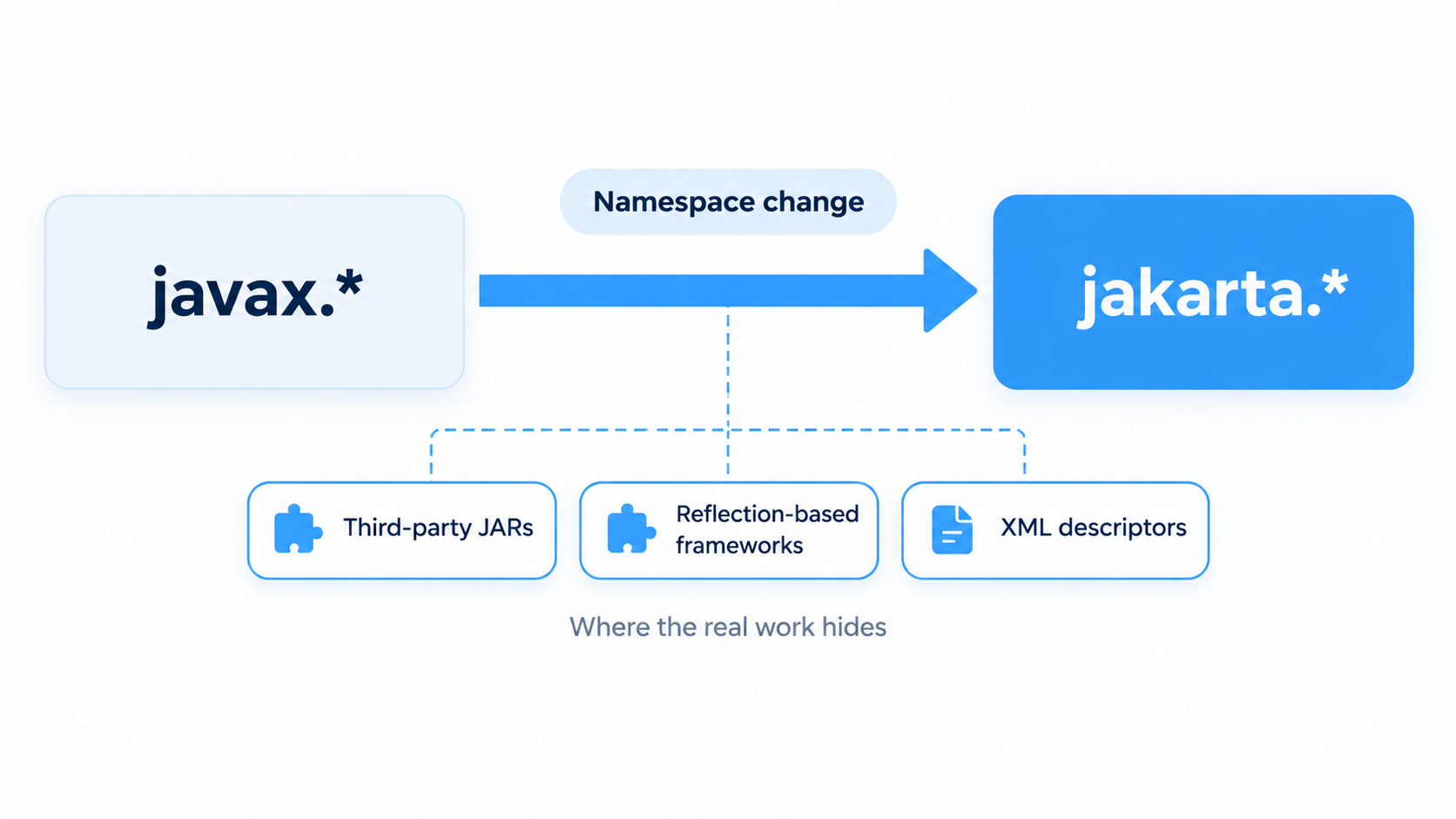
WildFly 27 dropped Jakarta EE 8 and moved to Jakarta EE 10, so every enterprise javax.* import (javax.servlet, javax.persistence, javax.ws.rs, javax.ejb) becomes jakarta.* in code that targets it. Plain Java SE packages such as javax.crypto stay where they are. Tools such as the Eclipse Transformer and OpenRewrite handle the mechanical rename in your own source. The harder work sits in everything else: third-party JARs compiled against javax, reflection-based frameworks, XML descriptors with old namespaces, and vendor libraries whose Jakarta releases behave differently. Chasing those dependencies can take longer than the rename itself.
Java SE and platform drift
The Java floor keeps rising. WildFly 27 required SE 11 or later, and WildFly 35 dropped SE 11 in January 2025. Current WildFly runs on SE 17, 21 and 25, and the project recommends SE 25, although WildFly 42 claims Jakarta EE 11 compatibility only on SE 17 and SE 21. The WildFly 42 announcement adds that WildFly 43 will be the last release to run on SE 17, because the project plans to raise its baseline to SE 21 with WildFly 44 next spring. An application still on Java 8 or 11 therefore faces a JDK migration and an app server migration at the same time, with removed APIs, stricter module encapsulation and changed GC defaults along the way. Each is manageable alone. Together they multiply the testing matrix, and when a load test fails it’s hard to tell which change broke it.
Testing, certification and team capacity
Even when the code ports cleanly, someone has to prove it. Regulated environments usually need documented regression testing, and ISV-bundled applications need the vendor to certify the new WildFly version, which some vendors never do. The engineers who built the application may have left, and the current team is busy shipping features.
A candid vulnerability assessment often concludes that the risk is real and the upgrade can’t happen this year. Weighing the real-world cost of leaving a critical CVE unpatched against migration cost then becomes an honest budget conversation, and vendor-backed patching for the version you run is a legitimate bridge until the migration happens.
Your Options After WildFly EOL
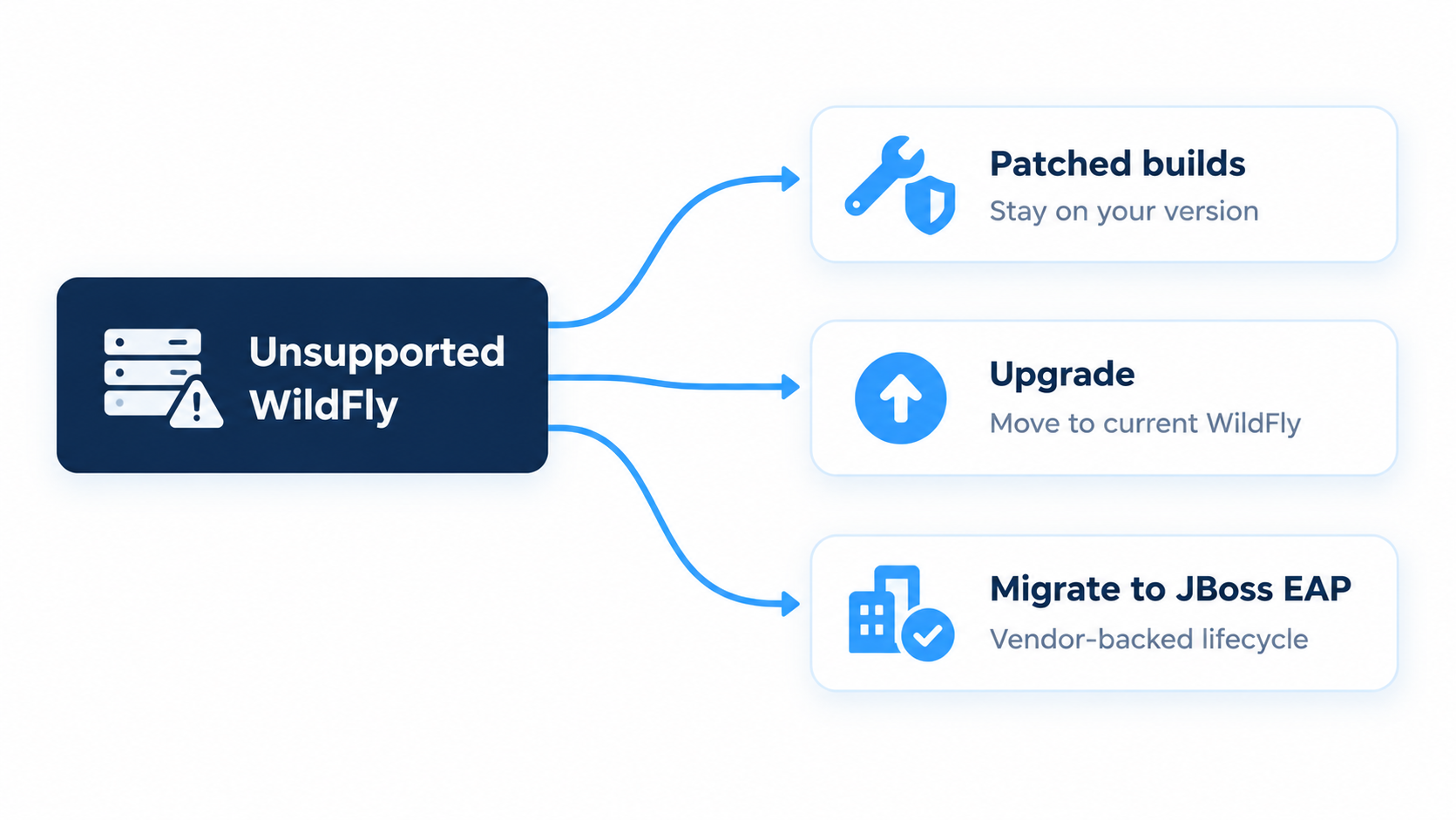
Three routes exist, and plenty of teams combine them, running patched builds now while they migrate on a schedule they control. The right mix depends on how far behind you are, how much engineering time you have, and how much risk your auditors will accept in the meantime.
| Your situation | Best-fit option |
| Running WildFly 19.0.1 or 27.0.1 with no migration capacity this year | Endless Lifecycle Support (ELS) for WildFly |
| Running another WildFly 26 or older release on javax packages | Plan the move to Jakarta EE 10 or later, and ask TuxCare whether your version can be added in the meantime |
| Jakarta-ready code and an active team | Upgrade to current WildFly |
| Need a vendor SLA, a long lifecycle and Red Hat certification | Migrate to JBoss EAP |
| Mixed estate with several WildFly versions | Patch covered servers with ELS and upgrade the rest on your own schedule |
Patched builds for the version you run
If you need to stay on an older WildFly while you plan the migration, a third-party extended support service can supply patched builds of the version you already have. TuxCare’s Endless Lifecycle Support for WildFly delivers security patches and selected bug fixes for WildFly 19.0.1 and 27.0.1 through TuxCare-hosted repositories.
The dependency tree makes this more valuable than it first looks. WildFly ships as a distribution of many modules, from the Undertow web server and RESTEasy to Hibernate ORM and Validator, Infinispan and JGroups for caching and clustering, Apache Artemis for messaging, WildFly Elytron for security, and Netty and Jackson for networking and JSON. CVE-2024-1635 sat in Undertow rather than in WildFly’s own code, while CVE-2025-23367 hit WildFly Core itself, so patching one layer and ignoring the other leaves holes either way. TuxCare’s ELS covers both direct and transitive dependencies in WildFly at no extra cost, and its CVE tracker shows which advisories have shipped fixes for the supported versions. The JDK under an old WildFly reaches its own end of life too, and ELS for Runtimes covers OpenJDK among other runtimes.
Upgrade to the current WildFly release
With Jakarta-ready code and an engineering team that has time, upgrading is the cleanest long-term fix. Start by moving the JDK on your current WildFly, where its support matrix allows, so the two changes don’t land at once. Then work through the announcements and release notes for every release between your version and 42. The announcements call out the headline incompatible and behavioral changes, and the release notes fill in the detail. WildFly 41, for example, deprecated the AJP listener and changed the Infinispan cache store default to non-segmented storage, and WildFly 42 logs a warning for JGroups channels that run without authentication and encryption protocols.
Before you deploy anything, boot the target version against a copy of your configuration and read the WARN output. Provision only the layers you need with Galleon, which shrinks the attack surface and, in WildFly 42, limits the generated SBOM to what you actually installed. Load-test before and after, and recheck firewall rules while you’re at it, because defaults such as the JGroups failure detection ports moved in WildFly 41.
The catch is the cadence. The project ships four feature releases a year and fixes only the newest, so staying current means upgrading every few months or letting a gap open again.
Migrate to Red Hat JBoss EAP
JBoss EAP gives you the lifecycle WildFly lacks, at the price of a Red Hat subscription. Red Hat has said EAP 8.0 Update 12 is the last 8.0 update, which makes EAP 8.1 (based on WildFly 35) the target for continued CVE fixes.
The move from WildFly 26 or older still means the full javax to jakarta migration, because EAP 8 has no javax option. EAP 7.4 is the javax release, and it left maintenance support on June 30, 2025, so only Red Hat’s paid Extended Life Support add-on covers it now. If you run EAP in production and WildFly in development, pin development to the WildFly version your EAP release is based on and still run your final tests on EAP itself. Red Hat states that no EAP release matches a WildFly version exactly, and those differences tend to show up late.
Keep WildFly Patched After End of Life with TuxCare
WildFly’s release model means even the version you install today will stop getting upstream fixes within a few months. Teams that can upgrade every quarter can live with that. Teams that can’t need patches for the version in front of them while the migration proceeds on their own timeline.
TuxCare’s Endless Lifecycle Support for WildFly provides SLA-backed security patches and selected bug fixes for WildFly 19.0.1 and 27.0.1, with 24/7 expert support. Running a different version? Ask TuxCare whether it can be added.
FAQs
Yes. WildFly 26 reached end of support under the project’s own practice. WildFly 26.1 shipped in April 2022, WildFly 27 replaced it in November 2022, and the only later 26 release was 26.1.3 in January 2023, a one-off backport for a critical Apache CXF vulnerability. Nothing has shipped for the 26 line since.
Yes. WildFly 10.0.0 arrived in January 2016, and the last release in the line was 10.1.0 in August 2016. More than 30 feature releases have shipped since, and the project fixes only the newest.
WildFly is a community project, and its security page names the Commonhaus Foundation as its sponsor. Red Hat offers no commercial support subscription or lifecycle commitment for WildFly itself. Red Hat’s supported product is JBoss EAP, built from WildFly code and covered by a published multi-year lifecycle.
WildFly is the upstream community project, released four times a year with the newest features. JBoss EAP is Red Hat’s downstream product, maintained on a separate source branch, with long support phases and a paid subscription. Red Hat says bugs are fixed in the current upstream release first and often backported to EAP.
Yes, it keeps working. The project stops issuing fixes for it, so new CVEs in the server or its bundled components stay open unless you upgrade, rebuild modules yourself or use a vendor that backports patches to your version.
Run the startup script with the –version flag, or query the management CLI on a running server:
$JBOSS_HOME/bin/standalone.sh –version
$JBOSS_HOME/bin/jboss-cli.sh –connect –command=”:read-attribute(name=product-version)”
If you’re on WildFly 26 or older and your code uses the enterprise APIs, yes. WildFly 27 and later use the jakarta.* namespace, starting with Jakarta EE 10. Standard WildFly 40 and later use Jakarta EE 11, although WildFly 40 and 41 also offered a temporary Jakarta EE 10 variant that ended with WildFly 42. If you’re already on 27 or newer, the namespace migration is behind you.