Tech Support
 Documentation
 Login
 Contact Us



Go straight to an AI summary of this blog post instead 


Key Takeaways
- Compliance platforms automate evidence collection and control monitoring across frameworks like SOC 2, ISO 27001, HIPAA, PCI DSS, and FedRAMP.
- GRC tools such as Vanta, Drata, Sprinto, and Secureframe flag failing controls, but they do not patch anything.
- Patching stays with your team, and that is one place continuous compliance can start to slip.
- Pricing is mostly quote-based across the category, so match the tool to your frameworks, your stack, and how much you need fixed rather than tracked.
Your auditor does not care that you bought a compliance platform. They care whether your servers were patched inside the remediation window your policies and applicable frameworks require, whether those access reviews actually happened, and whether the evidence survives a follow-up question.
The best IT compliance and remediation tools in 2026 automate most of the work behind maintaining controls, collecting evidence, and closing security gaps for frameworks like SOC 2, ISO 27001, and FedRAMP. Here is what each one does well, where it falls short, and how to pick the right fit for your stack.
What IT Compliance Tools Actually Do
IT compliance tools are software platforms that automate the work of proving your systems meet a security or regulatory standard. Instead of screenshotting AWS console pages into a spreadsheet the week before an audit, the tool talks to your cloud, your identity provider, and your code repositories, then collects timestamped evidence on an ongoing basis.
Most compliance automation platforms handle the same core jobs. Mapping controls to frameworks, watching those controls for drift, collecting evidence, and packaging it up for an auditor. The frameworks they target are the ones that show up in enterprise procurement. SOC 2 for SaaS vendors handling customer data, ISO 27001 for buyers who work to international standards, FedRAMP for cloud providers selling to U.S. federal agencies.
Governance, risk, and compliance platforms automate the reporting side. The technical controls underneath, meaning patching, vulnerability remediation, and configuration hardening, still have to happen somewhere. Knowing which side of that line a tool sits on keeps you from buying two products that cover the same half of the job while the other half stays exposed.
Four GRC Platforms Compared
This comparison looks at four platforms that come up constantly in regulated environments: Vanta, Drata, Sprinto, and Secureframe. All four automate evidence collection, control monitoring, and audit prep. None of them patch anything, which turns out to matter more than it sounds like it should.
| Tool | Product type | Best for | Observed annual spend | G2 rating (reviews) |
| Vanta | Compliance automation | A fast first SOC 2 | ~$7.5K to $57K | 4.6 (2,450+) |
| Drata | Compliance automation | Customizable multi-framework programs | ~$9.6K to $60K | 4.7 to 4.8 (1,150+) |
| Sprinto | Compliance automation | Cloud-native teams watching budget | ~$6K to $12K+ | 4.8 (1,650+) |
| Secureframe | Compliance automation | Federal and defense frameworks | ~$7K to $35K | 4.7 (800+) |
Most of the GRC vendors here do not publish standard list pricing, so those figures come from third-party contract trackers such as Vendr, marketplace listings, and community reports rather than rate cards. What you actually pay moves with headcount, framework count, and add-on modules, and audit fees are always separate. G2 ratings and review counts were read in August 2026 and change constantly, so check them before signing anything.
TuxCare
TuxCare is not a GRC platform and is not trying to be one. It does not automate your evidence collection or run your audit workflow. What it does is address the technical control those audits keep testing, which is whether your systems are genuinely patched against known vulnerabilities. That matters because patching can become a weak point in continuous compliance. A GRC tool flags an unpatched vulnerability. Something still has to close it. On 24/7 workloads, or fleets too large to reboot on any sane schedule, the gap between detected and fixed can become an audit finding.
Here is how it covers the remediation side of compliance across Linux distributions and open-source software.
Rebootless Patching for Linux Kernels and Shared Libraries
KernelCare applies kernel security patches to running systems without a reboot, and LibCare does the same for shared libraries like glibc and OpenSSL without restarting the processes using them. Together they mean your remediation window isn’t gated by a maintenance window nobody wants to schedule. TuxCare aims to deliver live patches for vendor-fixed kernel vulnerabilities within 10 days of public disclosure, often sooner for the high-profile ones. For vulnerability management controls under SOC 2 and ISO 27001, that shorter gap between disclosure and fix is what makes the remediation timeline easier to both hit and demonstrate.
TuxCare publishes KernelCare pricing directly rather than quoting it deal by deal: $5 per system per month for live patching, with larger and multi-product deployments quoted separately.
Long-term Security for End of Life Software
Plenty of enterprises still run CentOS 7, CentOS Linux 8, or something else that reached upstream end of life a while back. Once that happens the upstream project or vendor stops providing security updates, but the box is still in audit scope. Endless Lifecycle Support keeps security patches flowing to those distributions, so a legacy host doesn’t quietly turn into a gap you have to explain in a meeting.
FIPS 140-3 Continuity on AlmaLinux and Rocky Linux
If you run AlmaLinux or Rocky Linux somewhere FIPS 140-3 applies, you have a specific problem. Patching cryptographic modules can break the validation you were relying on in the first place. TuxCare’s Extended Security Updates, part of its Enterprise Support offering, ship a set of five FIPS-validated modules covering the kernel, OpenSSL, libgcrypt, NSS, and GnuTLS, with security updates that don’t alter the validated cryptography. The AlmaLinux modules went through accredited laboratory testing and CMVP validation, and Rocky Linux appears as a vendor-affirmed operational environment for those modules. When a fix genuinely has to change validated cryptography, TuxCare uses an expedited FIPS 140-3 revalidation process instead of restarting the whole thing.
Supply Chain Integrity for Open-Source Dependencies
Patching your own systems doesn’t help if the open-source package you pulled in last week was compromised before you ever installed it. SecureChain rebuilds packages from verified source, scans them for malware and tampering, and keeps them patched for as long as they’re in your stack, including after the upstream project stops maintaining them. It covers Python, Java, JavaScript, Go, Rust, and PHP. For audit purposes, it also generates SBOMs, VEX documents, and SLSA Level 3 provenance, which is increasingly the kind of evidence FedRAMP and enterprise security reviews expect for the software supply chain, not just the OS layer.
Where TuxCare falls short
Its live patching is Linux-focused, so a mixed-OS fleet needs a different remediation approach for everything that is not Linux. It produces patch evidence rather than audit evidence, which means control mapping, policies, and access reviews still need a GRC platform or a very patient spreadsheet. KernelCare runs a lightweight client on protected systems, which some change advisory boards will want to review at length. And its public review base is small, so there is less independent sentiment to lean on than there is for the GRC vendors.
Who TuxCare is for
Teams running production Linux at a scale or uptime where reboots genuinely hurt, and teams stuck on distributions that upstream stopped supporting.
Vanta
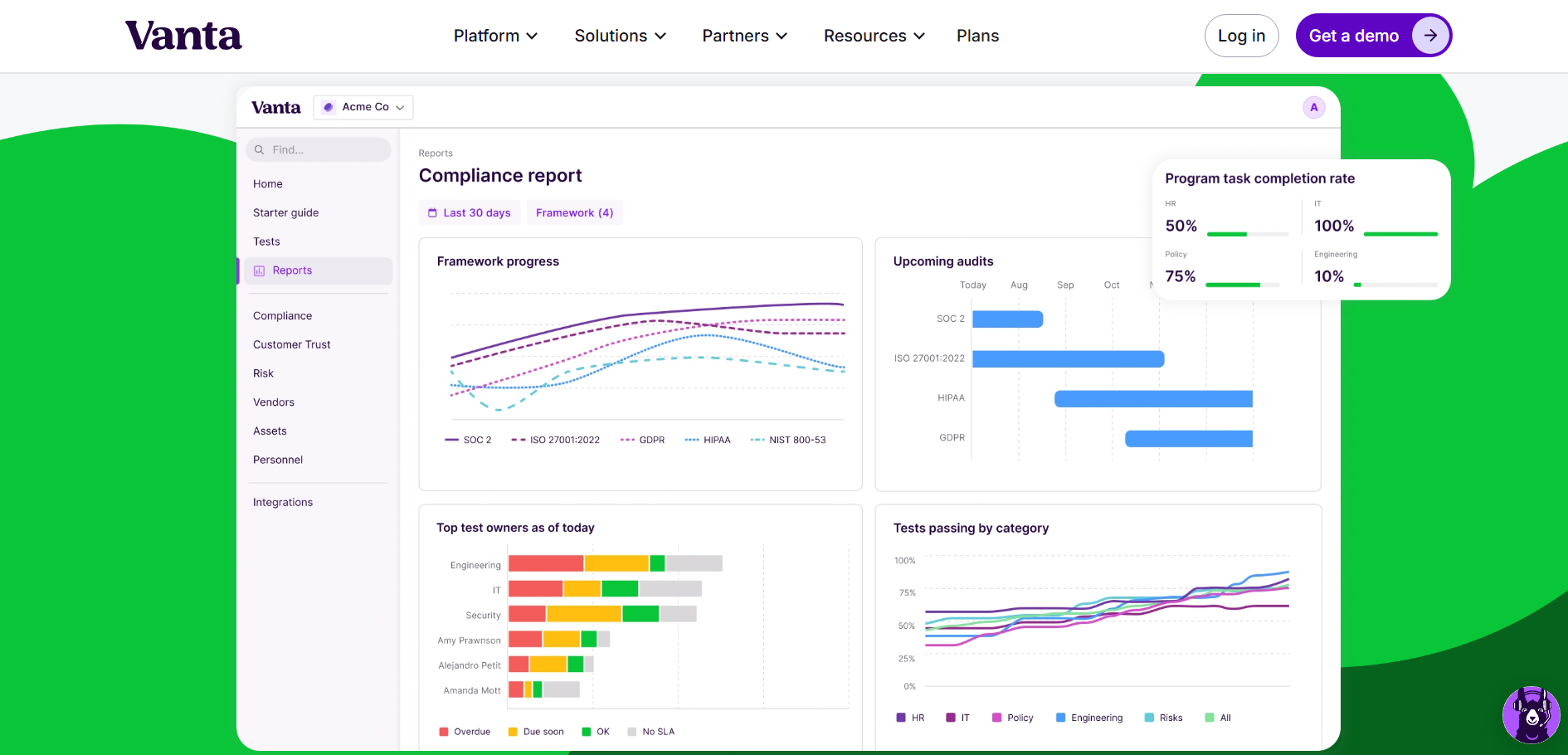
Vanta is the plug-and-play option, best known for getting companies through a first compliance program without hiring a GRC team. It has grown well past that starting point and now reports more than 16,000 customers. It automates evidence collection and control monitoring across SOC 2, ISO 27001, HIPAA, GDPR, PCI DSS, and 35 or more frameworks in total, with over 400 integrations doing the collecting.
What Vanta does well
Once integrations are connected, the platform gathers most of the required evidence with minimal ongoing engineering involvement, though failed tests, scoping changes, and broken connectors still land on someone’s desk. Evidence gets reused across overlapping SOC 2 and ISO 27001 controls, so a second framework does not double the workload. There is questionnaire automation that drafts answers from evidence you already have, plus vendor risk tracking in the same platform. The pitch is speed, and specifically a large reduction in the manual work between deciding to get audited and being ready for one.
What Vanta costs
Vanta does not publish pricing. Buyer-contract data tracked by Vendr puts observed annual contracts roughly between $7,500 and $57,000, with a median near $20,000. Community-reported numbers follow the same shape, with single-framework startup deals near the bottom of that band and multi-framework mid-market programs sitting well above it.
Where Vanta falls short
Cost is the recurring theme. Pricing tends to firm up midway through the sales cycle, bundled options are not obvious upfront, and renewal quotes are the most common complaint in reviews. Smaller teams can find the spend hard to justify unless a specific deal is blocked on compliance. Organizations with genuinely complex enterprise GRC requirements sometimes end up comparing Vanta against broader enterprise GRC suites.
What reviewers say
Vanta sits at 4.6 on G2 across more than 2,450 reviews as of August 2026, the largest review base among the four GRC platforms compared here. Reviewers commonly call out automated evidence collection and prebuilt policy templates. Critical reviews frequently mention renewal pricing, with some also citing integration issues.
Who Vanta is for
Early and mid-stage SaaS companies pursuing a first SOC 2 or ISO 27001 who want speed more than deep customization.
Drata
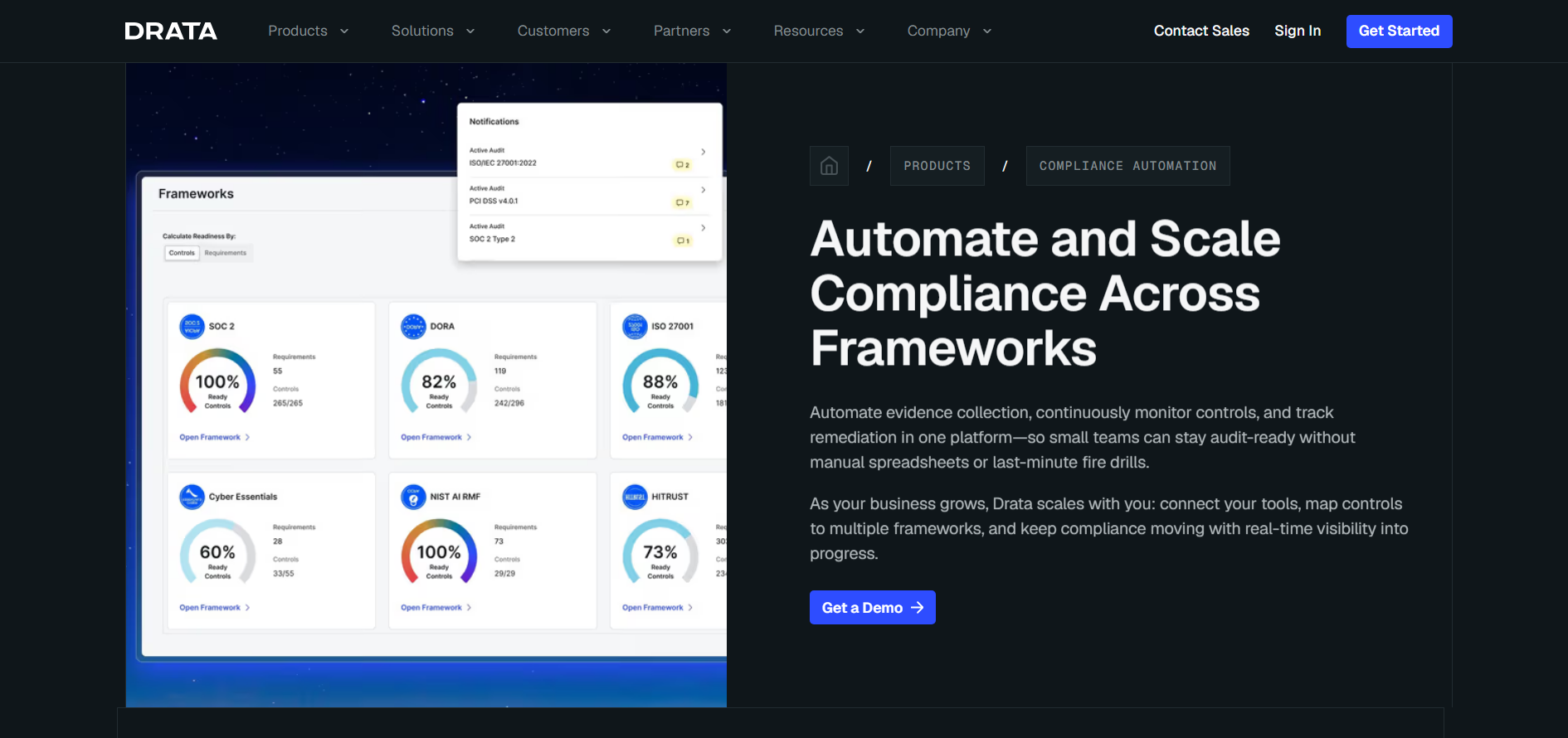
Drata is positioned for compliance programs that get more complicated over time. It combines deep automation and substantial customization with a support reputation reviewers bring up constantly. It reports more than 8,500 customers, and it acquired trust-center vendor SafeBase in February 2025, which is where its Trust Center product comes from.
What Drata does well
Controls get tested automatically and failures surface as they happen rather than in the two weeks before an audit. Multi-framework support runs deep across SOC 2, ISO 27001, HIPAA, PCI DSS, GDPR, and more, with cross-mapping between them. The SafeBase-derived Trust Center gives you a public-facing page that answers buyer security questions before anyone emails a questionnaire. Access reviews are automated and map cleanly onto the SOC 2 controls that usually cause the most manual grief.
What Drata costs
Also quote-based. Vendr’s tracked contracts put observed annual spend roughly between $9,600 and $60,000, with an average contract noticeably higher than Vanta’s, which fits the enterprise lean. Additional frameworks and modules such as Trust Center and vendor risk are commonly billed separately, so ask what is actually inside the base number.
Where Drata falls short
Cost scales quickly as frameworks and modules stack up, and renewal is where teams notice. If a platform you depend on is not on the integration list, that turns into manual work indefinitely. Reviewers also mention that failed-test explanations do not always make the root cause obvious.
What reviewers say
Depending on where you read it, Drata shows 4.7 or 4.8 on G2 across roughly 1,150 to 1,330 reviews, and its own site advertises 4.8. Reviewers frequently single out customer support as the thing that sets it apart. Criticism concentrates on renewal pricing and the learning curve of mapping several frameworks at once on day one.
Who Drata is for
Growing companies and enterprises running or planning multiple frameworks that need customization and a hands-on support relationship.
Sprinto
Sprinto targets cloud-native teams and builds its pitch around continuous, automated compliance. It supports more than 200 standards including SOC 2, ISO 27001, GDPR, HIPAA, PCI DSS, and ISO 42001 for AI governance, across more than 300 integrations. The platform reports more than 3,000 customers across 75 countries.
What Sprinto does well
Missing evidence gets flagged early rather than surfacing halfway through an audit. Sprinto positions its pricing around company scope rather than seat count, which suits teams that would rather not think about who has a login. There is an embedded AI assistant that summarizes policies, extracts risks, and triggers workflows without leaving the platform. Framework breadth is a genuine strength, and it picked up ISO 42001 for AI governance early.
What Sprinto costs
No public pricing page. Community-reported numbers land around $6,000 to $8,000 for a single framework on a clean cloud setup, $8,000 to $10,000 for a typical SOC 2 program, and past $12,000 once multi-region or multi-entity scope enters the picture. Implementation fees are sometimes waived for smaller teams.
Where Sprinto falls short
No published pricing, several features sitting outside the base quote, and reviewers who report noticeably higher numbers at renewal. Onboarding can also run slower than the marketing suggests for teams in a genuine hurry.
What reviewers say
Sprinto carries 4.8 on G2 across more than 1,650 reviews as of August 2026, one of the highest ratings among the four GRC platforms here and a substantial review base for the category. Praise centers on ease of setup and support quality. Criticism centers on renewal pricing and add-on costs that were not in the first quote.
Who Sprinto is for
Cloud-native startups and mid-market teams that want continuous compliance, pricing that does not track headcount, and a lot of onboarding help.
Secureframe
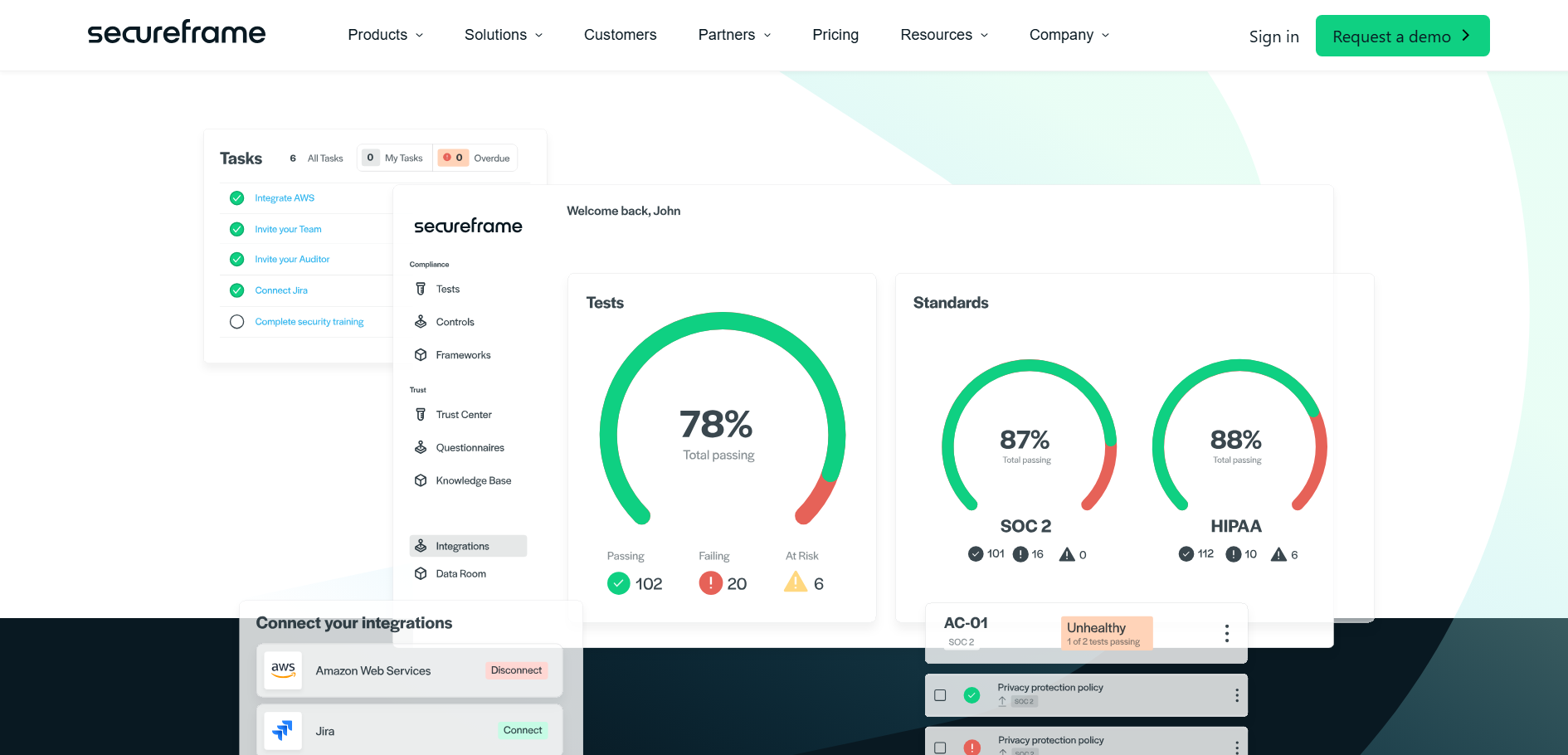
Secureframe stands out on this list when federal frameworks are in scope. Alongside SOC 2, ISO 27001, HIPAA, and PCI DSS, it runs FedRAMP, CMMC, and NIST 800-53 and 800-171 workflows through a dedicated federal offering, with dozens of prebuilt frameworks and more than 300 integrations. Founded in 2020, it reports more than 6,000 customers.
One piece of current context matters here. On July 13, 2026, the Department of War, formerly the Department of Defense, paused the transition to CMMC Phase 2 third-party certification and opened a 60-day review of the program. Phase 1 self-assessment requirements and DFARS obligations stayed in force, so the underlying work has not gone away, but the certification timeline that was set for November 2026 is on hold pending that review.
What Secureframe does well
The federal workflows are the headline, including SPRS score tracking for defense contractors. Control health is tracked continuously and mapped across framework requirements, so one piece of evidence can support requirements across several frameworks at once. There is a vCISO-curated library of prebuilt, audit-ready tests you can switch on rather than build, and an AI layer added in 2025 that handles risk assessment, policy drafting, and evidence mapping.
What Secureframe costs
Third-party analyses put a first framework somewhere around $7,000 to $10,000, with fuller deployments that add questionnaire automation and multiple workspaces landing in the $15,000 to $35,000 range. Each additional framework adds meaningfully to the total. Median observed contracts sit near $20,000.
Where Secureframe falls short
Some reviewers report gaps around niche and legacy integrations, which leaves more manual work than expected. Others find the workflows less flexible when their own process differs from Secureframe’s defaults. Pricing stays opaque until fairly late in the sales process, and reviewers occasionally flag AI-generated questionnaire answers that needed correcting before they went out.
What reviewers say
Secureframe sits at 4.7 on G2 across roughly 800 reviews as of August 2026, with consistent praise for support quality and time saved on evidence collection. Pricing transparency is the most common complaint.
Who Secureframe is for
Mid-market SaaS, fintech, and government-adjacent companies pursuing federal frameworks or running several certifications at once.
Why This Category Exists
Compliance stopped being a once-a-year scramble a while ago. Buyers want continuous evidence, regulators want ongoing controls, and manual compliance gets painful fast once frameworks start stacking up.
Large organizations make worthwhile targets, and the aftermath of a breach runs from expensive to genuinely existential. The fallout includes recovery costs, regulatory exposure, and reputational damage that money does not immediately repair. Meanwhile teams keep facing a high volume of newly disclosed vulnerabilities against patch cadences designed for a quieter era.
Lower breach risk
Compliance platforms improve visibility into control health. Remediation tooling such as automated patching shortens the time a known vulnerability stays open. A GRC platform tells you a control is failing. Something else has to fix the underlying issue. Run both and the window between disclosure and remediation gets meaningfully shorter.
Continuous readiness instead of last minute panic
A point-in-time audit is a snapshot. Continuous monitoring is closer to a video.
These platforms track control health year-round, so you are not reconstructing nine months of artifacts in the two weeks before an auditor arrives. Drift gets caught when it happens rather than once it has already become a finding.
Fewer manual engineering hours
Evidence collection is the part everyone hates. Automating it gets senior engineers off screenshot duty and back onto work that matters. Vendors and reviewers both report substantial reductions in audit preparation effort once integrations are live, and it is usually the clearest operational win these platforms deliver.
Closing the remediation gap
Monitoring tells you a control failed. It does not fix it. Unpatched vulnerabilities are one way a control quietly falls out of compliance between audits, often because the fix is waiting on a reboot window that keeps sliding to next quarter. Pairing GRC monitoring with automated patching is a direct way to keep vulnerability metrics healthy year-round rather than only in audit season.
Reality check. An audit report or certification reflects a defined assessment period. It does not tell you whether your systems are patched today. IBM’s 2025 Cost of a Data Breach Report put the average time to identify and contain a breach at 241 days, and the 2026 edition pushed that figure back up to 247. Numbers like those are the clearest argument for why point-in-time compliance on its own cannot tell you an environment is still secure.
The Frameworks You Are Probably Dealing With
Each framework targets a different risk and a different buyer. Compliance tools earn their keep by automating the evidence and reporting for whichever ones apply to you.
SOC 2
A common requirement for SaaS vendors handling customer data. SOC 2 examines your controls against the AICPA Trust Services Criteria. A Type 2 report covers a defined observation period, typically six to twelve months, rather than the single point in time a Type 1 covers. It is often one of the first assurance reports an enterprise buyer asks about.
ISO 27001
The international standard for information security management systems. SOC 2 is especially common in the U.S. technology market, while ISO/IEC 27001 is recognized across regions and industries, including inside the U.S. It expects a documented, ongoing management system rather than a set of controls that happened to pass on the day, which is exactly what continuous monitoring is good at supporting.
HIPAA
Covers protected health information in the U.S. Any vendor handling PHI on behalf of a covered entity is in scope as a business associate. HIPAA’s Security Rule requires administrative, physical, and technical safeguards, including access controls, audit controls, and ongoing risk management, which is where vulnerability remediation earns its place. Compliance tools map those requirements to evidence automatically.
PCI DSS
Required for anyone storing, processing, or transmitting payment card data, and more prescriptive than the rest. Under requirement 6.3.3 in PCI DSS v4.0.1, patches for critical vulnerabilities must be installed within one month of release, while other applicable security patches follow timeframes the organization determines through its own documented risk assessment. Automated remediation makes hitting that one-month window considerably less dramatic, though it is not itself a PCI DSS requirement.
FedRAMP
The bar for selling cloud services to U.S. federal agencies, built on NIST SP 800-53. It carries extensive continuous monitoring obligations, defined vulnerability remediation timelines tied to severity, and a documentation load heavy enough that vendors maintain dedicated federal offerings specifically to deal with it.
How to Choose the Right Tool
The right tool depends on what you are actually missing. Map the gap before you map the budget. Three things matter more than the rest.
Continuous monitoring versus point in time snapshots
If your compliance evidence lives in spreadsheets that get updated before each audit, continuous monitoring is the upgrade that pays for itself. Look for a platform that tests controls on a schedule and alerts on drift, not one that just stores documents. If the gap is evidence and reporting, a GRC platform is what you want. If the gap is fixing what monitoring finds, you need a remediation layer underneath it.
Framework and integration coverage
A tool is only as good as its coverage of the frameworks you need and the systems you actually run. Confirm the platform supports your target certifications and has native integrations for your cloud, identity provider, and code hosts. A missing integration tends to become a long-lived manual workaround.
If FedRAMP or CMMC is on the roadmap, Secureframe has a dedicated offering for federal and defense requirements. If you are on a mainstream SaaS stack, Vanta’s connector library probably covers most of it, but verify every in-scope system before you sign.
Remediation not just detection
This is the consideration most buyers skip. A GRC platform will tell you a server is running an unpatched kernel. It will not patch it. If your audit findings keep tracing back to patch latency, the fix is automated remediation rather than another dashboard. Teams running production Linux often pair a GRC platform with live patching for exactly this reason. The GRC tool handles the documentation, the patching layer handles the actual fix, and your GRC tool can then verify and report the resulting control status.
Where TuxCare Fits
Most of this article covers tools that help you demonstrate compliance. TuxCare addresses one of the technical areas that quietly determines whether you stay compliant, which is vulnerability remediation. GRC platforms can flag a patching control as failing, but they are not the patching layer that applies the fix.
If your team runs production Linux at a scale or uptime where reboots genuinely hurt, or on distributions that upstream stopped supporting, live patching helps keep vulnerability management controls inside their remediation timelines year-round rather than only around audit season. It makes routine remediation far less disruptive and leaves a clearer evidence trail, though patch policy, testing, staged rollout, and exception handling remain your job.
Efinity, which builds quote and bind systems for insurers, is a reasonable example. Its gateway and database nodes could not be clustered, which made the reboots that CentOS kernel updates demanded a direct conflict with uptime. KernelCare removed the reboot from the equation and Efinity credits it with a smoother SOC 2 process. Pair a remediation layer with the GRC platform that fits your frameworks and you address both compliance evidence and one important area of technical remediation.
Compliance Takes More Than a Platform
For enterprise-scale organizations, compliance is mandatory and awkward to sustain. The tools here handle different pieces of that problem. GRC platforms automate the evidence and reporting. Remediation tools close the vulnerabilities those reports keep surfacing.
The combination is the whole point. Buying a compliance platform without dealing with your patching backlog is like installing a smoke alarm and leaving the faulty wiring alone. You find out faster, but the underlying risk has not moved an inch.
If you are running Linux in a regulated environment and patching is the weak point that keeps showing up in your audits, that is worth addressing directly. Read more about how KernelCare supports enterprise compliance in Linux environments.