
 Tech Support
 Documentation
 Login
 Contact Us


Go straight to an AI summary of this blog post instead 


Key Takeaways
- RHEL 7 reached its end of life on June 30, 2024, leaving systems exposed to security, compliance, and stability risks.
- Upgrading to RHEL 8 or 9 is complex and costly, and Red Hat’s ELS is both expensive and time-limited.
- TuxCare offers indefinite support for RHEL 7, with affordable pricing and industry-leading patching technology.
Red Hat Enterprise Linux 7 has served as a reliable foundation for enterprise IT environments for over a decade. That era officially ended on June 30, 2024, when RHEL 7 reached the end of its standard maintenance lifecycle. With RHEL 7 EOL now in effect, organizations still relying on this legacy OS must address growing security and compliance risks as regular updates come to an end.
This blog post explores the impact of the RHEL 7 end-of-life security issue, the challenges of upgrading or relying on Red Hat’s limited Extended Life Cycle Support, and how TuxCare’s Endless Lifecycle Support can help maintain secure and compliant operation of RHEL 7 systems over the long term.
What Is RHEL 7 End of Life (EOL)?
Software is typically considered end of life when full support is discontinued by the vendor and security updates are no longer provided. In the case of RHEL, it is commonly referred to the end of maintenance (EOM) support phase, after which regular security updates and bug fixes are no longer delivered by the Red Hat Enteprise Linux-maintaining team. RHEL 7 reached the end of its maintenance support lifecycle on June 30, 2024.
After the EOM phase, each RHEL release moves to what’s called the Extended Life Phase. This means that, with RHEL’s extended subscription, you can receive security updates for last minor release of Red Hat Enterprise Linux 7 (7.9) until May 31, 2029. After maintenance support ends, no new releases, software updates, or full support (when it comes to security) are published for that version.
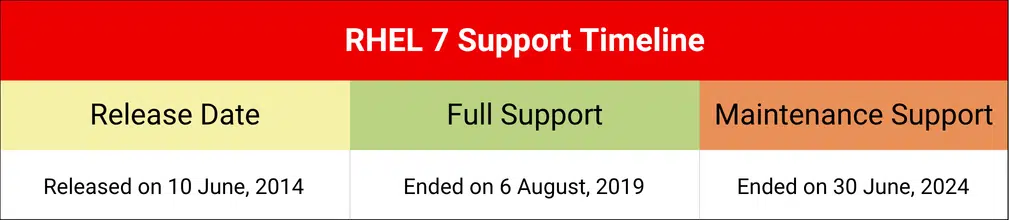
Note: In Red Hat’s official lifecycle terminology, RHEL 7 has not yet reached full end of life. It has transitioned into the Extended Life Phase following the End of Maintenance (EOM).
Risks of Running RHEL 7 After End of Life
Red Hat has stopped issuing security updates for RHEL 7 unless you’ve purchased their limited Extended Lifecycle Support. So, the main risk isn’t that RHEL 7 suddenly fails or becomes unstable after end of life. The risk is that security vulnerabilities continue to be discovered, but the operating system no longer receives vendor security patches to fix them. That creates an expanding backlog of unpatched CVEs across the kernel, core libraries, and installed packages.
Accumulating Unpatched Vulnerabilities
After end of life, newly disclosed vulnerabilities affecting RHEL 7 packages are no longer fixed by the vendor. These vulnerabilities are publicly documented, often with detailed analysis and, in some cases, proof-of-concept exploits are also available. Without access to patches, affected systems remain exposed for the lifetime of the workload.
The effect is cumulative. Each new disclosure adds to the list of unresolved vulnerabilities, increasing overall exposure. Systems that were once considered secure can gradually become vulnerable simply because known issues are left unpatched.
Increased Likelihood of Exploitation
Outdated software tends to attract attention from attackers for a simple reason: it becomes a predictable target. Known vulnerabilities on older systems are easier to exploit than developing new attack techniques, as the older versions haven’t received the security enhancements that newer versions enjoy.
Many security breaches rely on vulnerabilities that have been publicly known for months or even years, taking advantage of systems that were never updated after vendor support services ended.
A well-known example is the Equifax data breach, where a critical vulnerability (CVE-2017-5638) in Apache Struts remained unpatched, leading to a large-scale incident.
Compliance and Audit Failures
From a compliance standpoint, running an unsupported operating system introduces clear challenges. Most regulatory and standard frameworks, such as PCI DSS, HIPAA, ISO 27001, and SOC 2, expect systems to receive timely security updates.
During audits, unsupported operating systems are often flagged regardless of whether a breach has occurred. This can result in failed audits, compensating controls, or contractual penalties, particularly in customer-facing or regulated environments.
Operational and Business Risk
Beyond security and compliance, there is an operational impact. Teams often need to manage exceptions, track risk acceptance, and implement temporary mitigations. These measures add overhead without resolving the root issue.
At the business level, the risk can surface in less obvious ways. Cyber insurance providers, partners, or customers may require supported systems as a non-negotiable condition of coverage or engagement. This can force organizations into unplanned upgrades or migrations under time pressure.
Your Options and Alternatives
After RHEL 7 end of life, businesses are left with a few key options to maintain security and compliance:
1. Upgrade to RHEL 9 or RHEL 10
Upgrading to a supported version of RHEL provides access to ongoing security updates, bug fixes, and vendor support. Newer versions of this Linux distribution, including RHEL 9 and RHEL 10, also include modern kernel improvements, enhanced container support, and longer lifecycle benefits.
Upgrading offers a fresh start, but also introduces new challenges:
- Testing applications for compatibility with new libraries, runtime versions, and kernel behavior that can delay deployment.
- Risk of operational downtime during the transition. Planned downtime is often necessary.
- Infrastructure and configuration changes may be needed.
- The need to retrain IT staff on the new environment.
- Potential hardware upgrades or virtual machine migrations.
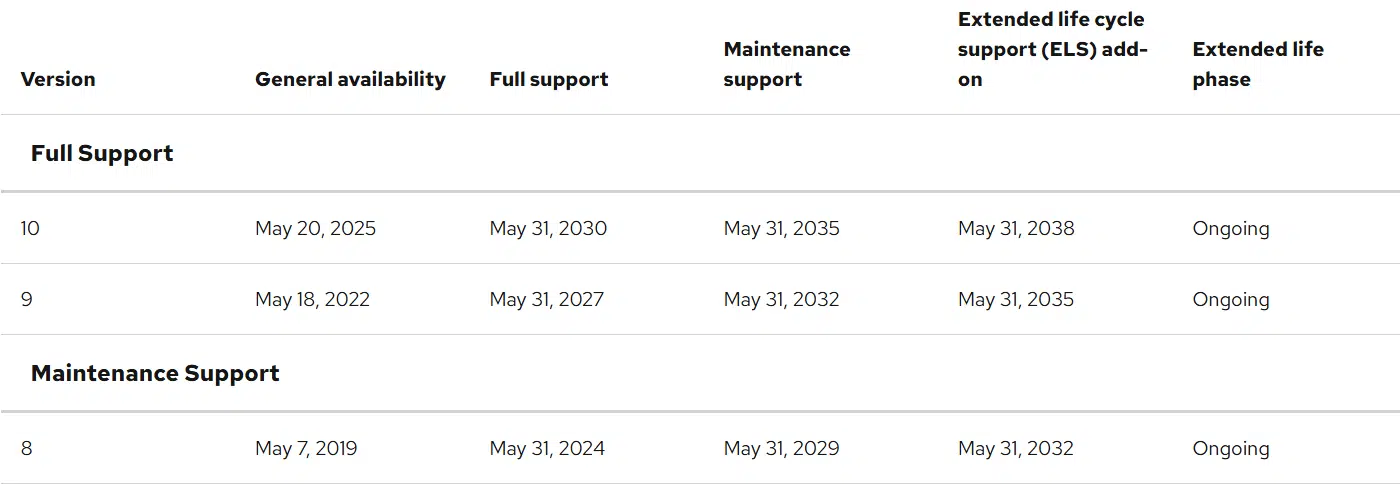
RHEL Versions Life Cycle Dates
2. Red Hat Extended Lifecycle Support
Red Hat offers an Extended Lifecycle Support add-on subscription that provides four additional years of maintenance support for selected critical security issues. This extends the support window but does not restore full maintenance support.
While Red Hat does provide an extended lifecycle option, it comes with several drawbacks:
- Only certain critical-impact security fixes are covered.
- It’s high cost, making it difficult for budget-conscious teams to justify.
- Standard or Premium Red Hat Enterprise Linux subscriptions are only eligible for extended maintenance.
- There’s a limited timeframe, which only delays the need for a full upgrade.
3. TuxCare’s Endless Lifecycle Support for RHEL 7
TuxCare’s Endless Lifecycle Support (ELS) provides ongoing security patching for RHEL 7 systems longer after its maintenance support ends. ELS delivers fixes for critical and high-severity vulnerabilities without requiring a migration or upgrade. Unlike RHEL extended support, TuxCare’s ELS is available for organizations for as long as they need.
TuxCare’s ELS solution offers a smarter path:
- Endless security updates for RHEL 7, with no forced upgrade timelines.
- Accurate risk assessment with NIST CVE scores, unlike Red Hat, which often assigns lower severities that can miss critical threats in specific environments.
- Massive cost savings compared to Red Hat’s extended support.
- Simple setup with a one-line script to connect to TuxCare’s repository – no reboot required.
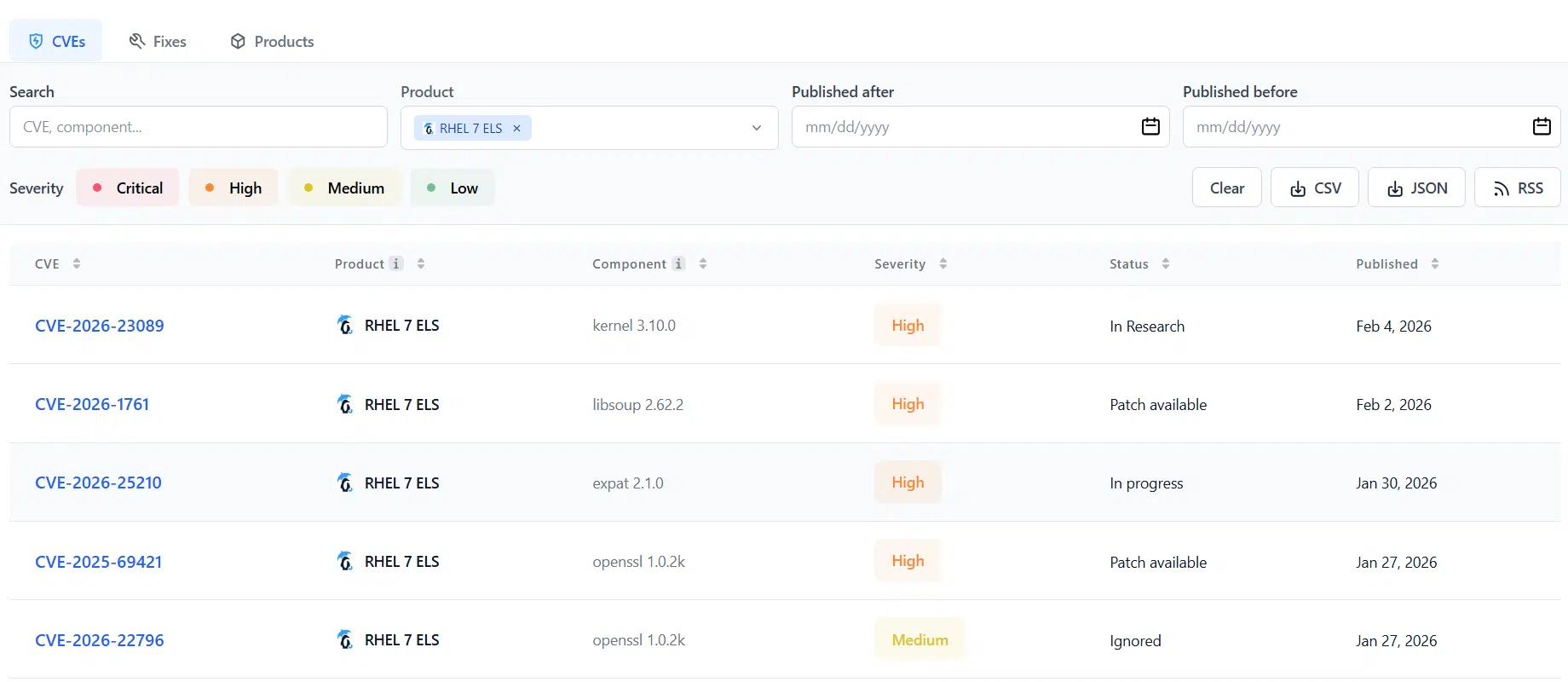
Visit our CVE tracker to see recent vulnerabilities affecting RHEL 7 systems and check which ones are patched through TuxCare’s Endless Lifecycle Support.
4. Migrate to an RHEL-Compatible Distribution
Some organizations choose to migrate workloads to RHEL-compatible distributions, such as AlmaLinux or Rocky Linux. These free and open-source alternatives aim to provide the same functionality and compatibility as RHEL at no license cost. For organizations comparing RHEL to other commercial options, such as Oracle Linux, the insights in our blog post “Oracle Linux vs Red Hat” can help clarify differences in cost, each support policy, and long-term flexibility.
Considerations:
- Migration is not always straightforward. Dependencies and custom configurations can complicate the process.
- Testing and validation remain critical to ensure workloads behave as expected.
- Operational risk exists during the transition period.
|
Feature |
Red Hat ELS (Vendor) |
TuxCare Endless Lifecycle Support |
Manual Migration (RHEL 8/9/10) |
|
Baseline Requirement |
Active RHEL Subscription |
No Red Hat subscription required |
New RHEL Subscription |
|
Primary Cost |
RHEL Subscription + ELS Add-on fee |
Flat per-node pricing |
Migration labor + New License |
|
Migration Required? |
No |
No |
Yes |
When Migrating Off RHEL 7 Makes Sense
Not every RHEL 7 system requires immediate migration, but there are situations where moving to a newer OS or a compatible Linux distribution is the most appropriate long-term strategy. Systems that run applications already certified on RHEL 9 or 8, or on compatible distributions, can benefit from updated libraries, improved container support, enhanced security features, and better overall performance. Migration in these cases aligns with broader IT modernization initiatives and reduces operational complexity over time.
In regulated environments, extended support solutions can bridge the gaps in industry-standard frameworks such as PCI DSS, HIPAA, or ISO 27001. However, migration may eventually become necessary to meet compliance obligations.
Even when compliance is not immediately at stake, migration can reduce operational risk. Systems that remain on RHEL 7 accumulate unpatched vulnerabilities over time and require ongoing risk management. Moving to a supported OS or distribution reduces this burden, simplifies patch management, and limits exposure to known threats.
Don’t Let RHEL 7 EOL Put Your Business at Risk
Running RHEL 7 post-EOL without a solid support plan puts your business at serious risk. Security vulnerabilities, compliance issues, and unexpected downtime can all result in costly consequences.
TuxCare’s Endless Lifecycle Support delivers the security, flexibility, and cost-efficiency needed to keep your systems protected – on your schedule, not Red Hat’s.
Learn more about TuxCare’s long-term RHEL 7 support to take control of your legacy systems today and ensure they remain secure, stable, and compliant for as long as you need.

