
 Tech Support
 Documentation
 Login
 Contact Us


Endless Lifecycle Support for RHEL 7
Keep RHEL 7 secure after
Red Hat’s June 2024 end of life
CVE patches for Red Hat Enterprise Linux 7 past its June 2024 end-of-life date.
Delivered through your existing package manager. A lower-cost alternative to Red Hat’s
own extended support, with no forced migration to RHEL 8 or 9.

RHEL 7 patches delivered
by TuxCare since EOL
RHEL 7 reached end of life on June 30, 2024, so free security updates stopped over a year ago.
To stay vendor-supported, you’d need an active RHEL Enterprise subscription (a hefty baseline cost) plus Red Hat’s Extended Lifecycle Support on top of that – effectively a two-layer fee – to avoid unpatched vulnerabilities and compliance gaps.
Without extended support for RHEL 7, you must quickly upgrade to a newer supported RHEL version, like RHEL 8, or seek an alternative support provider.
TuxCare’s Endless Lifecycle Support for RHEL 7 has your back.

Not ready to upgrade?
With TuxCare’s ELS for RHEL 7, you get precision-engineered, high, and critical-severity patches delivered
on your schedule. No costly double subscriptions, no forced upgrades – just seamless protection.
With Endless Lifecycle Support, you can:

Ensure security and compliance beyond the EOL date with ongoing long-term updates for Critical and High-risk vulnerabilities

Achieve maximum security for your RHEL systems with support for a comprehensive list of essential server packages

Track security updates, selected bug fixes, and affected packages across all architectures with qualified errata advisories

Verify your RHEL systems update status using our OVAL patch definitions with OpenSCAP or other OVAL-compatible tools
Precision-engineered patch
development
Our patches are designed with surgical precision and are rigorously tested to provide businesses with the assurance that their legacy systems remain secure, stable, and compliant in the face of increasingly sophisticated cyber threats.
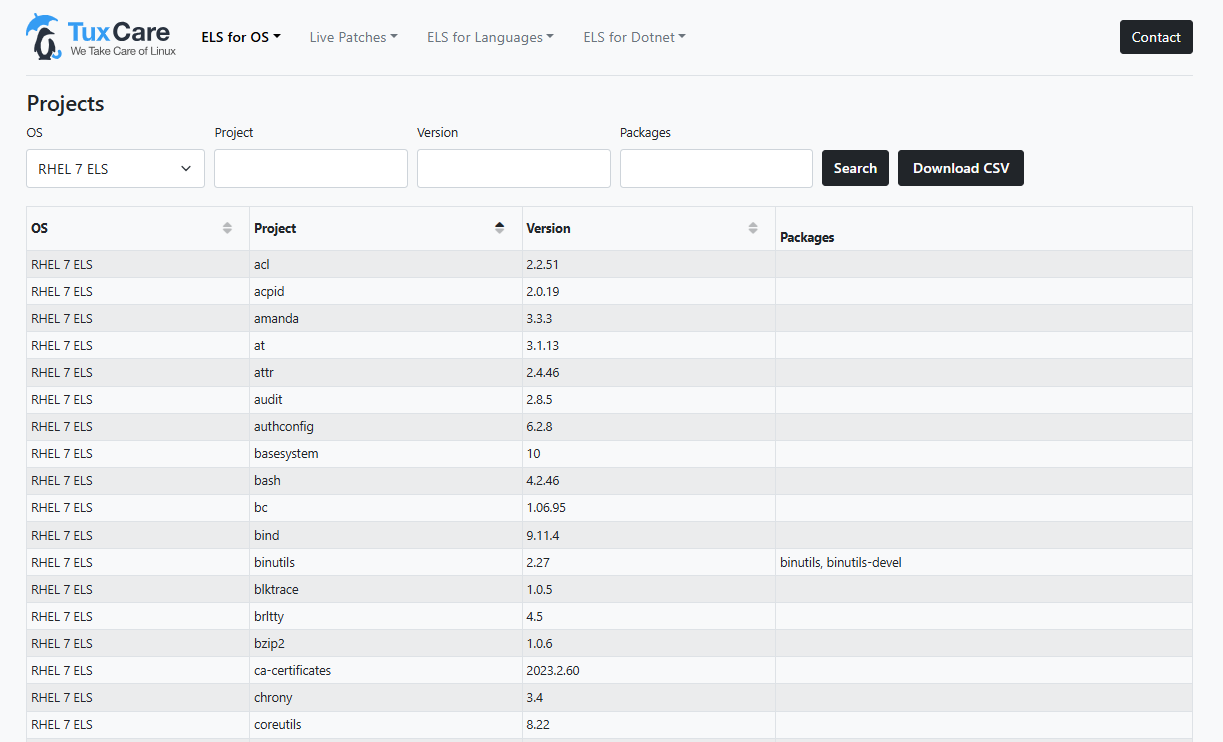
Support for a Comprehensive
List of Packages
When you sign up for TuxCare’s Extended Lifecycle Support, you’ll get patches for an
extensive package list, providing maximum security for your operating system
Switching to TuxCare for RHEL 7
Support is Simple

Step 1
Connect to the TuxCare repository with a simple
script – and no reboot
Step 2
You’re fully protected with regular ongoing security
patches for as long as you need
Why TuxCare?
The TuxCare team combines 450+ years of in-depth technical knowledge of
Linux and kernel development

We have a proven track record of security patching with over 5000 CVEs patched to date – and growing

You can request support for additional server packages that are not currently on our list

ELS gives you an affordable option to maintain the security and stability of your EOL systems

TuxCare can support environments that run multiple types of end-of-life Linux distributions
Long-Term Security After Standard Support Ends
TuxCare ELS continues to deliver enduring security for your distro, language, or software development framework for as many years as your organization requires
 CentOS Stream
Endless Lifecycle Support for CentOS Stream 8
End of life: June 2024You can rely on Endless Lifecycle Support for CentOS Stream 8 to continue receiving security updates for as long as you need – so that you have enough time to migrate to another Linux distribution securely.
Learn More RHEL 7
Endless Lifecycle Support for RHEL 7
End of life: June 2024Secure your RHEL 7 infrastructure beyond the end of life with ELS – an affordable, precision-engineered support solution that delivers ongoing security patches for as long as you need.
Learn More Oracle Linux 7
Endless Lifecycle Support for Oracle Linux 7
End of life: December 2024Give your team plenty of time to upgrade to Oracle Linux 8 or 9 with ELS for Oracle Linux 7, which continues to deliver security patches for as long as you need at a much more affordable cost than an Oracle Premier Support plan.
Learn More .NET 6.0
Endless Lifecycle Support for .NET
End of life: November 2024Keep using .NET 6 while continuing to receive security updates on both Windows and Linux, for as many years as you need, so your .NET applications remain secure, stable, and compatible until you’re ready to upgrade.
Learn More Angular
Endless Lifecycle Support for Angular
End of life: Varies for different versionsNeed more time for a safe and smooth upgrade to the latest Angular version? With ELS from TuxCare, you can maintain the security, stability, and compatibility of your existing Angular applications for as many years as you need.
Learn More AngularJS
Endless Lifecycle Support for AngularJS
End of life: December 2021Not ready to upgrade your end-of-life AngularJS applications just yet? TuxCare ELS lets you keep them secure, stable, and fully compatible for as long as you need — giving you the breathing room to upgrade when it works for you.
Learn More Apache Tomcat
Endless Lifecycle Support for Apache Tomcat
End of life: March 2024Ensure your Apache Tomcat deployment stays protected without security risks or compatibility concerns. With ELS, you can continue using end-of-life Apache Tomcat versions with confidence for as long as you need.
Learn More CentOS 6
Endless Lifecycle Support for CentOS 6
End of life: December 2020TuxCare’s Endless Lifecycle Support gives you the same official security patches you used to get with CentOS 6, and we’ll continue to provide you with ongoing security support for as many years as you need.
Learn More
CentOS 7
Endless Lifecycle Support for CentOS 7
End of life: June 2024CentOS 7 is going end of life in June 2024, but you can enjoy ongoing security updates for as long as you need with our Extended Lifecycle Support – buying time to plan your migration, while keeping your workload safe.
Learn More
RHEL 7
Endless Lifecycle Support for RHEL 7
End of life: June 2024Secure your RHEL 7 infrastructure beyond the end of life with ELS – an affordable, precision-engineered support solution that delivers ongoing security patches for as long as you need.
Learn More
RHEL 7
Endless Lifecycle Support for RHEL 7
End of life: June 2024Secure your RHEL 7 infrastructure beyond the end of life with ELS – an affordable, precision-engineered support solution that delivers ongoing security patches for as long as you need.
Learn More OpenJDK
Endless Lifecycle Support for OpenJDK
End of life:Keep your Java workloads secure on an out-of-support OpenJDK version – skipping the grind of full QA retest cycles and upgrade-induced breaking changes.
Learn More
Oracle Linux 6
Endless Lifecycle Support for Oracle Linux 6
End of life: March 2021TuxCare will deliver Extended Lifecycle Support for Oracle Linux 6 for as many years as you need, saving you significantly on costs compared to Oracle Linux Premier Support while providing the same vulnerability coverage.
Learn More PHP
Endless Lifecycle Support for PHP
End of life:Buy yourself and your organization time to develop new production code while receiving ongoing security patches for out-of-support PHP versions with Endless Lifecycle Support to maintain the safety of your systems.
Learn More Python
Endless Lifecycle Support for Python 2.x
End of life: January 2020Python Extended Lifecycle Service from TuxCare breathes new life into code written for Python 2.7 so you can continue using your existing software on AlmaLinux, Rocky, or Red Hat Enterprise Linux 9 as before.
Learn More Ubuntu 16.04
Endless Lifecycle Support for Ubuntu 16.04
End of life: April 2021Save on costs compared to Ubuntu Pro for Ubuntu 16.04 when you choose TuxCare Endless Lifecycle Support for ongoing security maintenance, which will keep you protected for as many years as you need beyond the end-of-life date.
Learn More
Ubuntu 18.04
Endless Lifecycle Support for Ubuntu 18.04
End of life: June 2023Choose TuxCare for Ubuntu 18.04 endless support and save significantly over an Ubuntu Pro subscription from Canonical, with security updates for your Ubuntu workloads lasting as long as you need.
Learn More
Ubuntu 20.04
Endless Lifecycle Support for Ubuntu 20.04
End of life: End of Life: May 2025Continue safely working with Ubuntu 20.04 for as many years as you’d like, with TuxCare delivering ongoing security updates to protect your systems for as long as your organization needs.
Learn More
CentOS 8
Extended Lifecycle Support for CentOS 8
End of life: December 2021All the way through January 2026, you can rely on TuxCare for Extended Lifecycle Support to cover security updates for your CentOS 8 Linux distribution – so that you have enough time to migrate to another distro.
Learn MoreFrequently Asked Questions
ELS for RHEL is TuxCare's security patching service for Red Hat Enterprise Linux releases that are past the support coverage you need. It covers RHEL 7 and RHEL 8. Systems point at a TuxCare repository and keep updating through yum, so existing automation, configuration management and patch workflows stay the same.
RHEL 7 maintenance support ended on June 30, 2024. TuxCare keeps patching RHEL 7 for as long as you need it and commits to a 25-year support term from that date, through June 30, 2049, at a fixed price for the length of your contract.
The kernel and 100+ packages integral to server operations, with high and critical vulnerabilities (CVSS 7.0 and above) targeted for a fix within 14 days of disclosure. The supported package list and every patched CVE are in the TuxCare CVE Tracker, and support for additional packages is available on request.
TuxCare publishes OVAL data and CSAF advisories for RHEL 7 ELS and RHEL 8 ELS at security.tuxcare.com. Scanners and compliance tools that support OVAL or CSAF can use those feeds to check which vulnerabilities the ELS updates have fixed. Check that your scanner ingests these formats.
You need a TuxCare ELS license key, root access and port 443 open to cln.cloudlinux.com and repo.tuxcare.com. Download install-rhel7-els-repo.sh (or the RHEL 8 equivalent), run it with --license-key, and verify with yum info els-define. After that, standard yum upgrade runs pull TuxCare-patched packages. Both releases are documented for x86_64.
Yes. TuxCare reviews customer-directed patch requests within three working days and, if accepted, delivers the patch within 14 days. A 10-pack of customer-directed patches is available for teams that know they'll need fixes outside ELS scope, and the sales team can share pricing.
Migration is the long-term answer for most RHEL 7 workloads, and ELS isn't meant to replace it. It's for the systems that can't move yet, such as ISV-certified applications pinned to RHEL 7, legacy middleware, or large fleets that need a staged migration. ELS keeps them patched in the meantime.