Tech Support
 Documentation
 Login
 Contact Us



Go straight to an AI summary of this blog post instead 


Key Takeaways
- Endor Labs’ paid tiers are quote-only, with Code and Open Source seats counted by contributing developers.
- SecureChain supplies rebuilt, patched packages, while Snyk and Aikido scan your code and dependencies.
- Socket watches package behavior, Mend.io automates fix PRs, and Sonatype blocks components at the repository.
- Black Duck focuses on binaries and licenses, the work that matters most in M&A and firmware reviews.
Endor Labs is an application security platform best known for reachability-based software composition analysis. Its reachability engine traces your code’s call graph to show which vulnerable dependency functions your application actually calls, so a backlog of thousands of findings shrinks to the ones your code can reach. The platform also covers first-party code, container images, and AI coding agent governance.
Plenty of teams still shop around. Usually it’s because they need a different focus, like malicious package blocking, automated fix pull requests, binary and license analysis, or patched packages when no upstream fix exists.
Each alternative overlaps with a different slice of what Endor Labs does. Snyk, Mend.io, and Aikido cover the most ground as full AppSec suites, while the others go deep on one control point.
Below, we compare each one on approach, coverage, and drawbacks.
Endor Labs Competitors Compared
| Tool | Approach | Pricing model | Best fit | Main drawback |
| TuxCare SecureChain | Curated, rebuilt package registry | Custom quote, fixed for the contract term | End-of-life and audit-heavy stacks | No code scanning or reachability |
| Snyk | Developer-first scanner suite | Published self-serve plans, Enterprise quoted | Developer-led teams | Costs climb with headcount and scanning volume |
| Socket | Behavioral package analysis | Free plan and published per-developer tiers, Enterprise quoted | npm and PyPI malware concerns | Full reachability is Enterprise-only |
| Mend.io | Scanning plus update PRs | Published per-developer prices, AppSec up to $1,000 per developer per year | Teams that want fix PRs at scale | AppSec is sold as one bundle |
| Aikido Security | Consolidated AppSec platform | Free plan for 2 users, flat paid tiers with 10 users included | Small teams on a budget | Usage limits step up by tier |
| Sonatype | Repository-level blocking | Published starting prices, consumption-based contracts | Java shops running Nexus | Several products with different usage-based pricing models |
| Black Duck | Binary, snippet, and license analysis | Quote only | Legal, M&A, and firmware review | Quote-only pricing |
*Pricing models checked September 2026.
1. TuxCare SecureChain
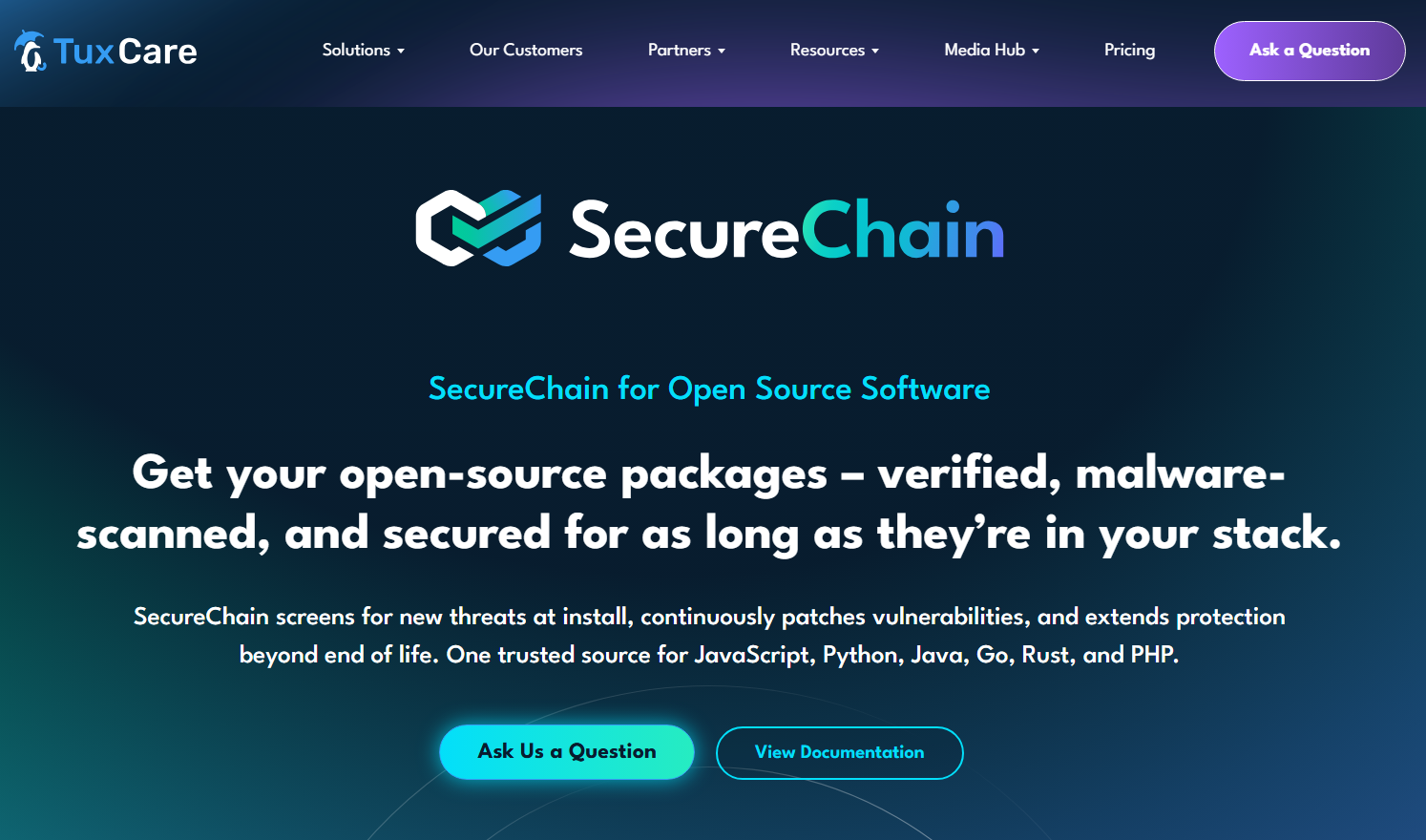
SecureChain works at the package source. It rebuilds each package from verified source in hardened, isolated build environments, screens it for known malware and suspicious code patterns, and serves it through a repository your developers already use. It’s built for exactly the kind of backlog where findings have no upstream fix to upgrade to.
Key features
Every package is rebuilt from source and served through one registry across JavaScript, Python, Java, Go, Rust, and PHP, with malware screening before anything reaches your build agent.
Patching follows the package through its lifecycle. Active packages get patched under SLA as CVEs land, and Endless Lifecycle Support takes over once upstream maintenance ends.
Every package also comes with audit evidence. Packages are built and signed to support SLSA Level 3, with SBOMs in SPDX or CycloneDX format (depending on the package) plus CycloneDX VEX documents.
Pricing
TuxCare doesn’t publish list prices, so pricing comes by custom quote, and a combined quote across TuxCare products is available too. Updates are delivered at a fixed price for the contract term. More details are on the pricing page.
Where SecureChain shines
The biggest draw is fixes after upstream goes quiet. TuxCare maintains packages directly once upstream stops releasing, and Endless Lifecycle Support backports security fixes to the exact versions you run under a published SLA. Vetting happens before your build ever asks for a package, too, because rebuilding and screening take place at the registry.
Adoption doesn’t mean a workflow overhaul. Point Artifactory, Nexus, GitHub Packages, or the package manager itself at SecureChain, and developers keep the same packages, APIs, and workflow. Cost stays steady as well, since pricing is fixed for the contract term.
Where SecureChain falls short
It doesn’t scan your own code. There’s no SAST, secrets detection, IaC scanning, or reachability analysis, so you’d keep a scanner alongside it. SecureChain doesn’t offer hardened container images either.
Package coverage spans JavaScript, Python, Java, Go, Rust, and PHP, so .NET and Ruby projects need another source. And the malware screening looks for known patterns and suspicious code rather than doing the install-time behavioral analysis Socket sells.
Best for: Teams with end-of-life or abandoned dependencies, regulated shops that need provenance and SBOM evidence on demand, and platform teams running Artifactory or Nexus across several languages.
2. Snyk
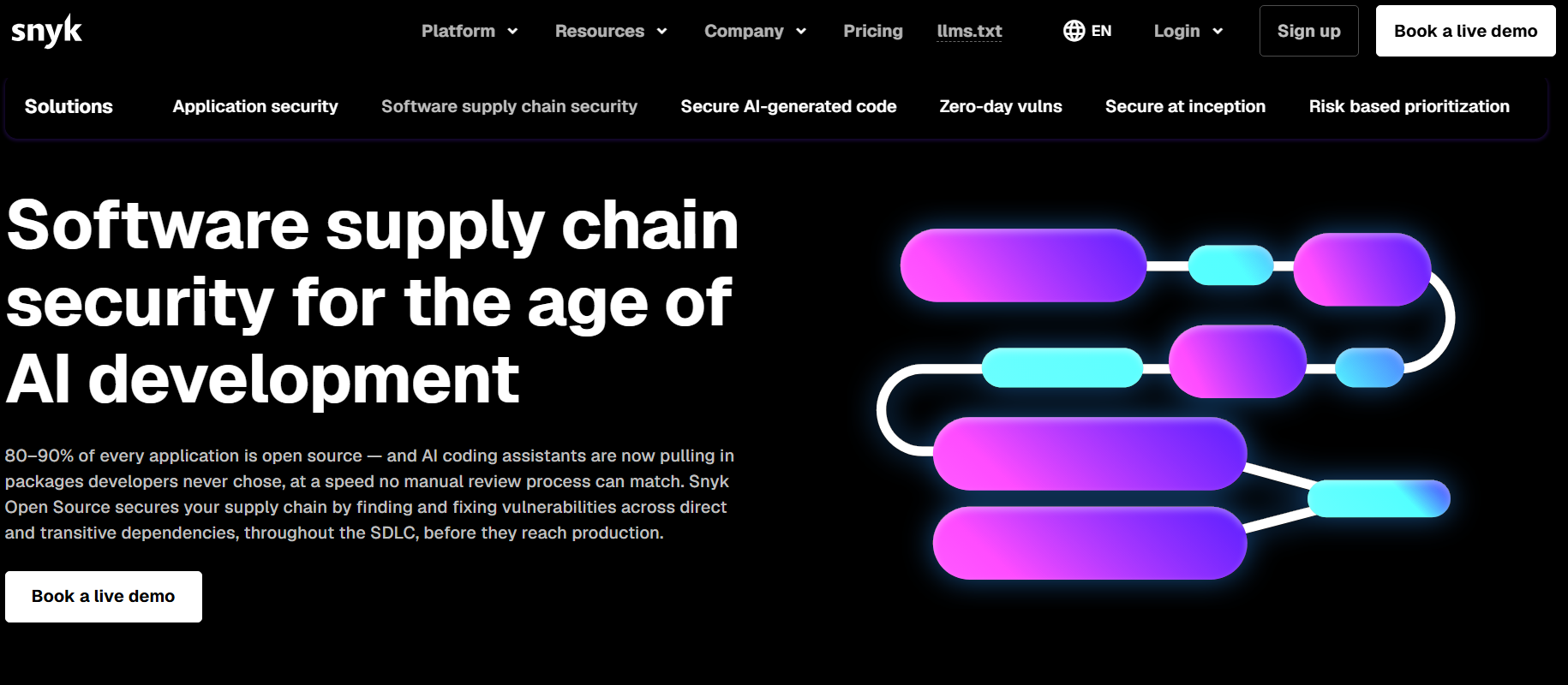
Snyk is a common point of comparison for Endor Labs, and its free plan is part of the appeal. It’s a developer-focused platform covering open source dependencies, first-party code, containers, and infrastructure as code.
Key features
Even the free plan includes SCA, SAST, IaC, and container scanning, with IDE, CLI, and source control integrations. Its reachability analysis compares your application’s call graph with your dependencies’ call graphs. That’s generally available for Java, JavaScript, TypeScript, and Python, with C# in early access.
Fix guidance shows up in the IDE and in pull requests, and Jira integration comes with the paid plans.
Pricing
Snyk publishes prices for its self-serve plans and sells Enterprise through sales. Pricing tracks contributing developers and how much of the platform you use, so a full-suite quote can land a long way from the entry price. See the Snyk pricing page for current figures.
Where Snyk shines
You can start free and buy a small-team plan without a sales call. Findings land in the IDE and in pull requests, right where engineers already work, and one vendor covers several scanning products.
Where Snyk falls short
The self-serve plans cap usage, so growing teams end up in an Enterprise conversation. From there, cost rises as you add contributors and switch on more scanning. Reachability also covers fewer languages than the scanner does.
Best for: Developer-led teams where engineers fix what the scanner finds, and small teams that want to start free.
3. Socket
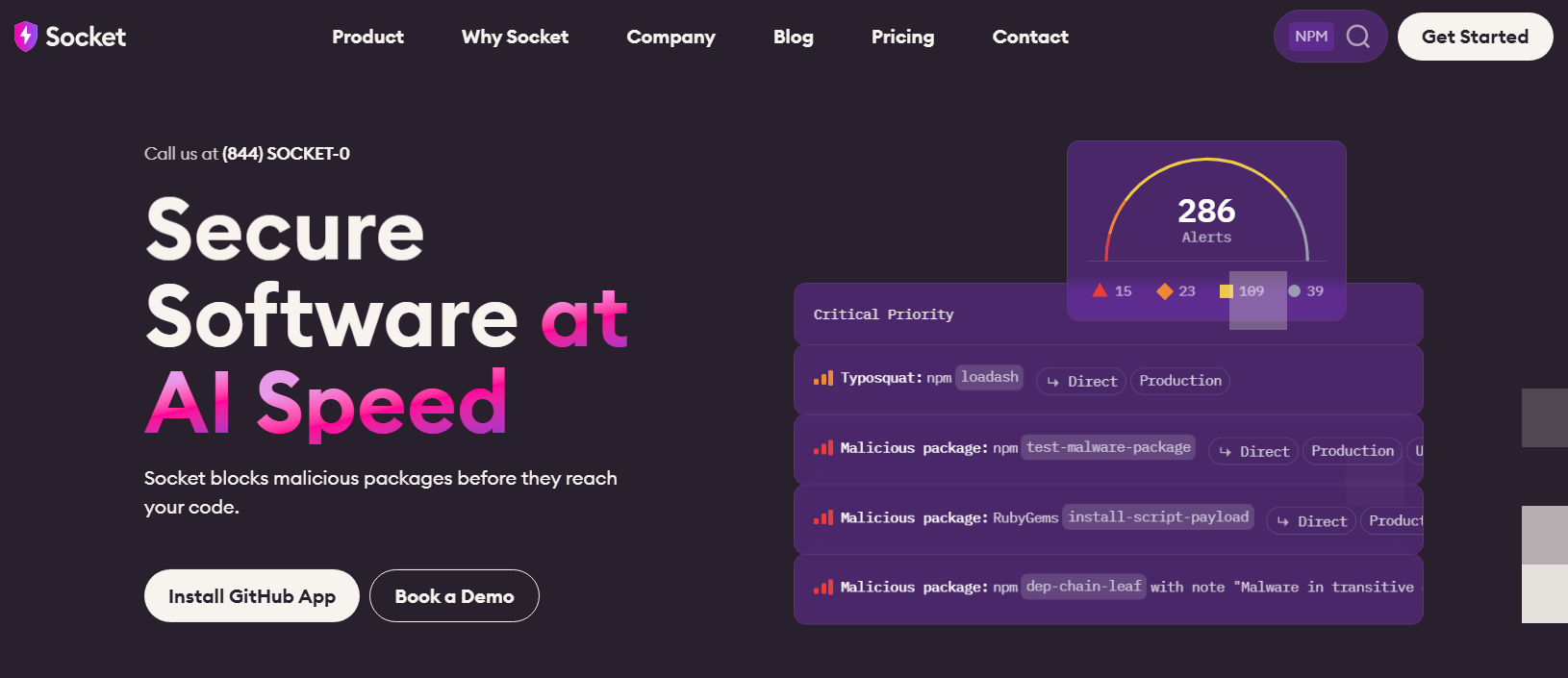
Socket analyzes what a package does at install, including scripts, network calls, filesystem writes, and obfuscated code. That lets it flag hijacked and typosquatted packages before any CVE exists.
Key features
Behavioral analysis covers more than 70 risk types, using AI scans followed by human review. Socket Firewall, a proxy, blocks confirmed malware before install. The free version covers npm, yarn, pnpm, pip, uv, and cargo on public registries, and Enterprise adds private registries, policies, and more ecosystems.
Paid tiers get precomputed reachability, and Enterprise gets full function-level reachability. The lineup also includes Socket Basics (SAST, secrets, containers) and Certified Patches.
Pricing
Socket publishes per-developer prices for Free, Team, and Business and quotes Enterprise. Team carries a five-developer minimum and Business a 20-developer minimum. Products are sold individually, so get the enterprise Firewall priced as part of your quote. See the Socket pricing page for current figures.
Where Socket shines
It catches malicious-package attacks that no vulnerability database lists yet. The free Firewall gives an individual developer install-time blocking in one command, no account needed. On privacy, Socket says your source code stays on your machine or in CI, with dependency information sent to its service.
Where Socket falls short
Full function-level reachability needs an Enterprise quote, and Business starts at 20 developers. The free Firewall doesn’t support private registries and only warns, rather than blocks, on packages flagged by AI analysis alone. Routing through Artifactory or Nexus means Enterprise.
First-party scanning comes through Socket Basics, which orchestrates open source scanners. Run it against your current SAST tool before retiring anything.
Best for: JavaScript and Python teams whose top worry is registry malware, and teams that already run a vulnerability scanning tool and want to add install-time blocking.
4. Mend.io
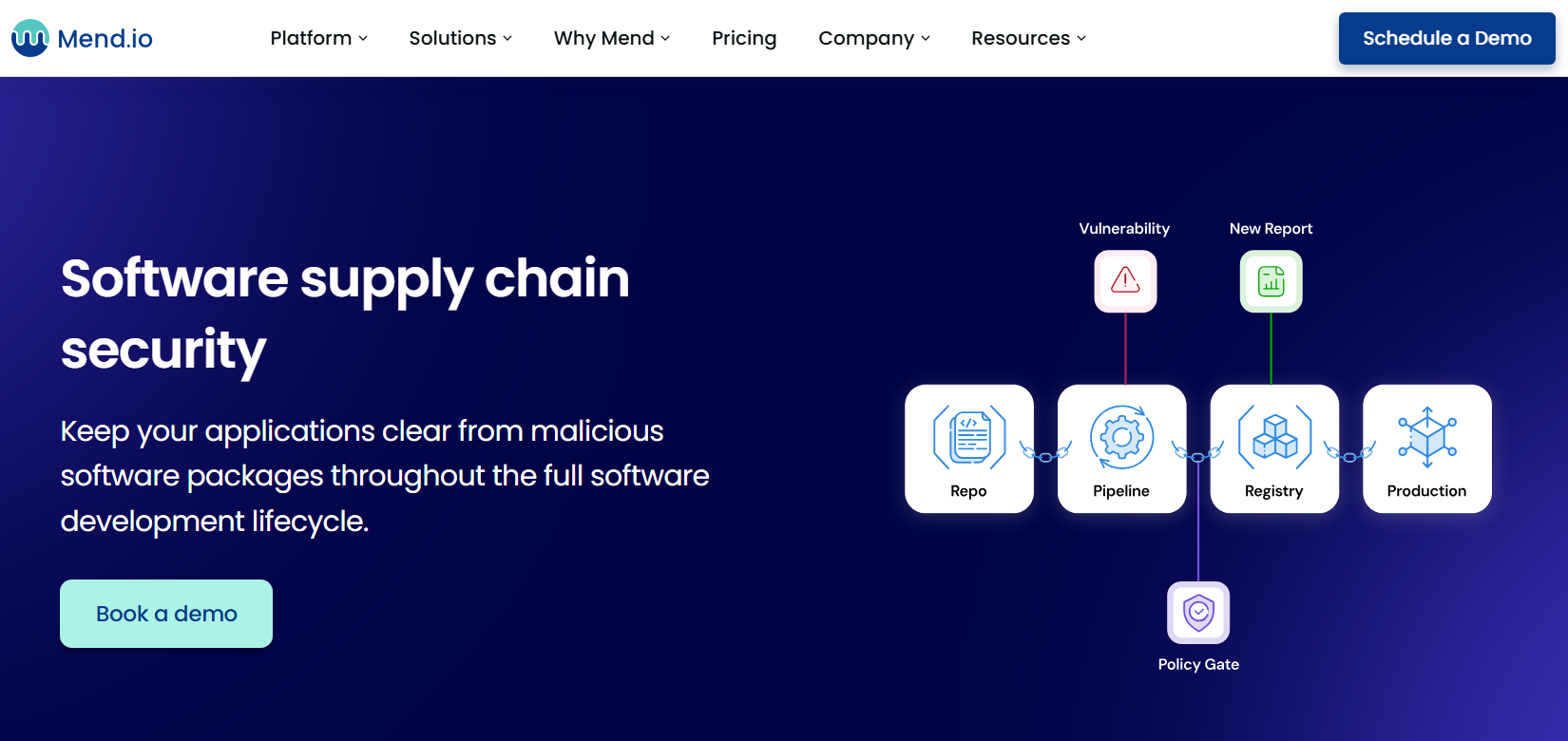
Mend.io focuses on getting findings fixed. It maintains Renovate, the open source tool many teams use to open dependency-update pull requests, and sells an enterprise edition alongside its SCA, SAST, and container scanning.
Key features
Renovate Enterprise opens update pull requests at scale, with Merge Confidence ratings that predict how likely an update is to break your build. The SCA engine adds reachability analysis for a subset of languages, and SAST, container scanning, and Mend AI sit on the same platform.
Pricing
Mend publishes per-developer prices. Mend AppSec is up to $1,000 per developer per year, Mend AI up to $300, and Mend Renovate Enterprise up to $250. AppSec covers SAST, SCA with container scanning, AI-generated code security, AI fix suggestions, and automated dependency updates. Renovate Enterprise is also sold standalone, while DAST, API security, and EOL Support for end-of-life packages are add-ons.
Anyone who writes scanned code or uses Mend’s web interface counts as a developer, so security staff who log in can add to your seat count. No free plan is listed. See the Mend pricing page for current figures.
Where Mend.io shines
Renovate turns a dependency backlog into pull requests your team can review and merge. Teams already running open source Renovate have a short path to the enterprise edition, and AppSec’s published price covers several scanners.
Where Mend.io falls short
Mend prices its main offering as one platform bundle, so a team that only needs SCA should ask whether a standalone quote is available. Reachability covers fewer languages than the SCA engine.
Renovate automates upgrades, so it has nothing to open a pull request for when no fixed version exists. For those packages, Mend points you to its EOL Support add-on, priced separately.
Best for: Teams already running Renovate, and organizations that measure success by how quickly fixes merge.
5. Aikido Security
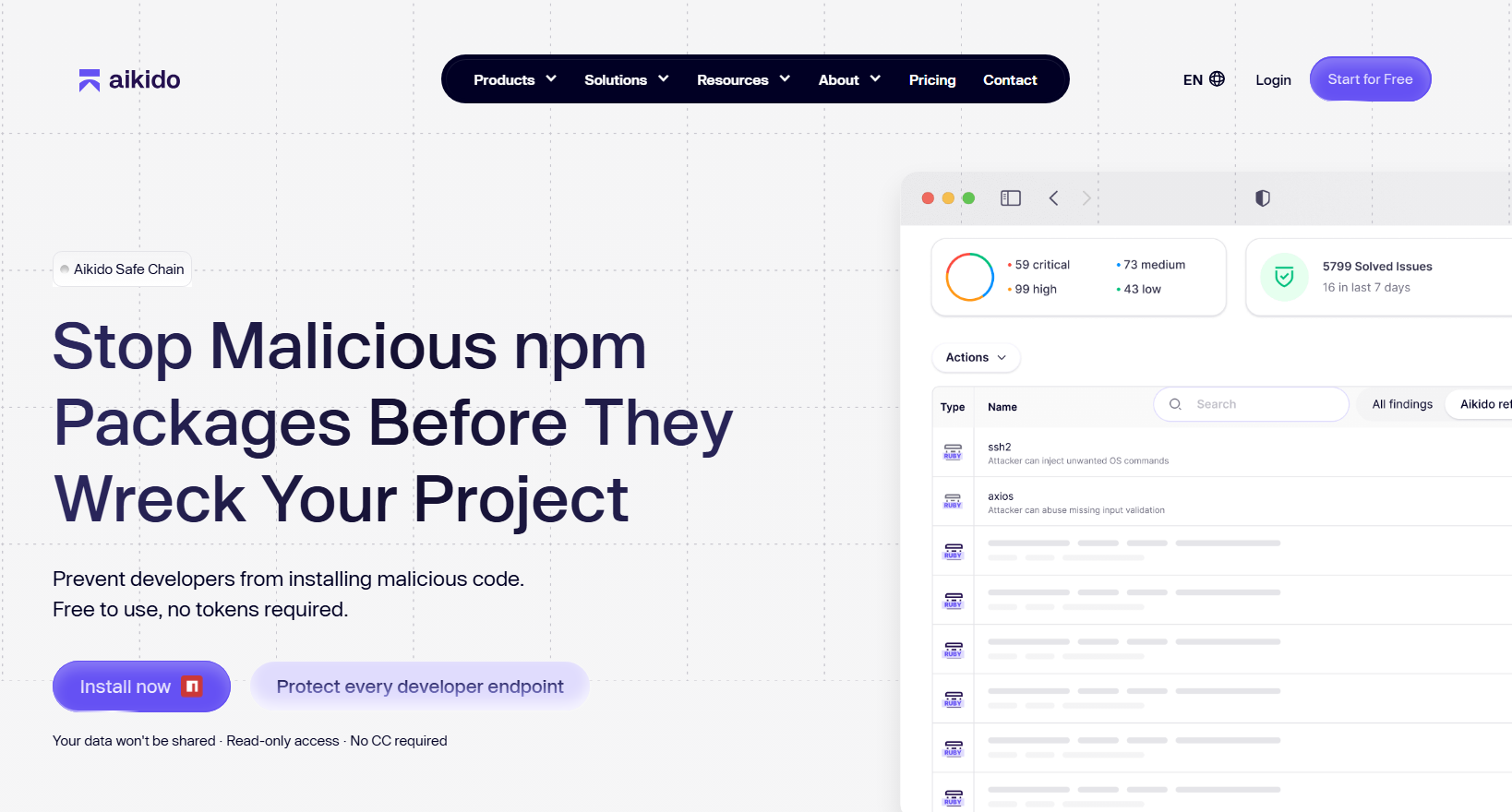
Aikido Security packs code, cloud, and runtime scanners into one platform, with a free plan for two users and flat monthly paid tiers that include 10. For a small team with a thin security budget, its pricing page is the easiest one here to explain to finance.
Key features
Scanning spans SCA, malware detection, SAST, secrets, IaC, containers, cloud posture, DAST, and runtime protection, and the SCA side adds reachability analysis, auto-triage, and AutoFix pull requests.
Aikido Libraries deserves a closer look here. It backports CVE fixes into the exact version pinned in your lockfile, adding only an aikido suffix to the version string, and Aikido says it has more than 9,500 secured libraries across JavaScript, Java, Python, PHP, Go, .NET, and Ruby.
Pricing
Aikido offers a free plan for two users and paid tiers billed as flat monthly fees that include 10 users, with fair-usage limits on repos, container images, domains, and cloud accounts. Annual billing is discounted. Advanced AI features run on credits, and so does Aikido Libraries repository protection, which is a credit-based annual subscription. See the Aikido pricing page for current figures.
Where Aikido shines
The tiers are published, and even the free plan includes SCA with reachability plus SAST. A flat fee covers 10 users, so growth happens in set steps. One console handles findings from several scanners.
What to check with Aikido
Each tier sets fair-usage limits on repos, container images, domains, and cloud accounts, so size the plan against your footprint before you buy. Dependency malware detection is part of the Pro tier, while the free plan still blocks malicious npm and PyPI installs on developer machines through Device Protection and rescans every three days.
Advanced AI features and Aikido Libraries both draw on credits, so factor expected usage into the budget. Aikido Libraries coverage varies by ecosystem, so check the catalog against your lockfile.
Best for: Startups and lean teams with no dedicated AppSec function, and teams that need published pricing to get approval.
6. Sonatype
Sonatype works from the repository outward. It maintains Maven Central, makes Nexus Repository, and sells Repository Firewall, which quarantines components that break your policies as they’re requested.
Key features
The full Repository Firewall is built for Nexus Repository. It compares each new component with your policies and quarantines violators before they reach your repository. Firewall Pro is the cloud option for everyone else, blocking malicious npm, PyPI, NuGet, and Maven packages in front of repository managers other than Nexus.
SCA, policy, upgrade recommendations, and SBOM management used to be sold as Lifecycle. New customers now get those capabilities through Sonatype Guide, which also gives developers and AI assistants context for choosing versions. Reachability analysis covers Java and other JVM languages, JavaScript, and .NET.
Pricing
Sonatype publishes starting prices for Nexus Repository (Community Edition is free), Guide, and Firewall Pro, and it quotes the full Repository Firewall and Guide Enterprise. New contracts are consumption-based, and Nexus Repository Cloud bills on egress plus storage. See the Sonatype pricing page for current figures.
Where Sonatype shines
The firewall checks components when they’re requested, so a flagged package is blocked before it reaches a developer’s machine or a cached artifact. Sonatype Research supplies the malware intelligence, and the full Repository Firewall supports air-gapped repositories.
It also has a long history with Java and Maven, and it publishes prices for most products.
Where Sonatype falls short
Working out total cost takes some arithmetic, since several products are priced on consumption. Firewall Pro covers four ecosystems and blocks malware only, while policy-based blocking comes with the full Firewall.
Components already in your proxy repository are audited rather than quarantined, so adopting Firewall doesn’t clean up what’s cached. Remediation guidance also assumes an upgrade path, so ask how it handles libraries with no newer release.
Best for: Organizations already running Nexus Repository or Artifactory, Java-first enterprises, and regulated or air-gapped environments.
7. Black Duck
Black Duck is a long-established SCA product built around discovery. It finds open source in source code, compiled binaries, containers, and firmware, then maps licenses and vulnerabilities. That’s why legal teams, acquirers, and firmware groups drive many of its purchases.
Key features
Discovery combines several techniques, such as signature scanning and snippet matching that traces copied code (AI-generated code included) back to its source project. Binary Analysis scans compiled files, containers, and firmware without source code and identifies modified binaries. A KnowledgeBase covering millions of projects and thousands of licenses backs it all, along with policy gates and SBOM generation.
Pricing
Black Duck publishes no list pricing and lists no free tier, so budgeting starts with its get-pricing form.
Where Black Duck shines
It finds undeclared, vendored, and copy-pasted code that a package manager never reports. License and obligation analysis is the reason legal teams often own the purchase. Coverage reaches source, containers, firmware, and post-build artifacts, which helps when you’re auditing software you didn’t build.
Black Duck’s Polaris platform can also open automated fix pull requests for vulnerable dependencies on GitHub, GitLab, Bitbucket, and Azure DevOps, with human approval before merge.
Where Black Duck falls short
Pricing is quote-only, so budgeting and trials need a sales conversation. Polaris does offer reachability analysis, but check its language coverage and how deep into transitive dependencies it goes before counting on it.
Best for: Enterprises where a license error outranks a CVE, and firmware, embedded, and M&A teams auditing code they didn’t build.
Reasons to Consider an Alternative to Endor Labs
Endor Labs does reachability well, and plenty of teams are right to stay with it. These are the situations where a different tool fits better.
Paid tiers are quote-only and seat-based
For Endor Code and Endor Open Source, Endor Labs counts seats by contributing developer, meaning anyone who committed to a monitored repository in the last 90 days, and pricing varies by product. Core and Pro have no published prices, and seats come with fair-use scan limits.
Code, Open Source, Package Firewall, Patches, SBOM Hub, and AI Coding Agent Governance are sold as separate products. The full cost shows up after a sales process, and for contributor-priced products it rises with headcount. Snyk, Socket, Aikido, Mend.io, and Sonatype publish prices for most of their plans.
Your main problem sits at another control point
Reachability tells you which known vulnerabilities your code can reach. It says nothing about a hijacked package with no CVE, a license obligation in an acquired codebase, or a proxy that should block components before download. Endor Labs sells its own Package Firewall product, so test it against your needs before assuming a gap. Socket, Sonatype, and SecureChain are built around package intake, and Black Duck around binaries and licenses.
Fixes for packages nobody maintains
Endor Labs sells backported patches, Socket and Aikido offer patched versions of some libraries, and Mend sells an EOL Support add-on. Coverage varies by vendor and ecosystem, so compare which ones patch the exact versions you run. SecureChain rebuilds JavaScript, Python, Java, Go, Rust, and PHP packages and, once upstream stops, backports security fixes under a published SLA.
Watch Out: A “no fix available” finding can sit in a backlog indefinitely if nothing changes upstream. Filter your backlog on that field once and see how long the oldest entries have been there.
Where SecureChain Fits
If your scanner already gives you a short, trustworthy list and your fix rate is healthy, stay with it and tune it. A long backlog is a different story, especially when much of it sits in transitive or unmaintained dependencies with no newer version to move to. There, where your packages come from matters as much as how well you rank findings.
SecureChain supplies curated, malware-screened packages that TuxCare rebuilds from source and keeps patching, delivered through your repository manager or package manager across JavaScript, Python, Java, Go, Rust, and PHP. It doesn’t scan your own code, so you’d run it beside a scanner. See how other teams use TuxCare, request a quote, or ask us a question about your stack.
FAQs
This guide covers seven of them: TuxCare SecureChain, Snyk, Socket, Mend.io, Aikido Security, Sonatype, and Black Duck. They differ mainly in focus. Some supply patched packages, some scan code and dependencies, some detect malicious packages, and some analyze binaries and licenses.
It’s a broader application security platform that began with software composition analysis and reachability. It now also sells SAST and secrets detection through Endor Code, plus SBOM Hub, Package Firewall, and Patches as separate products. Container image scanning is part of Endor Open Source.
Endor Labs counts seats by contributing developer for Endor Code and Endor Open Source and publishes no prices for Core and Pro, so you get a quote through sales. AURI for Developers is a free tier for individual developers that scans locally inside AI code editors.
Snyk, Socket, Mend.io, Aikido, Sonatype, and Black Duck (in Polaris SCA) each document a form of reachability analysis, and Socket’s full function-level version is an Enterprise feature. Language coverage varies, so test each on your own repositories. SecureChain doesn’t offer reachability analysis.
Some can. Endor Labs sells backported patches, Socket offers Certified Patches, Aikido Libraries backports fixes to the version in your lockfile, and Mend offers an EOL Support add-on. SecureChain rebuilds packages and backports security fixes after upstream stops. Coverage differs by vendor and ecosystem, so check the libraries you run.
Usually. SecureChain supplies curated, patched packages. It doesn’t scan your first-party code for SAST, secrets, or IaC issues, and it doesn’t rank findings by reachability, so most teams keep a scanner beside it.