Tech Support
 Documentation
 Login
 Contact Us


Go straight to an AI summary of this blog post instead 


Key Takeaways
- Use Linux-first scanning with Radar to focus on Linux environments, with accurate detection, risk-based prioritization, and actionable remediation guidance.
- Tools like Tenable Nessus & Qualys VM provide broad coverage and mature reporting; suitable for mixed OS environments.
- OpenVAS offers flexible, open-source vulnerability scanning, while Lynis focuses on Linux system hardening and compliance audits.
If you’ve used a vulnerability scanner on a Linux system, you’ve likely noticed the pattern: a long list of CVEs, limited context, and no clear sense of what actually needs attention. Some findings matter. Many don’t. Sorting through that noise takes time, and it often pulls focus away from the issues that carry real risk.
Part of the problem is that many scanners are built for broad environments, not Linux-specific ones. They often fail to account for CVEs that have already been patched. Security teams end up chasing ghost findings that aren’t relevant, while more important issues sit unresolved.
In this article, we compare popular Linux vulnerability scanners, explore their key strengths, and their limitations. More importantly, we will learn how TuxCare Radar reduces noise and helps prioritize real risks.
Linux Vulnerability Scanners: Comparison Table
This table compares each tool across key factors, including use case, strengths, tradeoffs, and pricing.
|
Tool |
Best For |
Key Strength |
Tradeoff |
Pricing |
|
TuxCare Radar |
Linux-first environments |
Accurate, low-noise results; ignores patched CVEs |
Linux-only focus; no Windows support |
Subscription-based |
|
Tenable Nessus |
Compliance & IT Audits |
Massive plugin library and standard compliance templates. |
High “noise” on Linux |
Starts at $4,790 per year |
|
Qualys VMDR |
Large Hybrid Enterprises |
Cloud-native platform with TruRisk prioritization |
Complex UI; expensive for small fleets |
Subscription-based |
|
Rapid7 InsightVM |
Real-time Risk Analysis |
Strong integration with Metasploit for exploit validation. |
Resource-heavy setup |
Subscription-based |
|
OpenVAS |
Budget-conscious teams |
Fully open-source and highly customizable |
Requires significant manual tuning |
Free / Paid versions |
|
Lynis |
System Hardening |
Deep system checks; finds config errors that scanners miss |
Not a full scanner |
Free / Paid versions |
1. TuxCare Radar
TuxCare Radar is a lightweight vulnerability scanner specifically built for Linux environments. Unlike general-purpose tools, Radar focuses on accurate detection and reducing noise, helping teams quickly see which vulnerabilities matter. It also provides AI-driven risk scoring and clear guidance on remediation, so findings can be acted on without extra investigation.
Key Features
- Patch-aware scanning: Filters CVEs already addressed through vendor patches, KernelCare live patching, or ELS.
- AI-assisted risk scoring: Prioritizes vulnerabilities based on exploitability and real-world context.
- Lightweight CLI: Command Line Interface (CLI) to install and scan; fast deployment with minimal resource usage.
- Compliance-ready reporting: Generates audit-ready reports in PDF or XLS formats.
Tradeoffs
- Linux-only focus: Does not support Windows, macOS, or network device scanning.
- Limited coverage: Only supports RHEL, CentOS, AlmaLinux, Ubuntu, and Debian.
Pricing and Use Cases
- Pricing: Subscription-based with a 30-day free trial.
- Use case: Linux environments and security teams that need accurate detection, reduced false positives, and faster remediation.
2. Tenable Nessus

Tenable Nessus is a long-standing player in vulnerability management that supports Linux along with Windows, macOS, and network devices. It offers broad coverage, integrations with enterprise tools, and mature reporting features.
Key Features:
- Extensive plugin library: Covers a wide range of known vulnerabilities across systems and devices.
- Compliance templates: Includes predefined scans for PCI DSS, CIS benchmarks, and other standards.
- Broad device support: Scans servers, endpoints, and network-connected devices.
Tradeoffs
- Limited Linux context: May flag vulnerabilities already addressed through vendor backports or patches.
- High volume of findings: Requires manual prioritization to reduce noise.
- Scan overhead: Resource-intensive in large environments.
Pricing and Use Cases
- Pricing: Subscription-based (e.g., Nessus Professional starts around ~$4,790/year).
- Use case: Enterprises with mixed OS environments that need comprehensive scanning and compliance checks.
3. Qualys VMDR
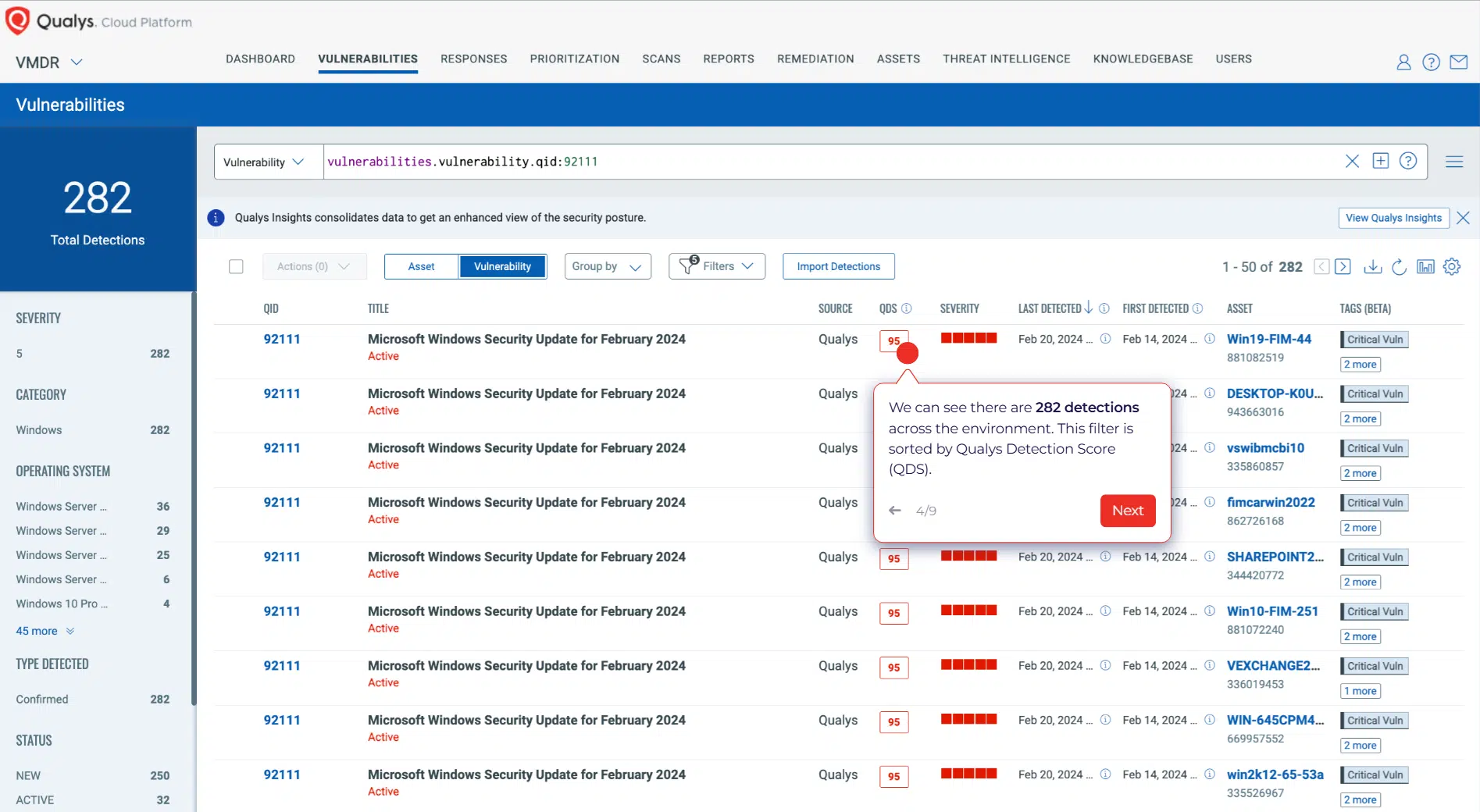
Qualys VMDR is a cloud-based vulnerability management platform designed for large-scale environments. It combines asset discovery, vulnerability detection, and remediation workflows into a single platform. It supports Linux and other operating systems, providing continuous monitoring, reporting, and compliance capabilities.
Key Features:
- Risk-based prioritization: Uses threat intelligence to highlight high-impact vulnerabilities.
- Continuous monitoring: Provides visibility across cloud, on-prem, and hybrid environments.
- Integrated workflows: Connects vulnerability detection with patching and remediation processes.
Tradeoffs
- Administrative complexity: Requires setup and tuning to match specific environments.
- Interface learning curve: Can take time for teams to use effectively.
Pricing and Use Cases
- Pricing: Subscription-based, typically per asset or module.
- Use case: Large enterprises needing centralized visibility across distributed environments.
4. Rapid7 InsightVM

Rapid7 InsightVM offers robust vulnerability management with strong integration into incident response workflows. It’s a solid enterprise option that supports Linux, Windows, and other platforms, and emphasizes continuous monitoring and risk prioritization.
Key Features
- Exploit correlation: Maps vulnerabilities to known exploits, including those in Metasploit.
- Dynamic asset tracking: Automatically updates asset groups and risk views.
- Integration support: Connects with tools like ServiceNow and Jira for remediation workflows.
Tradeoffs
- Resource-intensive: Requires significant system resources in larger deployments.
- Linux depth varies: Linux systems may require additional validation for accuracy.
Pricing and Use Cases
- Pricing: Subscription-based, often priced per asset.
- Use case: Large enterprises or security teams that prioritize exploitability and continuous risk tracking.
5. OpenVAS

OpenVAS, part of the Greenbone Vulnerability Management suite, is one of the most widely used open-source vulnerability scanners. It provides flexible scanning capabilities and full transparency into how checks are performed, making it a strong option for teams comfortable managing their own tooling.
Key Features
- Open-source flexibility: Access to a large library of vulnerability tests.
- Customizability: Supports custom checks and integration into security workflows.
- Community and enterprise feeds: Regular updates for new CVEs.
Tradeoffs
- Operational overhead: Requires manual setup, maintenance, and tuning.
- Limited remediation guidance: Focuses on detection rather than actionable fixes.
Pricing and Use Cases
- Pricing: Free community version; paid enterprise options available.
- Use case: Open-source users, small teams, or experts on Linux-based systems that don’t mind manual setup and maintenance.
6. Lynis
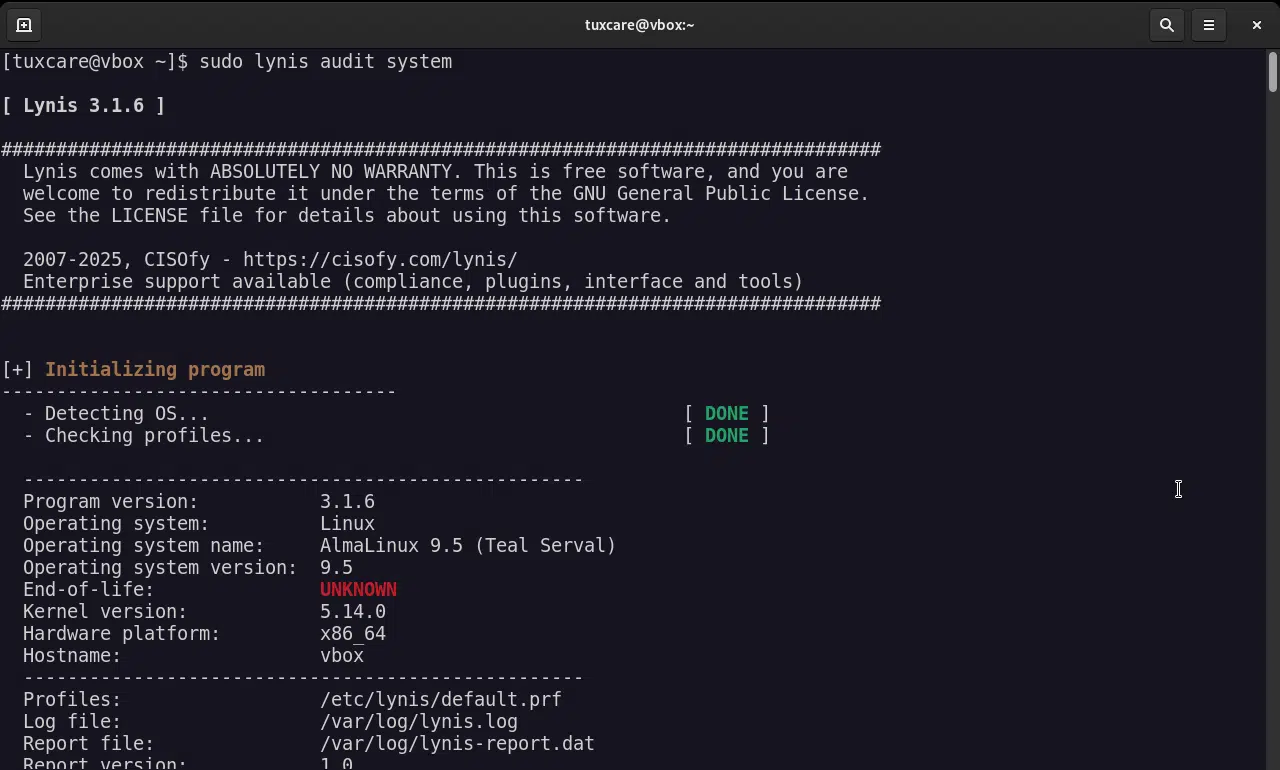
Lynis is a host-based security auditing tool rather than a traditional vulnerability scanner. It runs locally on a system and focuses on configuration, hardening, and compliance checks. It complements vulnerability scanners by identifying weaknesses that CVE-based tools may miss.
Key Features
- Deep system auditing: Reviews configuration, permissions, and system settings.
- Hardening guidance: Provides actionable recommendations for improving security posture, including Linux firewall rules, file permissions, and SSH configuration.
- Lightweight execution: Lightweight and runs from the command line, suitable for automation.
Pricing and Use Cases
- Pricing: Free open-source version; enterprise version available.
- Use case: System administrators and auditors focused on Linux hardening and compliance.
Key Features to Look for in a Linux Vulnerability Scanner
Over the past two years, the Linux ecosystem has seen a sharp increase in reported vulnerabilities. In 2024, kernel CVE disclosures rose significantly – with most estimates placing the total around ~3,500, depending on how they’re counted. The trend continued into 2025, with totals reaching roughly ~5,700 kernel CVEs across major datasets. In the first quarter of 2026 alone, more than 600 vulnerabilities have already been disclosed.
Not all of these vulnerabilities carry the same risk. The challenge isn’t detection; it’s prioritization. The right Linux vulnerability scanner should help teams focus on what matters, reduce noise, and support efficient remediation without adding operational overhead.
Here are the key features to look for:
High Signal, Low Noise
With thousands of new CVEs published every year, alert fatigue is a real problem. Not every vulnerability is exploitable in your environment. Look for scanners that prioritize findings based on real-world risk, exploitability, and system context. Reducing false positives helps teams focus on vulnerabilities that actually require action.
Wide Linux Coverage
Linux environments often include multiple Linux distributions, each with its own packaging system and patching approach. While they share the same kernel, vendors handle backports and security updates differently. A reliable scanner should provide native support for distributions like Ubuntu, RHEL, AlmaLinux, Rocky Linux, and Debian. Without this context, scan results can be inaccurate or misleading.
Continuous and Scheduled Scanning
Modern infrastructures change rapidly – new software packages, updates, and deployments are introduced daily. Point-in-time scans are no longer enough. Tools that support continuous or scheduled scanning help maintain visibility and ensure new risks are identified quickly.
Actionable Reporting and Compliance Support
Detection alone isn’t enough. Teams need clear, actionable output that connects vulnerabilities to remediation steps.
For organizations under PCI DSS, HIPAA, ISO 27001, or FIPS mandates, compliance-ready reporting is non-negotiable. Choose a tool that generates audit-ready, exportable reports that map findings to compliance requirements, saving your team weeks of manual preparation.
Scalability and Ease of Use
As environments grow, scanning should remain manageable. Whether you’re managing ten servers or ten thousand, tools should scale without adding unnecessary complexity.
Lightweight agents, simple deployment models, and intuitive dashboards all contribute to faster adoption and lower operational overhead.
Find Security Gaps with TuxCare’s Linux Vulnerability Scanner
TuxCare Radar is built for Linux-based systems where accuracy and context matter. Its Linux-first approach, patch-aware scanning, and AI-assisted risk scoring help teams focus on security vulnerabilities that are actually relevant, rather than working through long lists of low-impact findings.
If you’re looking to reduce false positives and simplify remediation, Radar provides a practical starting point. It’s lightweight to deploy and supports major distributions, including RHEL, Ubuntu, AlmaLinux, CentOS, and Debian.
Start a free trial to evaluate how TuxCare Radar improves visibility and streamlines Linux vulnerability scanning.