Tech Support
 Documentation
 Login
 Contact Us



Go straight to an AI summary of this blog post instead 


Key Takeaways
- The Cyber Resilience Act (CRA) makes cybersecurity mandatory for connected hardware and software made available in the EU.
- Reporting of actively exploited vulnerabilities and severe incidents has applied since 11 September 2026.
- The main obligations, including SBOMs, CE marking and fines of up to €15 million, apply from 11 December 2027.
- Start by classifying products, mapping components past the top level, setting support periods and rehearsing reporting.
Cyber Resilience Act compliance has two clocks running, and many teams only know about the later one. Complying means meeting the CRA’s essential cybersecurity requirements, documenting how you did it and affixing the CE marking to your product. Reporting of actively exploited vulnerabilities and severe incidents has applied since 11 September 2026, while the main obligations apply from 11 December 2027.
This guide covers which of your products are in scope, which deadlines have already passed and what to start on now.
What Is the Cyber Resilience Act?
The Cyber Resilience Act is Regulation (EU) 2024/2847, the EU’s horizontal law setting mandatory cybersecurity requirements for products with digital elements. It entered into force on 10 December 2024 and applies in full from 11 December 2027.
Recital 1 names the two problems it goes after. Products ship with too many vulnerabilities and get security updates inconsistently, if at all, and users lack the information they’d need to pick secure products and use them safely. Products with digital elements are hardware and software that connect to a device or network, directly or indirectly, and any remote data processing the product needs to perform to carry out one of its functions (recitals 9 and 11). That covers finished products such as phones and apps, and the Commission notes reach components like chips and operating systems too.
Because it’s a regulation, it applies directly in every Member State. Under Article 64(2), which applies from 11 December 2027, breaching the Annex I essential requirements or the manufacturer duties in Articles 13 and 14 can bring fines of up to €15 million or, for companies, 2.5% of total worldwide annual turnover for the preceding financial year, whichever is higher.
Who the CRA Applies To
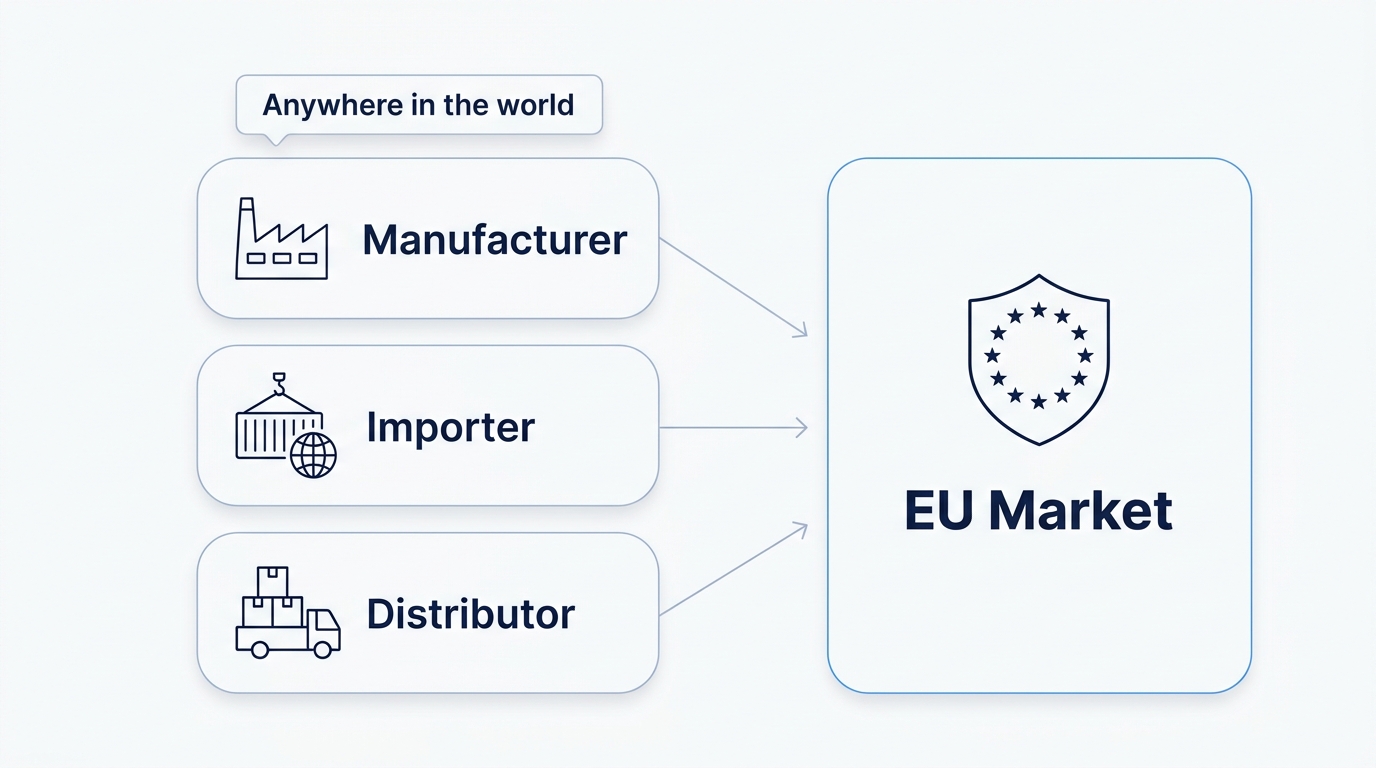
The CRA applies to manufacturers, importers and distributors that make products with digital elements available on the EU market. Manufacturers carry the heaviest load. The term covers anyone who develops or manufactures a product, or has one designed, developed or manufactured, and markets it under their own name or trademark, whether they charge for it or give it away (Article 3(13)). Importers and distributors have their own lighter duties. Where you’re based doesn’t matter either. A US or Asian company placing products on the EU market falls under the CRA just as an EU one does.
Category decides the conformity route. The examples below come from the Commission’s conformity assessment page.
| Category | Examples the Commission gives | How conformity gets assessed |
| Default | Mobile apps, computer games, smart speakers, memory chips | Self-assessment by the manufacturer |
| Important (Annex III, classes I and II) | Operating systems, anti-virus software, boot managers, network management systems, routers, firewalls, hypervisors | Class I can self-assess only by applying harmonized standards, common specifications or an EU certification scheme in full, and otherwise needs a notified body. Class II products, such as firewalls and hypervisors, always require third-party assessment. |
| Critical (Annex IV) | Smart cards, secure elements, smart meter gateways | A notified body is mandatory in every case, though an EU cybersecurity certificate may replace it once the Commission sets the conditions |
Open source gets its own route here. Under Article 32(5), manufacturers of free and open source software in an Annex III category can use any of the standard procedures, self-assessment included, as long as they publish the technical documentation when the product goes on the market.
Classification follows core functionality, so a product that merely includes a firewall isn’t automatically treated as one (recital 45). Implementing Regulation (EU) 2025/2392 sets out the precise technical descriptions.
Some products sit outside the regulation. Medical devices and in vitro diagnostics, vehicles under type-approval rules, certified aviation products and marine equipment have their own regimes (Article 2, recitals 25 and 27), and products built exclusively for national security or defense are excluded (recital 26).
SaaS gets a narrower reading. A website or cloud service that doesn’t support a product’s functionality, or that’s built outside the product manufacturer’s responsibility, isn’t covered. Cloud features built so a product can work are part of it (recitals 11 and 12).
Open source has its own carve-outs. Supplying free and open source software that its maker doesn’t monetize isn’t treated as a commercial activity, so the manufacturer duties don’t reach it (recital 18). A company that ships that code inside a commercial product is responsible for the whole product, components included (recital 34). Legal persons that systematically support open source projects meant for commercial use, such as certain foundations, count as open source software stewards. They get a lighter regime and aren’t permitted to affix the CE marking (recital 19), and their reporting duties under Article 24(3) apply from 11 December 2027.
Scope, categories and dates apply to hardware and software alike. From the requirements section on, the focus narrows to software components and open source, since third-party code is where most of a product’s inherited exposure comes from.
The CRA Compliance Timeline
Article 71 sets three application dates for the Cyber Resilience Act, and two of them have already passed. They’re 11 June 2026 for the conformity assessment body rules, 11 September 2026 for Article 14 reporting and 11 December 2027 for everything else.
| Date | What happens | Where it stands |
| 10 December 2024 | Entry into force, after publication in the Official Journal on 20 November 2024 | Done |
| 11 June 2026 | Chapter IV applies, so Member States can notify conformity assessment bodies | Applying, though no notified body is listed yet |
| 11 September 2026 | Article 14 reporting applies and ENISA opens the Single Reporting Platform | In effect since 11 September 2026 |
| 11 December 2027 | Main obligations apply, including Annex I, conformity assessment, CE marking and the Article 64 penalties | Next up |
Plenty of teams plan around December 2027, yet reporting has applied since 11 September 2026, more than a year earlier. The penalty rules run on the later schedule, since Article 71(2) pulls only Article 14 and Chapter IV forward and leaves the fines in Article 64 to apply from 11 December 2027.
Supporting pieces are partly in place. The Commission adopted a delegated act on 11 December 2025 on when a coordinating CSIRT may hold back a notification, and its non-binding guidance arrived on 27 July 2026. Harmonized standards are lagging. None had been cited in the Official Journal as of 6 November 2026, and the first two CEN-CENELEC standards, covering vocabulary and principles, were set for ratification on 2 November 2026 with no Official Journal citation expected for either. Notified bodies can be designated, but as of early October, designations were only starting, and the EU’s NANDO database still listed no CRA notified body in mid-October.
These dates still stand, and the Commission’s own CRA page, updated in September 2026, lists the same ones. The Digital Omnibus proposal would add an ENISA-run single entry point for incident reports, and the Council’s position of 21 October 2026 swaps that for national entry points. Neither change is law yet, so Article 14 reports still go through ENISA’s Single Reporting Platform.
The Core CRA Requirements
The core of Cyber Resilience Act compliance covers six areas. Annex I splits the essential requirements into two, with Part I covering what the product must do and Part II covering how the manufacturer handles vulnerabilities. Recital 54 sets out how each part applies. Vulnerability handling applies throughout the entire support period, while the product properties apply as dictated by the risk assessment. Market surveillance authorities can request to see the technical documentation, so tie each requirement to the evidence you’d provide.
Security by Design With a Risk Assessment
Annex I, Part I starts from a cybersecurity risk assessment. The manufacturer uses it to decide which product properties apply, then builds to them. Typical properties include no known exploitable vulnerabilities at launch, secure-by-default settings, access control, cryptography and security updates (Annex I, Part I, point 2). Where a requirement doesn’t apply, the assessment has to say why (recital 55). Keep the assessment in the technical documentation, with the reasoning for each requirement you set aside.
Vulnerability Handling and the SBOM
Part II applies to the whole support period (recital 54). It covers component and vulnerability records, fixes without delay, regular testing, publishing information about fixed vulnerabilities, a coordinated disclosure policy with a contact point, and secure, free update distribution (recitals 57, 63, 64 and 76).
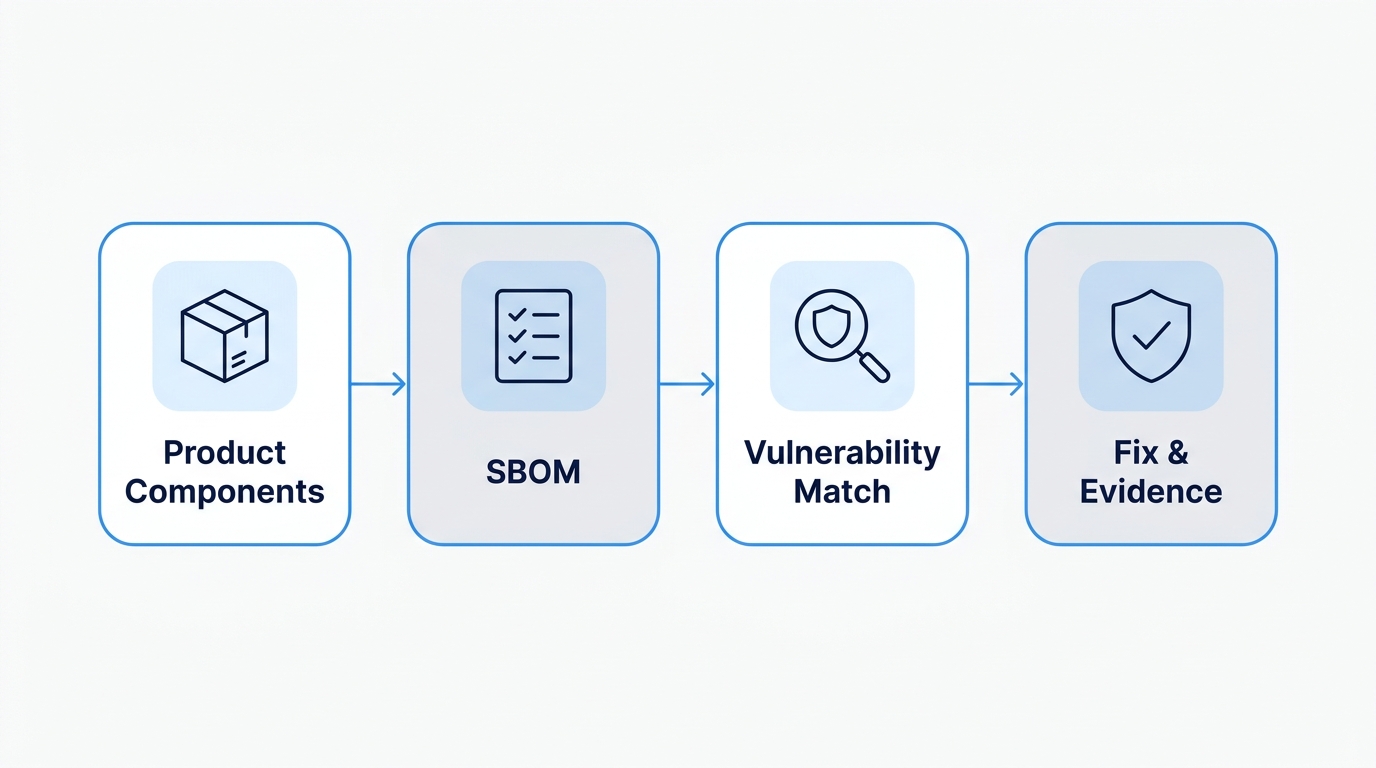
The CRA SBOM requirements sit in the first of those duties. Annex I, Part II, point 1 calls for an SBOM in a commonly used, machine-readable format that covers, at a minimum, the top-level dependencies. Authorities can request it, and recital 77 says manufacturers don’t have to publish it. A current SBOM for each release, dated records of triage and fixes, and a published disclosure policy make up the evidence trail. For the open source packages it covers, SecureChain for Open Source Software publishes machine-readable SBOMs, including CycloneDX, and VEX statements.
Due Diligence on Third-Party and Open Source Components
Article 13(5) requires due diligence when you integrate components from outside your organization, including free and open source ones. Recital 34 lists what that can involve, from checking the maker’s conformity and security-update history to searching vulnerability databases and running extra tests, scaled to the risk. If you find a vulnerability in a component, Article 13(6) says to report it to whoever maintains it, fix it in your own product and share your fix if you wrote one. The Commission’s July guidance clarifies that an upstream report isn’t required when you can confirm the maintainer already knows, or when the component has no maintainer left. Fixing it in your own product is still on you, which is why an unmaintained dependency stays your problem. Dated notes on what you checked, plus copies of reports sent upstream, make that diligence visible.
SecureChain rebuilds the packages it covers from source and records SLSA Level 3 provenance, which gives you build evidence to cite. Our 2026 supply chain attacks post shows why diligence has to cover how a package was built as well as which version you installed.
Security Updates Across the Support Period
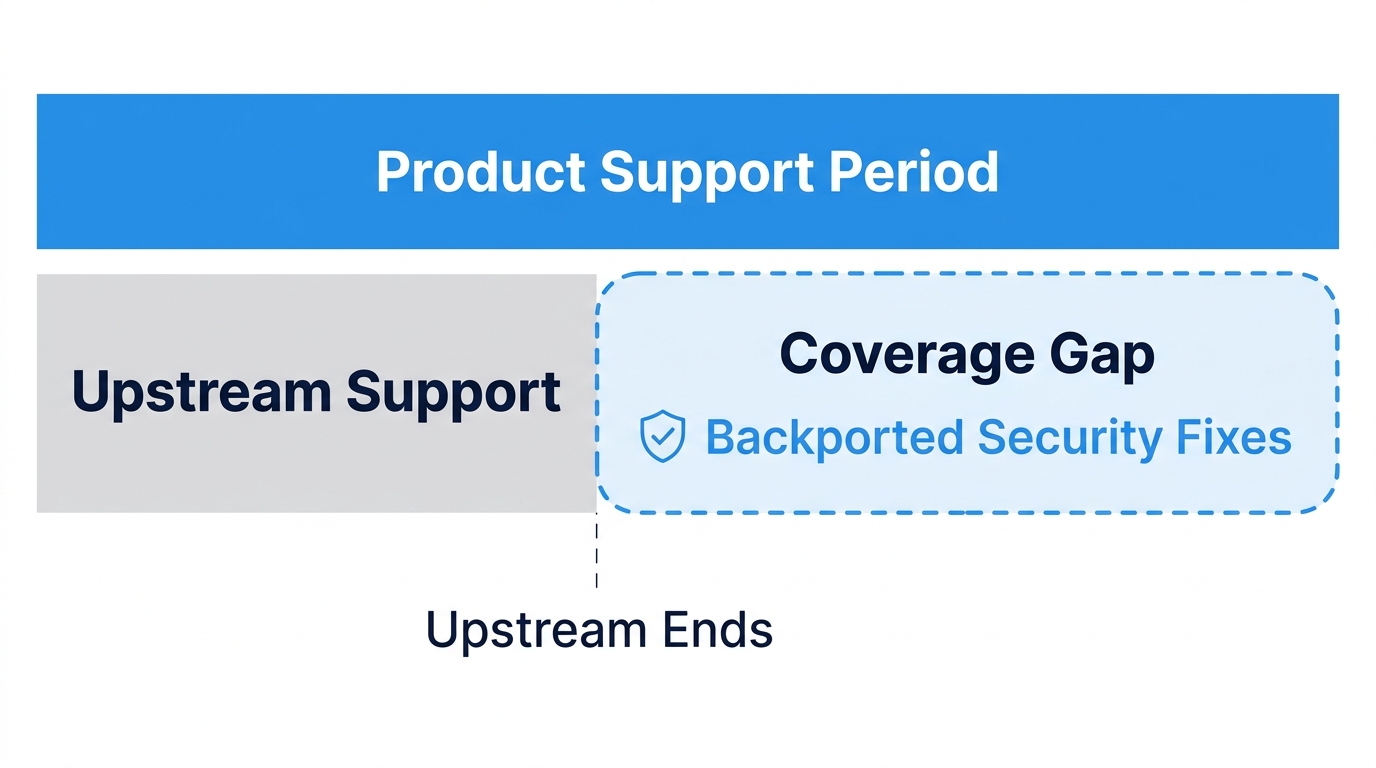
Manufacturers set a support period based on how long the product is expected to be in use. It has to be at least five years, unless the product is expected to be in use for less time, in which case the period matches that shorter period of use (Article 13(8)). Recital 60 expects longer periods for products people keep running for years, such as operating systems and routers. Each security update then has to stay available for at least 10 years after it’s issued, or for the remainder of the support period if that’s longer (Article 13(9)). Open source frameworks often stop issuing upstream fixes inside that window. Our CRA support period guide lines up the five-year floor against the end-of-life dates of popular frameworks. Keep the reasoning behind your period, since authorities can ask for it (recital 59).
Reporting Duties
Article 14 reporting has been in effect since 11 September 2026 and has its own section below. Keep a record of how you judged a vulnerability to be actively exploited, copies of what you filed at each stage, and the notices you sent to affected users (Article 14(8)).
Technical Documentation and CE Conformity
The process ends with the technical documentation, a conformity assessment for your product’s category, the EU declaration of conformity and the CE marking, as the Commission’s overview for manufacturers lays out. The documentation holds the risk assessment, the SBOM and the support-period reasoning. Manufacturers keep it and the declaration at the disposal of market surveillance authorities for at least ten years after placing the product on the market, or for the support period if that’s longer (Article 13(13)).
The September 2026 Reporting Obligation
Article 14 is the one manufacturer duty that’s already binding. Since 11 September 2026, a manufacturer that becomes aware of an actively exploited vulnerability in its product, or of a severe incident affecting the product’s security, has to notify through ENISA’s Single Reporting Platform. One submission reaches both ENISA and the coordinating CSIRT. The early warning is due within 24 hours of becoming aware, and a fuller notification within 72 hours. For an actively exploited vulnerability, the final report is due no later than 14 days after a corrective or mitigating measure is available. For a severe incident, it’s due within a month of the 72-hour notification. You also have to tell impacted users, and, where appropriate, all users about the vulnerability or incident and any mitigations they can apply themselves (Article 14(8)).
The duty applies to in-scope products already on the market, including those placed there before 11 December 2027 (Article 69(3)), so a release you shipped years ago can trigger it. Article 3(42) sets the bar at reliable evidence that a malicious actor has exploited the flaw in a system without the owner’s permission, and recital 68 makes clear that vulnerabilities found through good-faith testing aren’t reportable.
The formal SBOM duty doesn’t take effect until 11 December 2027, yet answering within a day whether an exploited component is in a product you ship usually depends on already knowing what each release contains. That puts component records at the front of your preparation, regardless of what the SBOM deadline says. Our CRA Article 14 guide shows what that looks like when the affected package sits deep in a dependency tree, and the clock is running.
How to Prepare With a Cyber Resilience Act Compliance Roadmap
The plan from here to December 2027 works toward the main deadline in six steps, and the reporting rehearsal covers the one duty that’s already live.
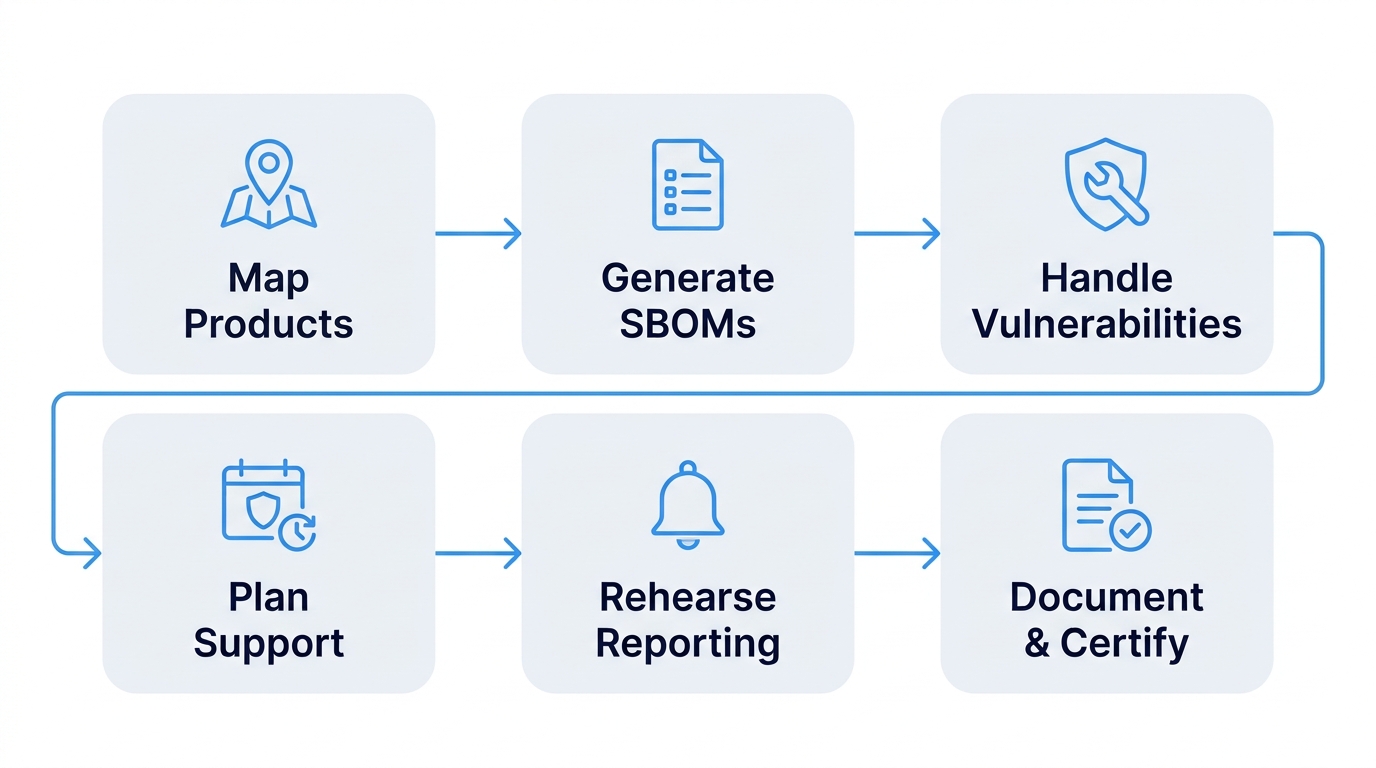
Map Your Products and Components Against the Scope Rules
List every product you make available in the EU, decide your role for each and check whether an exemption applies. Then place it in the default, important or critical category using Annexes III and IV and Implementing Regulation (EU) 2025/2392, and note the conformity route that follows. Record your reasoning and list the components inside each product, open source ones included, since later steps depend on that list. If anything lands in class I or II, or in the critical group, start talking now to the conformity assessment bodies applying to become CRA notified bodies. No harmonized standard has been cited yet, so even class I products can’t rely on self-assessment, and no CRA-notified body has been listed yet.
Generate and Maintain SBOMs
Build an SBOM for each release from the resolved dependency tree rather than from manifests alone, so it goes deeper than the top-level dependencies Annex I requires at minimum. Regenerate it whenever a release changes, keep the dated copies, and match each one against vulnerability data.
Stand Up Vulnerability Handling With Patch Service Levels
Set target fix times by severity, designate an owner to triage incoming reports, and publish a coordinated vulnerability disclosure policy with a contact point (recitals 63 and 76). Ship security updates separately from feature updates where that’s technically feasible (recital 57). Write down each decision with a date, since those records become the evidence trail for Annex I, Part II.
Plan the Support Period, Including End-of-Life Components
Set a support period for each product from its expected use date, then place each dependency’s end-of-life date next to it. Wherever upstream support ends first, someone has to supply the fixes, and the options are to upgrade, replace the component, patch it yourself, or buy fixes. Upgrading isn’t always safe. For end-of-life operating systems, runtimes, and libraries inside shipped products, Endless Lifecycle Support backports security fixes to the versions you already run, which suits products whose declared support period outlives the upstream vendor.
Rehearse the Reporting Playbook Against the 24-Hour Clock
Name who decides that a vulnerability is actively exploited, using Article 3(42) and recital 68 as the test, and who can log in and file. Get access to ENISA’s platform and identify your coordinating CSIRT. Under Article 14(7), that’s the one in the Member State where your main EU establishment is. If you have no EU establishment, the fallback runs in order through the Member State of your authorized representative, then your importer, then your distributor, and finally the Member State with the most users of your product. Then run tabletop exercises for both an exploited vulnerability and a severe incident, timing each stage against the 24-hour and 72-hour marks, the 14-day and one-month final reports, and the notice to affected users.
Assemble the Documentation and Choose Your Conformity Route
Compile the technical documentation, complete the conformity assessment for your category, issue the EU declaration of conformity and get ready to affix the CE marking. Review supplier contracts so that upstream vendors are required to promptly notify you of vulnerabilities in components you ship. Your 24-hour clock starts when you become aware. A vendor who sits on a notice just means you find out later. For products already on the market, only a substantial modification after 11 December 2027 brings them under the main requirements (Article 69(2)), and a security update that lowers risk without changing the product’s intended purpose does not (recital 39). Tools can supply evidence for the technical documentation, but the conformity assessment and the documentation itself stay with the manufacturer.
Support the CRA Patch and SBOM Duties With TuxCare
Fixing vulnerabilities without delay and keeping an SBOM current are the two Annex I duties that depend most on what’s inside your open source dependencies. SecureChain for Open Source Software screens package source for hidden malware and rebuilds the vetted packages in an isolated environment, and each one ships with SLSA Level 3 provenance, an SBOM and VEX statements. SecureChain also patches active components under a service-level agreement, and Endless Lifecycle Support backports fixes to versions that upstream no longer maintains, so patching can continue across your declared support period.
If you can’t yet say where a component came from or who patches it once upstream stops, send TuxCare your dependency list. If you build mostly hardware or firmware, the Commission pages linked above are the better next read.
FAQs
National market surveillance authorities in each Member State enforce it, while coordinating CSIRTs and ENISA receive reported vulnerabilities and incidents.
Yes. Manufacturers and others can voluntarily notify vulnerabilities, cyber threats and near misses to a coordinating CSIRT or ENISA (recital 74).
No. Annex I asks for a commonly used, machine-readable format without naming one. The Commission can specify one later in an implementing act (Article 13(24)). CycloneDX and SPDX are the two you’ll run into most.
Yes. Article 13(19) requires manufacturers to state the end date of the support period, at least the month and year, at the time of purchase. Where it’s technically feasible, they also have to show users a notification once support has ended, and recital 56 points to the product’s user interface as the place to do it.
Not by itself. The reporting platform is built to keep notifications confidential, especially for vulnerabilities that don’t have a security update yet (recital 69). Once a fix is available and the vulnerability is publicly known, ENISA adds it to the European vulnerability database in agreement with you (Article 17(5)). For a severe incident, the coordinating CSIRT can inform the public after consulting you (Article 17(2)).