Tech Support
 Documentation
 Login
 Contact Us



Go straight to an AI summary of this blog post instead 


Key Takeaways
- An abandoned package stays installable through Packagist, open CVEs and all, because fixing packages was never Packagist’s job.
- SecureChain rebuilds and screens PHP packages before install, then keeps patching them as upstream maintenance slows and stops.
- You can route your whole Composer setup through SecureChain, or send only the packages that need it.
- Private Packagist hosts and mirrors your packages, while SecureChain patches the ones nobody maintains.
An abandoned Composer package with an open CVE puts you in an uncomfortable spot. An upstream fix probably isn’t coming, and your options are forking it yourself, swapping it out, or documenting a compensating control and hoping an auditor accepts it. A Packagist alternative built around patching changes that math. SecureChain rebuilds and screens PHP packages before they reach your build, then keeps shipping fixes under SLA long after the original maintainer goes quiet, either instead of Packagist or alongside it.
Here’s what that coverage actually includes, and how it sits next to the Composer workflow you already run.
Why Teams Look for a Packagist Alternative
Packagist does what it was built to do. It indexes package repositories and tells Composer where to fetch code from, and it does that part well. What it was never built to do is fix anything. When a maintainer stops releasing, Composer happily keeps resolving an existing vulnerable version through Packagist metadata, CVE and all.
That picture did shift this year. Composer 2.10, released at the end of May, blocks versions flagged as malware during resolution and again on install from an existing lockfile, and folds advisories, abandoned packages, and malware into a single dependency policy. Packagist followed in July by making published stable versions immutable, so a re-tagged release can no longer quietly replace what you already locked. Both changes are real improvements, and neither one writes a patch. Blocking a bad release still leaves you holding an abandoned package with an open CVE and nobody upstream to fix it.
That’s usually the moment a team starts looking for a Packagist alternative instead of a one-off workaround. The distinction matters. A workaround handles a single audit finding. An alternative built around patching assumes this will keep happening, not just to the one abandoned package currently on your desk. For more on why Composer dependencies never get an end-of-life date the way PHP does, see Your Composer Dependencies Don’t Retire Just Because PHP Did, which digs into what that means for the packages still running in your app.
PHP isn’t unique here, either. Supply chain incidents across several open source ecosystems in 2026 have given teams reason to rethink registry trust, and the pattern hasn’t stopped at any one language.
How SecureChain Keeps Patching After Upstream Walks Away
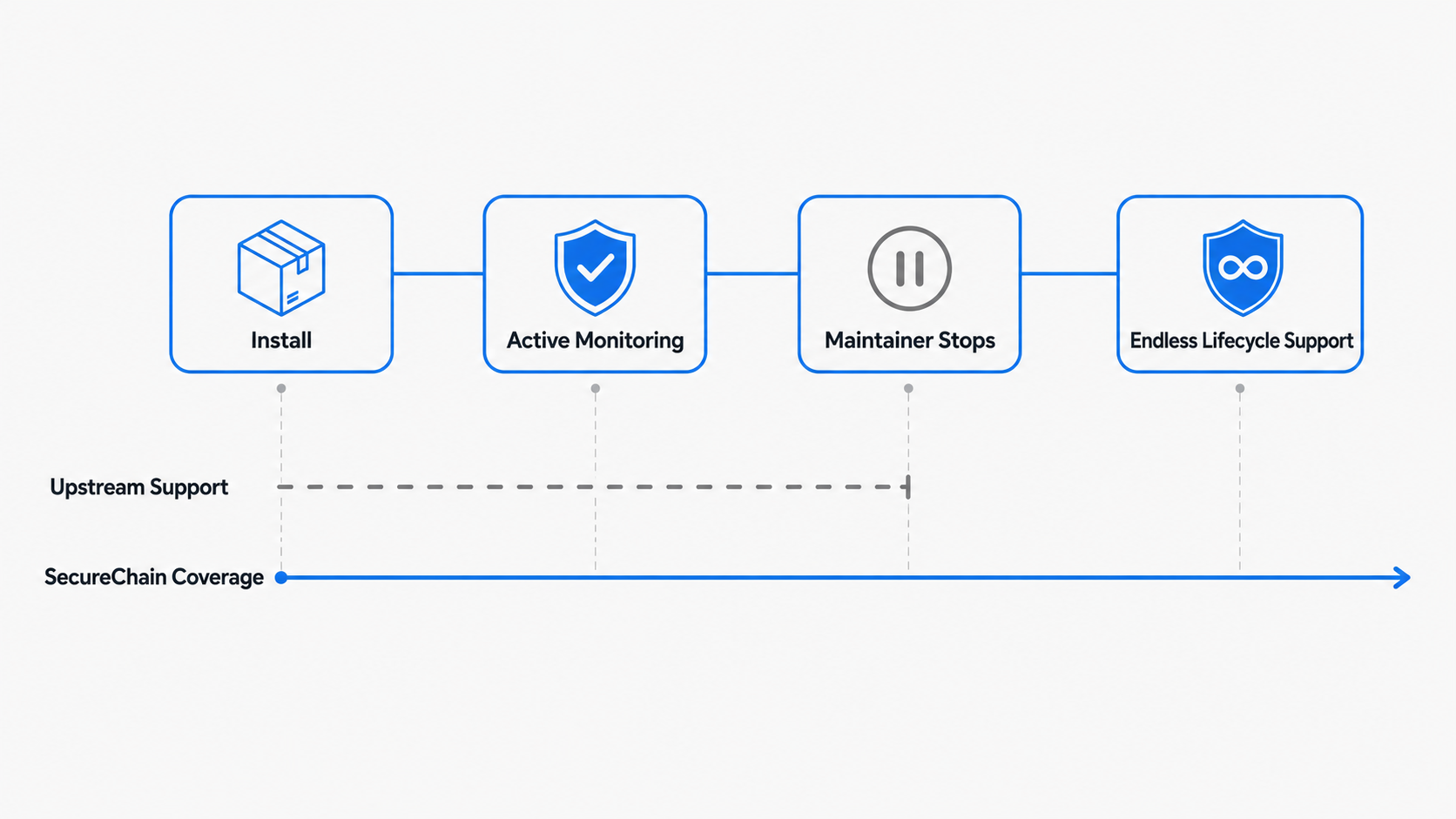
SecureChain treats this as a lifecycle problem rather than a one-time fix. Every PHP package it serves is rebuilt from source in an isolated environment before it’s available to install, so what lands in your build is verified end to end instead of taken straight from an upstream artifact that nobody rebuilt or checked. Packages are also screened for known malware and suspicious code patterns, and anything that fails inspection is blocked before it reaches you rather than flagged after the fact.
The work doesn’t stop once a package clears that first check. While upstream is still shipping releases, active components are monitored and patched under SLA as new CVEs surface, the way you’d expect from a maintainer who’s still paying attention. Once upstream goes quiet, TuxCare keeps maintaining the package directly, and roughly six months after the last upstream release, Endless Lifecycle Support takes over and keeps delivering fixes for as long as you depend on the package, whether or not the original maintainer ever comes back.
That gap, between flagging a problem and actually fixing it, is where a lot of supply chain tooling stops short. For teams that need to show their work, SecureChain also produces SLSA Level 3 provenance, an SBOM, and VEX data, so there’s a record behind “this was patched” instead of a claim you have to take on faith.
How SecureChain Fits Alongside Packagist
None of this requires ripping out how your team already works with Composer. SecureChain is a Composer-compatible repository you can point at instead of public Packagist or alongside it, and how much of your traffic goes through it is your call.
Some teams route their whole Composer setup through SecureChain, so everything they pull gets rebuilt and screened before install rather than just the abandoned packages. Others take a narrower approach and send only the packages they know are abandoned or high-risk, while everything else resolves from Packagist exactly as it does today. Anything not already in the catalog can be added on request. Either way, developers keep running the same composer install and composer update commands they already know, and once the repository is configured, the day-to-day workflow stays the same.
What changes is what happens behind those commands for anything routed through SecureChain. Instead of Composer downloading from wherever Packagist metadata points it – a source repository or a distribution archive – it pulls from a repository where the package has already been rebuilt, screened, and patched. Your lockfile still records the versions and references Composer resolved. What’s different is where they came from, a rebuilt and maintained package served out of TuxCare’s repository rather than whatever the ordinary upstream path would have handed you.
Putting SecureChain on Your Composer Stack
If your last audit turned up two or three abandoned packages with open advisories, that’s a narrow, well-scoped place to start, not a reason to rearchitect your whole dependency setup. If the abandoned list runs longer than that, the more useful first question is which of those packages can realistically be patched, since that shapes how much of your Composer setup makes sense to route through SecureChain from day one.
SecureChain isn’t a substitute for Private Packagist, and it helps to keep the two straight. Private Packagist, from Packagist Conductors, the company behind Composer and Packagist.org, handles private package hosting, mirroring, and distribution controls, and it has added a serious amount of supply chain security tooling of its own over the past year. What it doesn’t do is backport fixes to a dependency whose maintainer stopped answering years ago. A team whose main need is private hosting is better served there, and running both is a perfectly reasonable outcome, since neither one does the other’s job.
If PHP packages are the layer you’re missing coverage on, explore SecureChain for PHP to see how this works in more detail, or request a quote for a walkthrough of what it would cover in your specific stack.
FAQ
What is a Packagist alternative?
A Packagist alternative is a Composer-compatible repository used instead of, or alongside, public Packagist. Teams reach for one when they need something public Packagist doesn’t provide, such as private hosting, controlled distribution, tighter security screening, or continued patching for packages nobody maintains anymore.
What does SecureChain actually patch?
SecureChain patches vulnerabilities across the whole life of a PHP package. Active packages are patched under SLA, TuxCare keeps maintaining them directly once upstream activity stops, and Endless Lifecycle Support provides long-term coverage after that for as long as you run the package.
Do I have to replace Packagist completely to use SecureChain?
No. You can route your whole Composer environment through SecureChain, or route specific packages while everything else keeps resolving from Packagist as usual.
Does this replace Private Packagist?
No, they solve different problems. Private Packagist provides private package hosting, mirroring, and distribution controls, while SecureChain patches packages whose upstream maintainer has stopped fixing vulnerabilities.
Will developers need to change how they use Composer?
No. Once the repository is configured, Composer commands and workflows stay the same. What changes is what’s behind the packages being installed.