Tech Support
 Documentation
 Login
 Contact Us


Go straight to an AI summary of this blog post instead 


Key Takeaways
- Linux kernel vulnerabilities can lead to privilege escalation, data leaks, and service downtime.
- Common flaws include memory corruption, race conditions, side-channel attacks, and privilege escalation.
- Continuous scanning and timely patching are essential to keep Linux systems secure.
With the Linux open-source community, you have access to a global network of developers who continually improve its codebase, features, and performance. However, this environment also means that cybercriminals have access to the source code, making Linux-based devices, including critical servers, susceptible to potential vulnerabilities.
Known vulnerabilities are assigned a unique identifier under the Common Vulnerabilities and Exposures (CVE) system. They are published in public repositories like the National Vulnerability Database (NVD), where vendors, developers, and users can be aware of exploits that affect specific software versions. A CVE report serves as a signal for users to promptly apply software patches, including those for the Linux kernel, to address the identified issue.
This article walks you through recent Linux kernel vulnerabilities as well as provides solutions to mitigate them without having to reboot your servers and disrupt your services.
What Are Linux Kernel Vulnerabilities?
The Linux kernel is the core component of any Linux-based operating system. It acts as the bridge between application software and hardware, responsible for managing resources like the CPU, memory, and devices, and enforcing security boundaries.
A “kernel vulnerability” refers to a flaw or bug in the kernel’s source code, often found within the system call (syscall) interface that user-space applications rely on. If exploited, these flaws can compromise the entire system.
Examples of high-impact kernel vulnerabilities include:
- Memory Corruption Bugs: Flaws like Use-After-Free (UAF) or Buffer Overflows that allow an attacker to write malicious data to protected kernel memory.
- Privilege Escalation: Logic bugs that allow a low-privilege user to gain root access (full administrative control) over the system.
- Security Bypass Flaws: Bugs that let attackers bypass security protections like SELinux or firewalls to access restricted resources.
Common Types of Linux Kernel Vulnerabilities
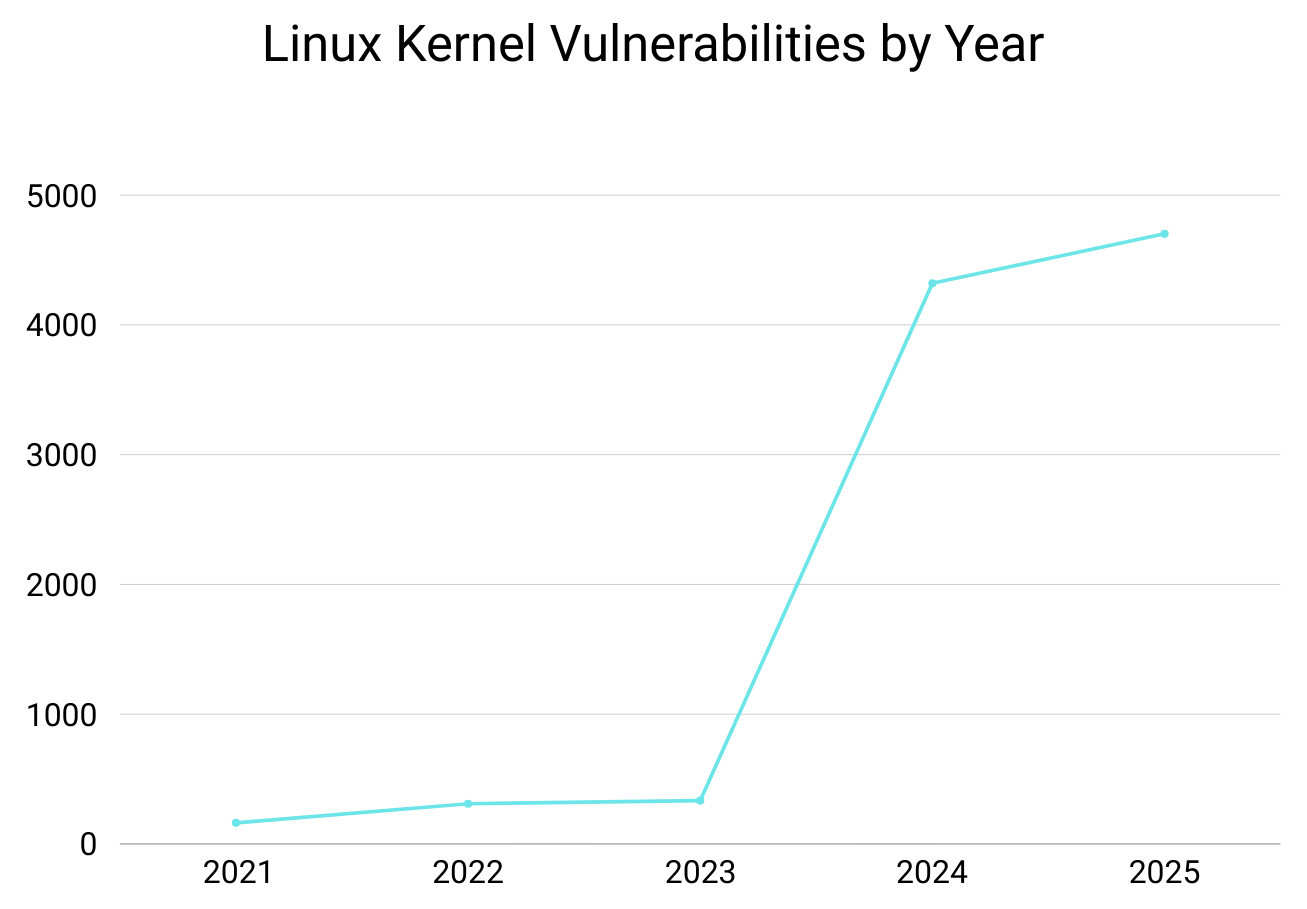
Every month, new CVEs are added to the publicly available NIST database and more than 4,000 Linux kernel vulnerabilities have already been recorded in 2025 alone. However, it is crucial to remember that not all vulnerabilities carry equal risk, and many don’t even pose serious threat to the system. Below are some of the most common types of vulnerabilities found in the Linux kernel.
Memory Corruption
Kernel memory-related bugs, such as buffer overflows, use-after-free (UAF), out-of-bounds reads/writes, and double-frees are among the most dangerous kernel vulnerabilities. They give attackers the ability to overwrite critical kernel structures, run arbitrary code, or make the system non-operational, often resulting in a kernel panic. Because the kernel operates with the highest privileges, successful exploitation often results in complete system takeover. These issues frequently appear in drivers, networking subsystems, and legacy code paths.
Privilege Escalation
Privilege escalation vulnerabilities are severe because attackers can exploit them to obtain unauthorized, higher-level access. They typically stem from improper permission checks, incorrect capability assignments, or syscall logic errors. Attackers frequently chain these flaws with others to escape containers, break sandbox isolation, or gain root access.
Race Conditions
Race condition bugs occur when multiple threads or processes improperly access shared resources simultaneously. A common example is a Time-of-Check to Time-of-Use (TOCTOU) flaw. In the kernel, these issues may lead to inconsistent states, data corruption, or exploitable conditions where security checks occur out of order.
Side-Channel Attacks
Side-channel attacks exploit indirect information leaks – such as timing differences, cache behavior, or speculative execution – to infer sensitive data. Variants of Spectre, Meltdown, and related CPU-level flaws fall into this category. Although difficult to execute, these attacks can cross isolation boundaries and expose cryptographic secrets or other sensitive memory contents.
Denial of Service
Denial-of-Service (DoS) vulnerabilities allow attackers to crash the system, exhaust memory, trigger kernel panics, or lock up resources. Even without privilege escalation, DoS flaws can disrupt services, affect availability SLAs, and cause costly downtime. These problems are often caused by unhandled error paths, incorrect handling of packets, or endless loops inside kernel subsystems.
Note: Memory corruption and race conditions are the most frequently exploited kernel vulnerabilities in enterprise environments.
Most Recent Linux Kernel Vulnerabilities (2023–2025)
Below we explore some recently discovered CVEs, as well as their respective security ratings, that you should be aware of to make sure you can protects your organization’s systems.
CVE-2023-32233: Netfilter Linux Kernel Vulnerability
CVSS 3.x Score: 7.8 (High)
Netfilter is a framework for packet filtering and network address translation (NAT) in the Linux kernel. Tools such as UFW and IP tables are used to manage this framework.
A new vulnerability was discovered in the Netfilter nf_tables due to the mishandling of anonymous sets. As a result, a local user can use this use-after-free vulnerability to gain root privileges and operate arbitrary read and write tasks on kernel memory.
CVE-2023-1252: Linux Kernel Ext4 File System Vulnerability
CVSS 3.x Score: 7.8 (High)
A use-after-free vulnerability was discovered in the Ext4 filesystem of the Linux kernel when a user starts multiple file operations at the same time while using the overlay FS usage. A local user can use this flaw to crash the system or potentially escalate their privileges.
CVE-2024-1086: Netfilter Double‑Free Leading to Privilege Escalation
CVSS 3.x Score: 7.8 (High)
A use‑after‑free flaw was discovered in the Linux kernel’s netfilter nf_tables component. The issue occurs because the nft_verdict_init() function allows invalid positive drop‑error values. When the kernel processes these values, nf_hook_slow() can trigger a double‑free condition.
A local attacker can exploit this to achieve local privilege escalation, allowing them to execute actions with root‑level permissions. This vulnerability affects multiple Linux distributions and requires timely patching.
CVE-2024-53104: Out-of-Bounds Write in UVC Video Driver
CVSS 3.x Score: 7.8 (High)
A vulnerability in the kernel’s USB Video Class (UVC) driver allows an out‑of‑bounds write when parsing video streams that contain frames with an undefined format (UVC_VS_UNDEFINED). Because the driver does not account for these frame types during buffer allocation, a crafted or manipulated video stream can overwrite adjacent memory.
An attacker who controls or influences the video input device could use this flaw to corrupt memory, escalate privileges, or potentially execute arbitrary code on the system.
CVE-2025-38352: POSIX CPU Timers Race Condition
CVSS 3.x Score: 7.8 (High)
A race condition was found in how the Linux kernel handles POSIX CPU timers. When a task is exiting, handle_posix_cpu_timers() may run at the same time as posix_cpu_timer_del(), creating a timing window that can lead to a use‑after‑free scenario.
Local users could exploit this flaw to crash the system or potentially escalate privileges. The issue affects kernels where CPU timers are handled without additional task‑work protections, making timely updates essential.
Notorious Historical Linux Vulnerabilities (2014–2020)
In addition to the recent kernel CVEs that we’ve talked about so far in this post, we’ve collected a few of the most important older Linux vulnerabilities that you should be aware of so that you can secure your Linux-based servers and devices.
Let’s take a look.
Heartbleed (CVE-2014-0160)
CVSS 3.x Score: 7.5 (High)
Codenomicon discovered a critical buffer over-read OpenSSL ‘Heartbleed’ vulnerability while doing a routine test of its software. Heartbleed became one of the most serious bugs impacting servers utilizing OpenSSL for SSL management. This incident serves as a reminder that a single line of code can lead to critical bugs because only one coding error led to the Heartbleed vulnerability.
memcpy(bp, pl, payload);
The bp variable is a pointer that receives copied data, while the pl variable is a pointer to the source data. And the payload variable denotes the number of bytes to copy. Unfortunately, the developers overlooked validating the length of the payload variable, creating a vulnerability that attackers can exploit.
In this scenario, an attacker could send a payload of 8 bytes of data for the pl variable while maliciously assigning 64 bytes to the payload variable. Consequently, the affected software, OpenSSL, would transmit 64 bytes of data instead of the intended 8 bytes. The remaining bytes in memory could be private keys, passwords, user data, or anything else stored in the remaining length of bytes in memory. It’s important to note that Heartbleed was not a buffer overflow but an over-read issue. The lack of proper checks on the payload length resulted in an excessive read operation, exposing unintended data from memory.
OpenSSL can be recompiled with the -DOPENSSL_NO_HEARTBEATS parameter to address this issue before applying the patch. However, this approach may have unforeseen consequences for applications relying on an SSL heartbeat. Consequently, applications that depend on a heartbeat may experience crashes, error messages, or failure to function properly. Therefore, it is crucial to prioritize timely patching.
Pro Tip: TuxCare’s LibCare allows administrators to patch OpenSSL without requiring a system reboot. This enables administrators to address vulnerabilities like Heartbleed while avoiding downtime or potentially risky mitigation methods.
Spectre and Meltdown (CVE-2017-5753, CVE-2017-5715, CVE-2017-5754)
CVSS 3.x Score: 5.6 (Medium)
What makes Spectre and Meltdown unique from most other CVEs is that they’re hardware issues rather than software-related problems. These vulnerabilities had a global impact, affecting almost every device and forcing Intel to change its processor manufacturing approach. Both vulnerabilities allow attackers to read memory running on the local device due to various failed privilege checks on the hardware.
Meltdown exploits bypass privilege checks and Spectre tricks applications into accessing privileged memory. In both cases, an attacker gains access to operating system instructions from mapped physical memory with the kernel, which could include passwords, keys, and other sensitive data.
After the discovery, Intel made an announcement regarding changes in their processor manufacturing process to eliminate the vulnerability in new processors. Patches were also released to address the issue, although users experienced a significant decrease in performance, particularly on older machines.
Two patches were released to mitigate the issue: Kaiser for Meltdown and the Retpoline patch for Spectre. The biggest problem with mitigation is that performance takes a major hit, and a reboot is required, but KernelCare applies patches for these two vulnerabilities with no reboot required.
Mutagen Astronomy (CVE-2018-14634)
CVSS 3.x Score: 7.8 (High)
Mutagen Astronomy (an anagram for Too Many Arguments) is one of the highly critical issues that can only be exploited by a local user to gain root privileges on the Linux system. A buffer overflow in Linux’s create_elf_tables() function led to the privilege escalation. An attacker can overflow the MAX_ARG_STRINGS value used to limit arguments passed to the function and inject their own environment variables and functions using a SUID-root binary.
The result is that an attacker can escalate privileges, run rogue functions on the local device, or inject their own environment variables. To see a breakdown of the vulnerable code, Qualys published its findings here.
It is important to note that this vulnerability not only requires the user to be on the local machine, but the attack also requires a device of more than 16 GB RAM running a 64-bit kernel. However, it’s a critical flaw and should be patched as soon as possible. The researchers at Qualys found that most Linux users are not affected, but the main targets vulnerable to this attack are RedHat and CentOS systems. RedHat published a workaround, but this still requires a reboot.
Instead of applying a lengthy workaround, Linux servers running KernelCare will receive the patch, and no reboot is required.
Zombieload (Microarchitectural Data Sampling) CVE-2018-12207
CVSS 3.x Score: 6.5 (Medium)
Following the discoveries of Spectre and Meltdown, another hardware bug known as “Zombieload” was identified. Zombieload comprises a series of exploits that exploit the speculative instruction functionality of microprocessors. In an effort to enhance performance, processors attempt to cache future instructions that are likely to run next.
Zombieload and other Microarchitectural Data Sampling (MDS) attacks take advantage of failed protection boundaries surrounding this memory space and trick applications into divulging critical data.
To address this issue, you can take the following three steps for mitigation.
- Updating the microcode on the processor
- Disabling hyperthreading in the BIOS (manual instructions depend on your BIOS manufacturer)
- Patching the Linux kernel
How to Protect Your Systems Against Linux Kernel Vulnerabilities
Keeping Linux systems secure starts with timely patching and continuous visibility into new kernel vulnerabilities. Below are the most effective ways to protect your infrastructure.
Vendor Patches
The distribution vendors provide security updates to address known vulnerabilities in the Linux kernel. You can apply these latest patches using the distribution’s package manager tool. To find about new updates, you can check the vendor’s security advisories, which includes the details of CVEs, their causes and impacts, as well as available fixes.
However, the industry-standard patching method involves security teams rebooting the system, which is why most organizations feel hesitant to apply the patches at the first place. This results to the delay of patches and leaving systems exposed to potential threats.
Rebootless Patching
Rebootless patching is the zero-disruption method of applying patches to your enterprise Linux systems. It enables you to deploy security updates to the running kernel without having to shut down your servers.
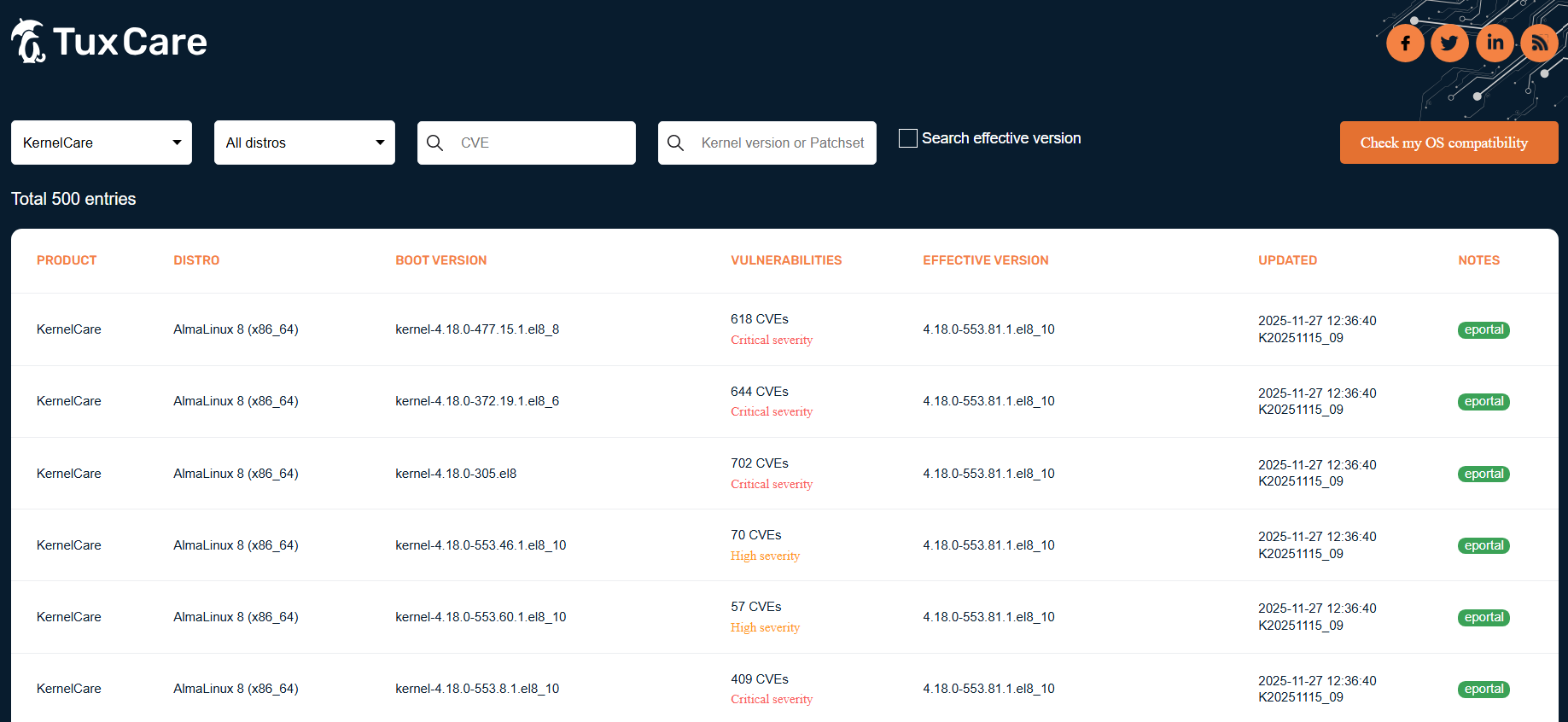
TuxCare’s KernelCare enables you to automatically apply security patches to the Linux kernel without requiring a system reboot or scheduled maintenance window. KernelCare supports all major enterprise Linux distributions, including RHEL, CentOS, AlmaLinux, Rocky Linux, Ubuntu, Amazon Linux, Oracle Linux, CloudLinux, and more.
Continuous Vulnerability Scanning
You don’t know what to fix if you don’t identify what to fix. While you can monitor security advisories daily for finding new vulnerabilities and updates, its a manual work, which is not an effective approach for vulnerability management.
Pro Tip: Automating kernel patching and vulnerability scanning reduces human error and ensures no critical updates are missed, especially in large or complex infrastructures.
Close the Gaps in Linux Security with Rebootless Patching
Although not every Linux kernel vulnerability gets its own CVE ID from the CVE Numbering Authority, it’s critical for Linux administrators to regularly scan servers with adequate detection tools and patch them whenever a new one is found.
Traditional patch management methods are no longer viable given the volume and severity of emerging Linux kernel vulnerabilities. The hesitancy to reboot critical servers creates a significant security gap, leaving systems exposed.
TuxCare’s KernelCare closes this gap with automated, rebootless kernel patching that keeps Linux workloads secure and fully operational. You can say goodbye to outdated patching methods and unnecessarily long patching cycles that are time-consuming, risky, create software usability issues, and only offer temporary solutions.
With KernelCare, you get non-critical and critical patches applied to your servers as soon as they are available, and they are deployed in the background while your systems are running. There are no delays, no cumbersome workarounds, no scheduling of maintenance operations, no downtime, and – most importantly – no vulnerable openings for potential attackers.