Tech Support
 Documentation
 Login
 Contact Us


Go straight to an AI summary of this blog post instead 


Key Takeaways
- FIPS 140-3 compliance requires the use of cryptographic modules that have been formally tested and approved by NIST – not just secure configurations or approved algorithms.
- For government agencies, contractors, and regulated industries, FIPS is a baseline requirement for protecting sensitive data and passing audits – not an optional security enhancement.
- Using validated modules, enabling FIPS mode, and preserving validation during updates are all essential to maintaining compliance in production environments.
If you run Linux systems in a regulated environment, FIPS is no longer a background consideration – it’s something auditors, customers, and security teams expect clear answers on.
When an auditor asks whether your cryptography is FIPS validated, “configured correctly” or “best practice” isn’t enough. You either have validated cryptographic modules in place, or you don’t. And, in 2026, that distinction matters more than ever as regulatory scrutiny increases and legacy validations expire.
Federal Information Processing Standards (FIPS) define how cryptographic modules must be built, tested, and operated to protect sensitive data. For Linux administrators and security teams, FIPS affects everything from how OpenSSL is configured to how updates are applied and audited.
This article explains FIPS in practical terms – what it is, how it applies to Linux environments, why validation matters, and what organizations need to do to stay compliant as security and regulatory expectations continue to rise.
Overview of FIPS
Federal Information Processing Standards (FIPS) 140-3 is a set of government-issued security requirements that define how cryptographic modules should be built and used. Developed by the National Institute of Standards and Technology (NIST), these standards ensure that the encryption protecting sensitive information meets predictable, well-tested security expectations.
In practice, this means federal agencies – and many private organizations that follow similar controls – rely on FIPS to ensure that the cryptography inside their systems isn’t weak, outdated, or proprietary. Instead of trusting unverified algorithms, FIPS creates a uniform baseline so teams know exactly what level of cryptographic strength they’re working with.
To put it simply: FIPS 140-3 validation gives organizations confidence that the cryptography shielding their data has been reviewed and tested by accredited labs and signed off by NIST, not just assumed to be secure.
Expert Picks: What to Read Next
- Confused about FIPS compliance in 2026? This guide breaks down FIPS 140-3, validation vs. compliance, and what teams must do to stay audit-ready.
- Community Linux vs. Commercial Linux: The difference isn’t about code quality – it’s about support, security, and assurance. Read the full post to learn more.
- Choosing between AlmaLinux and Rocky Linux? Our comparison guide shows you the key differences so that you can decide with confidence. [READ THE GUIDE]
The Concept of FIPS Compliance and Why It Matters
FIPS compliance means your organization is using cryptographic modules that meet NIST’s strict security requirements – and that those modules are configured correctly.
For many organizations, this isn’t optional; it’s a mandated safeguard against modern cyber threats and a foundational requirement for handling sensitive data securely. Compliance starts with selecting validated modules and ensuring they operate in an approved FIPS mode throughout the environment.
Use of Validated Cryptographic Modules
The fundamental requirement for FIPS 140-3 compliance is the exclusive use of cryptographic modules that have been officially validated under the Cryptographic Modules Validation Program (CMVP). This ensures the underlying encryption and hashing functions meet the specified security levels.
Correct Configuration and Implementation
Simply using a validated module isn’t enough; it must be implemented and configured correctly within the overall system. This often involves ensuring that only approved FIPS-validated algorithms are enabled and that modules operate in their approved FIPS mode.
Adherence to Security Policies
Organizations must establish and enforce security policies that dictate the secure use of FIPS-validated cryptography including key management, access control, and physical security measures for the modules.
Documentation and Auditing
Maintaining comprehensive documentation of cryptographic module usage, configuration, and security policies is crucial. Regular audits are also necessary to verify ongoing adherence and identify any deviations from FIPS requirements. In AlmaLinux this is largely controlled by system-wide-crypto-policies when FIPS mode is enabled at build time.
FIPS Compliant vs. Certified / Validated
Many organizations confuse “FIPS compliant” with “FIPS validated.” Understanding the difference is crucial for compliance planning and regulatory reporting.
| Aspect | FIPS Compliant | FIPS Validated |
| Definition | Uses cryptographic modules or systems in a way that meets FIPS standards. | Uses cryptographic modules officially tested and validated under NIST’s Cryptographic Module Validation Program (CMVP). |
| Verification | Determined internally by the organization through proper configuration and policy enforcement. | Verified externally by a third-party laboratory and listed in the CMVP database. |
| Requirement | May be sufficient for internal testing. | Required for federal contracts, regulated industries, or when official validation is mandated by law. |
| Scope | Can include software, hardware, or processes following FIPS guidance. | Strictly applies to cryptographic modules tested and validated to FIPS standards. |
| Examples | Configuring OpenSSL in FIPS mode or using FIPS-approved algorithms in an application. | A hardware security module (HSM) officially validated and listed as FIPS 140-3 certified. |
Note: Compliance is about using FIPS-approved methods correctly, while validation proves official testing and approval. Organizations aiming for regulatory adherence often need both.
Why FIPS is Indispensable for Data Security
FIPS gives teams confidence that the crypto protecting their systems has been vetted, not just assumed to be secure. Its widespread adoption underscores its importance in securing Sensitive But Unclassified (SBU) information across various sectors, especially for government-related operations.
Ensuring Cryptographic Strength and Trust
FIPS validation guarantees that the cryptographic algorithms and modules you deploy have undergone rigorous testing by accredited third-party laboratories. This process verifies that the implementations are free from known vulnerabilities, perform as expected, and adhere to globally recognized security best practices – such as rigorous startup self-testing to detect tampering or misconfiguration
For Linux security professionals, this translates into confidence that the underlying cryptographic operations like encryption for data at rest or in transit are genuinely strong and trustworthy, forming a reliable defense against unauthorized access and tampering.
Get Enterprise-Optimized Features
on AlmaLinux & Rocky Linux
Add rebootless patches, access to experts, migration
support, FIPS-aligned CVE fixes, and much more.
Meeting Government Mandates and Regulatory Requirements
For US and Canadian federal agencies, contractors, and organizations handling government data, FIPS compliance is a non-negotiable legal or contractual requirement. Standards like FISMA (Federal Information Security Modernization Act) mandate the use of FIPS-validated cryptography.
Beyond government, industries like finance, healthcare, and critical infrastructure increasingly reference FIPS as a benchmark for their own security policies, recognizing its role in safeguarding sensitive personal and financial data against breaches and regulatory penalties.
Industries and Organizations That Use FIPS
Although FIPS originated as a joint Canadian and U.S. federal standard, it quickly spread beyond government use because of its clear, enforceable security guarantees. Today, many industries rely on FIPS-validated cryptography to protect sensitive information and meet regulatory expectations.

Government agencies and contractors use FIPS because it’s often legally required. Defense and aerospace organizations depend on it to secure mission-critical systems and national security communications. Critical infrastructure providers — from utilities to transportation networks — use FIPS to protect operational technology and keep essential services running safely.
Finance, healthcare, and other regulated industries often adopt FIPS-validated solutions even when not explicitly required, because it helps them meet compliance frameworks like HIPAA or PCI DSS and demonstrates trustworthy data handling without the risk of insecure configuration due to ignorance of cryptographic standards
Cloud providers supporting government workloads (especially those pursuing or maintaining FedRAMP authorization) commonly include FIPS-validated crypto modules as part of their core offerings, giving customers a compliant foundation out of the box.
Increasingly, private-sector companies working with intellectual property, customer PII/PHI data, or regulated clients choose FIPS simply because it offers a proven, standards-based way to strengthen cryptographic security without guesswork.
Benefits and Limitations of FIPS at a Glance
Adopting FIPS-validated cryptography offers significant advantages for any organization committed to strong data security, but it also comes with specific considerations.
Benefits of FIPS Adoption:
Enhanced Security: Using FIPS-validated modules means the cryptography protecting your systems has been officially tested and vetted — not just assumed to be secure. That reduces the risk of hidden vulnerabilities and gives security teams more confidence in the integrity of their encryption.
Regulatory Compliance: Essential for meeting government mandates and increasingly critical for satisfying requirements in regulated commercial sectors.
Increased Trust & Reputation: Relying on validated cryptography signals to customers, partners, and auditors that your organization takes encryption seriously and follows recognized best practices. It’s a simple way to show you’re committed to strong security, not just minimum requirements.
Reduced Risk: Standardized and validated cryptography lowers the risk of data breaches, non-compliance penalties, and associated reputational damage.
Interoperability: Promotes consistency in cryptographic implementations, facilitating secure communication and data exchange across diverse systems.
Key Considerations:
Validation Process Complexity: Achieving FIPS validation for a custom module can be a lengthy and resource-intensive process, requiring specialized expertise and accredited lab testing.
Cost: The validation process, along with the acquisition of FIPS-validated hardware or software, can incur significant costs. You’re much better off using FIPS-validated modules from your OS vendor than validating your own software.
Performance Overhead: In some situations, FIPS-validated cryptographic implementations may run slightly slower due to their stricter design and testing requirements. For most workloads the impact is minor, but it’s something to keep in mind for high-performance environments.
Operational Specifics: Operating in a FIPS-compliant mode often requires specific configurations and strict adherence to operational security procedures, which must be carefully managed within Linux environments.
Streamlining FIPS Compliance in Linux with TuxCare
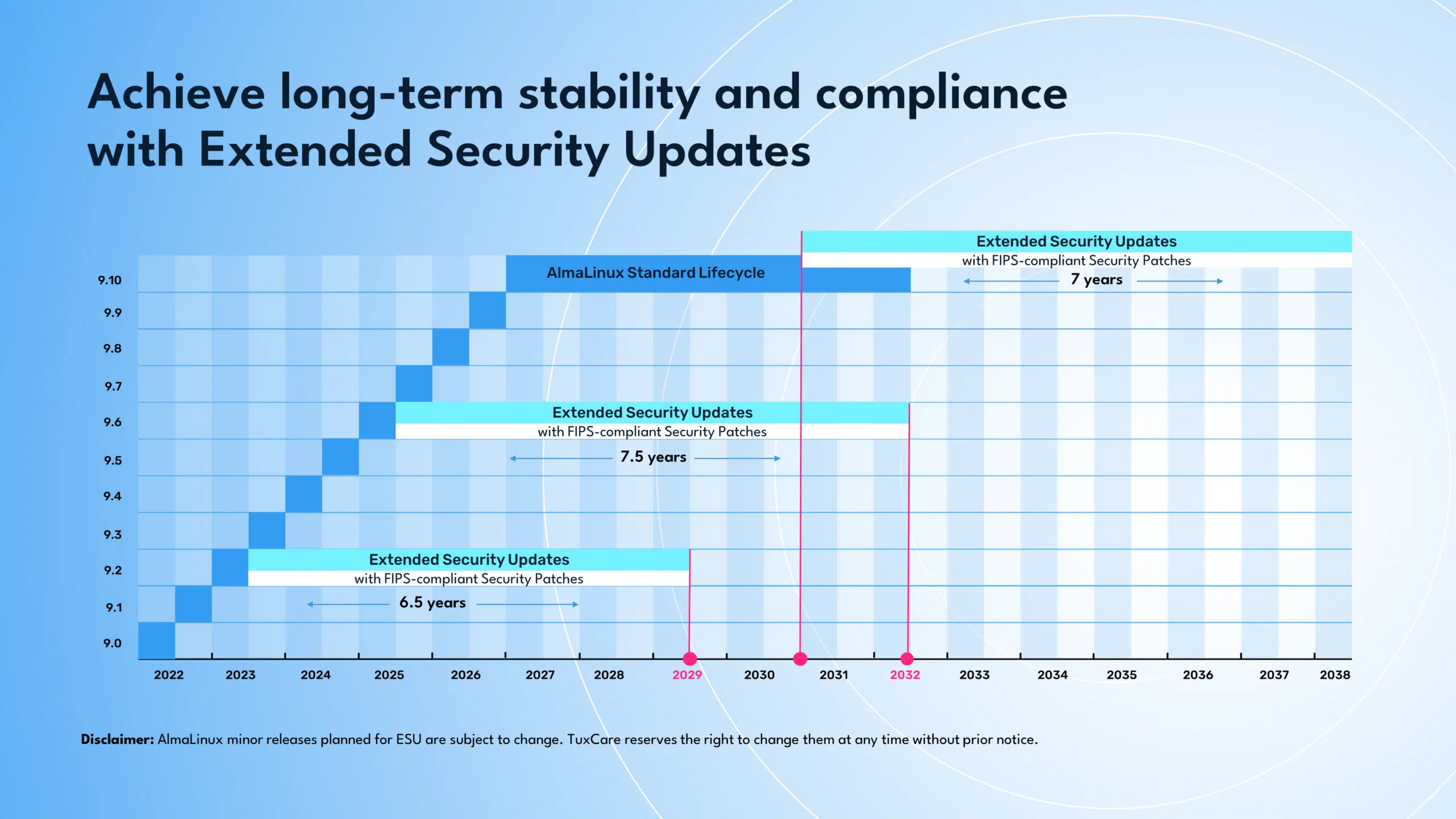
Understanding FIPS is only the first step. Achieving and maintaining compliance in Linux environments is an ongoing challenge for security professionals and sysadmins. TuxCare Enterprise Support (TES) for AlmaLinux and Rocky Linux simplifies this process by providing:
- Long-term security updates for high and critical vulnerabilities in FIPS-certified releases.
- Full coverage of all five FIPS-validated modules: kernel, OpenSSL, libcrypt, NSS, and GnuTLS.
- FIPS-compliant security patches that do not alter validated cryptography, maintaining FIPS 140-3 continuity.
- Re-validations where a CVE affects the cryptographic module in a FIPS-impacting way.
TES enables continuous security for FIPS-certified AlmaLinux and Rocky Linux 9 deployments. Patches are carefully designed to preserve validated cryptographic integrity, making them suitable for organizations that require FIPS compliance without disrupting critical operations.
Final Thoughts
FIPS compliance isn’t just about strong encryption. It’s about provable trust.
In regulated Linux environments, organizations must be able to demonstrate that their cryptography has been formally validated, correctly configured, and continuously maintained without breaking that validation.
As security threats evolve and regulatory pressure increases, relying on assumptions or partial compliance is no longer sufficient. Auditors expect evidence. Customers expect assurance. And security teams need a way to keep systems protected without introducing instability or compliance risk.
Understanding how FIPS works (and how validation differs from configuration alone) is the foundation. The next step is ensuring your Linux environments can remain secure, auditable, and compliant over time, even as vulnerabilities emerge and systems continue to run for years.
FIPS, done right, turns cryptography from a hidden risk into a dependable, standards-backed layer of trust.
FAQs
Does FIPS only apply to U.S. organizations?
No. While a U.S. standard, FIPS is globally recognized. Many international organizations, especially those dealing with U.S. federal agencies or highly regulated industries, adopt FIPS for its strong cryptographic assurance and to meet international best practices for data security.
Can small businesses benefit from FIPS-compliant products?
Yes. Small businesses handling sensitive data or planning to work with government or regulated clients can benefit. FIPS-compliant products provide a strong security baseline, build client trust, and help meet higher security standards proactively.
What happens if an organization fails FIPS compliance during an audit?
Failing a FIPS audit can lead to contractual penalties, loss of government contracts, and significant reputational damage. It indicates security vulnerabilities, increasing risk of data breaches. Remediation is typically required immediately, followed by re-auditing to regain compliance.