
 Tech Support
 Documentation
 Login
 Contact Us


Go straight to an AI summary of this blog post instead 


Key Takeaways
- Cloud security frameworks provide structured guidance for reducing risk across cloud environments.
- Selecting the right framework depends on regulatory needs, environment type, and organizational scale.
- Rebootless patching tools, such as TuxCare’s KernelCare, apply critical kernel updates without disrupting cloud workloads.
Organizations rely on cloud platforms to run core systems, store data, and support daily operations. This shift offers clear benefits, such as flexible scaling and reduced overhead. It also creates new security risks. Breaches, unauthorized access, misconfigurations, and weak identity controls remain common causes of cloud incidents.
A structured approach is essential. Cloud security frameworks give teams a defined set of controls, checks, and responsibilities. They help standardize how data is protected, how access is granted, and how systems are monitored. They also support regulatory compliance with laws and industry rules.
Using these frameworks lowers uncertainty. It helps security teams build consistent defenses across hybrid and multi-cloud environments and ensures that critical assets stay protected as their cloud footprint grows.
What is a cloud security framework?
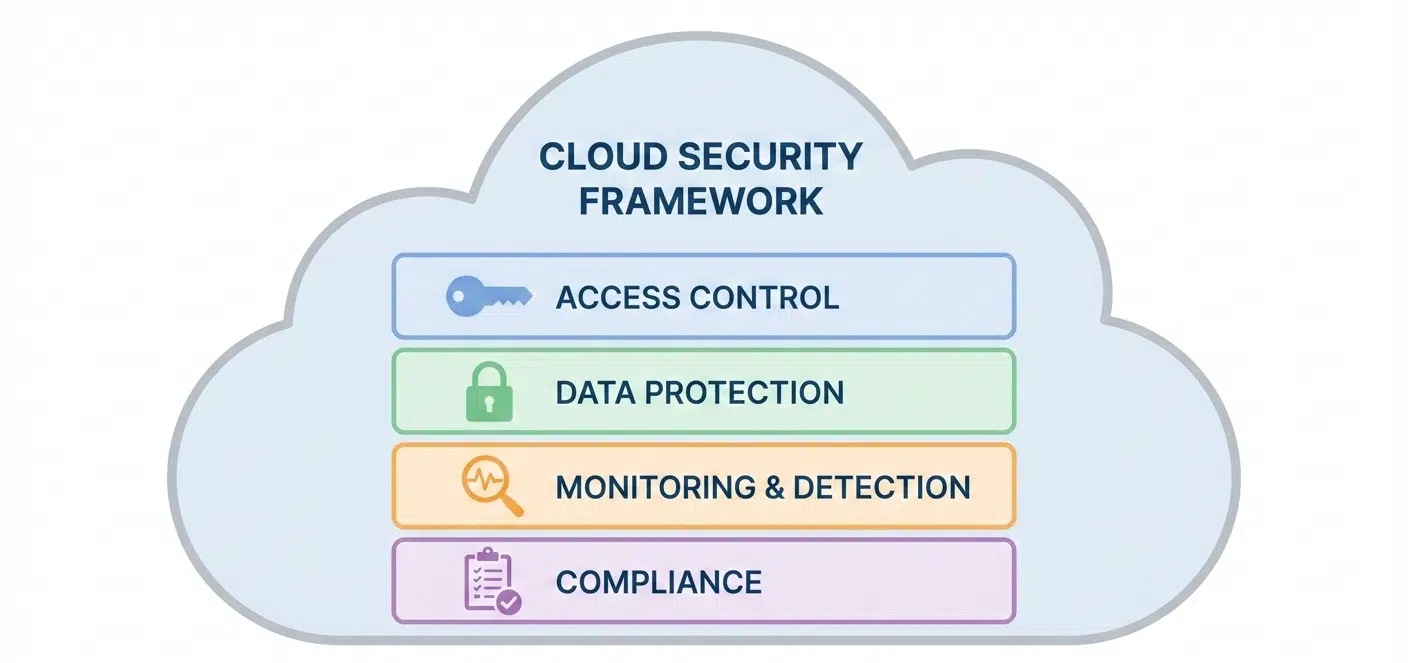
A cloud security framework is a structured set of guidelines, policies, and best practices designed to protect cloud-based environments from cyber threats. It provides a systematic approach for organizations and cloud service providers (CSPs) to manage risks, ensure compliance, and secure data and infrastructure by outlining specific security controls, such as access management, data encryption, threat detection, and monitoring. Frameworks like NIST and ISO/IEC offer a blueprint for building resilient security controls within cloud environments that enable you to foster trust.
What elements do cloud security frameworks cover?
Cloud security frameworks define the core areas that need protection across any cloud environment. While each framework has its own structure and best practices, most of them cover the same key elements:
1. Identity and Access Management (IAM)
Defines how users, services, and applications authenticate and what they can access. This includes IAM policies, role design, and credential management.
2. Data Protection
Covers how data is stored, processed, and transmitted. This includes encryption, key management, and controls that prevent unauthorized disclosure.
3. Configuration and Workload Security
Sets standards for secure configurations, baseline images, and workload hardening. It also includes checks to detect misconfigurations.
4. Network Security
Defines how traffic flows through cloud environments. This includes segmentation, firewall rules, and protections for public-facing services.
5. Monitoring and Incident Response
Covers logging, alerting, threat detection, and response plans. It ensures teams know when an event occurs and how to handle it.
6. Governance, Risk, and Compliance (GRC)
Aligns cloud operations with regulatory needs and internal policies. This includes audits, documentation, and risk assessments.
7. Business Continuity
Ensures services remain available during outages or incidents. This includes backup policies, disaster recovery plans, and resilience testing.
Pro Tip: Start with identity, configuration, and monitoring controls. The CSA Top Threats Report 2024 shows that misconfigured security settings and weak identity controls hold the first and second position in order of significance.
7 Most Common Cloud Security Frameworks
Here are the seven frameworks organizations use most often to secure cloud environments and meet regulatory needs.
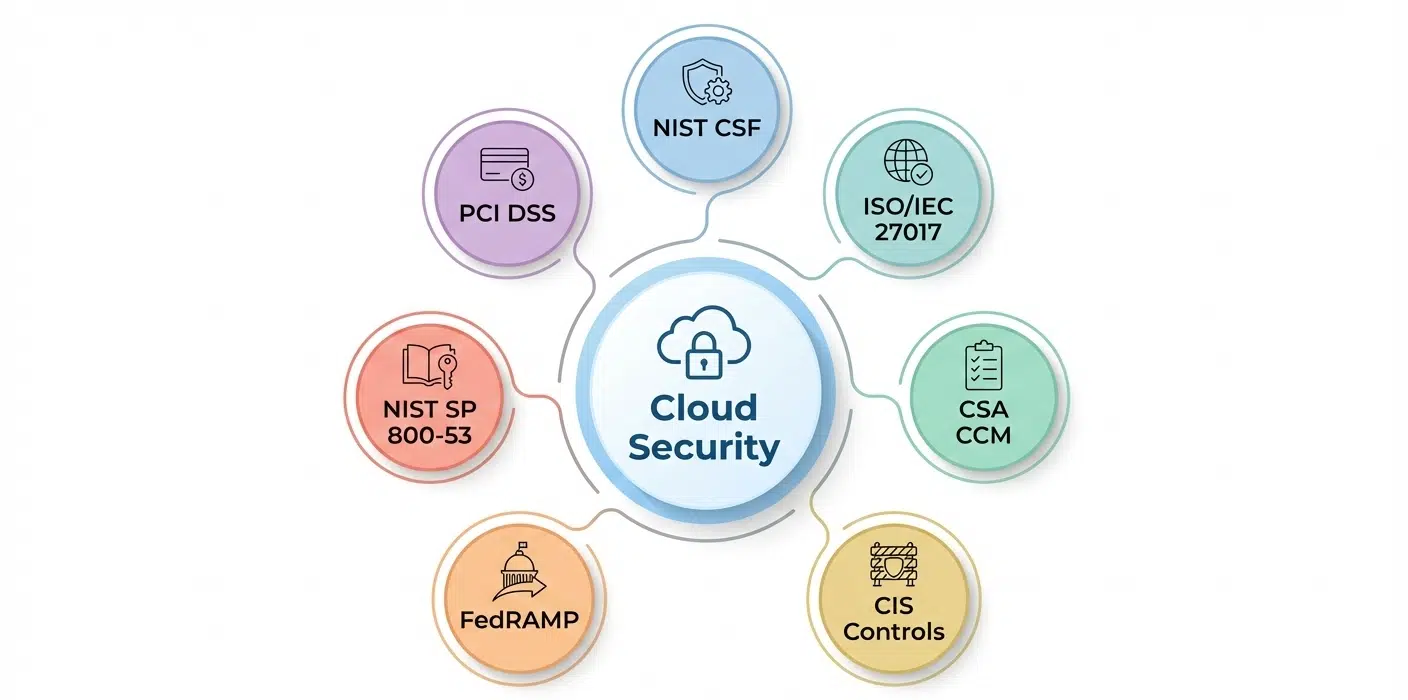
1. NIST Cybersecurity Framework (CSF)
The National Institute of Standards and Technology (NIST) Cybersecurity Framework provides a comprehensive approach to identifying, managing, and mitigating cybersecurity risks, including those in cloud environments. It focuses on six core functions:
- Govern: Establishes the organization’s cybersecurity risk management strategy, expectations, and policy.
- Identify: Evaluates assets, assesses their business impact, and identifies potential risks.
- Protect: Deploys security controls and safeguards to secure critical assets.
- Detect: Continuously monitors systems to identify cloud security threats and vulnerabilities.
- Respond: Develops and executes incident response plans to mitigate damage.
- Recover: Restores systems and data to normal operations after a security incident.
NIST introduced the latest version of the framework, CSF 2.0, on February 26, 2024. What sets this framework apart is its flexibility, enabling organizations to customize it according to their unique risk profiles and operational needs and its emphasis on enterprise-wide risk governance.
2. ISO/IEC 27017:2015
ISO/IEC 27017:2015 is an internationally recognized standard that provides specific guidance for securing cloud environments. Building on ISO 27001, it provides guidance for cloud service providers and users on managing shared responsibilities and ensuring data protection. The framework includes controls for preventing unauthorized access, ensuring data segregation, and managing third-party relationships.
It is unique because it provides specific, distinct controls and guidance for both the Cloud Service Provider (CSP) and the Cloud Service Customer (CSC). Its global acceptance makes it particularly beneficial for organizations operating across multiple regions, offering a unified approach to securing cloud environments.
3. CSA Cloud Controls Matrix (CCM)
The Cloud Security Alliance (CSA) Cloud Controls Matrix (CCM) is another framework that focuses specifically on cloud security. It consists of 197 control objectives organized into 17 domains. These domains cover all key aspects of cloud security, including A&A (Audit & Assurance), Application & Interface Security, Business Continuity Management & Operational Resilience, CEK (Cryptography, Encryption, Key Management), and more.
Aligned with the CSA Security Guidance for Cloud Computing, the CCM is widely regarded as a leading standard for ensuring cloud security and compliance. The CCM v4 Implementation Guidelines provide detailed instructions on how to effectively utilize the CCM and implement its controls.
4. CIS Controls
The CIS Controls, while not exclusively focused on cloud security, has earned widespread recognition as a reliable framework for safeguarding cloud environments. Developed by the Center for Internet Security (CIS), it offers a prioritized set of Implementation Groups (IGs) that allow organizations to focus on the controls that offer the highest risk reduction first.
This framework provides a clear roadmap for implementing essential security controls, making it easier for organizations to prioritize and address critical vulnerabilities through specific benchmarks for major cloud providers (AWS, Azure, GCP).
5. FedRAMP
FedRAMP (Federal Risk and Authorization Management Program) is a cloud security framework designed to ensure the security of cloud services used by U.S. federal agencies. While primarily aimed at public sector organizations, private organizations that handle sensitive government data can also benefit from using FedRAMP-certified cloud providers. For example, a healthcare provider working with government health programs may choose to use a FedRAMP-certified cloud service to securely store and process patient information. This ensures compliance with federal regulations and protects sensitive health data.
6. NIST SP 800-53
NIST SP 800-53 provides a detailed catalog of security and data privacy controls used across federal information systems. It includes requirements for access control, auditing, system integrity, and resilience. Although it originated for government use, many organizations adopt it to secure cloud workloads that process sensitive or regulated data.
The framework maps well to major compliance programs and cloud provider controls. This makes it a common reference in environments that need consistency across hybrid or multi-cloud f.
7. PCI DSS
The Payment Card Industry Data Security Standard (PCI DSS) applies to any cloud system that stores or processes cardholder data. It defines controls for encryption, access control, logging, network segmentation, and vulnerability management. These requirements help organizations reduce the risk of payment data exposure in hosted and cloud-native environments.
Cloud users remain responsible for meeting PCI DSS even when using third-party providers. Because of this, organizations rely on the framework to validate that cardholder data remains protected across all components of the cloud environment.
Note: A cloud security framework provides a repeatable way to secure cloud systems and maintain a predictable security baseline, even as applications and infrastructure change over time.
How to Choose the Right Cloud Security Framework
Selecting the right framework depends on your organization’s environment, goals, and compliance requirements. Consider these factors:
Regulatory Needs
Identify the regulations that apply to your business. For example, PCI DSS is essential for handling payment data, while FedRAMP is required for U.S. federal workloads. Choose a framework that aligns with these obligations.
Cloud Environment
Some frameworks are better suited for public, private, or hybrid clouds. CSA CCM and ISO/IEC 27017 focus on cloud-specific risks, while CIS Controls and NIST SP 800-53 apply broadly across cloud and on-premises systems.
Scope and scale
Evaluate how much of your infrastructure will be covered. Smaller organizations may start with a simpler framework like CIS Controls. Larger organizations or highly regulated industries often need more comprehensive frameworks such as NIST CSF or NIST SP 800-53.
Ease of implementation
Consider the resources and expertise required. Some frameworks provide detailed controls and guidance, while others offer high-level recommendations. Pick a framework that matches your team’s capacity to implement and maintain security controls.
Mapping and integration
If you already follow multiple data security standards or compliance programs, check whether the framework maps to other frameworks. Alignment reduces duplication and simplifies reporting.
Pro Tip: Even if frameworks like NIST or ISO are too comprehensive for your current needs, never start from scratch. Begin with a recognized benchmark (such as CIS Cloud Benchmarks for AWS, Azure, or GCP) to quickly address misconfigurations — the #1 cloud risk — and use this as your baseline while evaluating a full-scale framework.
How to Implement a Cloud Security Framework
Implementing a cloud security framework requires planning, coordination, and continuous monitoring. The following steps can help organizations apply a framework effectively.
1. Assess your environment
Start by identifying assets, workloads, and data stored in the cloud. Understand your current security posture, including gaps, risks, and existing controls. This baseline helps prioritize actions.
2. Select the right framework
Choose a framework that fits your regulatory requirements, cloud environment, and organizational scale. Ensure it provides controls relevant to your data and workloads.
3. Map controls and responsibilities
Translate the framework’s guidance into specific policies, procedures, and technical controls. Assign ownership for each control to teams or individuals to ensure accountability.
4. Implement technical and administrative measures
Apply access controls, encryption, monitoring, logging, and incident response processes. Configure cloud services securely and enforce consistent policies across accounts and regions.
5. Train staff
Ensure teams understand their responsibilities under the framework. Provide training on cloud security best practices, policies, and incident reporting.
6. Monitor and review
Continuously monitor systems, logs, and alerts. Conduct regular audits to verify compliance and identify gaps. Update controls and policies as cloud environments evolve or new threats emerge.
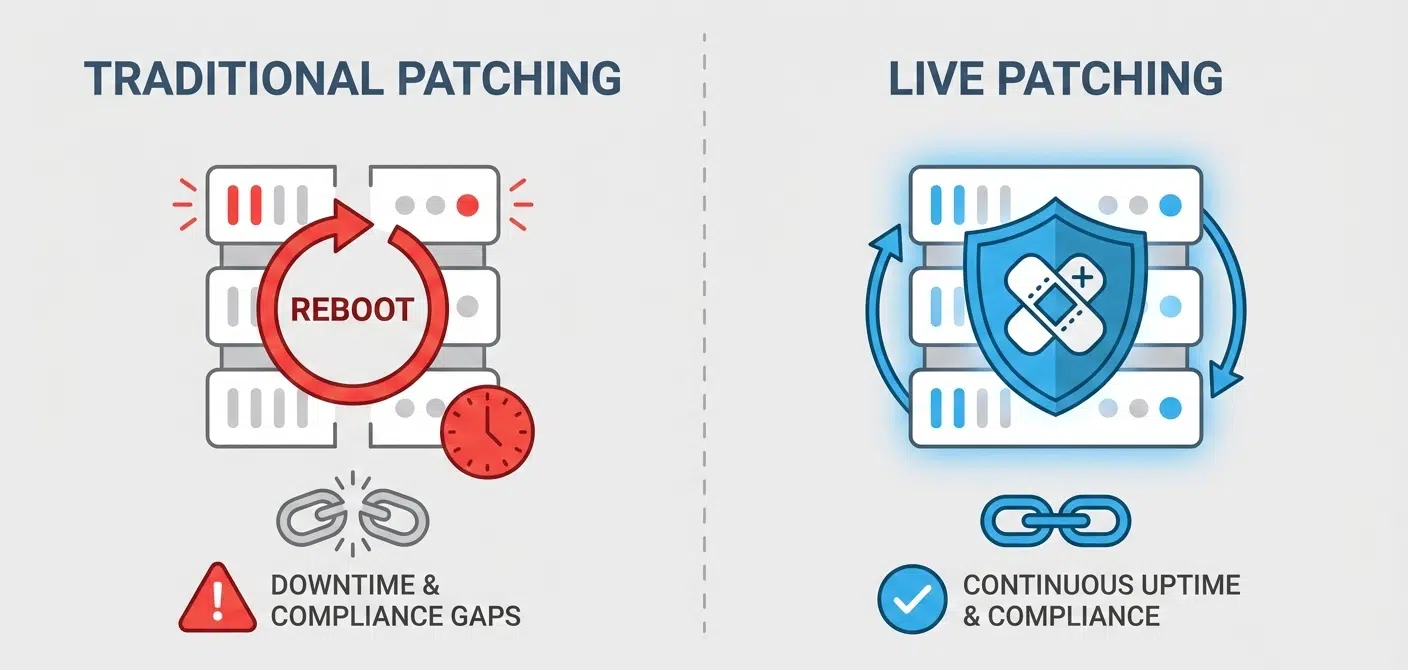
Implementation Challenge: A major hurdle during the Implement and Monitor phases is maintaining security for Linux kernel vulnerabilities. Unlike user-space applications, traditional kernel patching requires system reboots, causing downtime and breaking the continuous compliance that cloud security frameworks expect. Overcoming this operational gap is essential for a successful and sustainable implementation.
The Role of Rebootless Patching in Cloud Security Frameworks
Linux has long been the leading operating system for cloud computing, powering a majority of cloud infrastructure worldwide. Its open-source nature, security, and flexibility make it ideal for cloud workloads. Major cloud service providers like AWS, Google Cloud, and Microsoft Azure rely heavily on Linux to run virtual machines, containers, and other services.
However, maintaining the security of Linux systems presents unique challenges in cloud environments. The demand for high availability and continuous service delivery often conflicts with the need for timely security updates. Conventionally, patching the kernel would involve disruptive reboots, which can lead to downtime, a prolonged vulnerability exposure window, and increased operational risk. This operational conflict directly impedes the goal of continuous compliance mandated or expected by cloud security standards.
Live kernel patching, also known as rebootless patching, closes this operational gap by allowing security updates to be applied to a running Linux kernel without service interruption. It ensures that the security posture remains consistent 24/7, satisfying framework requirements for uptime and availability.
Close the Gaps in Cloud Security with TuxCare Rebootless Patching
Cloud security frameworks like NIST, PCI DSS, and ISO/IEC 27001 help organizations build a strong, compliant security posture. However, one persistent challenge remains: continuous vulnerability management. Traditional kernel patching requires system reboots, which creates gaps in coverage, disrupts uptime, and can break continuous compliance requirements.
TuxCare’s KernelCare solves this problem directly. As an automated rebootless patching solution, it applies critical kernel updates across many Linux distributions — including Ubuntu, RHEL, CentOS, AlmaLinux, CloudLinux, Rocky Linux, Amazon Linux, and Oracle Linux — without requiring reboots or service interruptions.
By turning disruptive kernel patching into a seamless, zero downtime process, KernelCare helps organizations maintain high availability, reduce operational risk, and meet the fast-patching expectations built into modern cloud security frameworks.

