Tech Support
 Documentation
 Login
 Contact Us


Go straight to an AI summary of this blog post instead 


Key Takeaways
- Only 1% of CVEs published in 2024 had confirmed exploitation evidence in the wild – which means most of what your scanner flags doesn’t need urgent action. (VulnCheck)
- Risk-based prioritization ranks vulnerabilities by actual risk to your environment – factoring in exploitability, asset value, and threat intel – not just CVSS severity scores.
- A repeatable process runs five steps: identify, assess exploitability, map to business impact, rank, then patch or mitigate – and it works best as a continuous loop, not a quarterly review.
- Scanners that don’t account for already-applied patches – including rebootless fixes – create false positives that corrupt your prioritization queue from the start.
You open Monday’s vulnerability scan, and 4,200 new findings are waiting. Around 600 are flagged Critical. You have two engineers – and patching is only part of their job. The math doesn’t work, and pretending it does is how breaches happen.
That gap is exactly what vulnerability prioritization closes. The goal was never to patch everything – it’s to find the handful of those 600 that have a real exploit in the wild, sit on systems that matter, and can actually be reached today. Everything else can wait, get mitigated, or be formally accepted as risk.
This guide walks through what risk-based prioritization actually looks like in practice: the factors that matter, the steps that hold up under pressure, the tools worth considering, and the mistakes that quietly wreck programs over time.
What Is Vulnerability Prioritization?
Vulnerability prioritization is the practice of ranking known security flaws by the real risk they pose to your environment, then fixing them in that order – not simply working down from the highest severity score. It’s the next step beyond basic vulnerability patching, built on one hard-won lesson: severity and risk are not the same thing.
CVSS – the Common Vulnerability Scoring System – assigns each CVE (Common Vulnerabilities and Exposures)
The Common Vulnerability Scoring System (CVSS) assigns every published vulnerability a severity score based on traits like attack vector and complexity, and the National Vulnerability Database publishes them as the de facto public reference. The traditional move is to sort by that score, start at 10.0, and work down – treating every Critical the same. But a score says nothing about whether an exploit exists, whether the system is internet-facing, or whether a compromise would matter to the business. Risk-based prioritization layers in threat intelligence, exploit availability, asset value, and business context. CVSS becomes one input, not the verdict.
Why Vulnerability Prioritization Matters

The scale mismatch is the core problem. Tens of thousands of new CVEs are published every year – yet VulnCheck recorded only around 432 vulnerabilities gaining first-time, in-the-wild exploitation evidence across H1 2025. Most of what your scanner flags will never be touched by an attacker. The noise is structural, not incidental.
The ones that do get exploited move fast. The 2025 Verizon DBIR found that vulnerability exploitation as an initial access vector jumped 34% year over year and now accounts for 20% of all breaches – second only to credential abuse. The fallout is concrete: ransomware, data loss, and regulatory scrutiny that won’t wait for your next patch window.
What makes this harder is that the problem usually isn’t awareness. In TuxCare‘s 2026 Open Source Landscape Report, 61.4% of organizations that suffered an incident said a patch was already available but hadn’t been applied. Teams knew. They just couldn’t close the gap in time – because without clear prioritization, everything feels equally urgent and nothing moves fast enough.
So prioritization has to do two things at once: cut through the noise and act on what matters before the window closes. It’s also how you stay audit-ready. PCI DSS, HIPAA, and SOC 2 all expect a documented, risk-ranked remediation process – not a “we patched what we could” shrug.
Key Factors in Vulnerability Prioritization
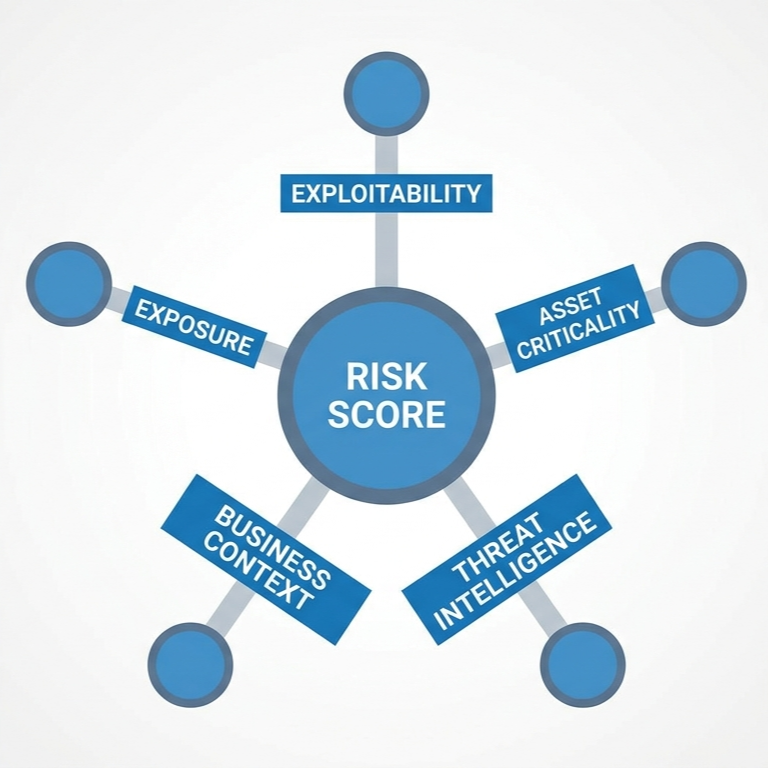
Five factors drive almost every prioritization decision worth making. Skip any of them and you end up either over-patching low-risk findings or missing the ones that quietly matter.
Factor 1: Exploitability
A CVE with a public Metasploit module behaves very differently from one that requires chained attacker access and a specific kernel build. Even a proof-of-concept (PoC) with no weaponized exploit code raises exploit probability more than a theoretical CVE with no public research behind it. Look at whether a working exploit exists, how reliable it is, and what privileges it needs.
Factor 2: Asset Criticality
Not all servers are equal. A CVE on the domain controller is not the same risk as one on a dev VM nobody has touched since 2023. Tier your assets – crown jewels, business-critical, supporting, low-value – before you start ranking findings. Without an asset inventory tied to business function, prioritization is theater.
Factor 3: Threat Intelligence
Threat actors have favorites. They reuse what works. Watching CISA KEV (Known Exploited Vulnerabilities) additions, vendor advisories, and credible threat feeds tells you which CVEs are being weaponized right now versus which remain theoretical. The CISA KEV catalog is the cleanest public signal for this – it stood at 1,484 entries by the end of 2025 and has already grown to 1,592 as of May 2026.
Cross-referencing findings against MITRE ATT&CK techniques adds another layer – if a CVE maps to a technique actively used in ransomware campaigns or observed in recent threat actor activity, that’s a different conversation than one buried in a year-old advisory.
Factor 4: Business Context
A CVE in a system processing PHI carries different weight than the same CVE in a marketing landing page. Healthcare, finance, and critical infrastructure have hard regulatory deadlines on certain remediation classes. Map findings to data sensitivity, regulated workloads, and contractual SLAs. This is where prioritization stops being a purely technical exercise and starts being a business conversation. For what to actually measure, see this guide on vulnerability metrics.
You can also explore our detailed guide to vulnerability management metrics to learn what to measure for your business.
Factor 5: Exposure
Internet-facing or not. Behind a WAF or not. Reachable from a low-privilege user account or not. A CVSS 9.8 on a host with no inbound connectivity ranks below a CVSS 7.4 on a public-facing API gateway, every time. This is also where the line between patch management and vulnerability management starts to matter – the question isn’t just “is this patched?” but “is this reachable, exploitable, and worth an attacker’s time?”
Watch Out: CVSS Base scores ignore your environment entirely. A 9.8 on a CVE affecting a service you don’t run, can’t reach, and have firewalled off is functionally a 0. Teams that prioritize on Base scores alone end up patching things that don’t matter while missing CVSS 6.5 issues on internet-facing systems that do.
Steps in a Risk-Based Vulnerability Prioritization Process
Five steps. Run them as a continuous loop, not a project with a finish line.

Step 1: Identify Vulnerabilities (Scanning)
Run authenticated scans on a regular cadence, plus continuous scanning where you can. Cover network, host, container images, and application-layer findings. You can’t prioritize what you don’t know exists. Pair scanning with a real vulnerability assessment so you’re catching misconfigurations and software vulnerabilities across on-prem and cloud environments, not just CVE matches.
Scan quality matters as much as cadence. A vulnerability scanner that doesn’t know which patches are already applied – especially rebootless patches – will report fixed vulnerabilities as still open. That false-positive noise corrupts your prioritization queue before you’ve ranked a single finding: you end up sorting dirty data and trusting the order it produces.
You can also explore our guide to open-source vulnerability scanners to see how free tools handle scanning in automated pipelines.
Step 2: Assess Exploitability and Severity
Pull in CVSS, EPSS, KEV status, and any vendor-specific scoring. For each finding: is there a public exploit? Is it in the KEV catalog? What’s the EPSS percentile? This is where raw scanner output becomes usable signal. Without this step, everything just looks critical.
Step 3: Map to Business Impact
Cross-reference each finding with your asset inventory. Tag the system, the data it touches, the regulatory bucket, the user population. If your CMDB (Configuration Management Database) is unreliable, this step will hurt – and it’s often where prioritization programs quietly stall.
Step 4: Rank by Risk
Combine technical and business inputs into a single ranking. Most teams use a tiered model: P0 (active exploitation on a critical asset), P1 (critical asset with high exploit likelihood), P2 (medium risk), P3 (low risk, accept or defer). Some teams formalize this with a risk matrix that also factors in attack paths – whether a vulnerability can be chained with weak permissions or misconfigurations to reach a higher-value target – rather than scoring each finding in isolation. Document the criteria so the ranking is reproducible and auditable, not vibes-based.
Step 5: Remediate or Mitigate
Patch where you can. Where you can’t – legacy systems, vendor delays, change-window constraints – use compensating controls: WAF rules, network segmentation, EDR coverage, kernel-level mitigations. According to TuxCare’s 2026 Open Source Landscape Report, 43% of teams name the inability to take critical systems offline as their single biggest source of patching delay – which is exactly why compensating controls aren’t a fallback. They’re part of the plan. And for Linux kernel flaws, rebootless patching is one of the few clean ways to remediate without scheduling a maintenance window.
Benefits of Risk-Based Vulnerability Prioritization
Here’s what actually changes when prioritization starts working.
1. Lower Breach Risk Without More Headcount
You’re focusing on the small fraction of vulnerabilities with a realistic chance of being exploited – which is where most breaches actually start. Same team, less wasted effort, better coverage on what matters.
2. Faster MTTR on the CVEs That Count
A separate queue and SLA for P0 findings pulls remediation time on actively exploited CVEs way down. Your overall MTTR may not move dramatically, but the number auditors and CISOs actually care about does.
Pro Tip: Track “MTTR for actively exploited CVEs” separately from your overall MTTR. The two diverge fast once a program matures, and that gap is what auditors and boards actually care about.
3. Cleaner Audit Conversations
Auditors don’t want proof that every Critical was patched within 30 days. They want a documented, defensible decision process. Risk-based prioritization gives you that – with evidence trails, ranking criteria, and exception handling built in.
4. Less Patch Fatigue, Better Engineering Relationships
Pushing 600 “Critical” patches a month at application teams burns the relationship fast. Pushing 30 P0/P1 items with clear rationale builds trust – and actually gets things patched faster.
5. Better Use of Compensating Controls
Once findings are ranked by real risk, the call gets clearer: patch this, segment that, accept the third. Mitigations stop being a fallback and become a deliberate, documented part of the strategy.
Top 3 Vulnerability Prioritization Tools for Smarter Patch Management
A short comparison before the per-tool detail:
|
Tool |
Best for |
Patching included? |
Strength |
|
TuxCare Radar |
Linux environments needing cleaner scan results |
No (scanning + prioritization; integrates with TuxCare patching solutions) |
Knows which CVEs are already patched – including rebootless patches |
|
Rapid7 InsightVM |
Mid-to-large enterprises wanting unified vulnerability management |
No (detection only) |
Active-risk scoring with active exposure context |
|
Tenable Vulnerability Management |
Compliance-heavy environments, broad asset coverage |
No (detection only) |
VPR scoring and large vulnerability research footprint |
1. TuxCare Radar
Most vulnerability scanners have a blind spot: they don’t know what’s already been patched. That’s fine if all your patches come through standard package managers, but it falls apart when you’re running live patching – where kernel fixes are applied in memory without a reboot and don’t always show up in the package database.
TuxCare Radar is a Linux vulnerability scanner built specifically around this blind spot. It knows which CVEs have already been remediated – by standard package updates and by rebootless patches – so it stops flagging fixed issues as open. The result is a far cleaner signal: dramatically fewer false positives and a prioritization queue you can actually trust.
Beyond false-positive elimination, Radar brings AI-assisted risk scoring that factors in exploitability, CVSS data, and confirmed patch status together – so your team sees what actually needs attention, not just what’s technically unpatched. It runs without a persistent agent and integrates directly with Qualys, Nessus, and OpenSCAP if you’re already using those in your workflow.
Best for: Linux environments where rebootless patching is in use, teams frustrated by noisy scan results, and organizations that need prioritization tied to actual remediation state rather than theoretical patch status.
2. Rapid7 InsightVM
InsightVM is built around what Rapid7 calls Active Risk – a scoring model that blends CVSS, exploit availability, malware kit usage, and exposure data into a single 0–1,000 score. It’s a detection and prioritization platform rather than a patcher, so it tells you what to fix and hands off to your patching toolchain via integrations.
- Pros: Active Risk scoring is more actionable than raw CVSS; solid agent-based continuous assessment.
- Cons: No native patching; licensing scales aggressively past mid-size deployments.
- Best for: Teams that want one platform to scan, score, and report – with patching handled separately.
3. Tenable Vulnerability Management
Tenable’s platform (the cloud-based successor to Nessus Manager) leans on its VPR (Vulnerability Priority Rating) score, which factors in threat intelligence, exploit code maturity, and exposure. It has one of the widest asset coverage footprints in the market, spanning IT, OT, and cloud. Like Rapid7, it’s detection-first.
- Pros: Wide coverage across IT, OT, cloud, and identity; strong compliance reporting.
- Cons: The UI is dense, and the value drops if your team doesn’t consistently act on VPR rankings.
- Best for: Compliance-heavy environments and organizations with mixed IT/OT estates.
Common Vulnerability Prioritization Pitfalls to Avoid
The pattern of failure is consistent across programs. These five show up everywhere.
Treating CVSS as the Whole Story

CVSS Base scores ignore exploitability in the wild and ignore your specific environment. A program that ranks purely by CVSS will spend most of its cycles on findings nobody is actually exploiting. Use CVSS as one input alongside KEV, EPSS, and asset context.
Ignoring the KEV Catalog
The CISA KEV list is, in practice, a free, curated “patch this first” feed maintained by the people who track real-world exploitation. Programs that don’t track it miss the most obvious public signal available. Wire KEV updates into your ticketing system as automatic high-priority alerts.
No Asset Inventory, or a Stale One
If you don’t know what you have, you can’t prioritize what’s vulnerable on it. A stale CMDB is the silent killer of prioritization programs – everything looks critical because nothing has business context attached.
Reality Check: Most “we have a vulnerability problem” situations are actually “we have an inventory problem.” Fix the CMDB before you buy another scanner.
Treating Prioritization as a Quarterly Exercise
Exploit code drops, KEV catalog updates, and business priorities all shift constantly. A finding that was P3 on Monday can be P0 by Friday. Treat prioritization as continuous – not episodic. This is essentially what Gartner’s Continuous Threat Exposure Management (CTEM) framework formalizes – the shift from point-in-time assessments to ongoing exposure visibility.
Writing Off Mitigations as a Fallback
Patching isn’t always possible – legacy apps, vendor delays, EOL software. Teams that treat compensating controls as failure end up with a backlog they can’t move and risk decisions that never get documented. Mitigations aren’t a consolation prize – they’re a deliberate, auditable part of a mature remediation strategy.
Secure Your Systems with Smarter Vulnerability Prioritization
Vulnerability prioritization isn’t a tool you buy – it’s a practice you build and keep running. The scoring model matters, the tooling matters, but the biggest gains come from a defensible process: identify, score on real risk, map to assets, rank, then remediate or mitigate, on a continuous loop. Teams that get this right aren’t patching more. They’re patching the right things faster and ignoring the rest with confidence.
If your scanner can’t see what’s already been patched – especially fixes applied without a reboot – every prioritization decision downstream is built on dirty data, and that error compounds at every step.
TuxCare Radar closes that gap directly: it accounts for both standard and rebootless patches, applies AI-assisted risk scoring tied to your actual remediation state, and plugs into the scanners you’re probably already running. Start with a single scan and see how much of your current queue is noise.
See how Radar works: Getting Started with Radar, TuxCare’s Linux Vulnerability Scanner
Want to see it in action? Watch: What to Expect From Your First Radar Scan